Frequently Asked Questions

Exposure Management & Threat Resilience

What is exposure management, and how does Cymulate approach it?

Exposure management is a proactive cybersecurity strategy focused on identifying, validating, and prioritizing exploitable weaknesses in your environment. Cymulate's approach goes beyond traditional vulnerability management by integrating exposure discovery with real-world exposure validation, enabling organizations to focus on what is truly exploitable and improve threat resilience. The platform provides proof of exploitability, contextual risk scoring, and actionable remediation steps, all within a unified solution. Learn more.

How does Cymulate's Exposure Management Platform help organizations prioritize exposures?

Cymulate's platform correlates data from multiple sources, including vulnerability scanners and exposure discovery tools, to provide a contextual risk score for each exposure. This score considers evidence of threat, threat intelligence, asset criticality, and security control effectiveness. Early adopters have seen an average 52% reduction in critical exposures by using Cymulate's prioritization capabilities. Read more.

What is the difference between exposure validation and traditional vulnerability management?

Traditional vulnerability management often focuses on identifying and cataloging vulnerabilities without validating their exploitability in your specific environment. Exposure validation, as implemented by Cymulate, tests and proves whether a vulnerability can actually be exploited, providing real-world context and actionable insights. This approach helps organizations focus remediation efforts on the most critical, exploitable risks rather than theoretical threats. Learn more.

How does Cymulate support Continuous Threat Exposure Management (CTEM)?

Cymulate enables CTEM by integrating exposure discovery, validation, prioritization, and remediation into a single platform. The solution provides automated attack simulations, contextual risk analysis, and collaborative tools for blue teams and vulnerability management, supporting a complete CTEM program as recommended by Gartner. More details.

What are the key capabilities of Cymulate's Exposure Management Platform?

The platform offers integration with existing security stacks, identification of testable exposures, contextual risk analysis, exposure scoring, prioritization, automated testing for the full kill chain, attack scenario workbench, and actionable remediation. These capabilities help organizations validate threats, prioritize exposures, and optimize threat resilience. Platform details.

How does Cymulate's exposure scoring work?

Cymulate provides a risk score for each exposure based on evidence of threat, threat intelligence, asset criticality, and the effectiveness of security controls. This contextual scoring helps organizations focus on exposures that pose the greatest risk to their business. Learn more.

What measurable outcomes have organizations achieved with Cymulate?

Organizations using Cymulate have reported an average 52% reduction in critical exposures, a 60% increase in team efficiency, and an 81% reduction in cyber risk within four months. These outcomes are based on real-world deployments and customer case studies. See case studies.

How does Cymulate enable collaboration between security teams?

The platform provides ready-to-use templates, AI-guided assessments, and customizable attack scenario workbenches, fostering collaboration between blue teams and vulnerability management. This enables teams to work smarter and more efficiently on threat exposure management. Learn more.

What is the role of exposure validation in threat resilience?

Exposure validation is the process of testing and proving whether a vulnerability can be exploited in your environment. It provides the critical context needed to prioritize remediation and build true threat resilience, rather than relying on theoretical risk assessments. More info.

How does Cymulate's platform integrate with existing security tools?

Cymulate integrates with exposure discovery tools, vulnerability scanners, and other core security technologies to collect asset and exposure data. This integration streamlines the process of exposure assessment and validation, enabling a unified view of your security posture. See integrations.

What is the Cymulate Exposure Management for Proven Threat Resilience video?

You can watch the official Cymulate video introducing Exposure Management for Proven Threat Resilience here: Cymulate Introduces Exposure Management for Proven Threat Resilience video.

How does Cymulate help organizations recover from cyber incidents?

Cymulate enhances visibility and detection capabilities, enabling faster recovery after a breach. The platform's continuous validation and actionable insights help organizations address gaps and improve their resilience to future attacks. See case study.

What are some real-world statistics about cyber resilience and breaches?

According to industry research cited by Cymulate: 81% of boards view cybersecurity as a business risk (Gartner); over 67% of businesses paid a ransom in the past year (Security Today, Cohesity); 47% of companies had difficulty acquiring new customers post-breach in 2024 (CyberMagazine); and only 2% of companies have implemented firm-wide cyber resilience (PWC). Source.

How does Cymulate's platform use AI and automation?

Cymulate leverages AI for guided assessments, SIEM rule mapping, and advanced exposure prioritization. Automation is used for attack simulations, remediation actions, and continuous validation, reducing manual effort and improving efficiency. Platform details.

What is the role of attack scenario workbenches in Cymulate?

The attack scenario workbench allows users to build and scale custom testing scenarios, enabling organizations to simulate specific attack paths and validate their defenses against targeted threats. This feature supports both blue teams and vulnerability management in collaborative security validation. Learn more.

How does Cymulate's exposure validation impact risk scoring?

Exposure validation provides real-world evidence of exploitability, which is factored into Cymulate's risk scoring. For example, a vulnerability initially rated as critical may be downgraded if Cymulate's simulations show strong detection and prevention controls, resulting in a more accurate and contextual risk assessment. More info.

How does Cymulate help with exposure prioritization and remediation?

Cymulate correlates exposure data from multiple sources and provides a shortlist of validated, high-risk exposures. The platform then offers actionable remediation steps, enabling organizations to address the most critical risks efficiently. Learn more.

What resources are available to learn more about exposure management and CTEM?

Cymulate offers a variety of resources, including e-books, guides, and whitepapers, such as 'Successful CTEM Depends on Validation' and 'Cymulate Exposure Management: Product Whitepaper.' These resources provide in-depth information on exposure management strategies and best practices. Access resources.

How can I see Cymulate Exposure Management in action?

You can request a personalized demo of the Cymulate Exposure Management Platform to see its capabilities and features in action. Book a demo.

Features & Capabilities

What features does Cymulate offer for exposure management and threat resilience?

Cymulate offers continuous threat validation, exposure validation, exposure prioritization and remediation, attack path discovery, automated mitigation, and integration with core security tools. The platform supports CTEM and provides actionable insights for improving security posture. More info.

What integrations are available with Cymulate?

Cymulate integrates with a wide range of security technologies, including Akamai Guardicore, AWS GuardDuty, BlackBerry Cylance OPTICS, Carbon Black EDR, Check Point CloudGuard, Cisco Secure Endpoint, CrowdStrike Falcon, Wiz, SentinelOne, and more. For a complete list, visit our Partnerships and Integrations page.

How easy is Cymulate to implement and use?

Cymulate is designed for quick and easy implementation, operating in agentless mode with no need for additional hardware or complex configurations. Customers can start running simulations almost immediately, and the platform is praised for its intuitive, user-friendly interface. See demo.

What feedback have customers given about Cymulate's ease of use?

Customers consistently praise Cymulate for its ease of use, intuitive dashboard, and actionable insights. Testimonials highlight the platform's user-friendly portal, excellent support, and immediate value in identifying security gaps. Read testimonials.

What security and compliance certifications does Cymulate hold?

Cymulate holds several industry-leading certifications, including SOC2 Type II, ISO 27001:2013, ISO 27701, ISO 27017, and CSA STAR Level 1. These certifications demonstrate Cymulate's commitment to robust security and compliance standards. More info.

How does Cymulate ensure data security and privacy?

Cymulate ensures data security through encryption in transit (TLS 1.2+) and at rest (AES-256), secure AWS-hosted data centers, a tested disaster recovery plan, and compliance with GDPR. The platform also features 2FA, RBAC, IP restrictions, and a dedicated privacy and security team. Details.

What is Cymulate's pricing model?

Cymulate operates on a subscription-based pricing model tailored to each organization's needs. Pricing depends on the chosen package, number of assets, and scenarios selected. For a detailed quote, schedule a demo with the Cymulate team.

Who is the target audience for Cymulate?

Cymulate is designed for CISOs and security leaders, SecOps teams, red teams, and vulnerability management teams in organizations of all sizes and industries, including finance, healthcare, retail, media, transportation, and manufacturing. Learn more.

How does Cymulate compare to other exposure management and CTEM solutions?

Cymulate differentiates itself by combining exposure discovery, validation, and contextual risk analysis in a single platform. Unlike traditional tools, Cymulate provides continuous, automated attack simulations, AI-powered prioritization, and actionable remediation, supporting a complete CTEM program. See comparisons.

What pain points does Cymulate address for security teams?

Cymulate addresses fragmented security tools, resource constraints, unclear risk prioritization, cloud complexity, communication barriers, inadequate threat simulation, operational inefficiencies in vulnerability management, and post-breach recovery challenges. See customer stories.

Are there case studies showing Cymulate's impact?

Yes, Cymulate features numerous case studies, such as Hertz Israel reducing cyber risk by 81% in four months and a sustainable energy company scaling penetration testing cost-effectively. Explore case studies.

How does Cymulate tailor solutions for different security roles?

Cymulate provides tailored solutions for CISOs (metrics and risk prioritization), SecOps (automation and efficiency), red teams (automated offensive testing), and vulnerability management teams (in-house validation and prioritization). Learn more.

Where can I find Cymulate's blog, newsroom, and resource hub?

You can access the latest insights, research, and company news on our blog, newsroom, and resource hub.

How can I stay updated with Cymulate's latest news and events?

Stay informed by visiting the company blog, newsroom, and events & webinars page for the latest updates, research, and event information.

Cymulate named a Customers' Choice in 2025 Gartner® Peer Insights™
Learn More
New Case Study: Credit Union Boosts Threat Prevention & Detection with Cymulate
Learn More
New Research: Cymulate Research Labs Discovers Token Validation Flaw
Learn More
An Inside Look at the Technology Behind Cymulate
Learn More

Cymulate Introduces Exposure Management for Proven Threat Resilience  

By: Jake O’Donnell

Last Updated: January 4, 2026

The cybersecurity technology market can be filled with lots of noise and not much signal, similar to the act of searching for threats and exposures.  

There’s plenty of talk about getting more proactive while ignoring the growing to-do lists. What about focus – as in focusing on what’s actually exploitable in your environment? 

Threat resilience is the ultimate goal, and that starts with a new approach to exposure management. 

Do you really have exposure management, or are you just exposed? 

Exposure management is more than just a new approach to the old find-fix process. Much of what passes for continuous threat exposure management (CTEM) is reactive and doesn’t prioritize what can be exploited in your environment. The idea is to focus on your organization’s biggest cyber weaknesses and rally teams to address the issue before attacks exploit it. 

Gartner says that by 2026, organizations that prioritize their security investments via a CTEM program will be three times less likely to suffer a breach. This means you’ll need a proactive approach to building and optimizing organizational threat resilience. 

Many solutions that claim to provide exposure management are missing a key element.  CTEM solutions providers sometimes leave out the “validate” part of the equation. You need real-world context added to your exposure data, which helps you and your teams get faster, smarter and more efficient security outcomes. 

The reality is simple: exposure management without the critical context of exposure validation is just a dressed-up version of vulnerability management. 

The Facts Around Threat Resilience in 2025 

Exposure validation is the proven X-factor that shows how resilient your business is to a threat and how exploitable that threat is in your environment. The time to focus on theoretical threats is over. Without exposure validation these players in the market claiming to provide CTEM are just offering more of the same. 

Increasingly, we’re seeing that more of the same just isn’t enough in 2025. Consider the following data points about the impact of breaches on organizations like yours: 

  • 81% of board of directors' view cybersecurity as business risk (Gartner) 
  • Over 67% of businesses paid a ransom in the past year, with 45% victimized by ransomware in the previous six months. (Security Today, Cohesity
  • In 2024, 47% of companies reported difficulty acquiring new customers post-breach (up from 20%), and 43% lost existing customers (up from 21%) (CyberMagazine
  • Nearly half of organizations require 6+ days to recover data and restore normal operations after a cyber event (Cohesity
  • Only 2% of companies have implemented firm‑wide cyber resilience, even though 66% ranked cyber as their top strategic risk (PWC
  • 67% of businesses do not feel confident in their ability to fully recover after a cyber attack (Security Today

Introducing Cymulate Exposure Management 

At Cymulate, we’ve long provided our customers with a rich experience around exposure validation, optimizing your threat resilience through continuous testing. Our attack simulations provide the basis for findings that give you proof of threat resilience so you can prioritize and mobilize critical remediation efforts with confidence. We also accelerate detection engineering that enhances alert logic and threat coverage with automation and AI. 

Now, the Cymulate Exposure Management Platform includes the capabilities your security team needs to collaborate and execute a complete CTEM program.  

By integrating with exposure discovery tools, Cymulate now brings together exposure assessment and exposure validation to focus security teams on what’s truly exploitable and improve their threat resilience. 

We intend to help teams meet needs for exposure prioritization. Your organization could have tens of thousands of exposures , and you may struggle to determine which to solve. Now, using the Cymulate platform, you can prioritize remediation action through correlated data from multiple sources, including vulnerability scanners and exposure discovery tools.  

This provides proof of exploitability from both security control and threat validation, offering a shortlist with validated risk. 

To prioritize threat exposure, Cymulate provides a score for each exposure based on criteria including evidence of threat, threat intelligence and asset criticality. In our early adopters, this has resulted in an average 52% reduction in critical exposures

These new capabilities allow you to both prioritize accurately and mobilize efficiently. 

Through ready-to-use templates, AI-guided assessments and customizable attack scenario workbenches, you’ll drive increased collaboration between blue teams and vulnerability management. This empowers them to work smarter, not harder, thanks to full threat exposure management. 
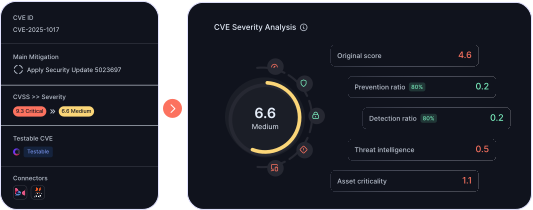
Risk-Based Exposure Prioritization

In this example, CVE-2025-1017 was initially rated a critical risk (9.3 CVSS), but Cymulate attack simulations revealed strong detection and prevention. This information, combined with threat intelligence and asset criticality, fed into a Cymulate severity analysis that delivered a more contextual assessment. As a result, the exposure risk score was reduced to medium (6.6). 

The True Power of CTEM from Cymulate 

With Cymulate Exposure Management, you’ll put threat resilience at the heart of your CTEM strategy. The new platform can: 

  • Integrate into existing security stack to collect assets and exposure 
  • Identify testable exposures by exploitation techniques and APT groups 
  • Analyze the risk factors influencing the severity including security control effectiveness, business context and threat intelligence 
  • Score exposures based on contextual data 
  • Prioritize by focusing on your most critical exposures 

By leveraging the platform, your security team gets: 

  • Easy integrations with your core security capabilities 
  • Automated testing for the full kill chain  
  • Validation with focus on improving resilience 
  • Attack scenario workbench to build and scale custom testing 
  • Automated threat validation vs. theoretical attack path mapping 
  • Prioritization with context of prevention and detection 
  • Actionable and automated remediation 

Security pros like you know the game has changed — it’s no longer about reacting to threats but proactively building resilience against them. 

Cymulate is an exposure management platform designed to validate threats, prioritize validated exposures and optimize threat resilience. 

It’s time to prove the threat and improve resilience. 

Sign up for a demo today to see the Cymulate Exposure Management Platform in action. 

Cymulate Exposure Validation makes advanced security testing fast and easy. When it comes to building custom attack chains, it's all right in front of you in one place.
Mike Humbert, Cybersecurity Engineer
DARLING INGREDIENTS INC.
Learn More
Book a Demo