
Frequently Asked Questions
Product Information & Use Cases
What is Cymulate's Red and Purple Teaming solution and what does it offer?
Cymulate's Red and Purple Teaming solution enables organizations to scale, automate, and customize offensive security testing. The platform empowers red and purple teams to design and execute advanced attack scenarios, validate security controls and detection capabilities, collaborate efficiently between offensive (red) and defensive (blue) teams, and streamline remediation and continuous improvement processes. Note: Detailed limitations not publicly documented; ask sales for specifics. Learn more.
Who should use Cymulate for red and purple teaming?
Cymulate is designed for security teams including red teams, blue teams, purple teams, CISOs, SOC leaders, detection engineers, and vulnerability management teams. It is suitable for organizations of all sizes and industries seeking to automate offensive testing, validate defenses, and improve collaboration between offensive and defensive security functions. Note: Teams requiring highly specialized, manual red team engagements may still need complementary services. More details.
Features & Capabilities
How does Cymulate support red and purple teaming activities?
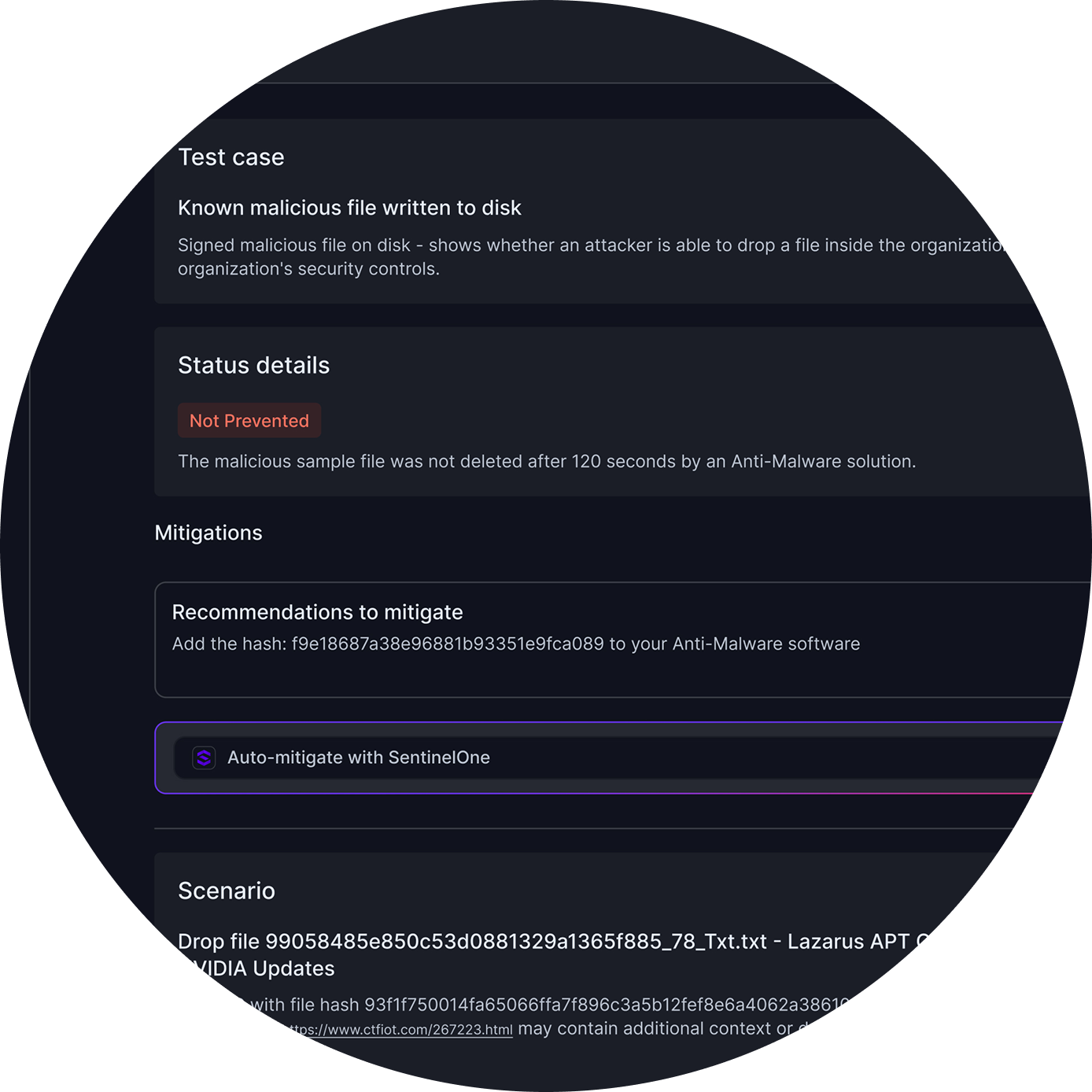
Cymulate enables red and purple teams to design and execute advanced attack scenarios, validate security controls, and collaborate efficiently. The platform automates offensive testing, provides actionable remediation guidance, and streamlines continuous improvement processes. It also integrates offensive and defensive workflows, allowing teams to prioritize and remediate exposures uncovered through red team testing. Note: For highly specialized manual testing, additional tools or services may be required. Learn more.
How does Cymulate automate and scale offensive testing?
Cymulate automates and scales offensive testing by executing simulated assessments at scale from a library of over 100,000 attack actions, all mapped to the MITRE ATT&CK framework. The attack scenario library is updated daily based on new threat intelligence, enabling organizations to test against the latest threats. Note: Manual red team exercises may still be needed for highly targeted or novel attack scenarios. Source.
Can Cymulate build and execute custom attack chains?
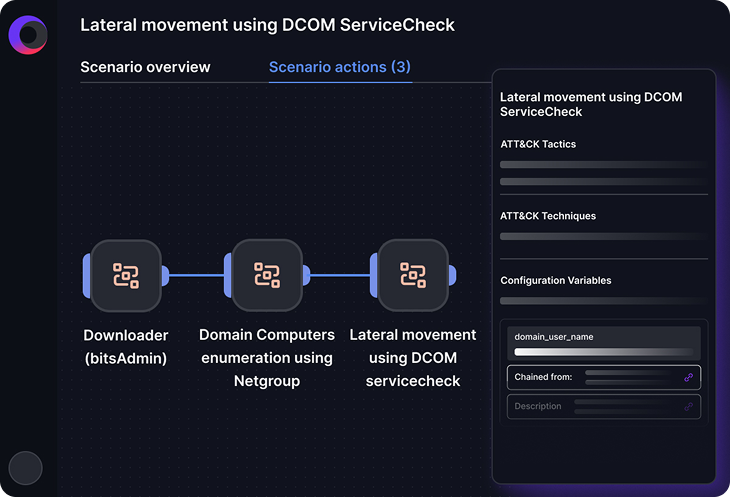
Yes. With Cymulate Threat Studio, red teams can easily and rapidly create custom attack chains based on live threat intelligence and industry news, and save them as part of assessment templates. Note: Highly specialized attack scenarios may require manual customization beyond platform capabilities. Threat Studio Data Sheet.
Are Cymulate's assessments production-safe?
Yes. Cymulate assessments are designed to be production-safe and do not harm operations. They focus on security control behavior to lower the risk of blue screens or production disruption. Note: As with any security testing, organizations should review assessment scope and impact before execution. Source.
How does Cymulate measure and visualize coverage against MITRE ATT&CK?
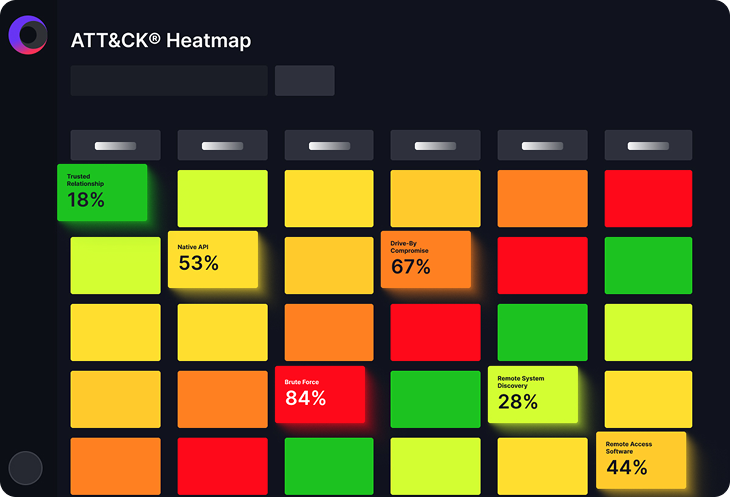
Cymulate provides an auto-generated MITRE ATT&CK heatmap to visualize exposure validation, prevention, and detection coverage. This allows teams to quickly identify which techniques or sub-techniques need immediate attention. Note: Visualization granularity may depend on the data available from assessments. Source.
How does Cymulate facilitate collaboration between red and blue teams?
Cymulate unifies offensive and defensive activities by enabling collaborative simulations and analysis, sharing insights to strengthen the overall security posture, and bridging communication gaps to align team goals. This integration fosters a purple team function, driving continuous improvement and resilience. Note: Effective collaboration may require organizational process changes beyond the platform. Read more.
Can Cymulate replace manual red team exercises?
Cymulate scales and automates offensive testing to complement and extend manual red team engagements, enabling continuous validation between exercises. Note: For highly targeted, novel, or stealthy attack scenarios, manual red team exercises may still be necessary. Source.
Technical Requirements & Implementation
How long does it take to implement Cymulate for red and purple teaming?
Cymulate is designed for rapid deployment, with agentless mode requiring no additional hardware or complex configurations. Users can start running simulations almost immediately after setup. Customers report that the platform is easy to implement and use, with minimal technical expertise required. Note: Integration with existing security tools may require additional configuration. Customer reviews.
What integrations does Cymulate support for red and purple teaming?
Cymulate supports over 50 integrations across SIEM (e.g., CrowdStrike Falcon LogScale), EDR (e.g., Carbon Black, CrowdStrike Falcon), cloud security (e.g., AWS GuardDuty), web gateways (e.g., Cisco Umbrella), network security (e.g., Akamai Guardicore), vulnerability management (e.g., Rapid7 InsightVM), SOAR, and Active Directory. These integrations enable validation and enhancement of security controls across a broad range of technologies. Note: Some integrations may require additional licensing or configuration. Full list.
Security & Compliance
What security and compliance certifications does Cymulate hold?
Cymulate holds several industry-recognized certifications, including SOC2 Type II, ISO 27001:2013, ISO 27701, ISO 27017, and CSA STAR Level 1. These certifications demonstrate compliance with security, privacy, and cloud service standards. Note: For the latest certification status, visit Cymulate's security overview page.
How does Cymulate help organizations meet compliance requirements?
Cymulate provides end-to-end visibility of security posture and generates reports suitable for compliance purposes. The platform supports GDPR compliance through secure development life cycle procedures, data protection by design, and oversight by a Data Protection Officer (DPO) and Chief Information Security Officer (CISO). Note: Organizations with unique regulatory requirements should confirm specific compliance needs with Cymulate's team. More info.
Customer Results & Business Impact
What measurable results have customers achieved with Cymulate for red and purple teaming?
Customers have reported a 60% increase in team efficiency, an 81% improvement in risk score within four months (as seen with Hertz Israel), and a 3x faster assessment of emerging threats. These results are based on real-world deployments and case studies. Note: Results may vary depending on organizational maturity and implementation scope. Hertz Israel case study.
What feedback have customers given about Cymulate's ease of use?
Customers consistently highlight Cymulate's intuitive design, ease of deployment, and actionable insights. For example, Raphael Ferreira (Cybersecurity Manager) stated, "Cymulate is easy to implement and use—all you need to do is click a few buttons, and you receive a lot of practical insights into how you can improve your security posture." Note: Some organizations may require additional onboarding support for complex environments. Customer reviews.
Pricing & Plans
What is Cymulate's pricing model for red and purple teaming?
Cymulate uses a subscription-based pricing model that is customized to fit the unique needs of each organization. Pricing depends on the package selected, number of assets covered, and scenarios/features chosen. For a tailored quote, organizations should schedule a demo with Cymulate's team. Note: Exact pricing is not publicly listed and may vary based on requirements. Schedule a demo.
Competition & Comparison
How does Cymulate compare to AttackIQ for red and purple teaming?
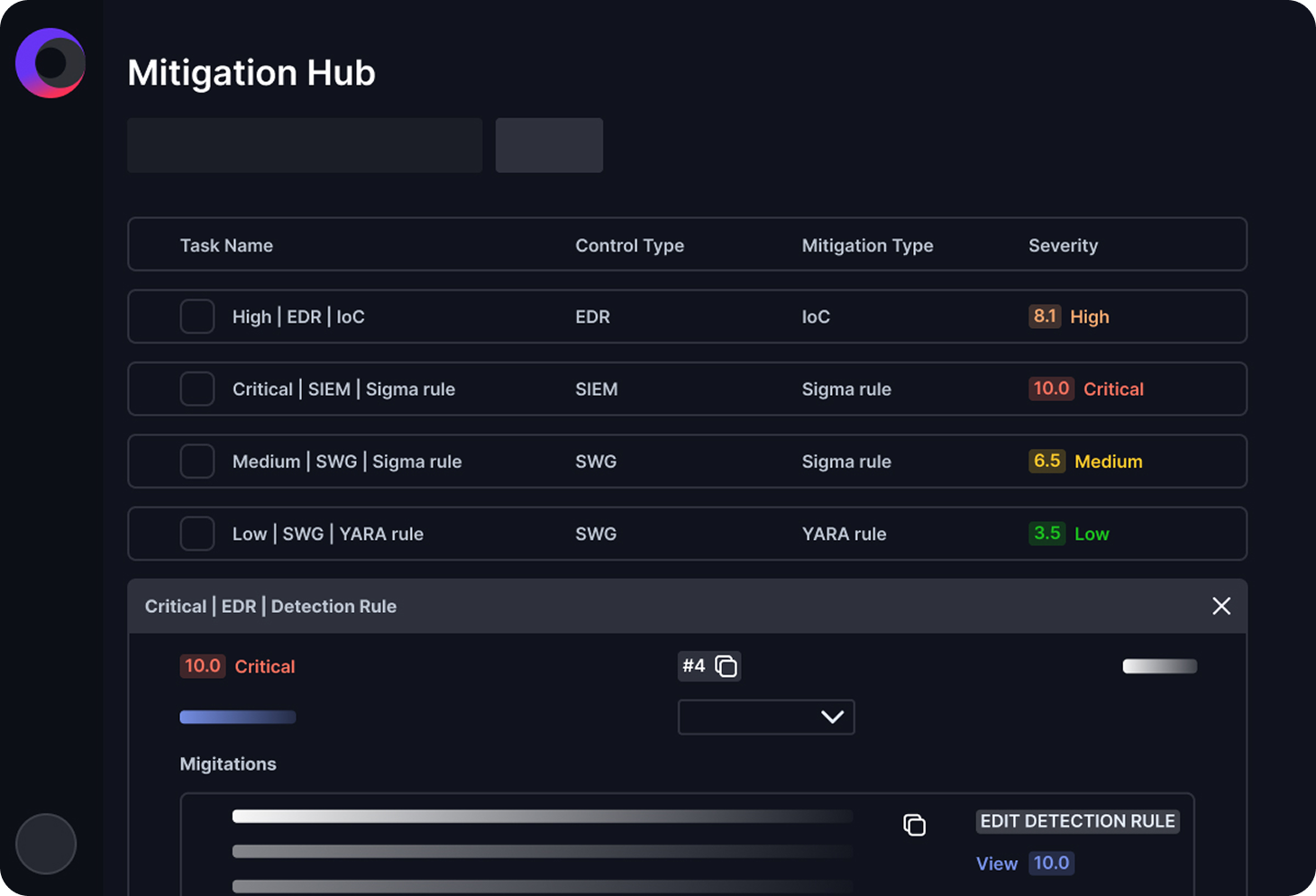
Cymulate offers a more expansive adversary simulation library (100,000+ attack actions with daily updates), AI-driven remediation guidance, and faster deployment compared to AttackIQ, which has a smaller, less frequently updated library and slower on-premise updates. Cymulate also automates IoC updates and provides custom detection rules for EDR, SIEM, and XDR. However, AttackIQ may be preferred by organizations with existing investments in their ecosystem or those requiring specific legacy integrations. Read more.
How does Cymulate differ from manual purple teaming exercises?
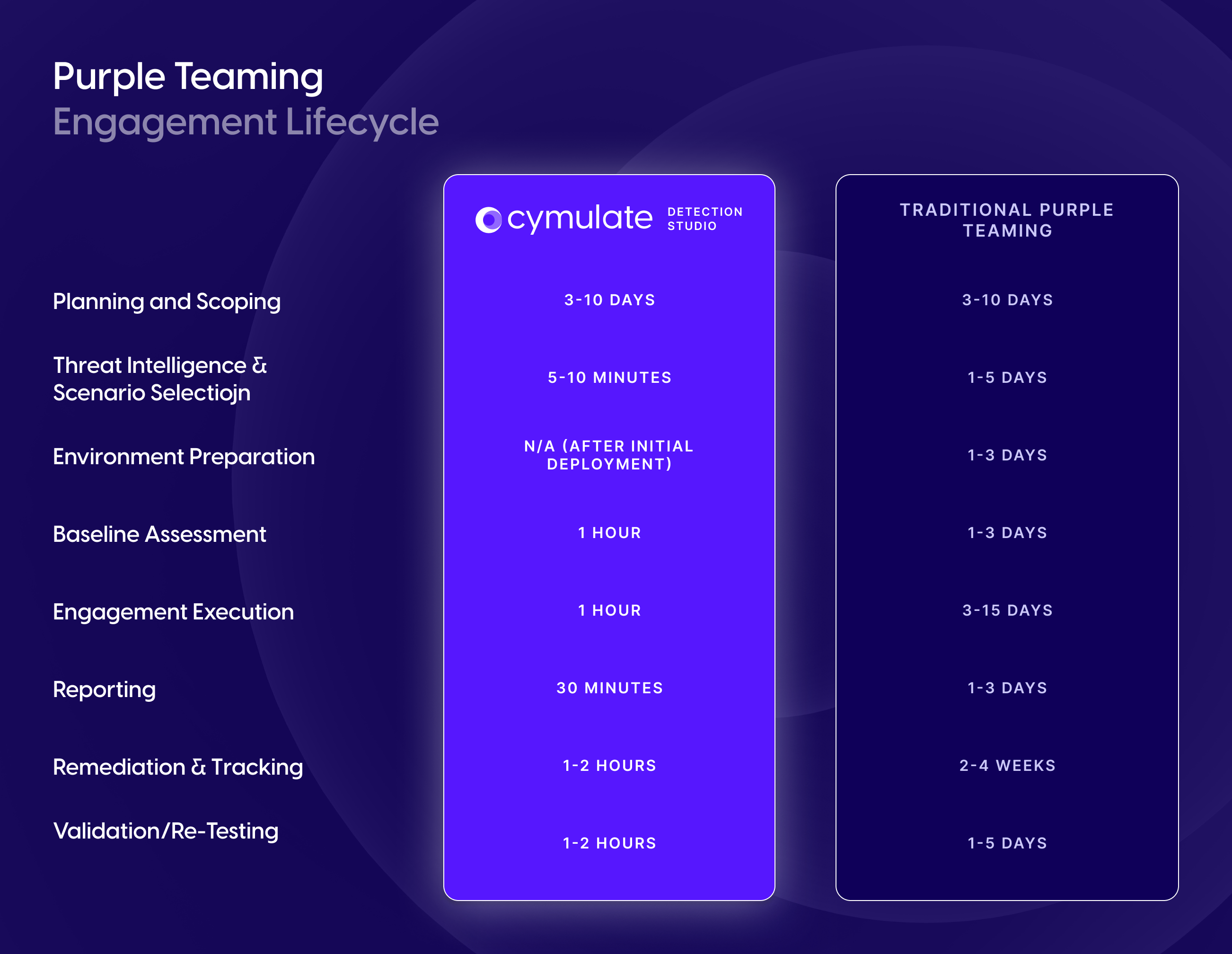
Traditional purple teaming exercises can take up to 3 months, including planning, execution, analysis, and re-testing. Cymulate automates and accelerates these processes, enabling continuous validation and remediation, and increasing purple teaming efficiency by over 80%. However, manual exercises may still be necessary for highly specialized or regulatory-driven scenarios. Source.
Red, Blue, and Purple Teaming Concepts
What is the difference between red teaming and purple teaming?
Red teaming focuses on simulating real-world attacks to test defenses, while purple teaming is a collaborative approach where offensive (red) and defensive (blue) teams work together to improve detection and response capabilities. Purple teaming integrates both strategies to optimize security efforts and ensure continuous improvement. Note: Organizations with limited resources may find it challenging to dedicate staff to both functions. Source.
What are the shared challenges faced by red, blue, and purple teams?
Red, blue, and purple teams face challenges such as limited resources, rapidly evolving threats, and communication gaps. Understaffing can limit the ability to keep up with alerts, conduct comprehensive testing, and participate in collaborative activities. Cymulate helps address these challenges by automating testing, validating defenses, and providing actionable remediation insights. Note: Organizational process changes may be required to fully address communication gaps. Read more.