

Frequently Asked Questions

Exposure Validation & Use Cases

What is exposure validation and why is it important for security teams?

Exposure validation is the process of continuously testing your security controls and environment against real-world attack scenarios to identify exploitable exposures and validate defenses. According to the 2026 Gartner® Market Guide for Adversarial Exposure Validation, exposure validation helps reduce skill and complexity barriers, enabling organizations to test their defenses more effectively and proactively. It is essential for moving from reactive to proactive security and for driving continuous improvement in threat resilience.

What are the three core use cases for adversarial exposure validation according to Gartner?

The 2026 Gartner® Market Guide for Adversarial Exposure Validation highlights three core use cases: (1) Defense optimization for security operations and blue teams, (2) Exposure awareness for vulnerability management and continuous threat exposure management (CTEM), and (3) Scaling offensive testing for red teams. Each use case addresses different security team needs, from optimizing controls to increasing visibility and automating adversarial testing.

How does exposure validation support continuous improvement in security?

Exposure validation enables continuous improvement by providing ongoing, automated testing of threats, security controls, MITRE ATT&CK techniques, SIEM rules, and more. This process helps organizations tune threat prevention, build and test new detection logic, and maximize coverage of attack techniques. Rather than a one-time audit, exposure validation supports a culture of ongoing enhancement and measurable outcomes.

What outcomes should security leaders expect from exposure validation?

Security leaders should expect exposure validation to deliver actionable insights for tuning security controls, building and deploying detection logic, and mobilizing remediation for validated exposures. The process goes beyond visibility, providing measurable improvements in threat prevention, detection, and operational efficiency. Gartner recommends starting with defensive optimization for the most tangible results.

How does Cymulate help organizations move from continuous testing to continuous improvement?

Cymulate's platform automates exposure validation, providing continuous, real-world attack simulations and actionable insights. This enables organizations to not only identify exposures but also prioritize and remediate them, tune controls, and build new detection logic. The platform supports a continuous improvement process, as recommended by Gartner, with measurable outcomes such as improved threat prevention and operational efficiency.

How does the Gartner Market Guide recommend using exposure validation for vendor management?

The Gartner Market Guide notes that exposure validation can be used for service provider performance validation and security vendor performance scorecards. CISOs and security leaders can use performance data from exposure validation to inform product renewals and vendor management strategies, ensuring investments are aligned with actual security outcomes.

What is the strategic planning assumption Gartner makes about AEV by 2029?

Gartner predicts that by 2029, 30% of organizations will link Adversarial Exposure Validation (AEV) results to automated remediation or orchestration workflows, enabling faster treatment of validated exposures. This highlights the growing importance of automation and integration in exposure management strategies. Source

Where can I access the full 2026 Gartner Market Guide for Adversarial Exposure Validation?

You can download the full 2026 Gartner® Market Guide for Adversarial Exposure Validation directly from Cymulate's website at this link.

How does Cymulate address the market confusion between BAS, automated pen testing, and red teaming?

Cymulate provides a unified platform that integrates breach and attack simulation (BAS), continuous automated red teaming (CART), and exposure analytics. This approach addresses the market confusion by offering comprehensive coverage for all three use cases—defense optimization, exposure awareness, and offensive testing—within a single solution, as highlighted in the Gartner Market Guide.

How does Cymulate help blue teams and security operations optimize defenses?

Cymulate enables blue teams and security operations to optimize defenses by continuously testing security controls, tuning them to block relevant threats, and providing actionable insights for building and deploying detection logic. The platform supports defensive optimization, which Gartner recommends as a starting point for exposure validation initiatives.

How does Cymulate support vulnerability management and CTEM programs?

Cymulate supports vulnerability management and Continuous Threat Exposure Management (CTEM) by providing exposure awareness, prioritizing vulnerabilities based on exploitability and business context, and automating validation processes. This enables organizations to focus remediation efforts on the most critical exposures and continuously improve their security posture.

How does Cymulate help red teams scale offensive testing?

Cymulate provides red teams with production-safe attack simulations, automation of offensive testing, and a library of over 100,000 attack actions aligned to MITRE ATT&CK. This allows red teams to scale their testing efforts, simulate advanced adversary techniques, and validate defenses more efficiently.

What is the difference between visibility and actionable improvement in exposure validation?

Visibility refers to identifying assets, vulnerabilities, and attack surfaces, while actionable improvement means using that visibility to tune controls, build detection logic, and remediate exposures. Gartner and Cymulate emphasize that exposure validation should go beyond visibility to drive measurable security improvements and continuous progress.

How does Cymulate integrate with existing security tools?

Cymulate integrates with a wide range of security technologies, including EDR, SIEM, cloud security, and network security solutions. Examples include integrations with Akamai Guardicore, AWS GuardDuty, CrowdStrike Falcon, and Check Point CloudGuard. For a full list, visit Cymulate's Partnerships and Integrations page.

How easy is it to implement Cymulate and start exposure validation?

Cymulate is designed for rapid implementation and ease of use. Customers report that deployment is fast and straightforward, with agentless mode and minimal resource requirements. The platform provides actionable insights within a few clicks, and comprehensive support is available to ensure a smooth onboarding process.

What measurable business impact can Cymulate deliver?

Cymulate customers report a 52% reduction in critical exposures, a 60% increase in team efficiency, an 81% reduction in cyber risk within four months, and a 30% improvement in threat prevention. These outcomes are supported by case studies and customer testimonials. See the Hertz Israel case study.

What pain points does Cymulate solve for security teams?

Cymulate addresses pain points such as overwhelming threat volume, lack of visibility, unclear prioritization, operational inefficiencies, fragmented tools, cloud complexity, and communication barriers. The platform provides continuous threat validation, actionable insights, and unified workflows to help teams focus on what matters most.

How does Cymulate's exposure validation platform differ from competitors?

Cymulate stands out by offering a unified platform that combines BAS, CART, and exposure analytics, continuous innovation with bi-weekly updates, AI-powered optimization, and the industry's largest attack simulation library. It delivers measurable outcomes and is recognized as a leader by Gartner and G2. For detailed comparisons, see Cymulate vs. Competitors.

What are Cymulate's key security and compliance certifications?

Cymulate holds SOC2 Type II, ISO 27001:2013, ISO 27701, ISO 27017, and CSA STAR Level 1 certifications. These attest to Cymulate's commitment to security, privacy, and compliance with international standards. For more details, visit Security at Cymulate.

Who are Cymulate's main competitors and how does Cymulate compare?

Main competitors include AttackIQ, Mandiant Security Validation, Pentera, Picus Security, SafeBreach, Scythe, and NetSPI. Cymulate differentiates itself with a unified platform, continuous innovation, AI-powered features, and comprehensive coverage of the attack lifecycle. For objective comparisons, visit Cymulate vs. Competitors.

What is Cymulate's pricing model?

Cymulate uses a subscription-based pricing model tailored to each organization's needs. Pricing depends on the chosen package, number of assets, and scenarios selected. For a personalized quote, schedule a demo with Cymulate's team.

Who can benefit from using Cymulate's exposure validation platform?

Cymulate is designed for CISOs, security leaders, SecOps teams, red teams, and vulnerability management teams across industries such as finance, healthcare, retail, and more. Organizations of all sizes, from small businesses to enterprises, can benefit from Cymulate's unified approach to exposure management.

What feedback have customers given about Cymulate's ease of use?

Customers consistently praise Cymulate for its intuitive design, rapid deployment, and actionable insights. Testimonials highlight the platform's user-friendly dashboard, ease of implementation, and excellent support. For example, Raphael Ferreira, Cybersecurity Manager, stated, "Cymulate is easy to implement and use—all you need to do is click a few buttons, and you receive a lot of practical insights into how you can improve your security posture." See more testimonials.

What is Cymulate's approach to product security and compliance?

Cymulate maintains a robust security program with SOC2 Type II and ISO certifications, secure AWS hosting, strong encryption, secure development lifecycle, and ongoing employee training. The company is GDPR-compliant and has a dedicated privacy and security team. For more, visit Security at Cymulate.

What is Cymulate's mission and vision?

Cymulate's mission is to revolutionize how companies approach cybersecurity by fostering a proactive stance against threats. The company empowers organizations to manage their security posture effectively and improve resilience. The platform enables continuous threat exposure management and collaboration across security teams. Learn more.

Where can I find Cymulate's blog, news, and resources?

You can stay updated on the latest threats, research, and company news by visiting Cymulate's blog, newsroom, and resource hub. These channels provide insights, thought leadership, and product information.

How do I subscribe to the Cymulate blog?

To subscribe to the Cymulate blog, you will need to provide your full name, email address, and country of residence. See privacy policy.

Where can I find resources like whitepapers, reports, and webinars from Cymulate?

Cymulate's Resource Hub offers a central location for whitepapers, reports, webinars, and thought leadership articles. Access it at cymulate.com/resources/.

Does Cymulate have a newsroom for media mentions and press releases?

Yes, Cymulate's newsroom features media mentions, bylines, and press releases. Visit cymulate.com/news/ for the latest updates.

Where can I find the Gartner Market Guide for Adversarial Exposure Validation?

You can access the Gartner Market Guide for Adversarial Exposure Validation for both 2025 and 2026 on Cymulate's website: 2025 Guide and 2026 Guide.

What insights are available in the 2026 Gartner Market Guide for Adversarial Exposure Validation?

The 2026 Gartner Market Guide provides insights on AEV use cases, key features, and market trends. It predicts that by 2029, 30% of organizations will automate remediation based on AEV results. The guide helps organizations improve threat exposure visibility and defenses. Read more.

Where can I find a video overview of exposure validation made easy?

You can watch the "Exposure Validation Made Easy" video on Cymulate's official YouTube channel: Exposure Validation Made Easy video.

New: 2026 Gartner® Market Guide for Adversarial Exposure Validation
Learn More
Cymulate named a Customers' Choice in 2025 Gartner® Peer Insights™
Learn More
New Research: Azure Arc Privilege Escalation & Identity Takeover
Learn More
An Inside Look at the Technology Behind Cymulate
Learn More

Exposure Validation: Continuous Testing Should Drive Continuous Improvement

By: Brian Moran, VP of Product Marketing

April 1, 2026

What’s your end goal? How exactly does this security project make you more secure? 
Like any technology initiative, those two questions should drive your evaluation, budgeting and ultimate decision-making around continuous security testing and exposure validation. 

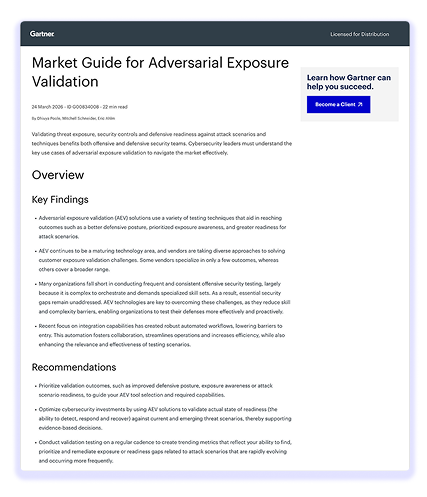
The concept of security validation and the automation of attacker behavior is generally associated with offensive testing and the specialized skills of red teams and penetration testers, but that’s just one of the three core use cases that Gartner highlights in its latest Market Guide for Adversarial Exposure Validation.1 

Beyond red teaming, the Gartner market guide highlights use cases of defense optimization and exposure awareness.  

You can download your complimentary copy here

Clarity from market confusion 

You can argue that Gartner added to market confusion when they combined the previous markets of breach and attack simulation (BAS), automated pen testing and continuous red teaming into the new consolidated adversarial exposure validation. 

Offensive testing provides a common thread among these three technologies, and the market is evolving where both BAS and auto pen testing vendors offer some form of red teaming tools. However, these technologies are generally targeted at different use cases, leaving buyers to choose from a jumbled list of validation vendors without clarity about each vendor’s core value. 

To its credit, the Gartner Market Guide challenges the market to move beyond the technology and focus on the value and outcomes for security teams. The report goes into detail for the mandatory and common features specific to the use cases that you can map different outcomes serving different security teams, including: 

  • Optimize defense => security operations and blue teams 
  • Exposure awareness => vulnerability management and continuous threat exposure management (CTEM) 
  • Scale offensive testing => red teams 

Across all three use cases, Gartner highlights the value of exposure validation solutions like Cymulate to “reduce skill and complexity barriers, enabling organizations to test their defenses more effectively and proactively.” 1
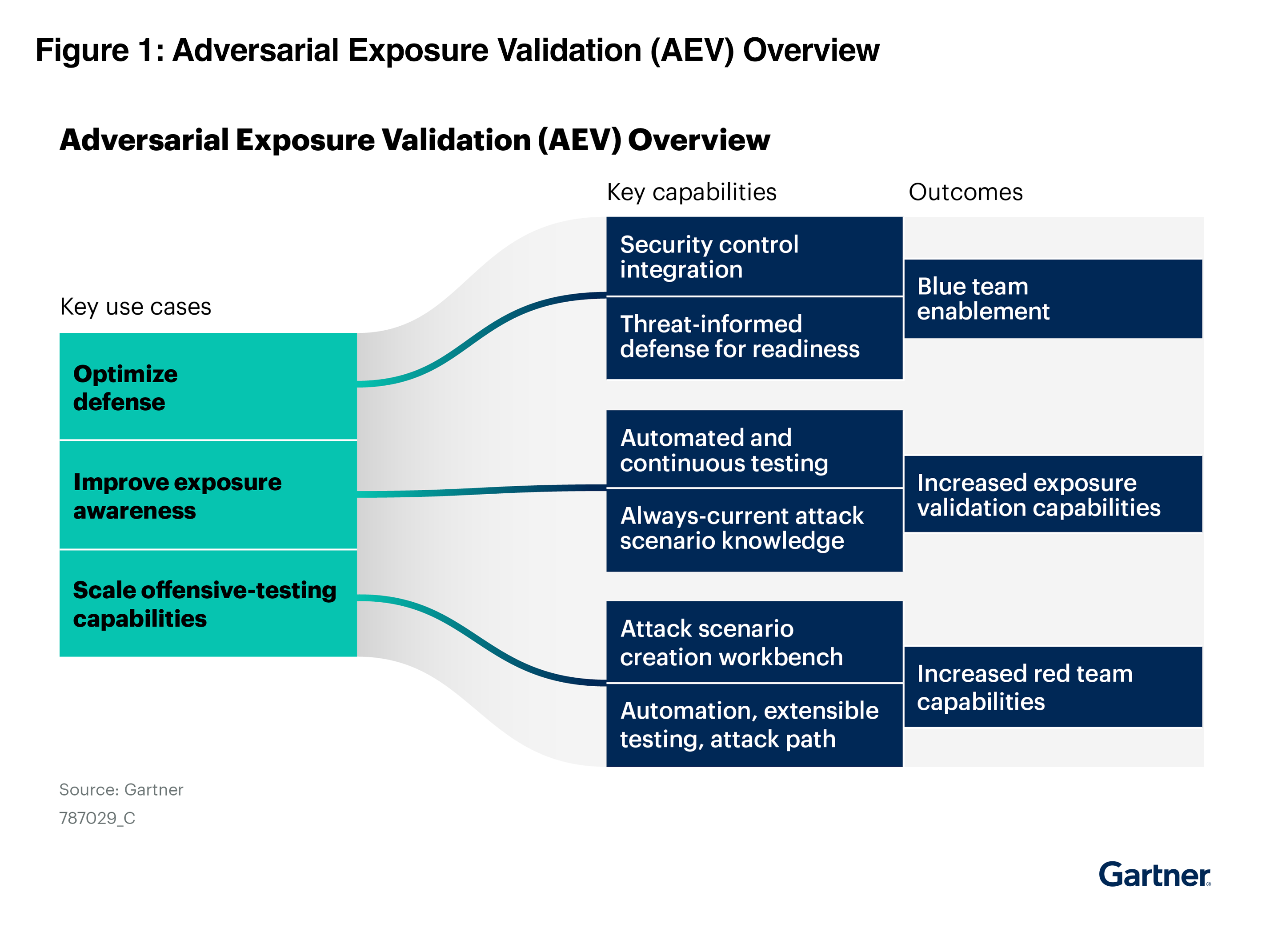
Adversarial Exposure Validation Overview

Thinking red, acting blue 

Offensive security testing has an undeniable cool factor – especially for security engineers who’ve spent countless hours triaging alerts, tuning firewall rules and chasing down vulnerabilities. 

We all know the adage that attackers need to be right just once, while defenders need to be right 100% of the time. That’s why security leaders recognize the value and of continuous testing. Testing like an attacker finds the gaps today instead of waiting for next year’s penetration test. 

However, finding the exposure is just the starting point. While testing and validation can provide the headlights to see the upcoming cliff drop off, it’s the security engineer and blue teams who sit behind the steering wheel with the experience, ability and most importantly the controls to act swiftly to mitigate the threat exposure. 

That’s the role of exposure validation to lead directly toward: 

  • Tuning security controls to block the threats that matter most to you 
  • Build and deploy detection logic for the threats that cannot be prevented 
  • Mobilize the required action to remediate the validated exposure that cannot be mitigated 

Go beyond visibility 

For more than 20 years and long before the term security posture management, security vendors have sold on the value of visibility. The core idea was that you must first identify the asset, application, vulnerability, attack surface, container, etc., before you can effectively secure it.  

When it comes to exposure validation, the Gartner report highlights a few of these visibility values: “service provider performance validation” and “security vendor performance scorecards.” CISOs and security leaders justify the spend on exposure management to: “Improving vendor management by using performance data for infrastructure security controls to better inform product renewals or vendor management strategies.”1 

To that end, Cymulate has helped many CISOs use exposure validation to understand their strengths, establish a clear baseline and build a roadmap for strategic investments and improvements. For the security team and their supporting vendors, however, this process can often feel more like an audit than a path to immediate progress. 

From continuous testing to continuous improvement 

Rather than making this a pass-fail exercise, the most successful security leaders take the opportunity to build a culture of continuous improvement. With continuous testing of threats, security controls, MITRE ATT&CK techniques, SIEM rules and more, validation supports a continuous improvement process with tangible outcomes of: 

  • Threat prevention tuned for the latest threats 
  • New detection logic built, deployed and tested 
  • Maximum coverage of MITRE ATT&CK 

The Gartner market guide drives this point home. “Gartner suggests starting with defensive optimization or the fundamentals of a blue team practice. Although having a red team sounds more appealing, it’s not for everyone, and the results are often more elusive to prove.”1 

While the identification of security gaps and discovering points of exposure provide necessary visibility, security leaders should expect more from their exposure validation with integrations that directly build better security. 

That takes us back to the initial question. How exactly will exposure validation improve your security? I’ll leave you with one more Gartner quote and their strategic planning assumption. “By 2029, 30% of organizations will link AEV results to automated remediation or orchestration workflows, enabling faster treatment of validated exposures.”1

In the end, exposure validation must lead to better security. 

I invite you to read the full Gartner Market Guide for Adversarial Exposure Validation. Download your complimentary copy here

1Gartner®, Market Guide for Adversarial Exposure Validation, Dhivya Poole, Mitchell Schneider, Eric Ahlm, Angela Zhao, 24 March 2026   

GARTNER® is a registered trademark and service mark of Gartner, Inc. and/or its affiliates in the U.S. and internationally and is used herein with permission. All rights reserved.   

Gartner® does not endorse any vendor, product or service depicted in its research publications, and does not advise technology users to select only those vendors with the highest ratings or other designation. Gartner research publications consist of the opinions of Gartner’s research organization and should not be construed as statements of fact. Gartner disclaims all warranties, expressed or implied, with respect to this research, including any warranties of merchantability or fitness for a particular purpose. 

“By 2029, 30% of organizations will link AEV results to automated remediation or orchestration workflows, enabling faster treatment of validated exposures.”
Gartner®, Market Guide for Adversarial Exposure Validation
2026
Learn More
Book a Demo