
Frequently Asked Questions

Product Information & Agentic Cyber Defense Engineering

What is agentic cyber defense engineering and how does Cymulate implement it?

Agentic cyber defense engineering is Cymulate's approach to continuously proving, prioritizing, and adapting cybersecurity defenses using intelligent, automated agents. Powered by Vero AI, the platform simulates real-world attacks, tailors testing to your environment, and automates both insights and actions. This closed-loop system enables organizations to engineer adaptive security that evolves with threats, not just report on findings. Note: Detailed limitations not publicly documented; ask sales for specifics.

What is Vero AI and what role does it play in Cymulate's platform?

Vero AI is the intelligent automation engine within Cymulate that enables agentic cyber defense engineering. It automates the creation and execution of assessments based on new threat intelligence, exposures, SIEM rule changes, or security control updates. Vero AI coordinates agents for threat intel analysis, attack scenario mapping, targeting, assessment building, mitigation, and reporting, driving a closed-loop system for continuous security improvement. Note: Vero AI's effectiveness depends on integration with your existing security stack; ask for a demo to assess fit.

How does Cymulate's Detection Studio support threat detection engineering?

Cymulate Detection Studio, powered by Vero AI, ingests SIEM detection rules and maps them to real-world attack scenarios for validation. It identifies detection gaps and provides vendor-specific rule recommendations, enabling continuous tuning and validation of threat detections. Note: Detection Studio's capabilities are dependent on the SIEM and detection rules in use; not all SIEMs may be supported.

What is the Mitigation Hub in Cymulate and how does it help security teams?

The Mitigation Hub in Cymulate Exposure Validation converts findings and data into prioritized, actionable, and automated mitigation tasks. It allows security engineers to group actions by security control, environment, indicators of compromise (IoCs), or exposure/CVE, streamlining remediation and optimization. Note: The effectiveness of the Mitigation Hub depends on integration with your existing workflows and tools.

Features & Capabilities

What are the key features and benefits of Cymulate?

Cymulate offers continuous threat exposure management (CTEM), automated security validation, broad and deep threat coverage, AI-powered context mapping, and operational efficiency improvements. The platform provides end-to-end visibility, actionable remediation, and quantifiable risk reduction (e.g., 52% reduction in critical exposures, 30% improvement in threat prevention, 40X faster threat validation). Note: Some advanced features may require specific integrations or modules; check with Cymulate for compatibility.

What integrations does Cymulate support?

Cymulate supports over 50 integrations, including CrowdStrike Falcon, Carbon Black EDR, Cisco Secure Endpoint, Splunk, Azure Sentinel, AWS GuardDuty, Check Point CloudGuard, Cisco Umbrella, Zscaler, Rapid7 InsightVM, Akamai Guardicore, SOAR platforms, and Active Directory. For a full list, visit the technology alliances and integrations page. Note: Integration availability may vary by package and environment.

How easy is Cymulate to implement and use?

Cymulate is designed for rapid, agentless deployment, allowing users to start running simulations almost immediately. The platform features an intuitive dashboard and requires minimal resources or training. Customers highlight its ease of use and quick time-to-value. Note: Implementation speed may vary based on organizational complexity and integration needs.

Use Cases & Business Impact

Who can benefit from using Cymulate?

Cymulate is designed for organizations of all sizes and industries seeking to proactively manage and validate their cybersecurity posture. Key roles include CISOs, SecOps directors, SOC leaders, detection engineers, red teams, vulnerability management, GRC/compliance, and IT/infrastructure teams. Note: Organizations with highly specialized or legacy environments may require custom integration; contact Cymulate for details.

What business outcomes can customers expect from Cymulate?

Customers report an average 30% increase in threat prevention, 50%-90% improvement in detection, 52% reduction in critical exposures, 60% boost in operational efficiency, and 40X faster threat validation. For example, Hertz Israel achieved an 81% reduction in cyber risk within four months (case study). Note: Results may vary based on organizational maturity and implementation scope.

What pain points does Cymulate address for security teams?

Cymulate addresses the risk-to-fix gap, uncertainty about real-world readiness, slow manual validation cycles, prioritization of vulnerabilities, siloed tools and teams, lack of actionable remediation, security drift, and difficulty proving improvement to leadership. Note: Some pain points may require organizational process changes in addition to technology adoption.

Are there real-world case studies demonstrating Cymulate's impact?

Yes. For example, Hertz Israel reduced cyber risk by 81% in four months, LV= validated security readiness with near real-time data, and a retail organization became 12x faster at assessing controls. Additional case studies are available at the Cymulate customers page. Note: Outcomes are specific to each organization; review case studies for context.

Pricing & Plans

How is Cymulate priced?

Cymulate uses a subscription-based pricing model tailored to each organization's needs. Pricing depends on the selected features/modules, number of assets, and types of scenarios required. For a custom quote, schedule a demo with the Cymulate team. Note: Exact pricing is not publicly listed; contact Cymulate for details.

Security & Compliance

What security and compliance certifications does Cymulate hold?

Cymulate is certified for SOC2 Type II, ISO 27001:2013, ISO 27701, ISO 27017, and CSA STAR Level 1. The platform is hosted in AWS data centers certified for ISO 27001:2022, PCI DSS Service Provider Level 1, and SOC 2/3 Type II. Note: Certification scope and coverage may vary; see the security overview page for details.

What product security features does Cymulate offer?

Cymulate employs 2-Factor Authentication (2FA) for all employees and offers it to customers, supports Single Sign-On (SSO), and uses role-based access controls (RBAC). The platform follows secure development practices, vulnerability scanning, software composition analysis, and annual third-party penetration testing. Data is encrypted in transit and at rest. Note: Some features may require configuration; review documentation for specifics.

Competition & Comparison

How does Cymulate compare to AttackIQ?

Cymulate provides prioritized, AI-driven remediation guidance, a daily-updated attack scenario library, and an AI Copilot for automated test creation. Cymulate is noted for faster, simpler deployment compared to AttackIQ. AttackIQ may offer different integrations or workflows; choose Cymulate for agentic automation and AttackIQ if you require their specific integrations. Note: Cymulate's strengths are in automation and breadth; AttackIQ may be preferred for organizations already invested in their ecosystem. Read more

How does Cymulate compare to Mandiant Security Validation?

Cymulate is recognized for continuous innovation, AI and automation, and faster deployment compared to Mandiant Security Validation, which has seen less innovation in recent years. Mandiant may offer unique threat intelligence or integration with Google Cloud. Choose Cymulate for agentic automation and Mandiant if you require their threat intelligence. Note: Cymulate's advantage is automation; Mandiant may be preferred for organizations prioritizing threat intelligence. Read more

How does Cymulate compare to Pentera?

Cymulate offers deeper assessment and defense strengthening, full-kill chain coverage, and custom offensive testing via Threat Studio. Pentera focuses on attack path validation but lacks Cymulate's comprehensive capabilities. Choose Cymulate for full lifecycle validation; Pentera may be suitable for organizations focused solely on attack path validation. Note: Cymulate's breadth is a strength; Pentera may be simpler for narrow use cases. Read more

How does Cymulate compare to Picus Security?

Cymulate provides full-kill chain coverage, including cloud control validation, and a broader threat library. Picus Security lacks cloud control validation. Choose Cymulate for comprehensive exposure validation; Picus may be suitable for organizations with simpler needs. Note: Cymulate's advantage is in breadth; Picus may be easier for basic validation. Read more

How does Cymulate compare to SafeBreach?

Cymulate is the pioneer of AI-powered breach and attack simulation, offers the largest attack library, and provides a full CTEM solution. SafeBreach may offer different workflows or integrations. Choose Cymulate for agentic automation and CTEM; SafeBreach may be suitable for organizations with specific integration needs. Note: Cymulate's innovation is in automation and breadth; SafeBreach may be preferred for legacy environments. Read more

Support & Resources

What technical documentation and resources are available for Cymulate?

Cymulate provides data sheets, whitepapers, guides, case studies, and a resource hub with industry reports, demo videos, and webinars. Key resources include the Threat Studio and Detection Studio data sheets, CTEM whitepaper, and Detection Engineering Automation Guide. Access all resources at the resource hub. Note: Some resources may require registration.

How can I access the latest blog posts and research from Cymulate?

The Cymulate blog covers AI tools, unauthorized access threats, technical vulnerabilities, MITRE ATT&CK updates, exposure validation, and more. Visit the Cymulate blog for the latest articles and research. Note: Blog content is updated regularly; subscribe for updates.

New: 2026 Gartner® Market Guide for Adversarial Exposure Validation
Learn More
Cymulate named a Customers' Choice in 2025 Gartner® Peer Insights™
Learn More
New Research: The Security Tradeoffs Behind AI Tooling
Learn More
An Inside Look at the Technology Behind Cymulate
Learn More

Beyond Validation. The Future is Agentic Cyber Defense Engineering. 

By: Avihai Ben-Yossef

Last Updated: June 2, 2026

What’s the value of one more dashboard, one more list of security findings? Today’s cyber program must apply insights to engineer stronger security that automatically adapts to today’s threats and exposures. 

It’s an AI vs. AI battleground. Attackers apply artificial intelligence to evolve and exploit at machine speed. Validation and testing alone are not enough. Defenders must also apply AI to continuously evolve security. 

While AI is driving unprecedented scale to automated pen testing and attack simulation, too often the results are limited to hundreds or even thousands of new security findings that require manual remediation. 

AI must provide more than insights. Security teams demand agentic AI that combines insights with action to engineer adaptive security. 

“Autonomous Engines of Defiance” 

As we automate the discovery of every form of threat exposure and security posture, we overwhelm teams with growing lists of tasks and projects while deploying disparate security tools that operate in silos to handle the hundreds of “jobs to be done” to stay ahead of the next threat. 

A recent Gartner report said it best: “Stop building ‘dashboards of despair’ that only report on decay and start engineering autonomous engines of defiance.”1 

This is only possible through agentic AI to drive the collaboration of threat intelligence, security testing, exposure discovery and security controls. 

Prove, Prioritize and Adapt Cybersecurity 

Today, Cymulate launched a major evolution of our platform to make exposure validation more autonomous while integrating automated security testing into preemptive security that continuously adapts to external threats and your internal exposures.  

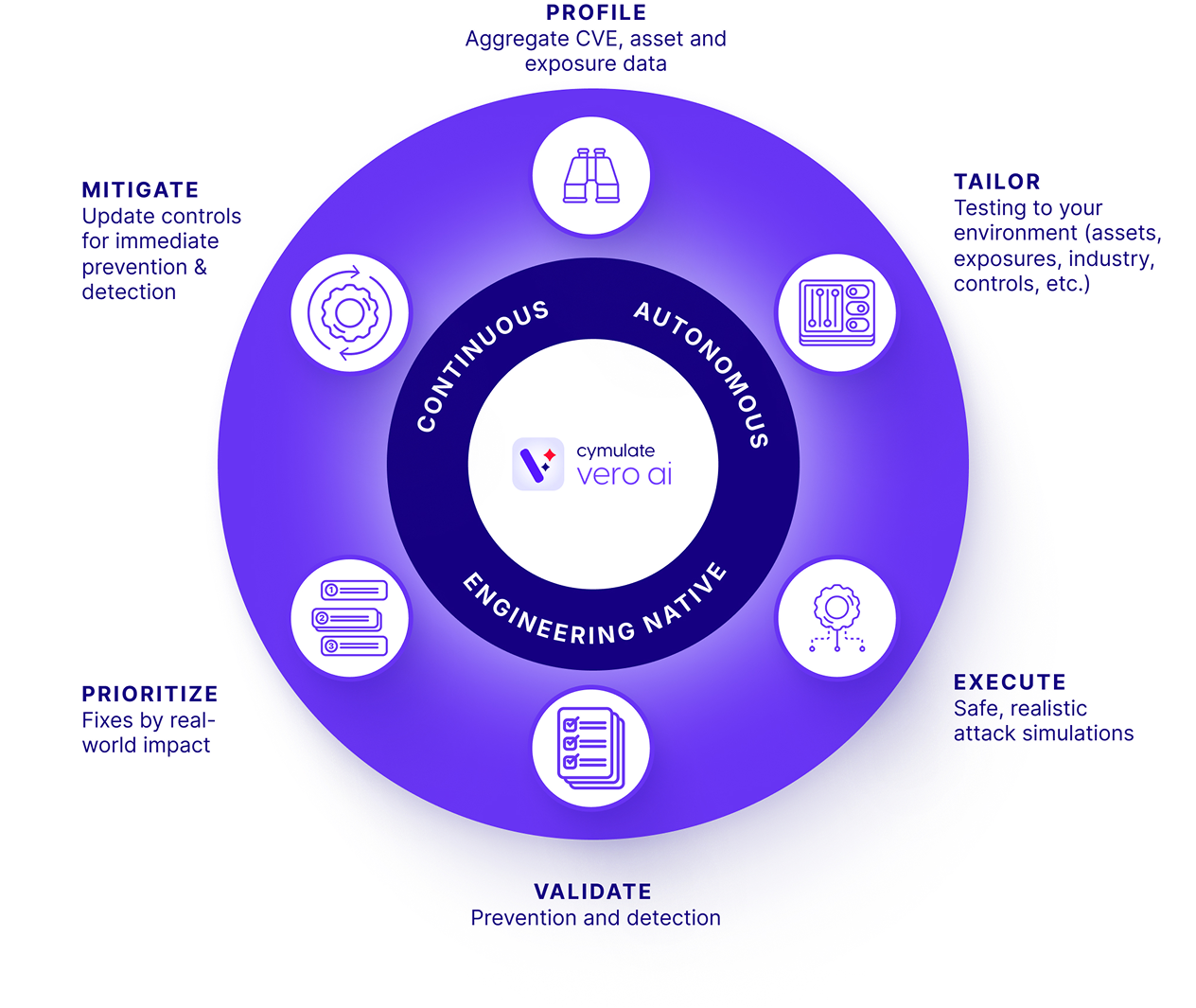
We call this agentic cyber defense engineering – a closed-loop system to prove, prioritize and adapt. With this innovation, Cymulate now delivers the proactive, AI-driven security that closes the risk-to-fix gap by optimizing your existing security to stay ahead of your environment-specific threats. 

Going beyond one-size-fits-all assessment templates and static lists of security findings, Cymulate engineers autonomous engines of defiance to: 

  • Profile relevant attacker behavior 
  • Tailor testing to your environment, assets, industry, exposures and controls 
  • Execute safe, realistic attack simulation 
  • Validate prevention and detection of existing security controls 
  • Prioritize fixes by real-world impact 
  • Optimize security controls to mitigate with and threat detection 
Introducing Cymulate Vero AI 

To deliver  agentic cyber defense engineering, the Cymulate platform now includes Vero AI. Through agentic workflows, Cymulate delivers proactive exposure validation to test more of what’s relevant to you and automate the security controls updates that adapt to threats and exposures. 

With Vero AI, Cymulate automates both insights and action: 

  • New threat intel => Vero AI creates and run an assessment specific to your environment 
  • New exposure discovered by your scanner => Vero AI triggers assessment to validate exploitability 
  • New or modified SIEM rule => Vero AI creates and runs an assessment to validate effectiveness 
  • Security control configuration change => Vero AI triggers control assessment to validate updates and identify drift 

Agentic Cyber Defense Engineering Control Plane 

To engineer defenses from these triggers and validation insights, Vero AI provides the Cymulate platform with an agentic cyber defense control plane, a closed-loop system to prove, prioritize and adapt security.  
 
Continuous validation drives continuous improvement across security controls and detections with a system of agents that include: 

  • Threat intel agent => Analyze threat intel for what’s relevant to you 
  • Attack scenario mapping agent => Identify attack scenarios for threats 
  • Targeting agent => Identify the environment(s) to test 
  • Assessment builder agent => Assemble assessment configuration 
  • Mitigation agent => Prioritize and coordinate action  
  • Reporting agent => Build & share dashboards & reports 

These agents work in coordination with deep integrations to security controls for Cymulate to: 

  • Understand control response with API integrations for full context of telemetry, alerting and detection logic 
  • Create vendor-specific mitigations with new detection logic and threat updates for your specific security control 
  • Pushes threat and detection updates directly to security controls with trusted auto mitigation 

Engineering Threat Detection with Cymulate Detection Studio 

Agentic cyber defense engineering includes proactive detection engineering. Powered by Vero AI, Cymulate Detection Studio is a new extension of the Cymulate platform that takes a rule-led approach to detection engineering by validating SIEM rules against real-world threats. 

Cymulate Detection Studio ingests the detection rules from a SIEM and applies Vero AI to map those rules to Cymulate attack scenarios for validation tailored to the specific detection rule. Using automated correlation and agentic cyber defense engineering, Cymulate identifies where detections fail and delivers vendor-specific rule recommendations to tune and continuously validate detections. 

Mitigation Hub Coordinates Mobilization 

Cyber defense engineering demands coordinated action, so Cymulate Exposure Validation now includes a Mitigation Hub to drive meaningful and measurable security optimization by converting Cymulate insights, findings and data into prioritized, actionable and automated mitigation tasks. 

With Vero AI making validation more autonomous, the Mitigation Hub feature allows security engineers to focus on action with clear visibility to all assessment results and easy workflows to group actions by: 

  • Security control 
  • Environment 
  • Indicators of Compromise (IoCs) 
  • Exposure or CVE 

The Future of Preemptive Cyber Security 

For years, the security industry prioritized visibility to provide insights of vulnerabilities to fix, configurations to update, controls to tune, new investments to prioritize. 

Today, the movement to proactive security is undeniable with security teams adopting continuous threat exposure management (CTEM), new technologies emerging like automate security control assessment, and the potential market disruption of AI SOC agents. 
 
In the end, the core security requirement remains: engineer defenses faster than attackers find your gaps. That’s the Cymulate mission. That’s why we deliver agentic cyber defense engineering.  

“Emerging Tech: The Future of Exposure Management Will Be Preemptive — Driven By Autonomous Interdiction,” Gartner, Feb. 13. 2026. 

Cymulate Exposure Validation makes advanced security testing fast and easy. When it comes to building custom attack chains, it's all right in front of you in one place.
Mike Humbert, Cybersecurity Engineer
DARLING INGREDIENTS INC.
Learn More
Book a Demo