Frequently Asked Questions
Product Information & Detection Engineering
What is detection engineering?
Detection engineering is a structured cybersecurity discipline focused on designing, implementing, testing, and maintaining detection logic that identifies malicious activity in an environment. It enables security teams to proactively create, fine-tune, and validate that SIEM, EDR, and XDR systems can accurately detect threats while minimizing false positives. For more details, see our detection engineering glossary entry. Note: Detection engineering requires ongoing effort to keep up with evolving threats.
How does Cymulate Detection Engineering work?
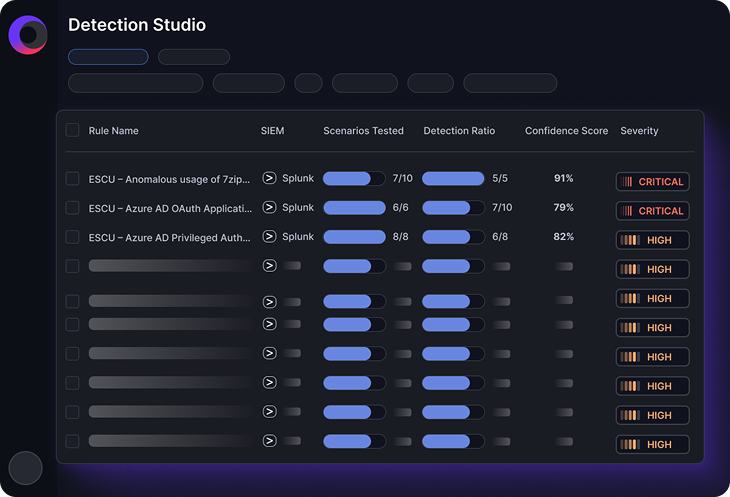
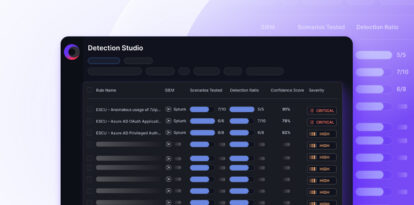
Cymulate Detection Engineering automates and streamlines the detection engineering workflow by combining attack simulation with AI-driven analysis (Vero AI). It enables teams to build, test, and optimize threat detection using live-data attack simulations and custom-generated rules. The platform supports threat-led, rule-led, and MITRE ATT&CK-aligned detection engineering, allowing users to validate and tune SIEM rules, baseline coverage, and deploy vendor-specific detection rules directly to controls. Note: Effectiveness depends on integration with your existing SIEM, EDR, and XDR platforms.
What are the main features of Cymulate Detection Engineering?
Main features include:
- Automated mapping of detection rules to attack techniques and scenarios using Vero AI
- Validation and tuning of detection rules with vendor-specific guided tuning
- Identification of coverage gaps using a dynamic MITRE ATT&CK heatmap
- Out-of-the-box integrations with leading SIEM, EDR, and XDR platforms
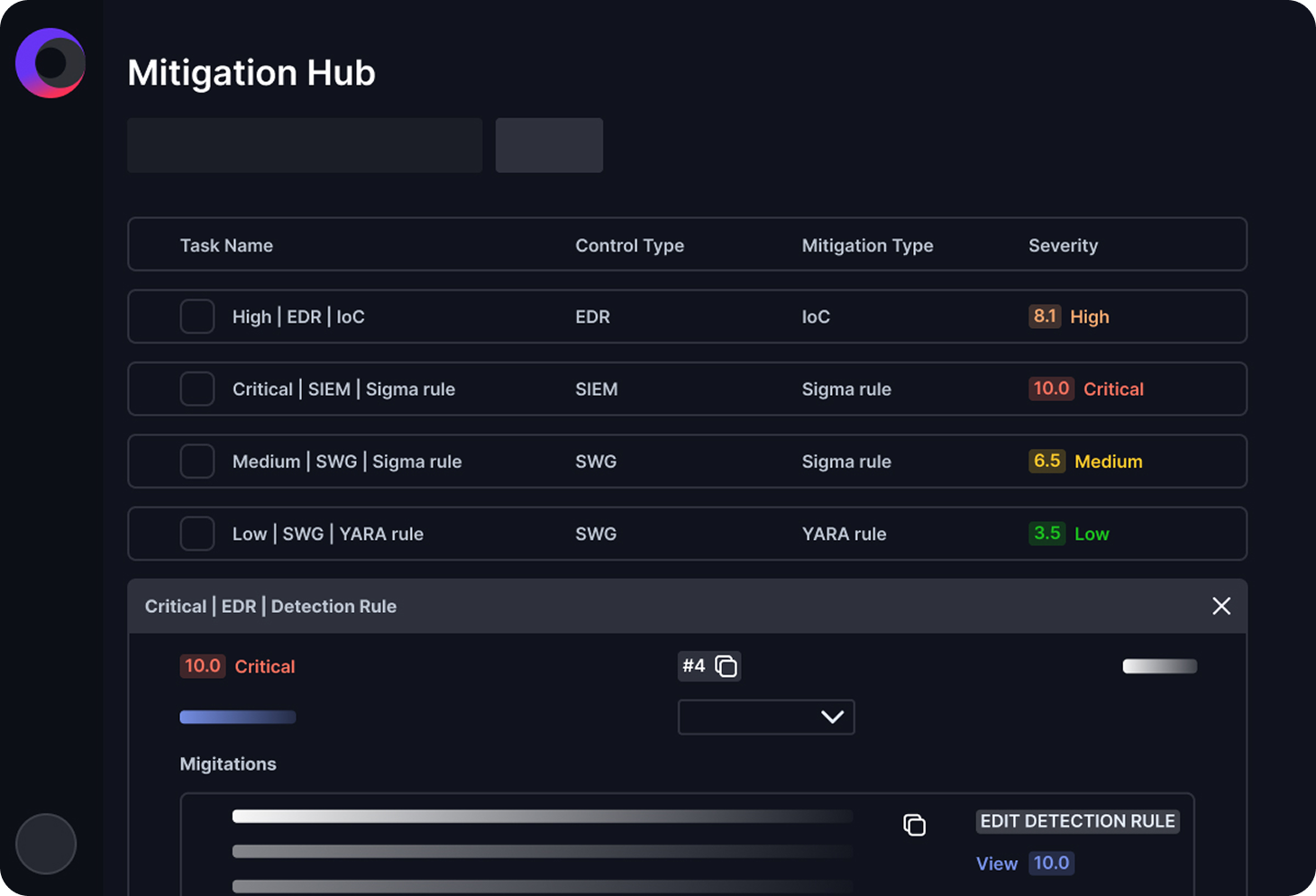
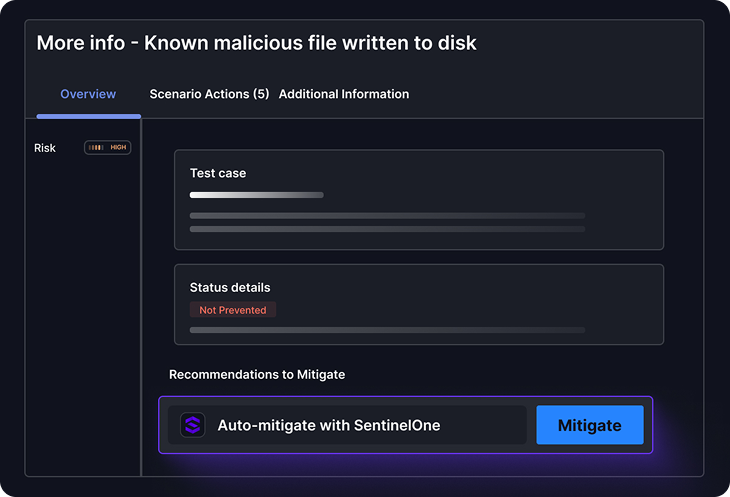
- Automatic deployment of behavioral detection rules and IoCs to integrated controls
Note: Some advanced features may require specific integrations or platform versions.
How does Cymulate Detection Engineering help with MITRE ATT&CK coverage?
Cymulate provides a dynamic MITRE ATT&CK heatmap to baseline and optimize detection coverage. Vero AI maps techniques to attack scenarios, tracks SIEM rule coverage, and highlights gaps, enabling continuous improvement as threats evolve. Note: Coverage depends on the completeness of your SIEM and detection rule set.
Features & Capabilities
What measurable results have Cymulate customers achieved with Detection Engineering?
Customers have reported:
- 81% improvement in security risk score in four months (Transportation customer)
- 60% increase in SecOps efficiency (Finance customer)
- 50% improvement in detection coverage (average of Cymulate customers)
Note: Results may vary depending on organizational maturity and integration depth.
What challenges do security teams face with detection engineering?
Key challenges include:
- 49% of security teams report difficulties validating custom detections (Source: Anvilogic)
- 18% of SIEM rules are broken and will never fire due to data source issues (Source: CardinalOps)
- 81% of MITRE ATT&CK techniques are not covered by the average SIEM (Source: CardinalOps)
Note: These challenges highlight the need for continuous validation and improvement.
How does Cymulate automate and simplify detection engineering?
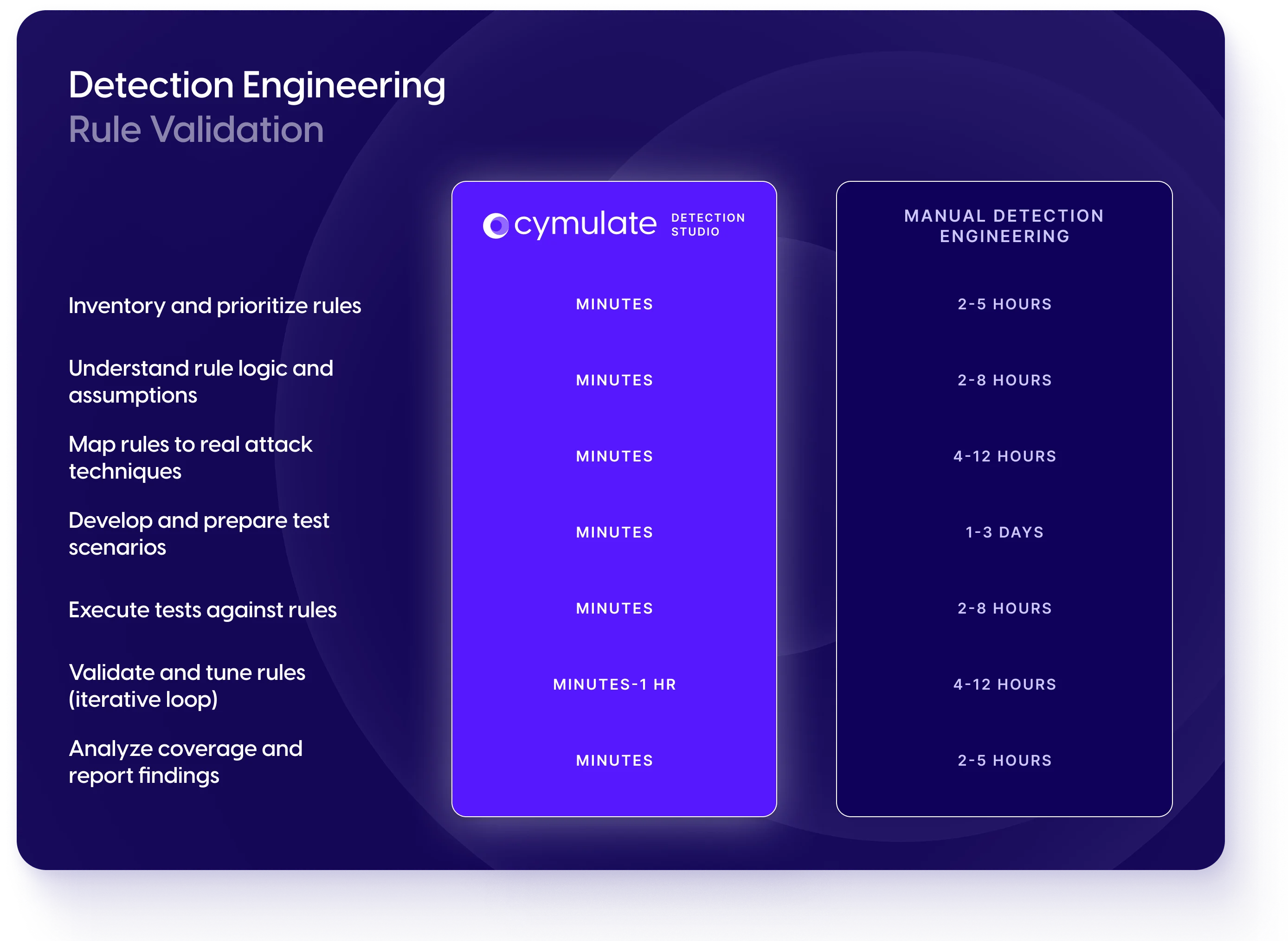
Cymulate automates resource-intensive tasks by combining attack simulations with AI-driven analysis, enabling security teams to build, test, and fine-tune threat detection. The platform streamlines rule creation, optimizes existing rules, and visualizes coverage across the MITRE ATT&CK framework. Note: Automation effectiveness may depend on the complexity of your environment and integrations.
What types of tools can help automate detection engineering?
Automated validation tools such as breach and attack simulation and automated red teaming enable continuous improvement. These tools provide production-safe simulations, built-in feedback loops, and can map directly to MITRE ATT&CK techniques for targeted assessment. Note: Not all tools offer the same depth of integration or coverage.
Implementation & Support
How easy is it to implement Cymulate Detection Engineering?
Cymulate is designed for rapid deployment and ease of use. It operates in agentless mode, requiring no additional hardware or complex configuration. Customers can start running simulations almost immediately and benefit from a user-friendly interface. Support is available via email and chat, and educational resources such as webinars and solution briefs are provided. Note: Some integrations may require additional setup depending on your environment.
What support and resources are available for Cymulate Detection Engineering?
Support options include email support ([email protected]), real-time chat, webinars, e-books, technical articles, and solution briefs. Technical documentation such as the Detection Engineering Guide is available for download at this link. Note: Some resources may require registration or a Cymulate account.
Integrations & Technical Requirements
What integrations does Cymulate Detection Engineering support?
Cymulate supports out-of-the-box integrations with leading SIEM, EDR, and XDR platforms. Examples include CrowdStrike Falcon LogScale, CrowdStrike Falcon Next Gen SIEM, BlackBerry Cylance OPTICS, Carbon Black EDR, and Cisco Umbrella. For a full list, visit the technology alliances and partners page. Note: Integration capabilities may vary by platform and version.
Security & Compliance
What security and compliance certifications does Cymulate hold?
Cymulate holds the following certifications:
- SOC2 Type II (security, availability, confidentiality, privacy)
- ISO 27001:2013 (Information Security Management)
- ISO 27701 (Privacy Information Management)
- ISO 27017 (Cloud Security)
- CSA STAR Level 1 (Cloud Controls Matrix compliance)
For more details, visit our Security at Cymulate page. Note: Certification scope may vary by product module.
Pricing & Plans
What is Cymulate's pricing model for Detection Engineering?
Cymulate uses a subscription-based pricing model, customized to each organization's requirements. Pricing is determined by the package selected, number of assets covered, and scenarios/vectors chosen. For a tailored quote, schedule a demo with the Cymulate team. Note: Exact pricing is not publicly listed and may vary by organization size and needs.
Use Cases & Customer Proof
What types of organizations benefit from Cymulate Detection Engineering?
Cymulate is used by organizations of all sizes and industries, including finance, healthcare, IT services, retail, manufacturing, and more. It is suitable for CISOs, SOC leaders, detection engineers, and security teams seeking to automate and scale detection engineering. For industry-specific case studies, visit our customer success page. Note: Organizations with highly specialized or legacy environments may require additional customization.
Are there customer testimonials or case studies for Cymulate Detection Engineering?
Yes. For example, Markus Flatscher, Senior Security Manager at RBI Bank, stated: “Cymulate streamlines our detection engineering validation processes, saving us hundreds of hours at scale.” The RBI case study details how RBI automated detection engineering and improved security. Note: Results are specific to each customer environment.
Competition & Comparison
How does Cymulate Detection Engineering compare to AttackIQ?
Cymulate offers a broader threat scenario library and AI-powered capabilities for workflow automation and coverage acceleration. AttackIQ focuses on automated security validation but does not provide the same depth of innovation, threat coverage, or ease of use. Choose Cymulate if you need advanced automation and threat coverage; AttackIQ may be suitable for organizations prioritizing traditional BAS workflows. Note: AttackIQ may be preferred by teams with established processes around their platform. Read more.
How does Cymulate Detection Engineering compare to Mandiant Security Validation?
Mandiant is one of the original BAS platforms but has seen little innovation in the past five years. Cymulate continually innovates with AI and automation, expanding into exposure management and detection engineering. Choose Cymulate for advanced automation and continuous improvement; Mandiant may be suitable for organizations seeking a traditional BAS approach. Note: Mandiant may offer deeper integration with other Google/Mandiant products. Read more.
How does Cymulate Detection Engineering compare to Pentera?
Pentera focuses on attack path validation but lacks the depth Cymulate provides for comprehensive exposure validation and detection engineering. Cymulate covers the full kill chain and offers advanced automation. Choose Cymulate for continuous validation and detection engineering; Pentera may be suitable for organizations focused on attack path analysis. Note: Pentera may be preferred for organizations with a primary focus on attack path validation. Read more.