Security drift is real, and in the world of detection engineering, it leads to a false sense of security driven by false negatives.
Detection rules that once worked reliably can silently fail over time due to parser changes, telemetry gaps, disabled logs, SIEM migrations and outdated logic.
In working with customers, Cymulate found that nearly 20% of existing SIEM detection rules do not fire as expected.
That is why continuous validation has become critical for modern detection engineering teams.
Cymulate Detection Studio helps automate that process by connecting SIEM detections to real attack simulations, validating detection effectiveness and continuously identifying coverage gaps before attackers do.
Cymulate Detection Studio Highlights
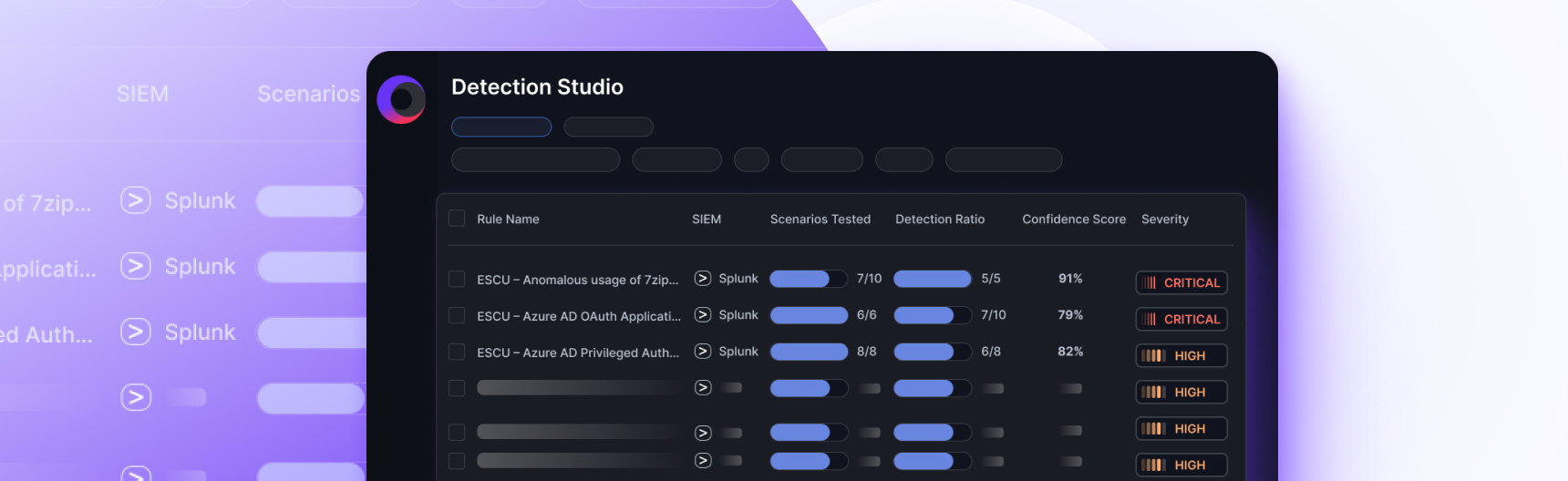
Cymulate Detection Studio automates the detection engineering lifecycle by importing SIEM rules, mapping them to attack techniques, validating them with simulations and recommending improvements.
Continuous validation helps detect security drift caused by parser changes, telemetry gaps, disabled logs, SIEM migrations and outdated rule logic.
Vero AI maps detection rules to MITRE ATT&CK techniques and Cymulate simulations, helping teams understand true coverage and identify gaps or overlaps.
Teams can reduce manual validation work and improve detection quality with evidence-based tuning, vendor-specific rule recommendations and continuous re-testing.
Why Detection Engineering Is Evolving
Within security operations, detection engineering has matured into a dedicated discipline with its own lifecycle, tooling and performance expectations. Gartner reports that 77% of organizations now have dedicated detection engineering roles within SecOps teams1. Engineers are expected to continuously improve coverage, reduce noise, validate detections against real techniques and prove effectiveness over time.
That shift is only accelerating with AI. While AI powers attackers to move at machine speed, security operations increasingly rely on AI to automate alert triage and repetitive SOC workflows.
With AI enabling triage of more alerts, security organizations are investing more heavily in proactive detection engineering functions focused on building, validating and continuously improving detection coverage.
Today’s SOC relies less on manually processing alerts and more on engineering detections that can reliably identify adversary behavior at scale.
But despite that evolution, many teams still operate with a one-way workflow. A rule is created from a threat report or framework mapping, pushed into the SIEM and implicitly trusted until proven otherwise. There is rarely a continuous feedback loop connecting detection logic to adversary behavior, telemetry quality, validation results and operational outcomes.
That gap is exactly what Cymulate Detection Studio is designed to solve.
"Cymulate Detection Studio streamlines our detection engineering validation processes with automated rule matching, saving us hundreds of hours at scale."
– Markus Flatscher, Senior Security Manager at Raiffeisen Bank International (RBI)
Cymulate Detection Studio provides security teams with a continuous detection engineering workflow: validate detections against real attack techniques, identify coverage gaps before attackers do, tune rules based on evidence and measure detection quality beyond raw alert counts.
The Current State of Detection Engineering
For many security teams, detection engineering is still largely reactive.
Rules are created from threat reports, Sigma repositories, or vendor recommendations and then pushed into production with limited ongoing validation. Coverage is often measured by the number of rules in the SIEM rather than by validated visibility into adversary techniques.
Over time, environments change. Parser updates modify field mappings, telemetry sources shift, logging pipelines fail and SIEM normalization logic evolves. Detections that once worked reliably can silently stop functioning, creating dangerous coverage gaps and false negatives.
False positives add another challenge. Analysts compensate with suppression rules, exceptions and manual tuning while confidence in detection quality gradually erodes.
That is the core problem: most detection programs lack continuous validation.
As a result, detection portfolios may appear mature in dashboards and compliance reports while failing unpredictably under real attack conditions. In many cases, attackers do not need sophisticated evasion techniques to bypass detections. Broken telemetry, outdated logic and unnoticed drift are often enough.
Treat Detections Like Software
Modern detection engineering increasingly mirrors software engineering practices. Detection logic is no longer static content living inside a SIEM. It is production security code that directly affects an organization’s ability to identify and respond to threats.
Mature teams now treat every detection as part of an engineering lifecycle. Rules are version-controlled, peer-reviewed, tested before deployment and maintained over time. Coverage is measured against frameworks like MITRE ATT&CK rather than reduced to raw rule counts. Success is defined by validated visibility into adversary behavior, not by the number of alerts on the platform.
But even organizations that have adopted detection-as-code practices often miss the most important step: continuous validation.
Writing a rule based on a threat report is not the same as proving that it works in your environment. A detection may appear syntactically correct while failing operationally due to telemetry gaps, parsing inconsistencies, enrichment failures, field mapping changes, or flawed assumptions about how the attack manifests in real systems.
The only reliable way to validate a detection is to execute the behavior it was designed to catch and observe how the security stack responds.
Continuous validation changes that model. Instead of assuming detections work until an incident proves otherwise, teams continuously simulate adversary techniques and verify outcomes directly.
Did the correct rule fire? Was the alert severity accurate? Did the detection include the right context and enrichment data? Did the event reach the SIEM at all?
This closes the feedback loop between detection logic and operational reality.
Detections stop being static rules trusted indefinitely and become measurable security controls that can be tested, improved and monitored continuously.
How a Continuous Validation Loop Works
This is what Cymulate Detection Studio automates: a continuous validation loop that connects detection logic to real-world adversary behavior and measurable outcomes.
Each stage produces actionable findings that feed directly into the next step, turning detection engineering into an iterative, evidence-driven process rather than a one-time deployment exercise.
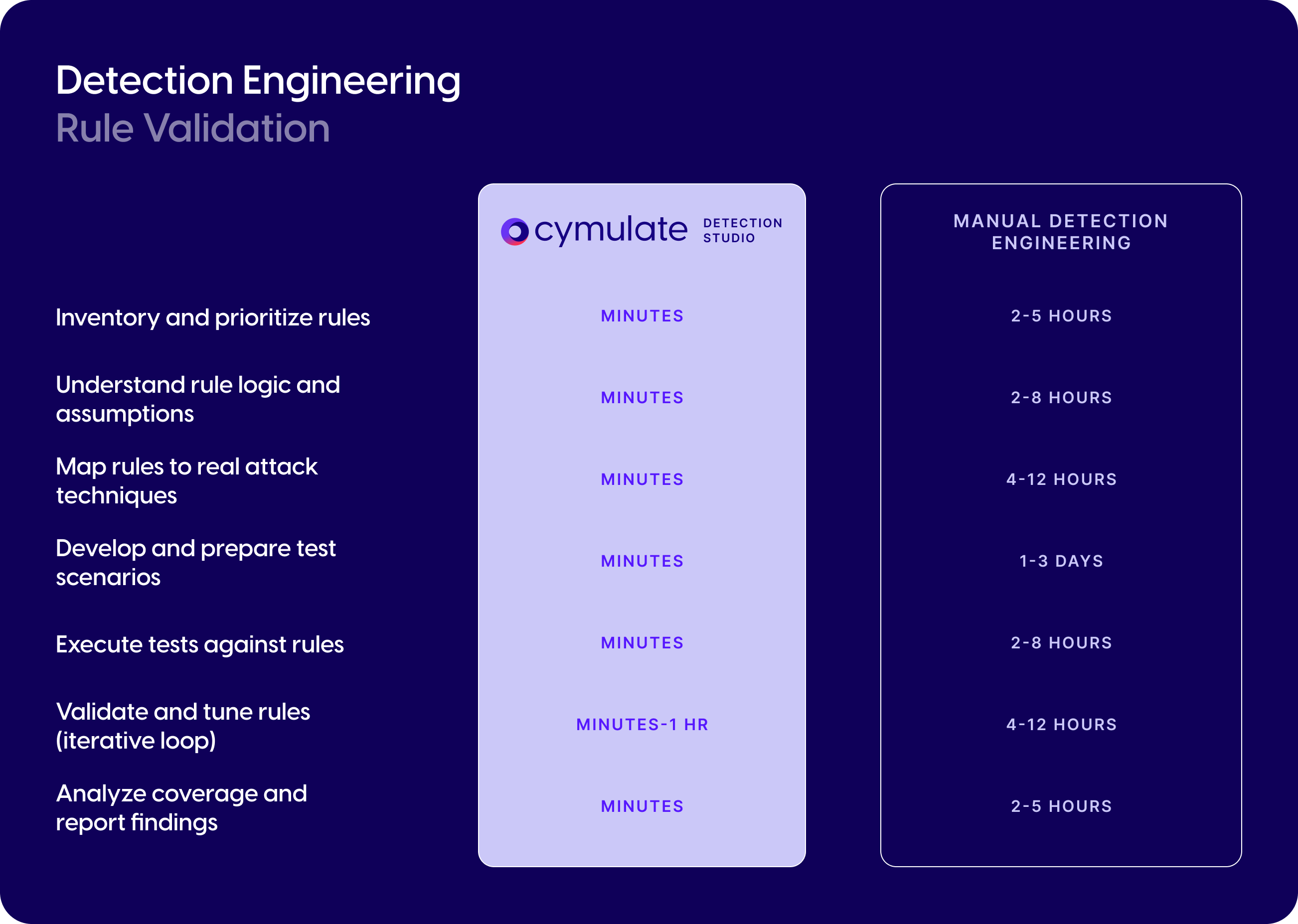
Just as importantly, automation dramatically reduces the manual effort traditionally required to validate detections. Instead of security teams manually mapping rules to ATT&CK techniques, building test scenarios, generating telemetry, reviewing logs and validating alerts across multiple tools, Cymulate Detection Studio automates the workflow end-to-end. This allows detection engineers to spend less time on repetitive validation tasks and more time improving coverage, tuning logic and responding to emerging threats.
The workflow includes:
Import Existing SIEM Rules. Cymulate Detection Studio connects directly to SIEM platforms and imports existing detection rules via native integrations, providing teams with centralized visibility into their detection portfolio.
Map Rules to Cymulate Simulations with Vero AI. Vero AI automatically correlates detection rules to relevant MITRE ATT&CK techniques and real-world adversary scenarios, helping teams understand actual coverage and identify gaps or overlaps.
Validate Detections with Real Attack Simulations. The platform safely executes attack simulations designed to test whether detections trigger correctly against realistic adversary behavior.
Collect and Analyze Detection Telemetry. Cymulate Detection Studio gathers the logs, events and telemetry generated during simulations to validate detection performance across the security stack.
Identify Triggered and Missed Detections. Teams receive clear evidence showing which rules successfully detected activity, which failed and where visibility or logic gaps may exist.
Recommend Detection Improvements. When coverage gaps are identified, Cymulate Detection Studio provides vendor-specific rule recommendations to help teams tune and improve detection logic faster.
Continuously Re-Test and Validate. Updated detections can be continuously re-validated to ensure improvements are effective and to quickly identify regressions caused by environment or telemetry changes.
Teams use Cymulate Detection Studio to validate new detections before production deployment, uncover silent failures in long-standing rules and answer the two questions that ultimately define detection effectiveness: Does this rule actually work? And what adversary behavior does it truly cover?
The Business Impact of Better Detection Engineering
Continuous validation changes detection engineering from a reactive process into a measurable security function. Instead of relying on assumptions, teams can continuously validate detection performance against real attack behavior and track improvements over time. That creates operational benefits across both the SOC and leadership levels.
Faster Detection and Response.
Detection gaps are identified during validation exercises instead of during active incidents, helping reduce mean time to detect (MTTD) and improving overall response readiness.
Lower False Positive Rates.
Detections are tuned against validated attack behavior and real telemetry, helping reduce noisy alerts and improving analyst confidence in the queue.
Measurable ATT&CK Coverage.
Coverage can be mapped directly to MITRE ATT&CK techniques, giving teams a concrete way to measure, report and trend detection effectiveness over time.
Automatic Regression Detection.
Changes to the environment, including SIEM updates, parser modifications, telemetry changes, or new log sources, can be continuously validated to quickly identify broken or degraded detections.
Reduced Analyst Toil.
Weak, noisy, or ineffective detections can be identified and improved before they overwhelm analysts, allowing SOC teams to focus on higher-confidence alerts and investigations.
Ultimately, continuous validation gives detection engineering teams something most organizations still lack: a repeatable way to prove that detections are operationally effective, continuously tested and aligned to real-world adversary behavior.
Where to Start
If your detections have not been continuously validated against real attack behavior, there is no reliable way to know whether they still work as intended. Rules may look healthy in the SIEM while silently failing because of telemetry gaps, parser changes, outdated logic, or shifts in the environment.
Most organizations assume their detections are working. Very few are actively proving it.
Cymulate Detection Studio helps teams validate detection effectiveness end to end by continuously testing rules against realistic adversary techniques and showing exactly what triggers, what fails and where coverage gaps exist.
Instead of manually testing detections one by one, security teams can automate the validation process across their existing SIEM environment and quickly identify where tuning, improvements, or additional coverage are needed.
Book a walkthrough of Cymulate Detection Studio to see how continuous validation can help your team measure, test and improve detection coverage at scale.
Cymulate Exposure Validation makes advanced security testing fast and easy. When it comes to building custom attack chains, it's all right in front of you in one place.