

Preparing for the AI Onslaught at Black Hat

AI will be everywhere at Black Hat 2026. Again.
Thankfully, the conversation is finally moving past booth signage, dashboard sparkle and “ask me anything” copilots toward something more useful: AI embedded into how security teams prioritize, investigate, remediate and prove outcomes.
As attackers use AI to move faster and scale broader, defenders need more than another chat window. They need acceleration without more headcount, more tool sprawl or more brittle automation.
At Cymulate, we see this as a turning point. AI in cybersecurity can’t stop at chat interfaces or isolated “copilots.” It needs to become operational: taking action, orchestrating workflows and continuously improving security posture based on real-world evidence. That’s why we’ve been investing in agentic cyber defense engineering -- a practical approach that uses autonomous, goal-driven agents to help security teams measure exposure, prioritize what matters and drive mitigation from findings to fixes.
And at Black Hat, we’ll be sharing more about what’s next. If you are in Las Vegas for the conference, please make sure you stop by booth 1369 or schedule a meeting.
From AI assistants to agentic cyber defense engineering
Security teams have experimented with automation for years: playbooks, scripts, SOAR and rule-based workflows. Those tools can be effective, but they often require constant tuning and assume that the environment is static. Reality is the opposite -- modern environments change daily and the threat landscape changes hourly.
Agentic systems are designed for that reality. Instead of executing a rigid sequence of steps, they pursue an objective, adapt to constraints and collaborate with people and other systems. Applied to cyber defense engineering, this means moving beyond “tell me what’s wrong” toward “help me fix what’s wrong, validate it and keep it fixed.”
We introduced this approach in our post on agentic cyber defense engineering, outlining how agentic capabilities can continuously translate security intent into measurable outcomes across environments and controls. (Read more at Introducing Agentic Cyber Defense Engineering.)
In practical terms, an agentic defense engineering model can:
- Continuously assess exposure (not just compliance)
- Turn raw findings into prioritized, context-rich tasks
- Recommend and guide remediation actions
- Validate whether mitigation works—then re-test as conditions change
That loop -- test, learn, mitigate, verify -- is where AI delivers real value.
Meet Cymulate Vero AI: purpose-built for agentic defense engineering
One of the biggest challenges with “AI everywhere” is separating signal from noise. Generic AI models can summarize, generate and chat -- but effective cyber defense requires domain-specific reasoning, knowledge of the environment and a tight feedback loop with validation.
That’s where Cymulate Vero AI comes in. In our post on Vero AI and agentic cyber defense engineering, we described how Vero AI is designed to bring agentic capabilities into security operations in a way that is grounded in the Cymulate platform data, exposure context and mitigation workflows.
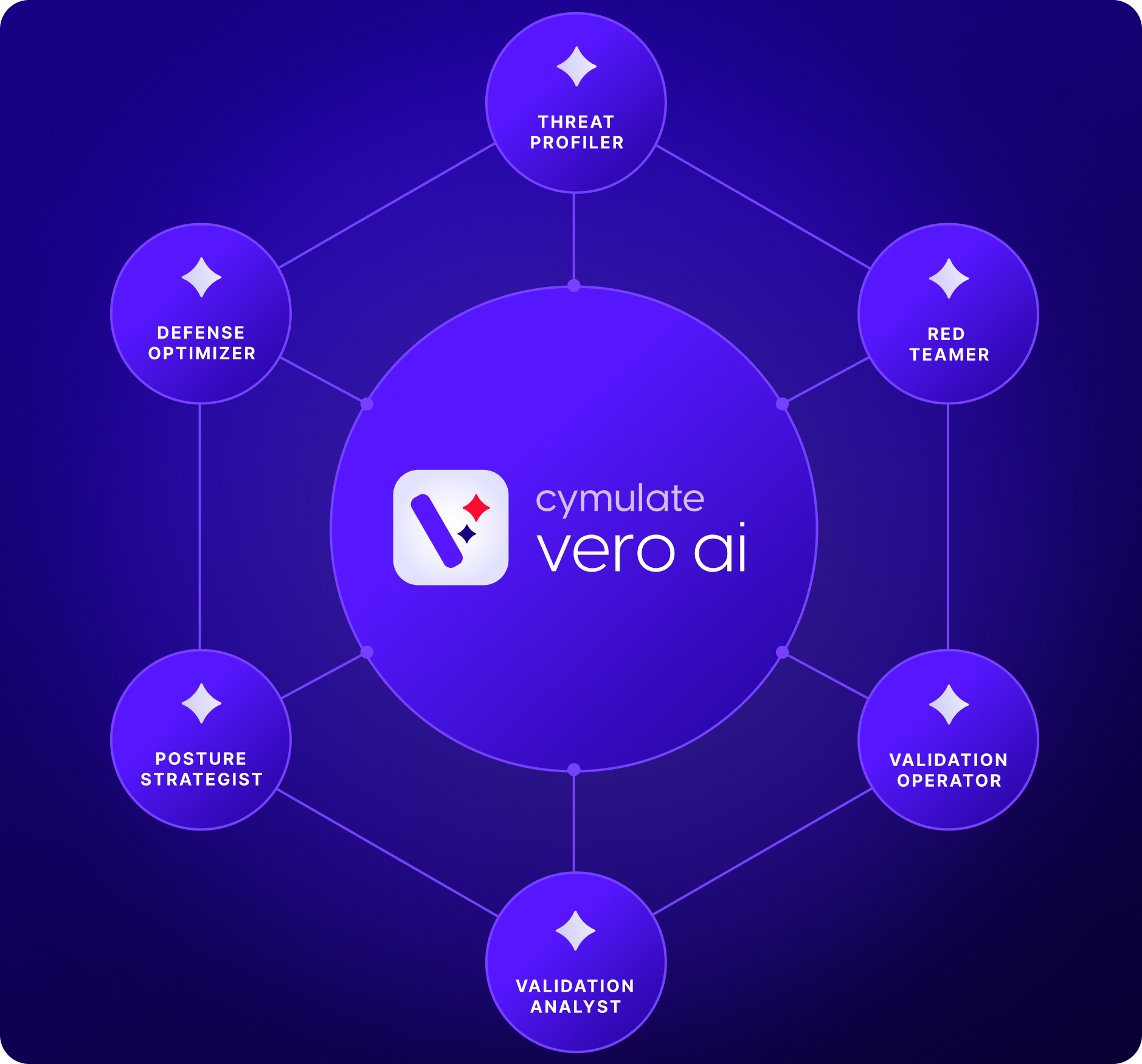
Think of Vero AI as more than a conversational layer. It’s a system that can:
- Interpret exposure data in context (assets, controls, configurations, attack paths
,and business risk) - Identify what’s actionable -- and what’s merely interesting
- Help coordinate remediation by turning insights into concrete steps
- Close the loop with validation by re-testing and measuring progress
In other words, Vero AI is designed to support the operational cycle of defense engineering—not just the presentation of information.

The missing link: turning findings into fixes
Every security leader knows the pain: assessments generate findings, findings generate tickets and tickets generate… delay. Even organizations with mature processes struggle to connect discovery to remediation at the pace the business demands.
That’s why Cymulate launched Mitigation Hub, a capability that focuses specifically on driving remediation outcomes, helping teams go from “we found issues” to “we fixed issues” and “we verified the fixes.” Our post on Mitigation Hub details how it brings structure and prioritization to the remediation process, aligning stakeholders and making it easier to track mitigation progress over time.
In an AI-enabled world, the goal isn’t to produce more findings faster. The goal is to reduce exposure faster. Mitigation Hub supports that goal by:
- Consolidating and organizing remediation work
- Helping prioritize based on impact and feasibility
- Providing a clear workflow from issue identification to resolution
- Enabling teams to verify whether mitigation actions actually reduce risk
This is where agentic capabilities become especially powerful. An agent can help identify the most impactful fixes, suggest remediation steps, coordinate stakeholders and continuously validate the results -- reducing back-and-forth and speeding up the path to measurable risk reduction.
What we’re excited to share at Black Hat
At Black Hat, Cymulate will continue the conversation about AI by focusing on what matters most: turning AI into measurable security outcomes.
We’ll be discussing how agentic cyber defense engineering can help organizations:
- Move from periodic assessments to continuous exposure validation
- Translate technical signals into prioritized, actionable work
- Accelerate mitigation across teams and tools
- Establish an evidence-based feedback loop that proves progress
And yes -- we’ll have more to announce at Black Hat about how Cymulate is expanding what’s possible with agentic capabilities across the platform.
The road ahead: outcomes over hype
AI will be everywhere at Black Hat. The organizations that get the most value won’t be the ones that simply “add AI” to their stack. They’ll be the ones who use AI to tighten the cycle between discovery, decision, action and verification.
That’s the promise of agentic cyber defense engineering -- and the direction Cymulate is building toward.
We look forward to connecting at Black Hat and sharing what’s next. Come see us at booth 1639.

Featured Resources
View More Resources
Beyond Validation. The Future is Agentic Cyber Defense Engineering.
Cymulate’s Vero AI powers agentic cyber defense engineering to prove, prioritize and adapt security.
The Truth About Your Security: Why We Built Cymulate Vero AI
Meet Cymulate Vero AI: the agentic AI system that validates threats, proves defenses and drives action.
Mitigation Hub Turns Findings into Fixes
Shiraz Arush Brinder, Senior Product ManagerAvigayil Stein, Senior Product Marketing Manager Security teams don’t need more dashboards or disconnected findings. They need a faster