

Four CTEM Fails and How to Fix Them
Long before Mythos, vulnerability management teams were already drowning in more vulnerabilities than any team could possibly manage with speed and scale.
Gartner analysts created continuous threat exposure management (CTEM) as a framework to reduce the “risk-to-fix” gap – or as a recent Gartner report plainly stated:
Your objective is to shift exposure management from counting vulnerabilities to measuring how quickly attacker-relevant exposures are identified, validated and mitigated within defined response objectives.
Gartner, Modernize Exposure Management to Counter AI-Augmented Vulnerability Discovery, Mitchell Schneider, Jonathan Nunez, September 24, 2026.
However, the old habits of vulnerability management are hard to break. Many security teams struggled to meet CTEM's new demands, ranging from exposure validation to workflows requiring collaboration across the security team.
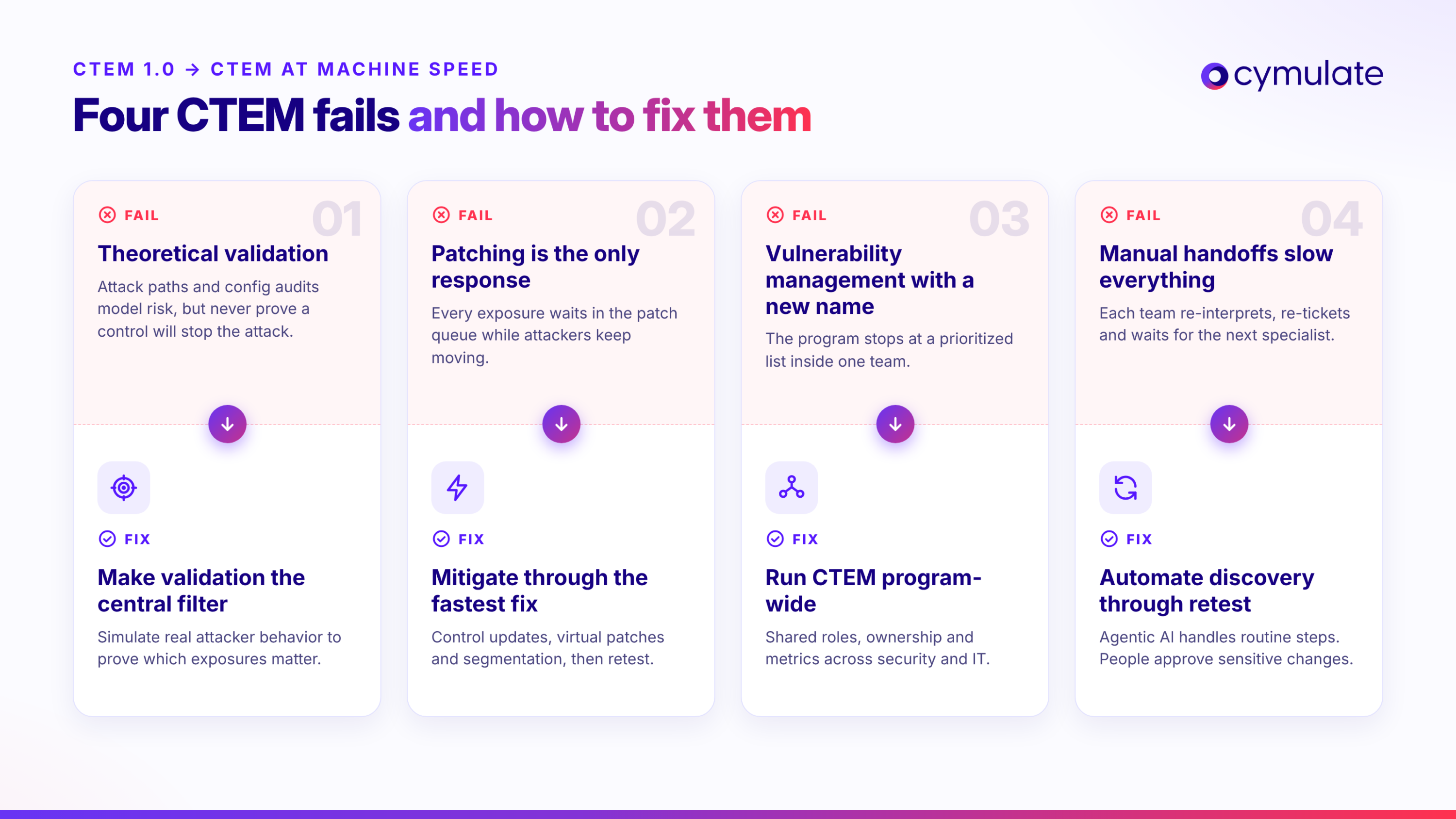
Many security team CTEM challenges comes down to four common failures:
- Too little validation
- Too much dependence on patching
- A program trapped inside vulnerability management
- Collaboration that adds more handoffs than action
In the world of Mythos and AI-powered exposure discovery, weaponization and targeted campaigns, we must quickly learn from the CTEM 1.0 mistakes and evolve security programs to prove, prioritize and adapt at machine speed.
Here is how security teams can address each of these four failures.
CTEM fail #1: Validation without evidence of security control effectiveness
Going back to the early research on CTEM, Gartner focused on the need for validation to answer the critical question: how would our controls and response cope with an attack against the exposure?i
However, many CTEM programs added theoretical validation by only considering what passive scanning can provide. For example, attack surface management (ASM) provides attack path mapping to understand how attackers could theoretically reach the exposure and the systems potentially accessed downstream of the exposure.
A theoretical attack path does not indicate whether an attacker can complete it within the organization’s environment. It does not prove whether an endpoint policy will stop execution, a network control will block movement or a security information and event management (SIEM) rule will generate an alert.
Security control configuration audits (often called automated security control assessments) provide another form of theoretical validation. The idea is that the configuration of the security control can validate which threats can and cannot be blocked or detected.
Like the theoretical attack paths of ASM, these control audits are essentially risk modeling without the proof and evidence of how the exposure can be exploited in your environment.
The fix: Make validation the central filter
Validation should separate discovered exposures from exposures that require immediate action.
Security teams should use automated attack simulation to safely reproduce the attacker behavior associated with an exposure. The test should measure whether controls prevent the attack, whether detection systems identify it and whether response processes produce the expected action.
This creates a practical set of outcomes:
- Prevented and detected: The current controls reduce immediate risk and provide response visibility
- Prevented and not detected: Prevention works, but the organization may lack evidence or warning of attempted exploitation
- Not prevented and detected: The attack can progress, but defenders have an opportunity to respond
- Not prevented and not detected: The exposure presents the highest urgency because the attack can succeed without an alert
Validation gives each team the same evidence. Vulnerability management can see exploitability. SecOps can see control performance. Security engineering can identify the failed policy or rule. Business and IT owners receive proof of why the issue requires action.
The outcome is focus: a broad set of potential exposures becomes an actionable list of gaps proven to matter in the organization’s environment.
CTEM fail #2: Patching is treated as the only response
Patching remains essential, but it rarely moves at the speed of exploitation.
A patch may require testing, a maintenance window, application owner approval and a rollback plan. Some systems cannot tolerate immediate downtime. Other exposures have no vendor patch available. Even an emergency process can leave a meaningful gap between disclosure and deployment.
A CTEM program that sends every validated exposure to the patch queue inherits the patch process' speed limits. The risk remains open while attackers continue to move.
This patch-first mindset can also miss faster ways to interrupt an attack. A control update may block the relevant technique in minutes or hours. A virtual patch may protect an exposed application while developers test the permanent fix. Segmentation, identity changes or service restrictions may remove the attacker’s path.
The fix: Mobilize through the fastest, most effective mitigation
The response should begin with one question: Which available action can reduce risk fastest?
Depending on the exposure, that action may include:
- Blocking indicators of compromise across endpoint, email, network and cloud controls
- Applying a web application firewall (WAF) rule or virtual patch
- Updating an endpoint detection and response (EDR) prevention policy
- Creating or tuning a SIEM, EDR or NDR detection rule
- Disabling an unnecessary service or restricting access
- Reducing identity privileges or revoking active sessions
- Segmenting a vulnerable asset from untrusted systems
- Deploying the permanent software patch
The team should test the proposed mitigation against the same attack used to validate the exposure. A successful retest proves that the control change reduced risk. Patching can then continue according to operational requirements without leaving the organization unprotected.
This approach does not weaken patching. It adds protection during the period when a permanent fix is unavailable or unsafe to deploy.
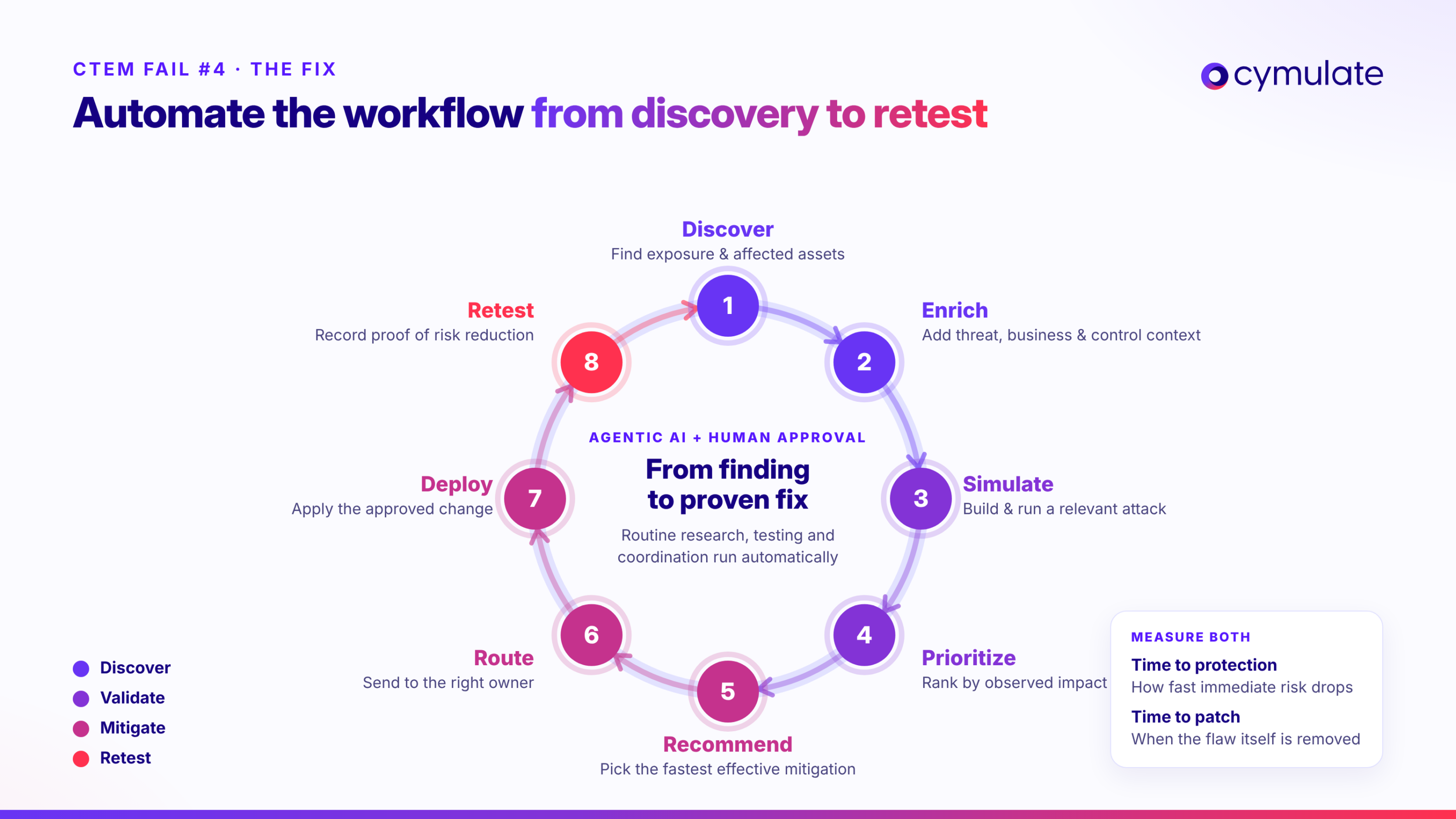
CTEM should track time to protection alongside time to patch. The first metric shows how quickly the organization reduced the immediate risk. The second shows what happens when the underlying flaw is removed.
CTEM fail #3: The program is vulnerability management with a new name
For many organizations, CTEM remains a slow evolution of vulnerability management. Teams added asset importance, business context, threat intelligence and attack-path data to improve prioritization.
That is useful progress. It does not create a complete CTEM program if the work remains within a single function.
Vulnerability management can discover and organize exposures. It usually does not own threat analysis, offensive testing, security control configuration, incident detection or production patch deployment. If the program stops with a prioritized list, the teams responsible for reducing risk still receive another queue of work.
This model also narrows the definition of exposure. Security gaps include vulnerable software, but they also include misconfigurations, excessive privileges, exposed services, missing detections and ineffective controls. A program centered on CVEs can overlook these paths.
The fix: Build CTEM as a program-wide operating model
CTEM needs defined roles across the security and IT organization:
- Vulnerability management discovers exposures and maps them to affected assets
- Cyber threat intelligence explains relevant attacker behavior and active campaigns
- Red teams and validation teams prove which exposures can be exploited
- SecOps and blue teams improve prevention, detection and response
- Security engineering changes control configurations and builds durable protections
- IT and application owners patch systems and make production changes
These teams should align on a shared outcome: reducing the business risk associated with validated exposure.
That requires common measures. A program-wide CTEM dashboard should show more than vulnerability counts and remediation age. It should track validated gaps, control failures, mitigation status, time to protection and confirmation that each fix worked.
Governance matters as well. Leaders should define which team owns each stage, how urgent findings are escalated and who can approve compensating controls. Clear ownership prevents validated exposures from sitting between teams.
CTEM fail #4: Collaboration creates slow, manual handoffs
Moving CTEM beyond vulnerability management introduces a new problem. More teams become involved, but they work in different systems with different priorities and processes.
A typical exposure may pass from a scanner to vulnerability management, then to threat intelligence for research, to a red team for testing, to SecOps for control analysis and to IT for remediation. Each handoff requires someone to interpret the previous team’s work, create a ticket and wait for the next available specialist.
The program becomes collaborative on paper while the actual response remains fragmented. Delays accumulate between discovery, validation and mitigation.
AI-powered threats make those delays more costly. A process measured in days cannot reliably respond to an attack that unfolds in hours.
The fix: Automate the workflow from discovery through retesting
The first step is to identify repeatable handoffs and turn them into automated triggers.
A newly discovered exposure can trigger the collection of threat intelligence and asset context. The workflow can map the exposure to a relevant attack scenario, launch a safe validation test and deliver the evidence to the teams responsible for action. A failed control can trigger a mitigation workflow. Once the approved change is deployed, the system can rerun the test and record the result.
Agentic AI can support tasks that previously required an analyst at each step. An agent can summarize the threat, map it to the environment, prepare a tailored assessment and recommend the security controls positioned to interrupt the attack. People review evidence and approve sensitive changes while the routine handles research, coordination and repeatable execution.
Effective automation should connect the existing systems used by each team. The goal is a continuous flow of context and evidence, not another console that requires manual monitoring.
A practical automated CTEM workflow looks like this:
- Discover an exposure and identify affected assets
- Enrich it with threat, business and control context
- Build and run a relevant attack simulation
- Prioritize the exposure using observed impact
- Recommend the fastest and most effective mitigation
- Route the action to the correct owner
- Deploy the approved change
- Retest and record proof of risk reduction
This sequence shortens the time between identifying a problem and proving that the organization has fixed it.
Move CTEM from ranked findings to validated outcomes
The first generation of CTEM improved how organizations manage exposure data. The next step is to improve how quickly they reduce risk.
That requires four changes:
- Replace theoretical prioritization with offensive validation
- Expand the response beyond patching to include mitigation, virtual patching and control optimization
- Operate CTEM across vulnerability management, threat intelligence, offensive security, SecOps, engineering and IT
- Automate the handoffs that delay validation and action
Together, these changes create a continuous cycle: discover, validate, mitigate and retest. Teams gain evidence about which exposures matter, which controls failed and which actions worked.
AI is increasing the speed and volume of threats. CTEM must give defenders the same advantage. Success should be measured by how fast the organization can prove risk, reduce it and adapt its defenses before the next attack.
i Gartner SecOps Hype Cycle 2023

Featured Resources
View More Resources
CTEM at Machine Speed
Build Exposure-Informed Defenses with AI and Automation

Continuous Threat Exposure Management
CTEM Demands Validation and Mobilization

Successful CTEM Depends on Validation
Explore how AI, automation, and proof-based validation shape effective CTEM strategies. Learn More