

Frequently Asked Questions

Understanding DHCP Spoofing & Network Security

What is DHCP spoofing and why is it a threat to network security?

DHCP spoofing is a cyberattack where a threat actor impersonates a legitimate DHCP server on a network. By responding to DHCP requests with rogue IP addresses and malicious configurations, attackers can intercept, redirect, or block network traffic, leading to data theft, business disruption, and loss of confidentiality. This attack is particularly dangerous because it can be difficult to detect, as the attacker appears to be a legitimate part of the network infrastructure.

How does a DHCP spoofing attack work?

A DHCP spoofing attack typically involves five steps: (1) The attacker sets up a rogue DHCP server on the network; (2) The victim device requests an IP address; (3) The rogue server responds with malicious network settings; (4) The victim's device routes traffic through the attacker's machine; (5) The attacker intercepts, redirects, or blocks traffic, potentially stealing credentials or causing network disruption.

What are the main risk factors that make a network vulnerable to DHCP spoofing?

Networks are especially vulnerable to DHCP spoofing if they are flat (lack segmentation or VLANs), do not have DHCP snooping enabled, have weak access controls, or lack monitoring for rogue DHCP servers. These factors make it easier for attackers to introduce rogue servers and manipulate network traffic undetected.

How can network segmentation help prevent DHCP spoofing attacks?

Network segmentation divides a network into smaller, isolated segments (often using VLANs), limiting the reach of rogue DHCP servers. By isolating DHCP services and critical infrastructure, segmentation prevents attackers from easily affecting the entire network and helps contain the impact of any attack.

What is DHCP snooping and how does it protect against spoofing?

DHCP snooping is a security feature that configures network switches to monitor DHCP traffic and restrict which ports can send DHCP responses. It blocks unauthorized (rogue) DHCP servers from issuing IP addresses, preventing attackers from manipulating network settings or launching man-in-the-middle attacks.

What are the top five ways to protect against DHCP server attacks?

The five most effective ways to protect against DHCP server attacks are: (1) Network segmentation; (2) Enabling DHCP snooping; (3) Enforcing strict access controls; (4) Using MAC address filtering; (5) Implementing intrusion detection systems to monitor DHCP traffic and alert on suspicious activity.

How does Cymulate help organizations combat DHCP spoofing?

Cymulate provides an AI-driven security validation platform that enables organizations to simulate DHCP spoofing attacks, test network segmentation, evaluate access controls, and detect weak configurations. By continuously validating defenses with real-world attack scenarios, Cymulate helps organizations proactively identify and remediate vulnerabilities before attackers can exploit them.

Can Cymulate simulate DHCP spoofing attacks to test my network's defenses?

Yes, Cymulate can simulate DHCP spoofing attacks to assess how vulnerable your network is to rogue DHCP servers. These simulations help identify gaps in DHCP protection mechanisms, such as missing DHCP snooping or insufficient network segmentation, and provide actionable insights for remediation.

How does Cymulate evaluate the effectiveness of network segmentation?

Cymulate uses simulation-based testing to assess whether network segmentation (such as VLANs) is effectively isolating critical infrastructure and preventing unauthorized access from rogue devices. This helps organizations ensure that segmentation strategies are working as intended to contain threats.

What types of misconfigurations can Cymulate help detect?

Cymulate provides continuous, automated testing to identify weak configurations, misconfigurations, or overlooked security gaps. This includes misconfigured network segments, improperly configured DHCP snooping, or missing access controls that attackers could exploit.

How does continuous validation with Cymulate improve network security?

Continuous validation with Cymulate ensures that security measures remain aligned with the latest threat landscape. Each simulation provides opportunities to refine defenses, making networks more resilient to both known and emerging cyber threats.

What is the Cymulate Exposure Validation Platform?

The Cymulate Exposure Validation Platform is an AI-driven solution that enables organizations to simulate real-world cyberattacks, including DHCP spoofing, to assess and strengthen their security posture. It provides actionable insights into vulnerabilities and helps prioritize remediation efforts.

How does Cymulate help with proactive defense improvement?

Cymulate's continuous validation approach allows organizations to regularly test and improve their defenses, ensuring they stay ahead of evolving threats. Each simulation highlights areas for improvement, enabling security teams to adapt quickly and effectively.

What are the key takeaways for preventing DHCP spoofing?

Key takeaways include implementing network segmentation, enabling DHCP snooping, enforcing access controls, monitoring for rogue DHCP servers, and using platforms like Cymulate for continuous validation. These measures collectively reduce the risk and impact of DHCP spoofing attacks.

How does Cymulate support security teams in identifying and remediating vulnerabilities?

Cymulate empowers security teams by simulating real-world attacks, identifying vulnerabilities, and providing actionable recommendations for remediation. This proactive approach helps teams address security gaps before they can be exploited by attackers.

What customer feedback highlights Cymulate's ease of use?

Customers consistently praise Cymulate for its intuitive interface and ease of use. For example, Raphael Ferreira, Cybersecurity Manager, stated, "Cymulate is easy to implement and use—all you need to do is click a few buttons, and you receive a lot of practical insights into how you can improve your security posture." More testimonials are available on the Cymulate customers page.

How quickly can Cymulate be implemented in an organization?

Cymulate is designed for rapid deployment, operating in agentless mode with no need for additional hardware or complex configurations. Customers can start running simulations almost immediately after deployment, maximizing value with minimal setup.

What support resources does Cymulate offer to new users?

Cymulate provides comprehensive support, including email and chat support, a knowledge base with technical articles and videos, webinars, e-books, and an AI chatbot for quick answers and guidance. These resources help users maximize the platform's effectiveness from day one.

What is Cymulate's pricing model?

Cymulate operates on a subscription-based pricing model tailored to each organization's needs. Pricing depends on the chosen package, number of assets, and scenarios selected for testing. For a personalized quote, organizations can schedule a demo with Cymulate's team.

Features & Capabilities

What are the key features of Cymulate's platform?

Cymulate's platform offers continuous threat validation, unified exposure management, attack path discovery, automated mitigation, AI-powered optimization, complete kill chain coverage, an extensive threat library, and an intuitive interface. These features help organizations proactively identify and remediate vulnerabilities across their IT environments.

Does Cymulate integrate with other security technologies?

Yes, Cymulate integrates with a wide range of security technologies, including Akamai Guardicore, AWS GuardDuty, BlackBerry Cylance OPTICS, Carbon Black EDR, Check Point CloudGuard, Cisco Secure Endpoint, CrowdStrike Falcon, Wiz, SentinelOne, and more. For a complete list, visit the Cymulate Partnerships and Integrations page.

What security and compliance certifications does Cymulate hold?

Cymulate holds several key certifications, including SOC2 Type II, ISO 27001:2013, ISO 27701, ISO 27017, and CSA STAR Level 1. These certifications demonstrate Cymulate's commitment to industry-leading security and compliance standards. More details are available on the Security at Cymulate page.

How does Cymulate ensure data security and privacy?

Cymulate ensures data security through encryption for data in transit (TLS 1.2+) and at rest (AES-256), secure AWS-hosted data centers, a tested disaster recovery plan, and compliance with GDPR. The platform also includes mandatory 2FA, RBAC, IP address restrictions, and continuous vulnerability scanning.

What types of organizations and roles benefit most from Cymulate?

Cymulate is designed for CISOs, security leaders, SecOps teams, red teams, and vulnerability management teams in organizations of all sizes and industries, including finance, healthcare, retail, media, transportation, and manufacturing. The platform is tailored to address the unique needs of each role and industry.

How does Cymulate compare to other security validation platforms?

Cymulate stands out with its unified platform that combines Breach and Attack Simulation (BAS), Continuous Automated Red Teaming (CART), and Exposure Analytics. It offers continuous, automated testing, AI-powered insights, and an extensive threat library, providing measurable improvements in threat resilience and operational efficiency. For more, see Cymulate vs. Competitors.

What measurable outcomes have customers achieved with Cymulate?

Customers have reported outcomes such as a 52% reduction in critical exposures, a 60% increase in team efficiency, and an 81% reduction in cyber risk within four months. Case studies, such as Hertz Israel's success, are available on the Cymulate customers page.

What are some common pain points Cymulate helps solve?

Cymulate addresses fragmented security tools, resource constraints, unclear risk prioritization, cloud complexity, communication barriers, inadequate threat simulation, operational inefficiencies in vulnerability management, and post-breach recovery challenges. Each solution is tailored to the needs of different security roles.

Where can I find Cymulate's blog, newsroom, and resource hub?

You can find the latest insights, research, and company news on the Cymulate blog, newsroom, and resource hub.

How can I stay updated with Cymulate's latest news and research?

Stay informed by visiting the Cymulate blog for the latest threats and research, and the newsroom for media mentions and press releases.

Where can I find events and webinars hosted by Cymulate?

Information about live events and webinars is available on the Cymulate Events & Webinars page.

What is Cymulate's mission and vision?

Cymulate's mission is to transform cybersecurity practices by enabling organizations to proactively validate their defenses, identify vulnerabilities, and optimize their security posture. The vision is to create a collaborative environment for lasting improvements in cybersecurity strategies. Learn more on the About Us page.

Where can I find case studies and customer success stories for Cymulate?

Case studies and customer success stories are available on the Cymulate customers page, showcasing real-world results across industries and use cases.

Cymulate named a Customers' Choice in 2025 Gartner® Peer Insights™
Learn More
New Case Study: Credit Union Boosts Threat Prevention & Detection with Cymulate
Learn More
New Research: Cymulate Research Labs Discovers Token Validation Flaw
Learn More
An Inside Look at the Technology Behind Cymulate
Learn More

The Role of Network Segmentation in Mitigating DHCP Spoofing Risks

By: Stacey Ornitz

Last Updated: January 1, 2026

Networks are the keystone of virtually every business, and the need for secure, reliable communication is a vital component. However, with this interconnectedness comes the constant threat of cyberattacks that can disrupt operations, steal sensitive data, or compromise an entire network without any warning. One such attack that has become increasingly prevalent is Dynamic Host Configuration Protocol (DHCP) spoofing.  

What is DHCP Spoofing? 

In order to understand what Dynamic Host Configuration Protocol (DHCP) Spoofing is, we first must define DHCP. DHCP is the network protocol responsible for automatically assigning IP addresses to devices on a network, where it then allows devices to connect seamlessly without requiring manual configuration.  

In a DHCP spoofing attack, a threat actor impersonates a legitimate DHCP server and responds to requests from devices on the network. The attacker can then assign rogue IP addresses, referred to as Man-in-the-middle (MITM), potentially directing devices to malicious websites, capturing sensitive data in the process. When the threat actor can access and take control of network traffic, they can cause significant damage in the form of business operations disruptions, loss of integrity and confidentiality as well as release highly sensitive data.  

While there are different types of IP protocol attacks, such as ARP Poisoning, which is typically easier to detect than a DHCP Spoof attack, because it’s directly modifying ARP caches. DHCP Spoofing are harder to detect because the attacker is often disguised as a legitimate DHCP server.  

How does DHCP Spoofing Work? 
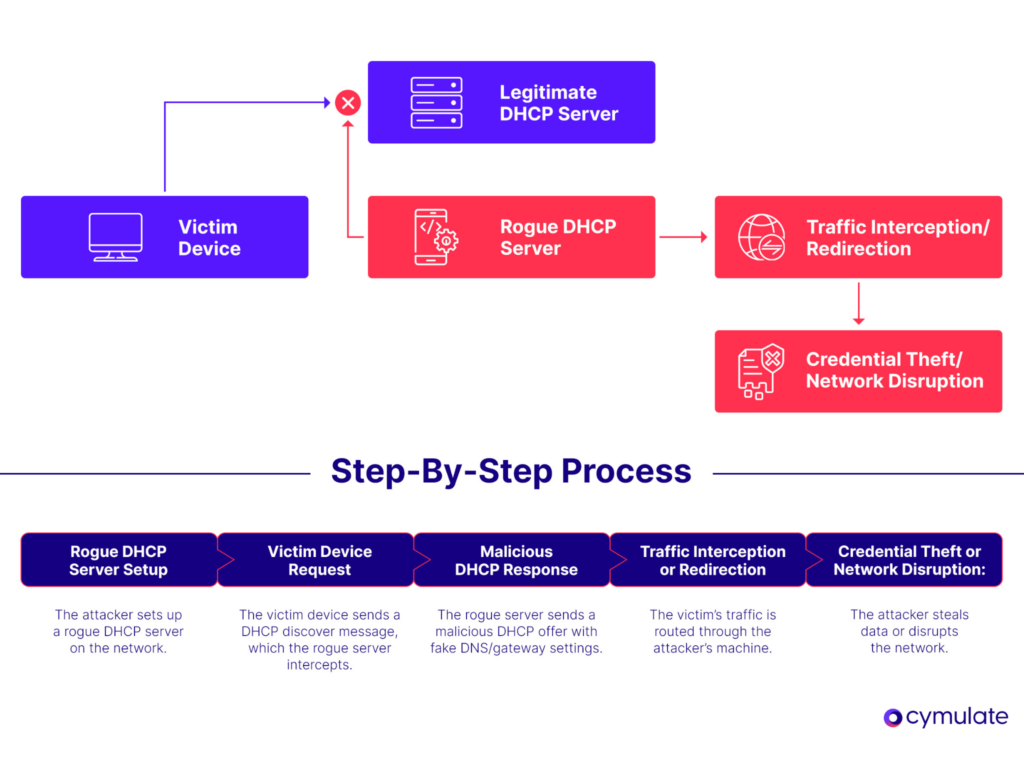
DHCP Spoofing

1. Rogue DHCP Server Setup

In this initial step, the attacker sets up a rogue DHCP server on the same network as the legitimate DHCP server. The rogue server then broadcasts DHCP offers and responses to the network devices, pretending to be the real DHCP server. The rogue server might use a tool like dhcpd or specialized spoofing software to achieve this.

2. Victim Device Request

Now that the attacker has set up a rogue DHCP server, the attacker’s server is able to send and respond to a DHCP discover message. The victim will see this message on their own device (e.g., a computer, smartphone, tablet, etc.), where it connects to the local network and broadcasts the discover message, requesting an IP address. The victim device will believe this is a legitimate request from the DHCP server. 

3. Malicious DHCP Response

The third step involves how the attacker wants to direct the victim to malicious services, or ensure traffic is sent through their device to facilitate MITM attacks. This happens by the rogue DHCP server mentioned in step one sending a malicious DHCP offer to the victim’s device, offering an IP address and potentially other critical network settings, like DNS and gateway.  
The malicious DHCP response contains harmful configurations like fake DNS servers to redirect traffic to an attacker-controlled site or a fake gateway, redirecting all traffic through the attacker’s machine.  

4. Traffic Interception or Redirection

In the fourth step the victim’s device accepts the attacker’s malicious DHCP offer, configuring itself with the attacker’s provided IP address, gateway and DNS settings. The device is now ready to send its traffic through the attacker’s machine, or the rogue gateway.  
On the attacker’s side, they can either MITM and intercept and potentially alter the victim’s traffic as it passes through the attacker’s device or redirect the victim to malicious websites or block access to certain services. Either way, the attacker gains the ability to monitor, alter or block network traffic, allowing them to further exploit their victim’s information. 

5. Credential Theft or Network Disruption

In the fifth and final step, if the attacker has setup malicious services, such as fake websites, then they can capture user credentials, credit card details and sensitive data as the victim interacts with the fake website. In some instances, the attacker may cause network disruptions by sending incorrect IP configurations, denying network access or causing denial of service (DoS) by interfering with the DHCP process.  

Is a Network Vulnerable to DHCP Spoofing? 

Most any network is susceptible to being attacked in some way and DHCP Spoofing presents its key risk factors that increase that likelihood: 

  • Flat networks (without segmentation or VLANs): In flat networks where all devices are on the same broadcast domain, there are no barriers to prevent rogue DHCP servers from responding to DHCP requests. Without segmentation or VLANs to isolate sensitive devices or network areas, an attacker can easily introduce a rogue server into a network.  
  • Lack of DHCP snooping configurations: DHCP snooping is a security feature that helps prevent unauthorized DHCP servers from operating on networks and without it enabled, network switches have no way to differentiate between legitimate and rogue DHCP servers. 
  • Weak access control to network infrastructure: If an attacker can physically or remotely access a network device, then they can likely configure a rogue DHCP server or manipulate network settings. Weak access control policies on network devices increase the chances of an attacker gaining unauthorized access to devices. 
  • No monitoring for rogue DHCP servers: Without regular monitoring, unauthorized DHCP servers can operate undetected. Implementing tools that detect suspicious DHCP traffic or rogue servers is critical in order to mitigate any threat quickly.  

5 Ways to Protect Against DHCP Server Attacks 

Mitigating DHCP spoofing requires a combination of proactive security measures to ensure the integrity and reliability of network services. 

  1. Network segmentation: Implementing network segmentation by isolating DHCP services into different VLANs helps contain the impact of any potential attack and prevents attackers from easily affecting the entire network, allowing for tighter control over where the DHCP services are available. 
  2. DHCP Snooping: This method is a security feature that configures network switches to monitor DHCP traffic and restrict which ports can send DHCP responses, while blocking rogue DHCP servers from issuing IP addresses, preventing attackers from manipulating network setting or launching MITM attacks. 
  3. Access control: Access control should be enforced by restricting physical and network access to authorized users and devices only. This method prevents attackers from physically connecting unauthorized devices to the network and impersonating a legitimate DHCP server. 
  4. MAC address filtering: Can be used to ensure that only known and authorized devices can request DHCP leases. This method helps avoid unauthorized devices attempting to access DHCP services, making it harder for attackers to spoof legitimate clients. 
  5. Intrusion detection: The intrusion detection system (IDS) helps to monitor DHCP traffic and identify unusual or malicious behavior; while setting up alerts allow administrators to quickly detect and respond to any spoofing attempts. This provides real-time monitoring and early detection of potential attacks. 

How Cymulate Can Help Combat DHCP Spoofing

Cymulate offers a powerful, AI-driven security validation platform that assists organizations in continuously assessing and strengthening their defenses against various cyber threats, including DHCP spoofing and other network-based attacks. With our capabilities, we enable security teams to proactively test the effectiveness of their network defenses through simulation-based attack scenarios that replicate real-world threats, offering valuable insights into potential vulnerabilities.  

Through the Cymulate Exposure Validation Platform, organization’s security teams can: 

  • Simulate DHCP Spoofing Attacks: Cymulate can test how vulnerable the network is to rogue DHCP servers by simulating various attack scenarios. This helps identify gaps in DHCP protection mechanisms, such as lack of DHCP snooping or network segmentation
  • Test Network Segmentation: Through simulations, Cymulate can assess whether network segmentation (using VLANs) is effectively isolating critical infrastructure and preventing unauthorized access from rogue devices. 
  • Evaluate Access Controls: Cymulate can simulate how attackers might exploit weak access control policies, such as unrestricted physical access or weak MAC address filtering, providing insight into potential security gaps. 
  • Detection of Weak Configurations: Cymulate provides continuous, automated testing to identify weak configurations, misconfigurations, or overlooked security gaps that might otherwise be missed during routine audits. This includes testing for misconfigured network segments, improperly configured DHCP snooping, or missing access controls that attackers could exploit. 
  • Proactive Defense Improvement: Continuous validation ensures that security measures remain aligned with the latest threat landscape, offering ongoing opportunities for improvement. With each simulation, organizations can refine their defenses to make them more resilient to both known and emerging cyber threats. 

Book a demo today to learn more about how Cymulate can help your organization prevent a DHCP Spoofing attack.  

Key Takeaways 

As cyberattacks grow more sophisticated, protecting your network from threats like DHCP spoofing becomes critical. Network segmentation is a powerful and practical strategy that not only limits the impact of such attacks but also provides a structured framework for managing and securing your network.

By dividing your network into smaller, more manageable segments, you reduce the chances of an attacker gaining full control and ensure that, in the event of an attack, the damage remains contained. 

When combined with other security measures such as DHCP snooping, ACLs, and regular monitoring, network segmentation is a strong pillar in your defense against DHCP spoofing. It's time to consider how segmentation could elevate your network's security and shield your organization from one of the most common yet dangerous threats in today’s digital world. 

Cymulate Exposure Validation makes advanced security testing fast and easy. When it comes to building custom attack chains, it's all right in front of you in one place.
Mike Humbert, Cybersecurity Engineer
DARLING INGREDIENTS INC.
Learn More
Book a Demo