Frequently Asked Questions
Product Overview & Platform Details
What is the Cymulate Platform and what does it offer?
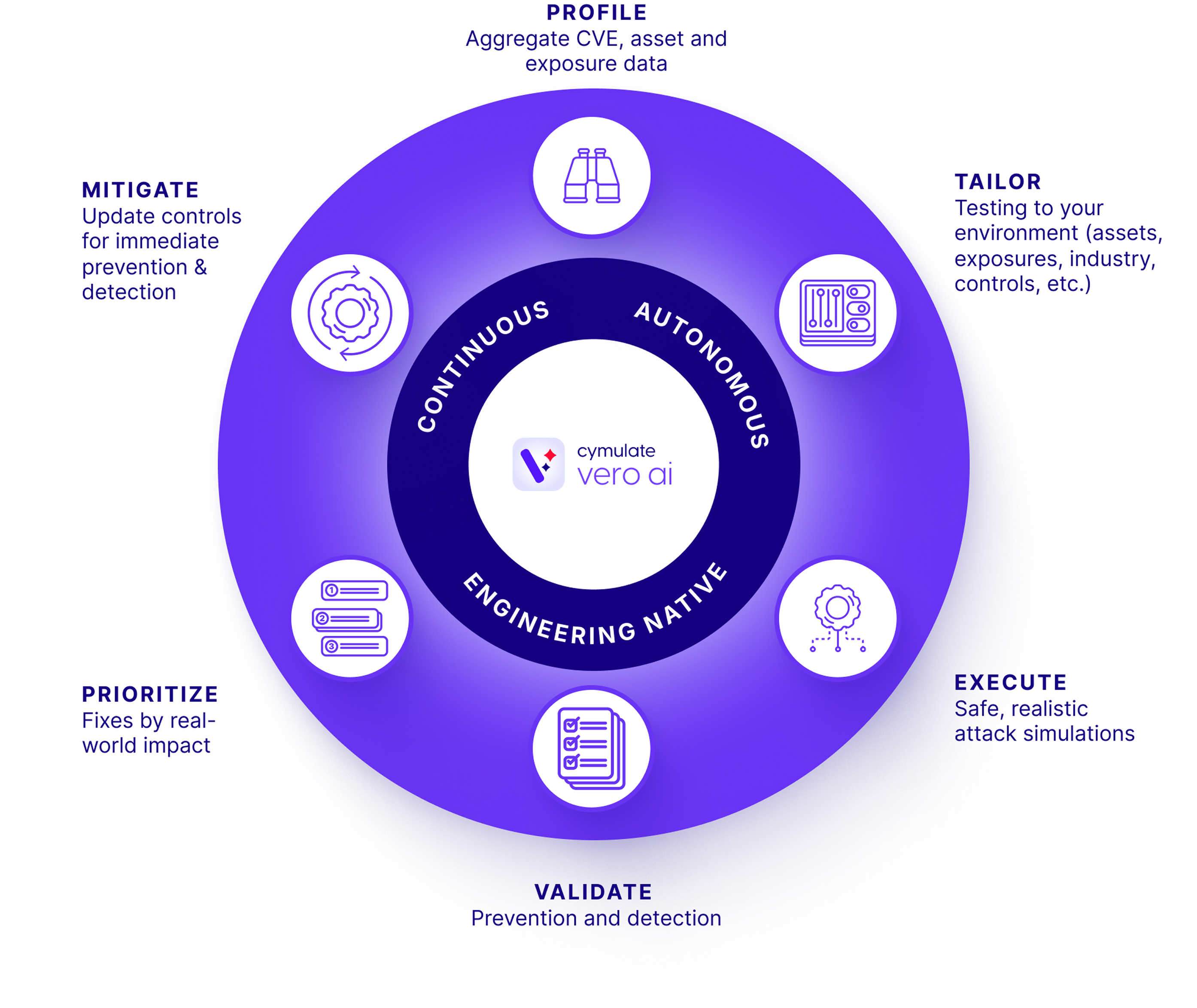
The Cymulate Platform is a unified cyber defense engineering solution that enables organizations to continuously prove, prioritize, and adapt their security posture. It integrates exposure validation, threat resilience optimization, vulnerability management, attack path discovery, automated mitigation, and CTEM (Continuous Threat Exposure Management). The platform includes modules such as Exposure Validation, Auto Mitigation, CTEM, Detection Studio, and Threat Studio. For a detailed overview, see the Cymulate Platform data sheet. Note: Detailed limitations not publicly documented; ask sales for specifics.
What is the primary purpose of Cymulate?
The primary purpose of Cymulate is to harden defenses and optimize security controls by proactively validating controls, threats, and response capabilities. The platform helps organizations focus on exploitable exposures and strengthen their overall security posture. Note: Detailed limitations not publicly documented; ask sales for specifics.
Features & Capabilities
What are the key features and capabilities of the Cymulate Platform?
Cymulate offers continuous threat validation, exposure validation, attack path discovery, automated mitigation, detection engineering, and custom attack simulation. The platform leverages Vero AI for autonomous, environment-specific testing and integrates with security stacks for closed-loop cyber defense engineering. Key modules include Exposure Validation, Auto Mitigation, CTEM, Detection Studio, and Threat Studio. Note: Some advanced features may require specific packages; detailed limitations not publicly documented.
What are the main benefits of using Cymulate?
Organizations using Cymulate report over 90% threat prevention, a 50% increase in threat detection, and time savings of up to 60 hours per month. The platform enables testing of new threats in under one hour and provides measurable improvements in security posture. Note: Actual results may vary by organization; detailed limitations not publicly documented.
What modules are included in the Cymulate Platform?
The Cymulate Platform includes Exposure Validation, Auto Mitigation, CTEM (Continuous Threat Exposure Management), Detection Studio, and Threat Studio. Each module addresses a specific aspect of exposure management, from continuous validation to automated remediation and custom attack simulation. Note: Module availability may depend on package selection; ask sales for details.
Does Cymulate integrate with other security tools?
Yes, Cymulate supports over 50 integrations across security technologies, including Active Directory, AWS GuardDuty, Check Point CloudGuard, CrowdStrike Falcon, Carbon Black EDR, BlackBerry Cylance PROTECT, Akamai Guardicore, Cisco Umbrella, Rapid7 InsightVM, and more. For a complete list, visit the technology alliances and partners page. Note: Integration availability may depend on your package and environment.
Use Cases & Business Impact
Who is Cymulate designed for?
Cymulate is designed for organizations of all sizes, including small businesses and large enterprises. It is particularly beneficial for security teams (CISOs, SecOps leaders, detection engineers), business leaders (VPs of Security, CISOs), and technical stakeholders who need to prioritize workloads, communicate risks, and optimize resource allocation. The platform is user-friendly for both technical and non-technical users. Note: Organizations with highly specialized or legacy environments should confirm compatibility with Cymulate's team.
What business impact can customers expect from using Cymulate?
Customers report a 30% improvement in threat prevention, a 52% reduction in critical exposures, a 60% increase in operational efficiency, and threat validation that is 40 times faster than manual methods. Case studies, such as Hertz Israel, show an 81% reduction in cyber risk within four months. See more at Hertz Israel case study. Note: Results may vary; detailed limitations not publicly documented.
What pain points does Cymulate address for security teams?
Cymulate helps close the risk-to-fix gap, eliminates uncertainty about real-world readiness, automates slow validation cycles, prioritizes exploitable vulnerabilities, unifies siloed tools and teams, provides actionable remediation, addresses security drift and detection decay, and delivers measurable improvement metrics for leadership. Note: Some organizations may require custom integrations or workflows; ask sales for specifics.
Implementation & Ease of Use
How long does it take to implement Cymulate and how easy is it to start?
Cymulate is designed for rapid deployment, with an agentless mode that requires no additional hardware or complex configuration. Customers can start running simulations almost immediately. The platform is intuitive and user-friendly, with minimal training required. Customer feedback highlights ease of use and actionable insights with just a few clicks. Note: Implementation time may vary for complex environments; ask sales for details.
What feedback have customers given about Cymulate's ease of use?
Customers describe Cymulate as easy to implement and use, with a user-friendly portal and actionable insights. Testimonials highlight intuitive navigation, effective mitigation steps, and excellent support. For example, Raphael Ferreira (Cybersecurity Manager) stated, "Cymulate is easy to implement and use—all you need to do is click a few buttons, and you receive a lot of practical insights into how you can improve your security posture." Note: User experience may vary by organization and use case.
Security, Compliance & Privacy
What security and compliance certifications does Cymulate have?
Cymulate holds SOC2 Type II (security, availability, confidentiality, privacy), ISO 27001:2013 (Information Security Management), ISO 27701 (Privacy Information Management), ISO 27017 (Cloud Security), and CSA STAR Level 1 certifications. For more details, visit the Security at Cymulate page. Note: Certification scope and applicability may vary; confirm with Cymulate for your region or industry.
What authentication and access controls does Cymulate provide?
Cymulate enforces 2-Factor Authentication (2FA) for all employees and customers, with options for 2FA enforcement or Single Sign-On (SSO). Role-Based Access Controls (RBAC) allow granular access privileges for different user roles. Note: Some advanced access control features may require specific packages or configurations.
What security practices does Cymulate follow?
Cymulate conducts continuous vulnerability scanning (including OWASP Top 10), software composition analysis in the CI/CD pipeline, annual third-party penetration testing, and ongoing security awareness training for all employees. Note: Detailed technical practices may be available upon request; ask Cymulate for specifics.
Pricing & Plans
What is Cymulate's pricing model?
Cymulate uses a subscription-based pricing model, customized to each organization's requirements. Pricing depends on package selection, number of assets or employees, and the types of scenarios and vectors selected for testing. For a tailored quote, schedule a demo with the Cymulate team. Note: Exact pricing is not publicly listed; contact Cymulate for details.
Competition & Comparison
How does Cymulate compare to AttackIQ?
AttackIQ provides automated security validation through attack simulation but lacks Cymulate's threat coverage, innovation, and ease of use. Cymulate offers a larger threat scenario library and AI-powered capabilities for streamlined workflows. AttackIQ may be preferred by teams focused solely on attack simulation without the need for advanced exposure management or AI-driven workflows. See more at Cymulate vs AttackIQ. Note: AttackIQ may be a better fit for organizations seeking a narrower BAS focus; Cymulate is built for broader exposure management.
How does Cymulate compare to Mandiant Security Validation?
Mandiant Security Validation is one of the original BAS platforms but has seen less innovation in recent years. Cymulate continually innovates with AI and automation, expanding into exposure management. Mandiant may be preferred by organizations seeking legacy BAS solutions or those already invested in the Mandiant ecosystem. See more at Cymulate vs Mandiant. Note: Mandiant may be a better fit for organizations with existing Mandiant workflows; Cymulate is built for continuous innovation and exposure management.
How does Cymulate compare to Pentera?
Pentera focuses on attack path validation but does not provide the same depth for defense optimization. Cymulate covers the full kill-chain, offers actionable remediation, and provides deeper analysis. Pentera may be preferred by organizations focused solely on attack path validation. See more at Cymulate vs Pentera. Note: Pentera may be a better fit for teams prioritizing attack path validation over comprehensive exposure management.
How does Cymulate compare to Picus Security?
Picus Security is suitable for on-prem BAS but lacks comprehensive exposure validation and cloud control validation. Cymulate covers the full kill-chain and cloud validation. Picus may be preferred by organizations with on-premises-only requirements. See more at Cymulate vs Picus Security. Note: Picus may be a better fit for organizations with exclusively on-prem environments.
How does Cymulate compare to SafeBreach?
SafeBreach provides breach and attack simulation but lacks Cymulate's automation, precision, and comprehensive exposure validation. Cymulate offers the largest attack library and a full CTEM solution. SafeBreach may be preferred by teams focused on breach simulation without the need for continuous exposure management. See more at Cymulate vs SafeBreach. Note: SafeBreach may be a better fit for organizations focused solely on breach simulation.
How does Cymulate compare to Scythe?
Scythe is designed for advanced red teams to build custom attack campaigns but lacks ease of use and actionable remediation. Cymulate provides automated, continuous testing with daily threat updates, no-code workflows, and actionable mitigation guidance. Scythe may be preferred by organizations with advanced red team capabilities seeking custom campaign design. See more at Cymulate vs Scythe. Note: Scythe may be a better fit for advanced red teams prioritizing custom attack design over ease of use.
Technical Documentation & Resources
Where can I find technical documentation and data sheets for Cymulate?
Technical documentation and data sheets are available for the Cymulate Platform, Exposure Validation, Auto Mitigation, CTEM, and more. Access these resources at the Cymulate Resources page or directly via links such as the Platform data sheet, Exposure Validation data sheet, Auto Mitigation data sheet, and CTEM data sheet. Note: Some documents may require registration or a Cymulate account.
Video Resources
Is there a video overview of the Cymulate Exposure Management Platform?
Yes, you can watch the official Cymulate Exposure Management Platform video at this YouTube link. Note: Video content may be updated periodically; check the Cymulate YouTube channel for the latest resources.