Frequently Asked Questions

Cyber Threat Management Fundamentals

What is cyber threat management?

Cyber threat management is the continuous process of identifying, assessing, prioritizing, and mitigating cyber threats to minimize risk exposure and prevent breaches. It integrates threat detection, intelligence, response, and validation into an ongoing lifecycle to ensure organizations can detect, understand, and neutralize threats before they cause harm. [Source]

Why is cyber threat management critical for organizations today?

Cyber threat management is essential due to the rapidly expanding digital attack surface, including cloud computing, remote work, and IoT. Modern threats are sophisticated, persistent, and can impact business continuity, cause reputational damage, and result in regulatory fines. Effective threat management directly supports operational resilience and compliance with frameworks like GDPR, HIPAA, PCI-DSS, and ISO 27001. [Source]

What are the key stages of cyber threat management?

The key stages include threat detection, threat intelligence gathering, threat analysis and prioritization, threat mitigation, response planning and incident handling, and post-incident analysis and improvement. Each stage leverages technologies like SIEMs, EDR/XDR, threat intelligence platforms, exposure management platforms, and breach and attack simulation tools. [Source]

How does cyber threat management support compliance requirements?

Cyber threat management practices are directly tied to compliance with data privacy and security regulations such as GDPR, HIPAA, PCI-DSS, and ISO 27001. These frameworks require organizations to demonstrate ongoing threat detection, incident response, and risk mitigation capabilities. [Source]

What technologies are commonly used in cyber threat management?

Common technologies include SIEMs (Security Information and Event Management), EDR/XDR (Endpoint/Extended Detection and Response), threat intelligence platforms, exposure management platforms, and breach and attack simulation (BAS) tools. These technologies help aggregate data, monitor environments, enrich threat context, and validate security controls. [Source]

What are the best practices for effective cyber threat management?

Best practices include establishing comprehensive threat visibility, integrating threat intelligence feeds, prioritizing based on business impact, automating detection and response, regularly testing incident response, and continuously validating security controls. [Source]

What are the common challenges in cyber threat management?

Common challenges include alert fatigue and resource constraints, struggles with prioritization, siloed data and tools, an evolving threat landscape, and lack of validation for security controls. Addressing these challenges requires the right technologies, integrations, and validation processes. [Source]

How does threat exposure validation enhance cyber threat management?

Threat exposure validation (TEV) actively tests an organization’s security controls in real-world scenarios to ensure they are effective against current threats. TEV closes the loop in the cyber threat management lifecycle by validating not just whether threats are detected, but whether they are truly stopped. According to the Threat Exposure Validation Impact Report 2025, 71% of security leaders agree that TEV is essential. [Source]

What measurable benefits does threat exposure validation provide?

Organizations adopting TEV report a 47% improvement in security controls for prevention and detection, 41% express confidence in handling the next significant threat, 47% see improved mean time to detection, 40% have increased threat resilience, 44% see improved hand-off to system owners, and 37% experience continuous validation and tuning of controls. [Source]

How does Cymulate support cyber threat management and exposure validation?

Cymulate provides an exposure management platform that uses automated breach and attack simulations, attack surface discovery, and threat intelligence to simulate real-world attacks, identify defense gaps, prioritize remediation, and provide continuous security posture insights. [Source]

Where can I find a glossary of cybersecurity terms?

Cymulate offers a comprehensive glossary of cybersecurity terms, acronyms, and jargon. You can access it at https://cymulate.com/cybersecurity-glossary/. The glossary is continuously updated. [Source]

What related topics should I explore to understand cyber threat management better?

Related topics include cloud security management, vulnerability prioritization, and data security posture management (DSPM). These are covered in Cymulate's glossary and resource hub. [Source]

Where can I find Cymulate's thought leadership content like blogs, reports, and glossaries?

You can access Cymulate's thought leadership and informational content through the Resource Hub, blog, Threat Exposure Validation Impact Report 2025, and the cybersecurity glossary. Visit Resource Hub and Blog for more information. [Source]

What is the role of exposure management platforms in cyber threat management?

Exposure management platforms, like Cymulate, help organizations discover and manage attack surfaces, validate security controls, and prioritize remediation efforts based on validated risk. They are a key technology for proactive cyber threat management. [Source]

How does Cymulate's platform help with continuous validation of security controls?

Cymulate's platform continuously validates security controls by running automated breach and attack simulations, providing real-time insights into the effectiveness of defenses, and enabling organizations to address gaps before they are exploited. [Source]

What is the difference between traditional cyber threat management and threat exposure validation?

Traditional cyber threat management focuses on detection and response, while threat exposure validation actively tests whether security controls are effective against real-world threats. TEV provides measurable, testable, and continuously improving security assurance. [Source]

How can organizations measure the effectiveness of their cyber threat management program?

Organizations can measure effectiveness by tracking improvements in mean time to detection, threat resilience, security control performance, and validated risk reduction. Adopting threat exposure validation platforms like Cymulate provides quantifiable metrics and continuous improvement. [Source]

What is the impact of alert fatigue on cyber threat management?

Alert fatigue occurs when security teams are overwhelmed by high volumes of alerts, leading to missed threats and slower response times. Effective cyber threat management prioritizes alerts based on business impact and leverages automation to reduce manual workload. [Source]

How does Cymulate help organizations overcome resource constraints in cyber threat management?

Cymulate automates threat validation and exposure management, reducing manual workload and enabling security teams to focus on strategic initiatives. This helps organizations overcome resource constraints and improve operational efficiency. [Source]

What are the main benefits of using Cymulate for cyber threat management?

Cymulate delivers improved security posture, operational efficiency, faster threat validation, cost savings, enhanced threat resilience, and better decision-making through actionable insights and quantifiable metrics. Customers have reported up to an 81% reduction in cyber risk within four months. [Source]

Features & Capabilities

What features does Cymulate offer for cyber threat management?

Cymulate offers continuous threat validation, a unified platform combining BAS, CART, and exposure analytics, attack path discovery, automated mitigation, AI-powered optimization, complete kill chain coverage, ease of use, and an extensive threat library with over 100,000 attack actions updated daily. [Source]

Does Cymulate integrate with other security technologies?

Yes, Cymulate integrates with a wide range of security technologies, including Akamai Guardicore, AWS GuardDuty, BlackBerry Cylance OPTICS, Carbon Black EDR, Check Point CloudGuard, Cisco Secure Endpoint, CrowdStrike Falcon, Wiz, SentinelOne, and more. For a complete list, visit the Partnerships and Integrations page. [Source]

How easy is it to implement Cymulate?

Cymulate is designed for quick and easy implementation, operating in agentless mode with no need for additional hardware or complex configurations. Customers can start running simulations almost immediately, and comprehensive support is available via email, chat, and educational resources. [Source]

What feedback have customers given about Cymulate's ease of use?

Customers consistently praise Cymulate for its intuitive, user-friendly interface and actionable insights. Testimonials highlight its ease of implementation, accessible support, and immediate value in identifying security gaps. [Source]

What security and compliance certifications does Cymulate hold?

Cymulate holds SOC2 Type II, ISO 27001:2013, ISO 27701, ISO 27017, and CSA STAR Level 1 certifications, demonstrating adherence to industry-leading security and privacy standards. [Source]

How does Cymulate ensure data security and privacy?

Cymulate ensures data security through encryption in transit (TLS 1.2+) and at rest (AES-256), secure AWS-hosted data centers, a tested disaster recovery plan, and compliance with GDPR. The platform also includes 2FA, RBAC, and IP address restrictions. [Source]

What is Cymulate's pricing model?

Cymulate operates on a subscription-based pricing model tailored to each organization's requirements. Pricing depends on the chosen package, number of assets, and scenarios selected. For a detailed quote, schedule a demo with the Cymulate team. [Source]

Who is the target audience for Cymulate?

Cymulate is designed for CISOs and security leaders, SecOps teams, red teams, and vulnerability management teams in organizations of all sizes and industries, including finance, healthcare, retail, media, transportation, and manufacturing. [Source]

What problems does Cymulate solve for security teams?

Cymulate addresses fragmented security tools, resource constraints, unclear risk prioritization, cloud complexity, communication barriers, inadequate threat simulation, operational inefficiencies in vulnerability management, and post-breach recovery challenges. [Source]

How does Cymulate compare to other cyber threat management solutions?

Cymulate stands out with its unified platform combining BAS, CART, and exposure analytics, continuous threat validation, AI-powered optimization, complete kill chain coverage, ease of use, and measurable outcomes such as a 52% reduction in critical exposures and an 81% reduction in cyber risk within four months. [Source]

What case studies demonstrate Cymulate's effectiveness?

Case studies include Hertz Israel reducing cyber risk by 81% in four months, a sustainable energy company scaling penetration testing, and Nemours Children's Health improving detection in hybrid environments. Explore more at Cymulate's Case Studies page. [Source]

How does Cymulate tailor solutions for different security roles?

Cymulate provides quantifiable metrics for CISOs, automates processes for SecOps, offers automated offensive testing for red teams, and enables efficient vulnerability prioritization for vulnerability management teams. [Source]

What is Cymulate's overarching vision and mission?

Cymulate's vision is to transform cybersecurity practices by enabling organizations to proactively validate defenses, identify vulnerabilities, and optimize their security posture. The mission is to empower teams to achieve lasting improvements in threat resilience and operational efficiency. [Source]

How does Cymulate ensure ongoing innovation?

Cymulate updates its SaaS platform every two weeks with new features such as AI-powered SIEM rule mapping and advanced exposure prioritization, ensuring customers have access to the latest capabilities. [Source]

Where can I find educational resources such as case studies, reports, and webinars from Cymulate?

Cymulate provides a Resource Hub with case studies, industry reports, webinars, e-books, and a cybersecurity glossary. Visit https://cymulate.com/resources/ for access. [Source]

Cymulate named a Customers' Choice in 2025 Gartner® Peer Insights™
Learn More
New Case Study: Credit Union Boosts Threat Prevention & Detection with Cymulate
Learn More
New Research: Cymulate Research Labs Discovers Token Validation Flaw
Learn More
An Inside Look at the Technology Behind Cymulate
Learn More

Cyber Threat Management

What is Cyber Threat Management? 

Cyber threat management is the continuous process of identifying, assessing, prioritizing and mitigating cyber threats to minimize risk exposure and prevent breaches. It's a proactive and structured approach that ensures security teams can detect, understand and neutralize threats before they cause harm. 

With the digital attack surface expanding rapidly (thanks to cloud computing, remote work, and IoT) organizations face an increasingly complex threat landscape. Cyber threat management helps organizations stay ahead by integrating threat detection, intelligence, response, and validation into an ongoing lifecycle of protection and resilience. 

Why Cyber Threat Management Is Critical 

A Growing and Evolving Threat Landscape 

Cyber threats are no longer limited to opportunistic malware or phishing. Sophisticated, persistent and targeted attacks now span supply chains, cloud services, APIs and more. The adoption of hybrid and remote work models as well as digital transformation has further increased the attack surface, making cyber threat management essential.
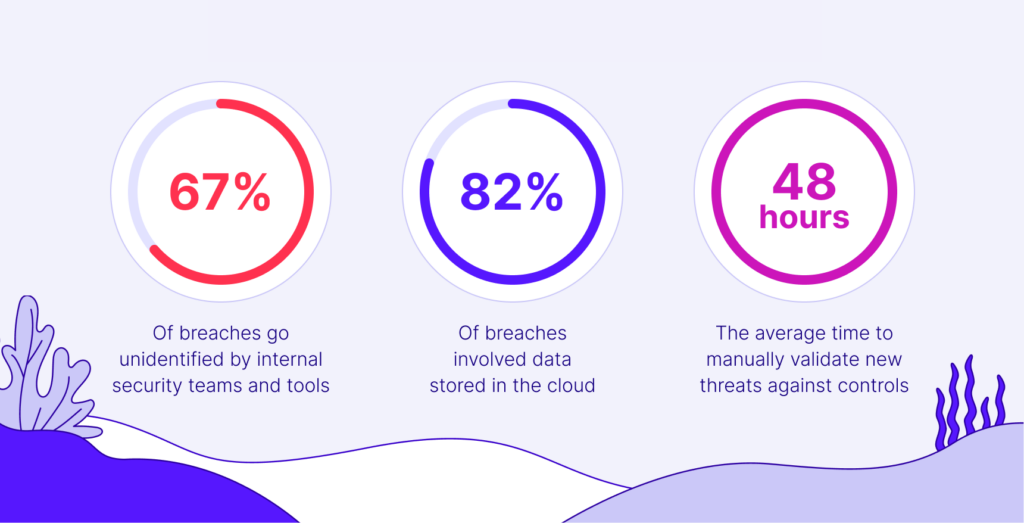
Breach Stats

Business Risk is Cyber Risk 

Cyber threats have moved from being purely IT concerns to major business risks. A successful attack can cause downtime, data loss, reputational damage, customer churn and even regulatory fines. For enterprises, effective threat management directly impacts business continuity and stakeholder trust. 

Compliance Requirements 

Cyber threat management practices are directly tied to compliance with data privacy and security regulations like GDPR, HIPAA, PCI-DSS and ISO 27001. These frameworks require organizations to demonstrate ongoing threat detection, incident response and risk mitigation capabilities. 

Operational Resilience 

Cyber threat management strengthens an organization’s operational resilience by enabling fast threat detection, coordinated response and continuous improvement. It helps teams maintain control and visibility during high-stress incidents, reducing both recovery time and damage. 

How Cyber Threat Management Works 

Cyber threat management is not a single tool or process. It’s a layered, continuous cycle that involves several critical stages and technologies. 

Key Stages 

Threat Detection: With tools like SIEMs, IDS/IPS and endpoint monitoring, threat detection helps your organization identify suspicious activity in real time. 

Threat Intelligence Gathering: Collecting data from internal logs and external sources, gathering threat intelligence will aid your organization in understanding attacker tactics, techniques and procedures (TTPs). 

Threat Analysis and Prioritization: There are so many potential sources of attacks, so making sure you prioritize them is essential. Assessing threats based on risk level, business impact and likelihood will help to determine which ones need immediate attention. 

Threat Mitigation: The process of threat mitigation should be a central tenant to any process around cyber threat management. Applying security patches, network segmentation and enhanced monitoring to neutralize threats. 

Response Planning and Incident Handling: Despite your best efforts, incidents can still happen. Your organization has to be ready to react. The best option is to create plans for relevant stakeholders to follow. Developing response playbooks, engaging incident response teams and initiating mitigation strategies. 

Post-Incident Analysis and Improvement. Learning from incidents to strengthen defenses is critical. Following an incident, update your processes to inform future strategies and minimize the damage going forward. 

Supporting Technologies 

  • SIEMs – Aggregate and analyze log data for anomalies. 
  • EDR/XDR – Monitor endpoint and extended environments for signs of compromise. 
  • Threat Intelligence Platforms – Enrich threat data with context. 
  • Exposure Management Platforms – Discover and manage attack surfaces. 
  • Breach and Attack Simulation (BAS) – Test defenses in simulated real-world attack scenarios. 

Best Practices for Effective Cyber Threat Management 

To mature your capabilities, organizations should follow these best practices: 

  1. Establish Comprehensive Threat Visibility: Map all digital assets and attack surfaces—including cloud, on-prem, mobile and IoT—to ensure no blind spots. 
  2. Integrate Threat Intelligence Feeds: Combine internal telemetry with curated external intelligence to detect threats faster and with better context. 
  3. Prioritize Based on Business Impact: Implement risk-based prioritization frameworks to focus on threats that could disrupt critical business operations. 
  4. Automate Detection and Response: Use SOAR, XDR and BAS platforms to automate routine tasks, speed up triage and reduce human error. 
  5. Test Incident Response Regularly: Conduct tabletop exercises and red/blue/purple team simulations to ensure teams are ready for real-world attacks. 
  6. Continuously Validate Security Controls: Regularly assess whether your existing defenses are working as intended. This is where threat exposure validation plays a crucial role. 

Common Challenges in Cyber Threat Management 

Even with the right tools and intentions, organizations face recurring challenges in executing cyber threat management effectively. When you’re developing your strategy, be sure to account for the following roadblocks that might come up along the way. 

Alert Fatigue and Resource Constraints

Security teams are overwhelmed by high volumes of alerts with limited personnel to investigate them. Ensure that your organization is protecting what’s vital to your core business and alert on what’s most important. It’s also important to implement the right technologies and rely on the right providers who will extend the expertise of your existing teams. 

Struggles with Prioritization

Not all threats are equal, but many teams lack a clear way to identify which ones matter most. Similar to avoiding alert fatigue, make sure your organization is focused on what matters most by identifying what are the vulnerable areas of your infrastructure, taking steps to protect them and determining what threats need to be addressed most crucially.  

Siloed Data and Tools

Disconnected security solutions lead to fragmented views and missed indicators of compromise. With the right technological integrations and resource planning, your organization can avoid these issues. 

Evolving Threat Landscape

Attackers innovate quickly, using new TTPs that evade traditional detection mechanisms. It’s never easy to stay ahead of the attackers, but by utilizing the most up-to-date technology and processes that consider new threat vectors your organization will be in the best position to minimize risk and damage. 

Lack of Validation

Many organizations don’t know if their controls work until they fail—by which point it’s too late. By leveraging a threat exposure validation solution, your organization can continuously ensure that your security controls are working as intended. 

The Next Evolution: Threat Exposure Validation 

Bridging the Gaps in Traditional Cyber Threat Management 

Traditional cyber threat management has focused on detection and response, often missing a critical question: Are our defenses actually working? 

This is where Threat Exposure Validation (TEV) comes in. Rather than relying on assumptions or passive monitoring alone, TEV actively tests an organization’s security controls in real-world scenarios to ensure they are effective against current threats. 

Increasingly, organizations are finding that TEV is critical to a holistic cybersecurity approach. In the survey of 1,000 global security leaders shared in the Threat Exposure Validation Impact Report 2025, 71% agreed that TEV is absolutely essential today.  

71%

How Threat Exposure Validation Works 

Threat exposure validation platforms like Cymulate use automated breach and attack simulations, attack surface discovery, and threat intelligence to: 

  • Simulate real-world attacks across email, web, endpoints and cloud environments. 
  • Identify where defenses succeed—and where they fail. 
  • Prioritize remediation efforts based on validated risk, not guesswork. 
  • Provide continuous, up-to-date security posture insights. 

There is ample evidence of the benefits that TEV can provide organizations. According to the Threat Exposure Validation Impact Report 2025, of organizations that adopted TEV: 

  • 47% have improved security controls for prevention and detection 
  • 41% express confidence in the security program’s ability to handle the next significant threat 
  • 47% see improved mean time to detection 
  • 40% have increased threat resilience against the latest immediate threats 
  • 44% see improved hand-off to system owners who are responsible for patching and mitigation 
  • 37% experience continuous validation and tuning of security controls 

Key benefits of exposure validation:

47%

Improved mean time to detection

40%

Increased threat resilience against the latest immediate threats

37%

Continuous validation and tuning of security controls

TEV offers a shift from reactive defense to proactive, data-driven risk management. It closes the loop in the cyber threat management lifecycle by validating not just whether threats are detected—but whether they are truly stopped. 

Get the Cyber Threat Management You Need 

Cyber threat management is no longer optional. It’s a core discipline for any organization aiming to maintain cyber resilience and operational continuity. However, its effectiveness depends not just on detection and response but on validation

By incorporating threat exposure validation, organizations can evolve from hoping their defenses work to knowing they do. Platforms like Cymulate help bridge the gap between theory and reality, enabling enterprises to build a threat management program that is measurable, testable and continuously improving

Book a Demo