

Frequently Asked Questions

Email Threats & Security Validation

What are the most common email threats organizations face today?

Organizations face a variety of email threats, including phishing, spear phishing, business email compromise (BEC), spoofing, malicious attachments, malicious URLs, credential harvesting, clone phishing, thread hijacking, HTML smuggling, and zero-day exploits in email clients. Each threat exploits different vulnerabilities in email communication and security controls. (Source: Cymulate Blog)

How does Cymulate help organizations defend against phishing attacks?

Cymulate's phishing simulation capabilities allow security teams to test and measure user susceptibility and email gateway effectiveness. By simulating real-world phishing scenarios, organizations can identify weaknesses in both technology and user awareness. (Source: Cymulate Blog)

What is business email compromise (BEC) and how does Cymulate address it?

Business email compromise (BEC) involves attackers spoofing or taking over legitimate business email accounts to manipulate internal communications, often for financial gain. Cymulate validates whether detection and workflow controls can identify and mitigate anomalous BEC activity through targeted simulations. (Source: Cymulate Blog)

How does Cymulate test for email spoofing vulnerabilities?

Cymulate’s configuration assessments help ensure that email authentication protocols such as SPF, DKIM, and DMARC are enforced correctly, reducing the risk of spoofed emails reaching users. (Source: Cymulate Blog)

What is HTML smuggling and how does Cymulate help detect it?

HTML smuggling is a technique that delivers malicious payloads via HTML and JavaScript within email attachments or links, bypassing perimeter defenses. Cymulate can simulate this attack vector to test browser isolation, SEG filtering, and endpoint controls. (Source: Cymulate Blog)

How does Cymulate validate Secure Email Gateway (SEG) effectiveness?

The Cymulate Email Gateway Validation module evaluates the effectiveness of Secure Email Gateways (SEGs) against known and emerging threats by simulating real-world attacks, including phishing, malware, BEC, and spoofing. (Source: Cymulate Blog)

What is credential harvesting and how does Cymulate help prevent it?

Credential harvesting attacks trick users into providing login credentials via fake login pages. Cymulate’s simulations help measure the ability of Secure Email Gateway (SEG) solutions and users to identify and block credential theft attempts. (Source: Cymulate Blog)

How does Cymulate help organizations address zero-day exploits in email clients?

Cymulate’s continuous testing helps identify residual risk exposure and validates layered defenses against zero-day exploits targeting unknown or unpatched vulnerabilities in email clients. (Source: Cymulate Blog)

What is clone phishing and how does Cymulate test for it?

Clone phishing involves duplicating a legitimate email and replacing links or attachments with malicious versions. Cymulate’s clone phishing tests expose gaps in both technical and human defenses by simulating these attacks. (Source: Cymulate Blog)

How does Cymulate help uncover misconfigurations in email security controls?

Cymulate continuously tests email security controls under real-world conditions, enabling SecOps and IR teams to uncover misconfigurations, identify exposure points, and harden defenses against advanced email-based attacks. (Source: Cymulate Blog)

What is thread hijacking and how does Cymulate assess defenses against it?

Thread hijacking occurs when attackers insert malicious content into ongoing email conversations. Cymulate assesses whether email security and detection systems can identify anomalous behavior in legitimate threads through targeted simulations. (Source: Cymulate Blog)

How does Cymulate evaluate the effectiveness of email gateway configurations?

Cymulate’s attack simulations test link-based threat detection, configuration drift analysis for SPF, DKIM, and DMARC, and overall SEG effectiveness, helping organizations maintain robust email security. (Source: Cymulate Blog)

What are the benefits of using Cymulate for email security validation?

Benefits include uncovering misconfigurations, identifying exposure points, validating user and technical controls, and hardening defenses against advanced email-based attacks through continuous, real-world testing. (Source: Cymulate Blog)

How does Cymulate help with configuration drift in email security protocols?

Cymulate provides configuration drift analysis for SPF, DKIM, and DMARC, ensuring that email authentication protocols remain enforced and effective over time. (Source: Cymulate Blog)

What types of simulations does Cymulate offer for email security?

Cymulate offers simulations for phishing, spear phishing, malware and payload delivery, BEC, spoofing, and more, allowing organizations to test both user behavior and technical controls. (Source: Cymulate Blog)

How does Cymulate help organizations stay ahead of evolving email threats?

Cymulate continuously updates its threat library and simulation capabilities, enabling organizations to test defenses against the latest email-based attack techniques and adapt their security posture proactively. (Source: Cymulate Blog)

Where can I find best practices for validating email security controls?

You can find best practices for validating email security controls in Cymulate's blog post "Security Validation Best Practices: Email Gateways" and related resources in the Resource Hub. (Source: Cymulate Blog)

What resources does Cymulate offer for learning about email-based threats?

Cymulate provides a whitepaper titled "Relieving the Stress from Email-based Threats," blog posts, and a Resource Hub with guides, case studies, and best practices for defending against email threats. (Source: Cymulate Whitepaper)

How can I access Cymulate's Resource Hub for more information?

You can access Cymulate's Resource Hub for insights, thought leadership, and product information at https://cymulate.com/resources/.

What are some key statistics highlighting the importance of email security?

Email remains the most significant vector for cyber attacks: 94% of organizations suffered email security incidents (Egress Software), 79% of cyber attacks started with a phishing email (Egress Software), and 69% of ransomware attacks began with an email (Barracuda Networks). (Source: Cymulate Email Gateway Validation)

Features & Capabilities

What features does Cymulate offer for email security validation?

Cymulate offers phishing and spear phishing simulations, malware and payload delivery assessments, BEC and spoofing simulations, configuration drift analysis, and continuous testing of Secure Email Gateways (SEGs). (Source: Cymulate Blog)

Does Cymulate integrate with other security technologies?

Yes, Cymulate integrates with a wide range of security technologies, including Akamai Guardicore, AWS GuardDuty, BlackBerry Cylance OPTICS, Carbon Black EDR, Check Point CloudGuard, Cisco Secure Endpoint, CrowdStrike Falcon, Wiz, SentinelOne, and more. For a complete list, visit the Partnerships and Integrations page. (Source: Cymulate Partners)

What are the key capabilities and benefits of Cymulate's platform?

Cymulate provides continuous threat validation, unified BAS and CART, attack path discovery, automated mitigation, AI-powered optimization, complete kill chain coverage, ease of use, and an extensive threat library. Benefits include up to 52% reduction in critical exposures, 60% increase in team efficiency, and 81% reduction in cyber risk within four months. (Source: Cymulate Solutions)

How easy is Cymulate to implement and use?

Cymulate is designed for quick, agentless deployment with no need for additional hardware or complex configurations. Customers can start running simulations almost immediately, and the platform is praised for its intuitive, user-friendly interface. (Source: Cymulate Demo)

What feedback have customers given about Cymulate's ease of use?

Customers consistently praise Cymulate for its ease of use, intuitive dashboard, and accessible support. Testimonials highlight its user-friendly portal, immediate value, and the ability to quickly identify and mitigate security gaps. (Source: Cymulate Customer Quotes)

Use Cases & Benefits

Who can benefit from using Cymulate?

Cymulate is designed for CISOs, security leaders, SecOps teams, red teams, and vulnerability management teams in organizations of all sizes and industries, including finance, healthcare, retail, and more. (Source: Cymulate Roles)

What problems does Cymulate solve for security teams?

Cymulate addresses fragmented security tools, resource constraints, unclear risk prioritization, cloud complexity, communication barriers, inadequate threat simulation, operational inefficiencies, and post-breach recovery challenges. (Source: Cymulate Solutions)

Are there case studies showing Cymulate's impact on email security?

Yes, Cymulate features case studies such as Hertz Israel reducing cyber risk by 81% in four months and other organizations improving detection and response capabilities. See more at the Cymulate Case Studies page.

How does Cymulate support different security personas?

Cymulate tailors solutions for CISOs (metrics and strategy alignment), SecOps (automation and efficiency), red teams (offensive testing), and vulnerability management teams (validation and prioritization). (Source: Cymulate Roles)

Security & Compliance

What security and compliance certifications does Cymulate hold?

Cymulate holds SOC2 Type II, ISO 27001:2013, ISO 27701, ISO 27017, and CSA STAR Level 1 certifications, demonstrating adherence to industry-leading security and privacy standards. (Source: Security at Cymulate)

How does Cymulate ensure data security and privacy?

Cymulate uses encryption for data in transit (TLS 1.2+) and at rest (AES-256), secure AWS-hosted data centers, a tested disaster recovery plan, and compliance with GDPR and other privacy standards. (Source: Security at Cymulate)

What application security measures does Cymulate implement?

Cymulate follows a strict Secure Development Lifecycle (SDLC), including secure code training, continuous vulnerability scanning, annual third-party penetration tests, and mandatory 2FA and RBAC. (Source: Security at Cymulate)

Pricing & Plans

What is Cymulate's pricing model?

Cymulate operates on a subscription-based pricing model tailored to each organization's requirements, considering the chosen package, number of assets, and scenarios. For a detailed quote, schedule a demo with the Cymulate team. (Source: Cymulate Demo)

Support & Implementation

What support options are available for Cymulate customers?

Cymulate offers email support, real-time chat support, a knowledge base with technical articles and videos, webinars, e-books, and an AI chatbot for quick answers and guidance. (Source: Cymulate Demo)

Where can I find news, events, and blog posts from Cymulate?

You can stay up-to-date with Cymulate through the blog (Blog), newsroom (Newsroom), and events & webinars page (Events).

Company & Vision

What is Cymulate's mission and vision?

Cymulate's mission is to transform cybersecurity practices by enabling organizations to proactively validate defenses, identify vulnerabilities, and optimize their security posture. The vision is to create a collaborative environment for lasting improvements in cybersecurity strategies. (Source: About Us)

Where can I find a glossary of cybersecurity terms?

Cymulate provides an expanding glossary of cybersecurity terms, acronyms, and jargon at https://cymulate.com/cybersecurity-glossary/.

Cymulate named a Customers' Choice in 2025 Gartner® Peer Insights™
Learn More
New Case Study: Credit Union Boosts Threat Prevention & Detection with Cymulate
Learn More
New Research: Cymulate Research Labs Discovers Token Validation Flaw
Learn More
An Inside Look at the Technology Behind Cymulate
Learn More

11 Email Threats Your Organization Needs to Know 

By: Jake O’Donnell

Last Updated: September 7, 2025

cymulate blog article

Email remains the primary entry point for cyberattacks. From nation-state actors to low-level cybercriminals, adversaries continually exploit the ubiquity and human trust inherent in email communication.  

Malicious emails can lead to operational paralysis, financial loss and reputational damage. Despite advancements in secure email gateways and filtering technologies, email threats continue to evolve in complexity and evasiveness. 

What are Email Threats? 

Email-based threats are tactics used by threat actors to infiltrate organizations via email communication channels. These threats exploit human psychology, technical misconfigurations and lapses in email security controls.  

Attackers leverage various payload delivery mechanisms, social engineering techniques and evasion tactics to bypass defenses.  

The increasing sophistication of these threats underscores the need for proactive security validation and continuous assessment of email security configurations. 

Breaking Down the Most Common Email Threats

Let’s look at 11 different email threats your organization must understand. Knowledge of these threats can help minimize their impact if your organization gets hit. We’ll also share how using Cymulate’s Exposure Validation platform can help ensure your security controls are prepared to handle such attacks. 
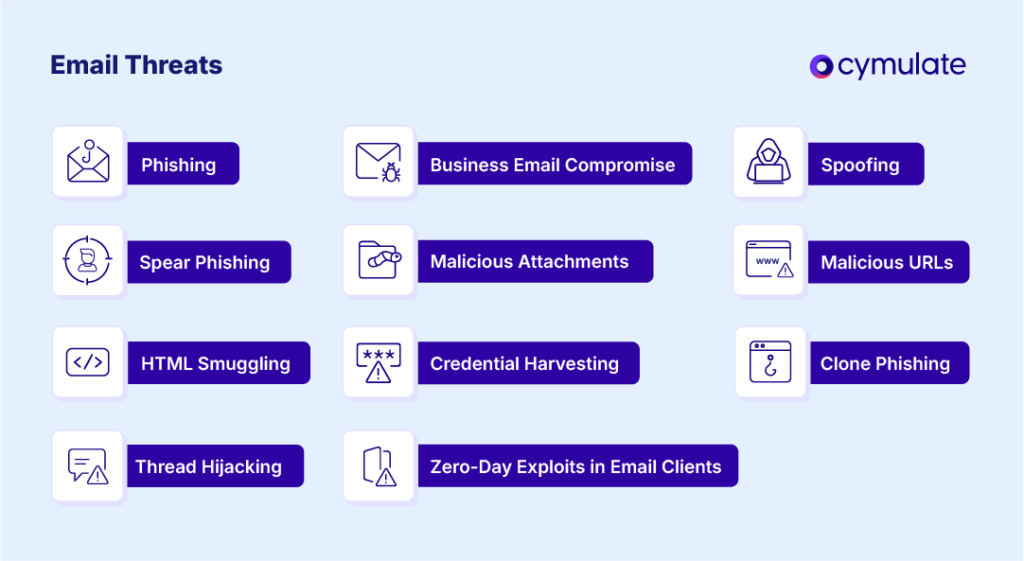
Email threats

1. Phishing 

  • Definition: A form of social engineering where attackers trick recipients into clicking malicious links or downloading attachments by masquerading as a legitimate source. 
  • Example: A fake email from a bank prompting users to verify their account by clicking on a credential-harvesting link. 
  • Challenge: Generic phishing is widespread and can overwhelm users and filtering systems alike. 
  • Control Validation: Cymulate's phishing simulation capabilities allow security teams to test and measure user susceptibility and email gateway effectiveness. 

2. Spear Phishing 

  • Definition: Spear phishing is a targeted version of phishing that uses personalized information to increase credibility. 
  • Example: An attacker poses as a company executive and sends an urgent email to the finance department requesting a wire transfer. 
  • Challenge: Spear phishing emails often bypass traditional filters due to their personalized and context-aware nature. 
  • Control Validation: Testing tailored attack scenarios with Cymulate’s BAS platform uncovers blind spots in detection logic and employee awareness. 

3. Business Email Compromise (BEC) 

  • Definition: An attack in which threat actors spoof or take over a legitimate business email account to manipulate internal communications. 
  • Example: An attacker impersonates a CEO to instruct finance to send funds to a fraudulent account. 
  • Challenge: These attacks typically do not contain malicious payloads, making them difficult for secure email gateways to detect. 
  • Control Validation: Cymulate validates whether detection and workflow controls are capable of identifying and mitigating anomalous BEC activity. 

4. Spoofing 

  • Definition: Email spoofing involves forging email headers to make messages appear as if they come from a trusted source. 
  • Example: An email appears to originate from a known partner domain but is actually sent from an attacker-controlled server. 
  • Challenge: Without proper SPF, DKIM and DMARC configurations, spoofed emails can reach the inbox. 
  • Control Validation: Cymulate’s configuration assessments help ensure email authentication protocols are enforced correctly. 

5. Malicious Attachments 

  • Definition: Emails containing attachments that, when opened, execute malicious code on the recipient’s device. 
  • Example: A disguised resume document containing embedded macros that deploy a remote access Trojan (RAT). 
  • Challenge: File obfuscation and evasion techniques often bypass antivirus and sandboxing. 
  • Control Validation: Cymulate evaluates how effectively email gateways and endpoint solutions identify and block malicious payloads. 

6. Malicious URLs 

  • Definition: Embedded links in emails that direct users to credential harvesting sites or initiate malware downloads. 
  • Example: A seemingly benign link that redirects to a phishing page mimicking a Microsoft 365 login portal. 
  • Challenge: Shortened URLs and redirect chains can bypass URL filters. 
  • Control Validation: Cymulate’s attack simulations test link-based threat detection across security controls and user behavior. 

7. Credential Harvesting 

  • Definition: Attacks designed to trick users into providing login credentials via fake login pages. 
  • Example: An attacker sends an email pretending to be IT support asking the user to reset their password on a spoofed site. 
  • Challenge: Sites are often hosted on compromised domains and designed to look legitimate. 
  • Control Validation: Cymulate’s simulations help measure the ability of Secure Email Gateway (SEG) solutions and users to identify credential theft attempts. 

8. Clone Phishing 

  • Definition: Clone phishing is a type of phishing where attackers duplicate a legitimate email previously sent and replace legitimate links or attachments with malicious versions. 
  • Example: An attacker replicates a real company newsletter but modifies the URLs to point to malicious destinations. 
  • Challenge: High familiarity makes it harder for users to detect subtle changes. 
  • Control Validation: Clone phishing tests with Cymulate expose gaps in both technical and human defenses. 

9. Thread Hijacking 

  • Definition: Attackers gain access to email threads and insert malicious content within ongoing conversations. 
  • Example: A compromised partner account sends malware within an existing project discussion thread. 
  • Challenge: The context and legitimacy of the thread make malicious activity less suspicious. 
  • Control Validation: Cymulate assesses whether email security and detection systems can identify anomalous behavior in legitimate threads. 

10. HTML Smuggling 

  • Definition: A technique that delivers malicious payloads via HTML and JavaScript within email attachments or links. 
  • Example: A .html file attachment that, when opened, reconstructs and downloads a malicious file in the browser. 
  • Challenge: It bypasses perimeter defenses by avoiding traditional download mechanisms. 
  • Control Validation: Cymulate can simulate this attack vector to test browser isolation, SEG filtering, and endpoint controls. 

11. Zero-Day Exploits in Email Clients 

  • Definition: Exploits targeting unknown or unpatched vulnerabilities in email clients. 
  • Example: An email exploiting a zero-day in a popular email reader that triggers remote code execution. 
  • Challenge: Zero-day vulnerabilities lack immediate signature-based detection. 
  • Control Validation: Cymulate’s continuous testing helps identify residual risk exposure and validates layered defenses. 

How Cymulate Helps Validate Your Security Controls Against Email-Based Threats 

Cymulate’s platform offers a comprehensive suite of tools to test, validate, and optimize defenses against email threats. The Email Gateway Validation module evaluates the effectiveness of Secure Email Gateways (SEGs) against known and emerging threats by simulating real-world attacks. The platform supports: 

  • Phishing and spear phishing simulations to test user behavior and endpoint detection. 
  • Malware and payload delivery assessments to evaluate content and attachment filtering. 
  • BEC and spoofing simulations to validate business process controls and identity protection. 
  • Configuration drift analysis for SPF, DKIM, and DMARC enforcement. 

By continuously testing controls under real-world conditions, Cymulate enables SecOps and IR teams to uncover misconfigurations, identify exposure points and harden their defenses against advanced email-based attacks. 

Cymulate Exposure Validation makes advanced security testing fast and easy. When it comes to building custom attack chains, it's all right in front of you in one place.
Mike Humbert, Cybersecurity Engineer
DARLING INGREDIENTS INC.
Learn More
Book a Demo