Frequently Asked Questions

Understanding Network Attacks & Prevention

What are the most common types of network attacks organizations face today?

The most common types of network attacks include unauthorized access attacks, malware-based attacks (such as worms, trojans, and ransomware), denial-of-service (DoS) and distributed denial-of-service (DDoS) attacks, man-in-the-middle (MITM) attacks, spoofing attacks (IP, DNS, DHCP), phishing and social engineering with network implications, advanced persistent threats (APTs), network device exploits, insider attacks and misuse, and supply chain attacks affecting network layers. Each attack type targets different vulnerabilities and requires specific prevention strategies. Source

How can organizations prevent unauthorized access attacks?

To prevent unauthorized access attacks, organizations should enforce multi-factor authentication (MFA) and strong password policies, monitor for anomalous login behavior, and implement network segmentation and least privilege access. Regularly reviewing access controls and monitoring for insider threats are also essential. Source

What are the best practices for defending against malware-based attacks?

Best practices for defending against malware-based attacks include deploying advanced endpoint detection and response (EDR) solutions, regularly patching systems, monitoring for anomalous activity, and validating lateral movement controls. Continuous validation and simulation of malware scenarios help ensure defenses remain effective. Source

How can organizations mitigate the risk of DDoS attacks?

Organizations can mitigate DDoS attacks by using DDoS protection services, implementing traffic filtering, hardening endpoints, validating resilience under load, and segmenting networks to isolate critical services. Regular testing of network resilience is also recommended. Source

What are man-in-the-middle (MITM) attacks and how can they be prevented?

Man-in-the-middle (MITM) attacks involve an attacker secretly intercepting and potentially altering communications between two parties. Prevention includes enforcing TLS encryption, securing key exchanges, using endpoint and network detection tools, and validating encryption enforcement across all communication paths. Source

How do spoofing attacks work and what defenses are effective?

Spoofing attacks involve impersonating a legitimate device or service to deceive systems or users. Defenses include validating DHCP servers, enforcing IP filtering, implementing DNSSEC, monitoring DNS traffic, and using breach and attack simulation (BAS) tools to test spoofing defenses. Source

What is the impact of phishing and social engineering on network security?

Phishing and social engineering attacks can lead to credential theft, enabling attackers to move laterally, establish persistence, and extract data from networks. Regular phishing simulations, behavioral analytics, and continuous validation of access controls are effective countermeasures. Source

How do advanced persistent threats (APTs) evade detection?

APTs use stealthy, targeted intrusions with custom malware, fileless attacks, and zero-day vulnerabilities. Their low-and-slow approach often evades standard detection tools. Continuous validation with breach and attack simulation, monitoring for command and control (C2) communications, and strict segmentation of sensitive data environments are recommended defenses. Source

What are network device exploits and how can they be prevented?

Network device exploits target vulnerabilities in routers, switches, firewalls, and other infrastructure. Prevention includes routine configuration audits, red teaming, penetration testing, and testing resilience with network security validation tools like Cymulate. Source

How do insider attacks and misuse threaten network security?

Insider attacks and misuse originate from internal actors, either intentionally or accidentally. Risks include privileged users bypassing controls, lack of monitoring on internal traffic, and inadequate segmentation. Prevention involves enforcing least privilege access, monitoring user behavior with UEBA, and regularly testing segmentation and access controls. Source

What are supply chain attacks at the network layer and how can they be mitigated?

Supply chain attacks exploit vulnerabilities in third-party software, hardware, or service providers. Mitigation strategies include maintaining a vetted list of suppliers, isolating and monitoring third-party access, and regularly validating third-party security posture. Source

Why is proactive validation essential for preventing network attacks?

Proactive validation is essential because network threats are increasingly complex and can bypass traditional perimeter defenses. Continuous validation through breach and attack simulation, penetration testing, and exposure management helps organizations detect and neutralize risks before attackers exploit them. Source

How does Cymulate's network security validation help prevent network attacks?

Cymulate's network security validation allows organizations to safely emulate real-world attacks, identify security gaps, and remediate vulnerabilities before exploitation. It simulates both north–south and east–west network traffic, testing the effectiveness of controls and policies for web gateways, firewalls, intrusion prevention/detection systems, segmentation, lateral movement, and data loss prevention. Source

What features does Cymulate's network security validation offer?

Key features include simulation of network traffic using PCAP files, network segmentation and penetration testing, validation of resilience to known exploits (such as Print Nightmare, SIGRed, Log4j, and other CVEs), and detailed dashboards and heatmaps that highlight strengths and weaknesses across the MITRE ATT&CK® framework. Source

How does Cymulate help test and improve network segmentation?

Cymulate tests internal network configuration and segmentation policies against lateral movement using various techniques and protocols. This helps organizations identify weaknesses that could allow attackers to move within the network and gain control over additional systems. Source

Can Cymulate validate resilience to known network exploits?

Yes, Cymulate can simulate specific network traffic exploits and vulnerabilities, such as Print Nightmare, SIGRed, Log4j, and other CVEs, to gauge your network's resilience against known security weaknesses. Source

What reporting and analytics does Cymulate provide for network security validation?

Cymulate provides detailed reports, findings, dashboards, and heatmaps that highlight strengths and weaknesses in the prevention and detection of different tactics and techniques across the MITRE ATT&CK® framework. Source

Features & Capabilities

What are the key capabilities of Cymulate's platform?

Cymulate's platform offers continuous threat validation, a unified platform combining Breach and Attack Simulation (BAS), Continuous Automated Red Teaming (CART), and Exposure Analytics, attack path discovery, automated mitigation, AI-powered optimization, complete kill chain coverage, ease of use, and an extensive threat library with over 100,000 attack actions updated daily. Source

How does Cymulate automate network security validation?

Cymulate automates network security validation by simulating both malicious and non-malicious network traffic, testing segmentation, lateral movement, and IDS/IPS controls, and providing actionable insights through dashboards and reports. This automation enables continuous assessment and rapid identification of vulnerabilities. Source

Does Cymulate support integration with other security tools?

Yes, Cymulate integrates with a wide range of security technologies, including Akamai Guardicore, AWS GuardDuty, BlackBerry Cylance OPTICS, Carbon Black EDR, Check Point CloudGuard, Cisco Secure Endpoint, CrowdStrike Falcon, Wiz, SentinelOne, and more. For a complete list, visit the Partnerships and Integrations page.

How easy is it to implement Cymulate and start using its features?

Cymulate is designed for quick and easy implementation, operating in agentless mode with no need for additional hardware or complex configurations. Customers can start running simulations almost immediately, and comprehensive support is available via email, chat, and educational resources. Source

What feedback have customers given about Cymulate's ease of use?

Customers consistently praise Cymulate for its intuitive, user-friendly interface and actionable insights. Testimonials highlight its ease of implementation, practical dashboards, and accessible support. For example, Raphael Ferreira, Cybersecurity Manager, stated, "Cymulate is easy to implement and use—all you need to do is click a few buttons, and you receive a lot of practical insights into how you can improve your security posture." Source

Use Cases & Benefits

Who can benefit from using Cymulate's network security validation?

Cymulate's network security validation is beneficial for CISOs, security leaders, SecOps teams, red teams, vulnerability management teams, and organizations of all sizes across industries such as finance, healthcare, retail, media, transportation, and manufacturing. Source

What problems does Cymulate solve for security teams?

Cymulate addresses challenges such as fragmented security tools, resource constraints, unclear risk prioritization, cloud complexity, communication barriers, inadequate threat simulation, operational inefficiencies in vulnerability management, and post-breach recovery challenges. Source

Are there real-world examples of organizations improving security with Cymulate?

Yes. For example, Hertz Israel reduced cyber risk by 81% in four months using Cymulate. Other case studies include a sustainable energy company scaling penetration testing, a credit union optimizing SecOps, and Nemours Children's Health improving detection in hybrid environments. Read case studies

How does Cymulate help organizations prioritize risk and exposures?

Cymulate validates exploitability and ranks exposures based on prevention and detection capabilities, business context, and threat intelligence, enabling organizations to focus on the most critical vulnerabilities. Source

What measurable outcomes have customers achieved with Cymulate?

Customers have reported a 52% reduction in critical exposures, a 60% increase in team efficiency, an 81% reduction in cyber risk within four months, and up to 60 hours per month saved in testing new threats. Source

Security & Compliance

What security and compliance certifications does Cymulate hold?

Cymulate holds SOC2 Type II, ISO 27001:2013, ISO 27701, ISO 27017, and CSA STAR Level 1 certifications, demonstrating adherence to industry-leading security and privacy standards. Source

How does Cymulate ensure data security and privacy?

Cymulate ensures data security with encryption for data in transit (TLS 1.2+) and at rest (AES-256), secure AWS-hosted data centers, a tested disaster recovery plan, and compliance with GDPR. The platform also features 2FA, RBAC, IP restrictions, and a dedicated privacy and security team. Source

What application security practices does Cymulate follow?

Cymulate follows a strict Secure Development Lifecycle (SDLC), including secure code training, continuous vulnerability scanning, and annual third-party penetration tests to ensure robust application security. Source

Resources & Support

Where can I find more resources about network attacks and prevention?

You can find more resources, including blog posts, solution briefs, e-books, and case studies, in Cymulate's Resource Hub. The blog covers topics like network attacks, lateral movement, and prevention strategies.

Does Cymulate provide educational content like blogs and webinars?

Yes, Cymulate offers a variety of educational resources, including a blog, webinars, e-books, and a glossary of cybersecurity terms. Visit the blog and Resource Hub for the latest content.

Where can I find news and updates about Cymulate?

Stay updated with Cymulate's latest news, research, and events by visiting the blog, newsroom, and events page.

How can I get support for Cymulate's platform?

Support is available via email at [email protected] and real-time chat through the chat support page. Customers also have access to a knowledge base, webinars, and e-books for self-service learning.

New: 2026 Gartner® Market Guide for Adversarial Exposure Validation
Learn More
Cymulate named a Customers' Choice in 2025 Gartner® Peer Insights™
Learn More
New Research: The Security Tradeoffs Behind AI Tooling
Learn More
An Inside Look at the Technology Behind Cymulate
Learn More

10 Types of Network Attacks: Common Threats and How to Prevent Them 

By: Jake O’Donnell

Last Updated: March 25, 2026

cymulate blog article

Network attacks have evolved far beyond simple brute-force intrusions or spam. Threat actors now employ complex, multi-vector tactics that can infiltrate even the most fortified infrastructures.  

As attack surfaces grow with cloud adoption, remote work and third-party integrations, defending the network edge has become both more critical and more complex. 

According to Akamai, 16% of organizations encountered command and control (C2) traffic in their network and 42% of overall web traffic originates from botnets. These are sobering reminders that threats come from just about anywhere. 

Understanding the most common types of network attacks—and how to detect and prevent them—is essential for security leaders, architects, and defenders across SOCs and red teams.  

Visibility alone is no longer sufficient; organizations must actively validate their defenses to stay resilient against emerging threats. Let’s look at 10 types of network attacks and what your organization can do to fight back against them. 

Understanding Today’s Most Common Network Attacks
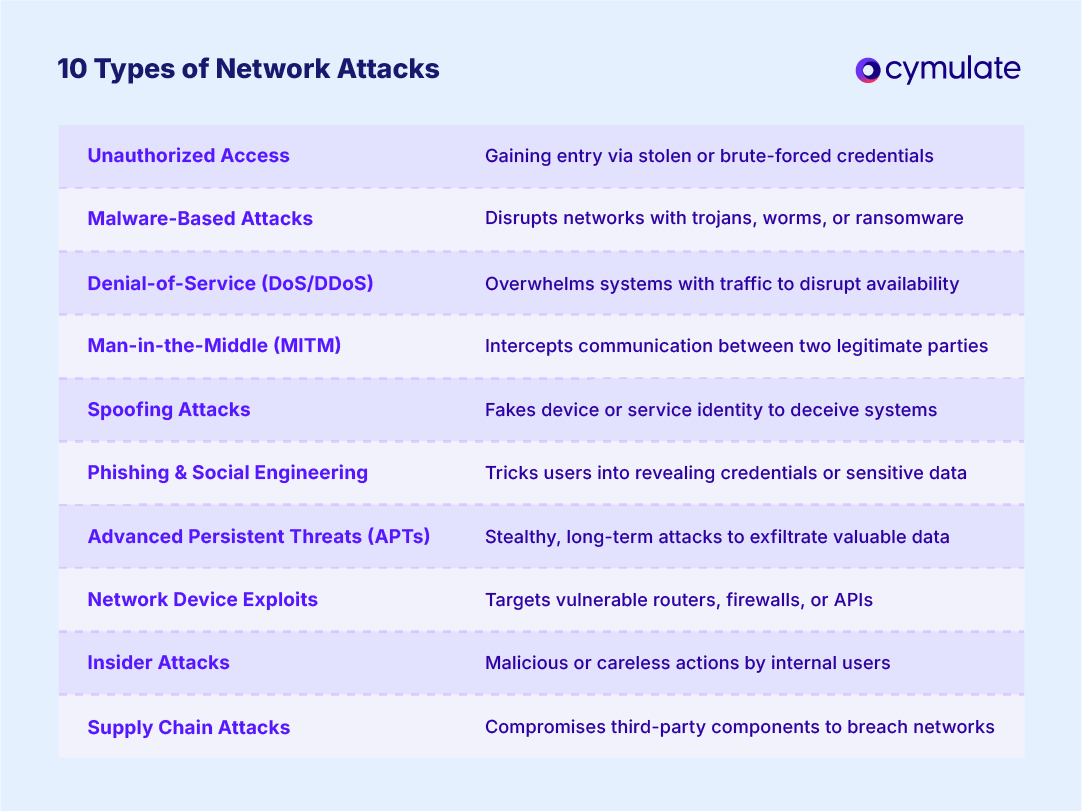
types of network attacks

1. Unauthorized Access Attacks 

These attacks aim to gain access to network systems without permission, either through stolen credentials, brute force, or malicious insiders. 

Variants: 

  • Brute-force attacks: Automated scripts try multiple password combinations to gain access. 
  • Credential stuffing: Stolen credentials from one breach are reused across multiple systems. 
  • Insider threats: Legitimate users misuse access for malicious purposes or unintentionally introduce risk. 

Prevention Tips: 

  • Enforce MFA and strong password policies 
  • Monitor for anomalous login behavior 
  • Use network segmentation and least privilege access 

cymulate blog article
Further reading
Protect Your Network from Unauthorized Access: 6 Security Controls Every CISO Needs in 2026

A breakdown of unauthorized access threats and essential controls to strengthen prevention and detection.

Read More

2. Malware-Based Attacks 

Malware disrupts or damages networks through payloads like trojans, ransomware and worms. 

Variants: 

  • Worms: Self-replicating code that spreads across networks without user action 
  • Trojans: Disguised as legitimate software to create backdoors 
  • Ransomware: Encrypts network data and spreads laterally to maximize damage 

Prevention Tips: 

  • Deploy advanced endpoint detection and response (EDR) 
  • Regularly patch systems and monitor for anomalous activity 
  • Validate lateral movement controls 

3. Denial-of-Service (DoS) and Distributed Denial-of-Service (DDoS) 

This attack floods network resources with traffic to disrupt availability and functionality. 

Targets: 

  • Web servers  
  • DNS infrastructure  
  • Firewalls  
  • API gateways 

Prevention Tips: 

  • Use DDoS protection services and traffic filtering 
  • Harden endpoints and validate resilience under load 
  • Implement network segmentation to isolate critical services 

4. Man-in-the-Middle (MITM) Attacks 

Here, an attacker secretly intercepts and potentially alters communications between two parties. 

Techniques: 

  • Packet sniffing: Captures network traffic to extract credentials or data 
  • Session hijacking: Takes control of a valid session after authentication 

Vulnerabilities: 

  • Weak encryption protocols 
  • Misconfigured VPNs 
  • Public Wi-Fi networks 

Prevention Tips: 

  • Enforce TLS encryption and secure key exchanges 
  • Use endpoint and network detection tools 
  • Validate encryption enforcement across all communication paths 

5. Spoofing Attacks 

The attacker impersonates a legitimate device or service to deceive systems or users. 

Types: 

  • IP spoofing: Sends packets with a forged IP address to bypass filters 
  • DNS spoofing: Redirects traffic to malicious domains 
  • DHCP spoofing: Distributes rogue network configurations to devices 

Prevention Tips: 

  • Validate DHCP servers and enforce IP filtering 
  • Implement DNSSEC and monitor DNS traffic 
  • Use breach and attack simulation (BAS) tools to test spoofing defenses 

cymulate blog article
Further reading
The Role of Network Segmentation in Mitigating DHCP Spoofing Risks

Discover how DHCP spoofing works and key defense strategies like network segmentation and snooping.

Read More

6. Phishing and Social Engineering with Network Implications 

Attackers deceive individuals into revealing credentials that lead to deeper network intrusions. 

Network Impact: 
Once access is gained, attackers can move laterally, establish persistence and extract data. 

Prevention Tips: 

  • Conduct regular phishing simulations 
  • Use behavioral analytics to detect abnormal access patterns 
  • Continuously validate access controls with tools like Cymulate’ network security validation 

7. Advanced Persistent Threats (APTs) 

Stealthy, targeted intrusions designed to stay hidden while gathering intelligence or exfiltrating data. 

Tactics: 

Challenges: 
Standard detection tools often miss these threats due to their low-and-slow approach. 

Prevention Tips: 

  • Employ continuous validation with breach and attack simulation 
  • Monitor for command and control (C2) communications 
  • Isolate sensitive data environments with strict segmentation 

8. Network Device Exploits 

Exploits that target vulnerabilities in routers, switches, firewalls and other infrastructure. 

Common Issues: 

  • Outdated firmware 
  • Misconfigured access rules 
  • Insecure APIs 

Prevention Tips: 

  • Conduct routine configuration audits 
  • Use red teaming and penetration testing to validate defenses 
  • Test resilience with Cymulate network security validation 

9. Insider Attacks and Misuse 

These are ttacks originating from internal actors. Sometimes these attacks happen intentionally, or they can be accidental when a user has the best of intentions, but they do something unsafe or careless. 

Risks: 

  • Privileged users bypassing controls 
  • Lack of monitoring on internal traffic 
  • Inadequate segmentation allowing lateral movement 

Prevention Tips: 

  • Enforce least privilege access 
  • Monitor user behavior with UEBA (User and Entity Behavior Analytics) 
  • Regularly test segmentation efficacy and access control enforcement 

10. Supply Chain Attacks Affecting Network Layers 

Exploitation of vulnerabilities in third-party software, hardware or service providers. Many cyberattacks and security breaches have happened through unsecured third parties. 

Entry Points: 

  • Compromised updates 
  • Embedded malware in third-party devices 
  • Insecure vendor integrations 

Prevention Tips: 

  • Maintain a vetted list of suppliers 
  • Isolate and monitor third-party access 
  • Validate third-party security posture regularly 

Proactive Validation Is Essential for Preventing Network Attacks 

As network threats grow in complexity and scale, so must an organization’s ability to preemptively detect and neutralize risk. Relying solely on perimeter defenses or periodic assessments is no longer viable. Continuous validation through breach and attack simulation, penetration testing, and exposure management is vital. 

Cymulate network security validation provides organizations with the ability to safely emulate real-world attacks, identify gaps and remediate vulnerabilities before they can be exploited.  

Cymulate delivers automated security validation to simulate malicious network traffic for both north–south traffic into and out of the network and east–west internal traffic across the network. Network security validation assessments enable you to test the effectiveness of security controls and policies associated with your:  

  • Web gateways and firewalls  
  • Intrusion prevention / detection systems  
  • Network segmentation 
  • Lateral movement  
  • Data loss prevention 

Solution features include: 

Simulate network traffic (PCAP files): Simulate both malicious and non-malicious network traffic using packet capture (PCAP) files to replay network traffic scenarios, providing valuable insights into potential weaknesses in your network infrastructure. 

Network segmentation and penetration testing: Test your internal network configuration and segmentation policies against lateral movement using various techniques and protocols to elevate privileges, evade detection, spread within a network and gain control over additional systems. 

Validate network resilience to known exploits: Simulate specific network traffic exploits and vulnerabilities like Print Nightmare, SIGRed, Log4j and other CVEs to gauge your network's resilience against known security weaknesses. 

View results dashboard and heatmap: View detailed reports, findings and dashboards that highlight strengths and weaknesses in the prevention and detection of different tactics and techniques across the MITRE ATT&CK® framework

By leveraging proactive, automated validation, security teams can turn their networks from reactive to resilient, closing doors to attackers before they knock. 

Cymulate Exposure Validation makes advanced security testing fast and easy. When it comes to building custom attack chains, it's all right in front of you in one place.
Mike Humbert, Cybersecurity Engineer
DARLING INGREDIENTS INC.
Learn More
Book a Demo