
What is Cymulate Exposure Prioritization and Remediation?
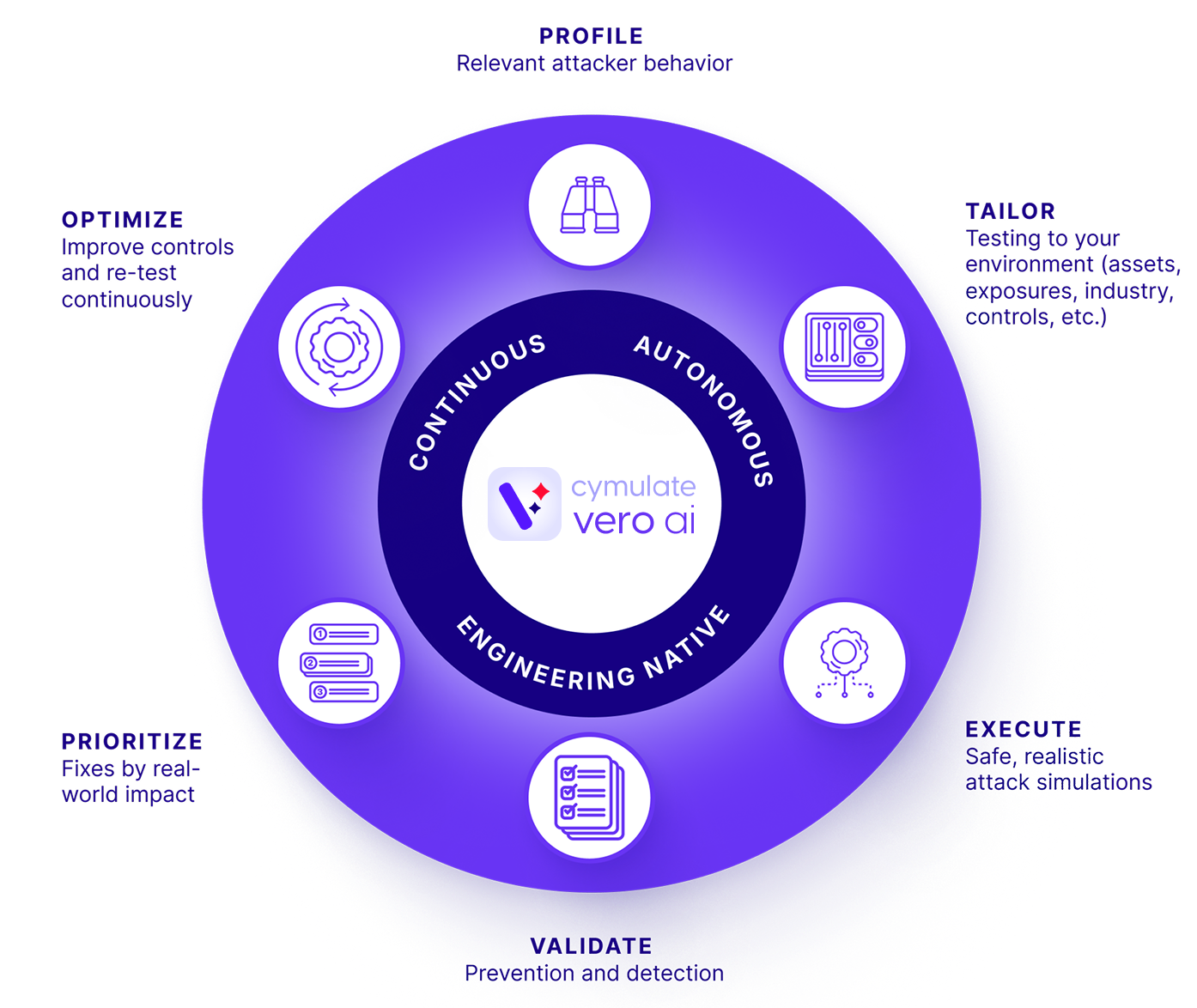
Cymulate Exposure Prioritization and Remediation is a solution that automates threat validation, enabling organizations to move from theoretical risk lists to actionable, validated exposures. It helps security teams focus remediation efforts on vulnerabilities that are proven exploitable in their environment, using empirical data from attack simulations and exposure validation. [Source]
What is the primary purpose of Cymulate's Exposure Prioritization and Remediation solution?
The primary purpose is to help organizations proactively validate their cybersecurity defenses, identify which exposures are truly exploitable, and optimize remediation efforts. This ensures that security teams focus on the most critical risks, improving overall threat resilience and operational efficiency. [Source]
How does Cymulate Exposure Prioritization and Remediation differ from traditional vulnerability management?
Unlike traditional vulnerability management, which often results in long lists of theoretical risks, Cymulate's solution validates which exposures are actually exploitable in your environment. It uses attack simulations and integrates with vulnerability scanners to provide empirical proof, enabling teams to prioritize and remediate based on real-world risk rather than just CVSS scores. [Source]
How does Cymulate Exposure Prioritization and Remediation support continuous threat exposure management (CTEM)?
Cymulate puts the "T" in CTEM by making threat validation a continuous process. It enables collaboration across security operations, threat intelligence, and vulnerability management teams, ensuring that exposure management is always based on up-to-date, validated data. [Source]
Features & Capabilities
What are the key features of Cymulate Exposure Prioritization and Remediation?
Key features include automated threat validation, validated exposure scoring, unified inventory of assets and exposures, business-aligned asset classification, risk-based exposure prioritization, and focused remediation guidance. The platform also integrates with existing security and IT tools for comprehensive visibility. [Source]
How does Cymulate validate exposures and vulnerabilities?
Cymulate validates exposures by running attack simulations and correlating findings with vulnerability scanner data. It provides empirical proof of threat prevention and detection, enabling organizations to focus on exposures that are actually exploitable. [Source]
What is validated exposure scoring and how does it work?
Validated exposure scoring is Cymulate's method of ranking exposures based on proof of exploitability, threat intelligence, business context, and asset criticality. This scoring system helps prioritize remediation efforts on exposures with the highest potential business impact. [Source]
How does Cymulate integrate with existing security and IT tools?
Cymulate integrates with your existing security and IT tools, including vulnerability scanners and exposure discovery solutions, to build a unified inventory of assets and exposures. This integration enables comprehensive risk assessment and streamlined workflows. [Source]
What is business-aligned asset classification in Cymulate?
Business-aligned asset classification allows organizations to categorize assets based on business impact. Automated filters and tagging assign assets to defined business tiers, highlighting critical systems and aligning exposure scoring with organizational priorities. [Source]
How does Cymulate's risk-based exposure prioritization work?
Cymulate's risk-based exposure prioritization analyzes each exposure using proof of exploitability, threat intelligence, business context, and CVSS scores. This enables organizations to prioritize exposures based on their potential impact, not just severity ratings. [Source]
Can Cymulate provide remediation guidance?
Yes, Cymulate provides focused remediation guidance for exposures that can penetrate your defenses. The platform also allows you to rerun assessments to validate the effectiveness of remediation actions. [Source]
How does Cymulate help improve decision making for security teams?
Cymulate enables organizations to move from asset-centric to impact-centric prioritization, aligning security decisions with business risk. This approach improves decision making by focusing resources on exposures with the greatest potential impact. [Source]
Use Cases & Benefits
Who can benefit from Cymulate Exposure Prioritization and Remediation?
Security leaders, SecOps teams, red teams, and vulnerability management teams in organizations of all sizes and industries can benefit from Cymulate. The solution is especially valuable for those seeking to prioritize remediation based on validated, exploitable exposures. [Source]
What measurable benefits have customers seen with Cymulate?
Customers have reported a 52% reduction in critical exposures, 60% more efficient prioritization, and the ability to escalate high-risk, low-severity vulnerabilities. These metrics demonstrate significant improvements in security posture and operational efficiency. [Source]
Are there any customer testimonials for Cymulate Exposure Prioritization and Remediation?
Yes. For example, a Cybersecurity Manager at Banco PAN stated: "We integrated Cymulate with our vulnerability management to validate each vulnerability and understand if there are compensating controls in place protecting us. It helps us focus and prioritize the high-risk vulnerabilities that are exploitable in our environment." [Source]
How does Cymulate help organizations with fragmented security tools?
Cymulate integrates exposure data and automates validation, providing a unified view of the security posture. This helps organizations overcome the challenges of disconnected tools and improves visibility and control. [Source]
Can Cymulate help prioritize exposures based on business impact?
Yes, Cymulate's business-aligned asset classification and risk-based prioritization enable organizations to focus on exposures that could have the greatest impact on critical business systems. [Source]
How does Cymulate support collaboration across security teams?
Cymulate provides a validated, shared view of exposures and risk, enabling SecOps, red teams, and vulnerability management teams to collaborate efficiently and reduce friction in remediation efforts. [Source]
Technical Details & Integrations
What types of integrations does Cymulate Exposure Prioritization and Remediation support?
Cymulate integrates with a wide range of security and IT tools, including vulnerability scanners and exposure discovery solutions. For a full list of integrations, visit the Cymulate Partnerships and Integrations page.
Does Cymulate Exposure Prioritization and Remediation provide a unified inventory of assets and exposures?
Yes, Cymulate builds a comprehensive inventory of assets and exposures by aggregating data from integrated tools. This centralized inventory includes details on impacted assets, status, related tasks, CVEs, and exploitability information. [Source]
How does Cymulate handle exposures with no prior validation data?
If there is no history of validation for a specific exposure, Cymulate provides the option to launch attack simulations to test exploitability and prove the current state of detection and prevention. [Source]
Is there a data sheet available for Cymulate Exposure Prioritization and Remediation?
What security and compliance certifications does Cymulate hold?
Cymulate holds several key certifications, including SOC2 Type II, ISO 27001:2013, ISO 27701, ISO 27017, and CSA STAR Level 1. These certifications demonstrate Cymulate's commitment to robust security and compliance standards. [Source]
How does Cymulate ensure data security and privacy?
Cymulate ensures data security through encryption for data in transit (TLS 1.2+) and at rest (AES-256), secure AWS-hosted data centers, a tested disaster recovery plan, and a dedicated privacy and security team including a Data Protection Officer (DPO) and Chief Information Security Officer (CISO). [Source]
Is Cymulate Exposure Prioritization and Remediation GDPR compliant?
Yes, Cymulate incorporates data protection by design and is GDPR compliant, with a dedicated privacy and security team overseeing compliance. [Source]
What application security measures does Cymulate implement?
Cymulate follows a strict Secure Development Lifecycle (SDLC), including secure code training, continuous vulnerability scanning, annual third-party penetration tests, and mandatory 2-Factor Authentication (2FA) and Role-Based Access Controls (RBAC) for the platform. [Source]
Pricing & Plans
What is Cymulate's pricing model for Exposure Prioritization and Remediation?
Cymulate operates on a subscription-based pricing model tailored to each organization's requirements. Pricing depends on the chosen package, number of assets, and scenarios selected. For a detailed quote, organizations can schedule a demo with the Cymulate team. [Source]
Support & Implementation
How easy is it to implement Cymulate Exposure Prioritization and Remediation?
Cymulate is designed for quick and easy implementation, operating in agentless mode with no need for additional hardware or complex configurations. Customers can start running simulations almost immediately after deployment. [Source]
What support resources are available for Cymulate customers?
Cymulate offers comprehensive support, including email and chat support, a knowledge base with technical articles and videos, webinars, e-books, and an AI chatbot for quick answers and guidance. [Source]
How do customers rate the ease of use of Cymulate?
Customers consistently praise Cymulate for its intuitive interface and ease of use. Testimonials highlight the platform's user-friendly dashboard, quick implementation, and accessible support team. [Source]
Competition & Differentiation
How does Cymulate Exposure Prioritization and Remediation compare to other solutions?
Cymulate stands out by combining Breach and Attack Simulation, Continuous Automated Red Teaming, and Exposure Analytics in a unified platform. It offers continuous validation, AI-powered prioritization, and a comprehensive threat library, making it more holistic and actionable than point-in-time or siloed solutions. [Source]
What makes Cymulate unique for different user segments?
Cymulate tailors its solution for CISOs, SecOps teams, red teams, and vulnerability management teams, providing quantifiable metrics, automated processes, and advanced offensive testing. This ensures measurable improvements in threat resilience and operational efficiency for each persona. [Source]
Cymulate named a Customers' Choice in 2025 Gartner® Peer Insights™
We integrated Cymulate with our vulnerability management to validate each vulnerability and understand if there are compensating controls in place protecting us. It helps us focus and prioritize the high-risk vulnerabilities that are exploitable in our environment.
– Cybersecurity Manager, Banco PAN
Focus on Your Exploitable Exposures
Without validation, exposure management is just vulnerability management by another name – a long list of theoretical risks, lacking context, overwhelmed by volume and blind to what can actually be exploited.
Cymulate Exposure Management automates threat validation, so you can move from theoretical to actionable by proving which risks are truly exploitable in your environment. By leveraging findings from attack simulations run through Cymulate Exposure Validation, you gain empirical proof of threat resilience to confidently prioritize and mobilize remediation efforts where they matter most.
This scoring process enables true exposure management by driving collaboration across security functions. Armed with evidence of what’s truly exploitable, SecOps, red teams and vulnerability management teams share a validated view of exposure and risk. With proof as a common language, teams reduce friction, work more efficiently and focus remediation efforts on the exposures that matter most.
Score Exposures with Validated Prevention & Detection
Cymulate Exposure Management analyzes and scores exposures and vulnerabilities by considering your threat resilience to exploits that target the exposure. Cymulate Exposure Management first consolidates exposure findings by integrating with vulnerability scanners and other exposure discovery tools and then correlates those exposures with Cymulate Exposure Validation attack simulation findings.
The result is a stack-rank of all exposures based on validated exposure scoring that considers:
Proof and evidence of threat prevention and/or threat detection
Threat intelligence for known exploits, threat actors and active campaigns targeting your industry
Business context and asset criticality
Unified Inventory of Assets and Exposures
Cymulate integrates with your existing security and IT tools to build a comprehensive view of assets and exposures across your environment. The asset inventory aggregates a list of components and resources within your infrastructure that are monitored and managed for security purposes.
The list of exposures contains in-depth information about each exposure, including details on impacted assets, status, related tasks, data from integrations, associated Common Vulnerabilities and Exposures (CVEs) and exploitability details. This centralized inventory provides the context needed to assess risk accurately and act decisively.
Business-Aligned Asset Classification
Categorize your aggregated assets based on business impact to enable more precise risk prioritization. Automated filters and tagging assign assets to defined business tiers, highlighting your most critical systems (“crown jewels”) and aligning exposure scoring with organizational priorities.
Risk-Based Exposure Prioritization
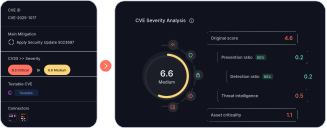
For every discovered exposure in your environment, Cymulate Exposure Management delivers a severity analysis that goes beyond basic CVSS scoring. Exposure analysis is based on proof of exploitability and on a combination of threat intelligence, the affected asset’s business context and the original CVSS (Common Vulnerability Scoring System) score. This combination of data enables you to begin prioritizing exposures based on their potential impact on your organization.
If Cymulate Exposure Validation has testing data related to the exposure, that proof of prevention and/or detection is included in the analysis. If there’s no history of validation for that exposure, Cymulate Exposure Management provides the option to launch attack simulations that exploit the exposure and prove the current state of your detection and prevention. Post assessment, Cymulate calculates a validated exposure score based on detection and prevention ratios and feeds this score into the severity analysis.
In this example, CVE-2025-1017 was initially rated a critical risk (9.3 CVSS), but Cymulate attack simulations revealed strong detection and prevention. This information, combined with threat intelligence and asset criticality, fed into a Cymulate severity analysis that delivered a more contextual assessment. As a result, the exposure risk score was reduced to medium (6.6).
Focused and Streamlined Remediation
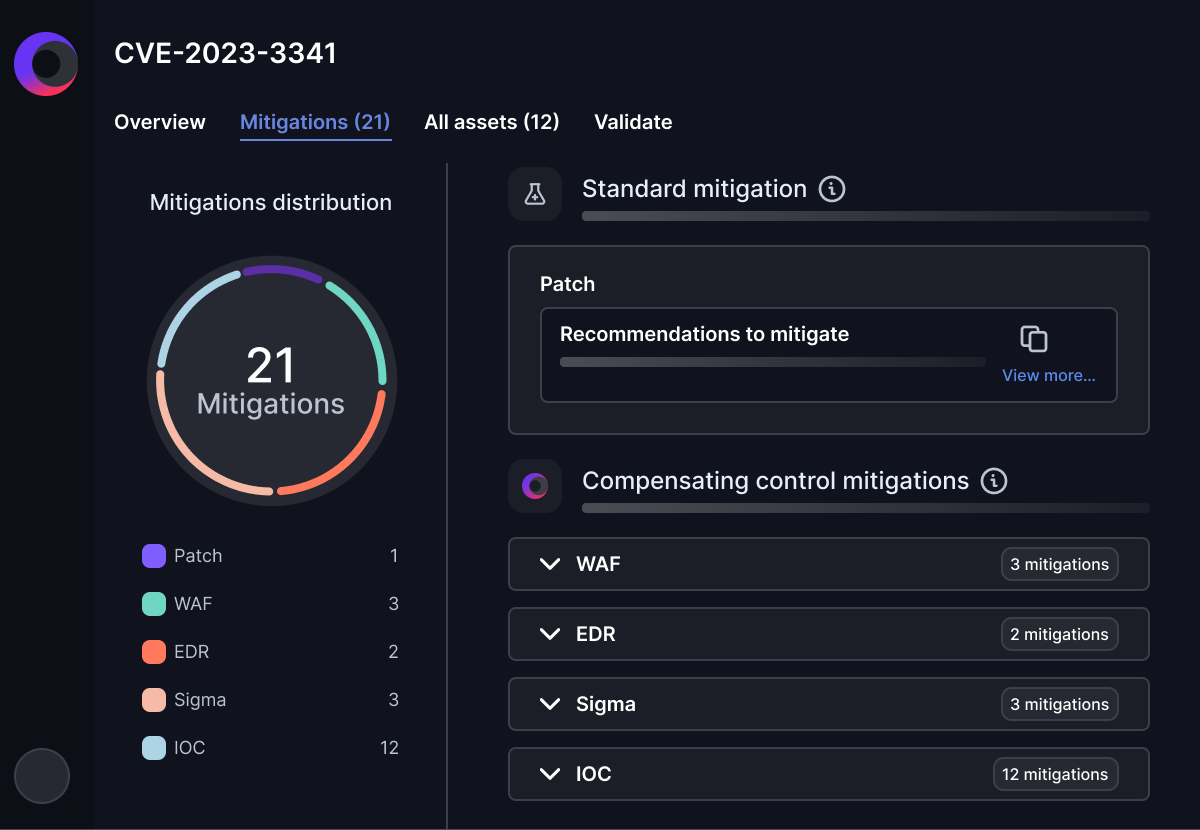
With stack ranking of exposures, Cymulate helps you focus your remediation efforts on exposures that can penetrate your defenses and provides remediation guidance that optimizes control effectiveness. The platform also allows you to rerun the assessment to easily validate remediation.
Why Choose Cymulate?
Put the “T” in CTEM
Make threat validation a continuous process with collaboration across security operations, threat intel and vulnerability management teams.
Focus on Real Threats
Prioritize remediation on exposures and vulnerabilities that are actively targeted and exploitable as proven by threat validation.
Improve Decision Making
Move from asset-centric to impact-centric prioritization, aligning security with business risk for improved decision making.