Frequently Asked Questions

WAF Validation & Remediation

What is Cymulate's WAF validation and why is it important?

Cymulate's WAF validation simulates real-world web attacks—such as SQL injection, cross-site scripting (XSS), and API abuse—against your web applications and APIs to test if your Web Application Firewall (WAF) is actually preventing the attacks that matter. This outcome-based approach helps teams move beyond assumptions and ensures that WAF protections are effective in practice.

How does Cymulate evaluate the effectiveness of my WAF?

Cymulate evaluates WAF effectiveness by launching controlled attack simulations aligned with OWASP Top 10 techniques and common exploits directly against your public-facing application endpoints. The platform observes how your application and WAF respond, analyzing HTTP status codes, error handling, and whether malicious payloads are blocked or allowed. This method does not require direct integration with your WAF.

What happens if my WAF does not stop a simulated attack?

If a Cymulate WAF assessment identifies a finding labeled 'Insufficient Web Application Firewall (WAF) Protection,' it means a simulated attack was able to bypass your application-layer defenses. This indicates missing, incomplete, or misconfigured WAF logic for the tested technique. Cymulate provides actionable mitigation guidance to address these gaps.

What are Cymulate WAF rules and how do they help with remediation?

Cymulate WAF rules are ready-to-use detection rules derived from the exact attack payloads used in Cymulate's WAF scenarios. They provide structured, actionable guidance—including universal mitigation logic, vendor-specific translations (e.g., F5, ModSecurity), and rule quality rankings—so teams can quickly move from validation results to practical improvements in their WAF configuration.

How are Cymulate WAF rules generated?

Each Cymulate WAF rule is built through deep research and engineering by Cymulate Research Labs. The team analyzes each scenario to identify the precise detection logic needed to stop the simulated attack, then consolidates this into a universal format and translates it for supported WAF platforms like F5 and ModSecurity.

What is the benefit of vendor-specific rule translation in Cymulate WAF rules?

Cymulate provides rule translation for supported WAF platforms, such as F5 and ModSecurity. This means you can select your WAF product, copy the translated rule, and deploy it directly—reducing friction and minimizing manual interpretation or errors during implementation.

How does Cymulate help teams understand the quality of WAF rules?

Every Cymulate WAF rule includes a quality ranking. Higher-ranked rules use more specific detection logic with lower risk of false positives, while lower-ranked rules provide broader coverage but may require tuning. This transparency helps teams make informed deployment decisions.

Can Cymulate WAF rules be used for both detection and prevention?

Yes. Cymulate recommends first deploying WAF rules in detection mode to monitor their effectiveness and tune as needed. Once validated, you can switch to prevention mode to actively block malicious traffic based on the rule logic.

How does Cymulate extend detection validation across other security layers?

Cymulate's validation-driven approach extends beyond WAFs to other security controls, including EDR and SIEM technologies. The platform provides actionable detection rules and guidance for these layers, enabling consistent, structured improvements across endpoints, logs, and web applications.

How can I get started with Cymulate WAF validation and rules?

If you are a Cymulate customer, you can use the Ask AI feature in the Cymulate Platform for step-by-step guidance on reviewing WAF findings and implementing recommended detection logic. If you are evaluating Cymulate, you can request a demo to see how the platform supports detection validation across your environment.

What platforms are currently supported for Cymulate WAF rule translation?

As of February 2026, Cymulate WAF rule translation is supported for F5 and ModSecurity platforms. Support for additional WAF products will be added over time.

How does Cymulate ensure WAF rules are effective in real-world environments?

Cymulate Research Labs builds each WAF rule based on real attack payloads and deep analysis of how WAFs operate in production. Rules are structured for technical accuracy and deployability, ensuring they address the exact detection logic required to stop simulated attacks.

What types of attacks does Cymulate simulate during WAF validation?

Cymulate simulates attacks such as SQL injection (SQLi), cross-site scripting (XSS), remote file inclusion (RFI), command injection, and other OWASP Top 10 techniques against externally accessible web applications and APIs.

How does Cymulate help teams move from validation to action?

Cymulate provides ready-to-use WAF rules, mitigation guidance, and vendor-specific translations directly in the platform. This enables teams to quickly implement, test, and tune new detection logic, turning validation results into measurable defensive improvements.

What is the recommended process for deploying Cymulate WAF rules?

Cymulate recommends first deploying WAF rules in detection mode to monitor for false positives and tune as needed. Once validated, you can switch to prevention mode to actively block malicious traffic. This staged approach helps ensure operational safety and effectiveness.

How does Cymulate's approach to WAF validation differ from traditional methods?

Traditional WAF validation often stops at identifying gaps and providing generic recommendations. Cymulate goes further by delivering actionable, vendor-specific WAF rules based on real attack payloads, enabling teams to implement and validate improvements quickly and accurately.

How can I learn more about Cymulate's WAF validation capabilities?

You can read the Cymulate WAF Solution Brief for an in-depth overview, or explore related blog posts and resources linked throughout the Cymulate website.

How does Cymulate support continuous improvement of WAF defenses?

Cymulate enables teams to re-run WAF assessments after deploying new rules, validate changes, and iteratively strengthen web and API security in a controlled, measurable way. The platform's continuous validation approach ensures defenses keep pace with evolving threats.

What is the role of Cymulate Research Labs in WAF validation?

Cymulate Research Labs is responsible for developing the attack scenarios, detection logic, and rule translations that power Cymulate's WAF validation and remediation guidance. Their expertise ensures rules are effective, precise, and deployable in real-world environments.

How does Cymulate's WAF validation fit into a broader security strategy?

Cymulate's WAF validation is part of a comprehensive exposure management platform that includes attack simulation, exposure prioritization, and automated mitigation across endpoints, logs, and web applications. This unified approach helps organizations continuously prove, prioritize, and improve their cyber defenses.

Features & Capabilities

What are the key capabilities of Cymulate's platform?

Cymulate offers continuous threat validation, attack path discovery, automated mitigation, accelerated detection engineering, complete kill chain coverage, and an extensive threat library with daily updates. These features help organizations stay ahead of emerging risks and improve operational efficiency. Learn more.

Does Cymulate support integrations with other security tools?

Yes, Cymulate integrates with a wide range of technology partners across network, cloud, endpoint, and SIEM domains, including Akamai Guardicore, AWS GuardDuty, BlackBerry Cylance OPTICS, Carbon Black EDR, Check Point CloudGuard, CrowdStrike Falcon, and more. See the full list.

How does Cymulate support automated remediation?

Cymulate offers actionable and automated remediation by integrating with leading security controls to push IoC updates and build custom detection rules. The platform generates actionable plans based on validated threats, streamlining the remediation process. Learn more.

How can detection rules be validated in Cymulate?

Detection rules can be validated by simulating the techniques you want to detect and confirming whether the rules trigger the expected alerts. Cymulate automates this process, making it faster and more reliable than manual validation. Learn more.

What is Cymulate's approach to exposure prioritization?

Cymulate prioritizes exposures based on exploitability, business context, and threat intelligence, enabling teams to focus remediation efforts on the most critical vulnerabilities. This evidence-based approach improves risk management and operational efficiency.

Use Cases & Benefits

Who can benefit from using Cymulate?

Cymulate is designed for CISOs, security leaders, SecOps teams, red teams, and vulnerability management teams across industries such as finance, healthcare, retail, media, transportation, and manufacturing. The platform addresses the unique needs of each persona with tailored features and insights. Learn more.

What business impact can customers expect from Cymulate?

Customers have reported an 81% reduction in cyber risk within four months, a 60% increase in team efficiency, 40X faster threat validation, a 30% improvement in threat prevention, and a 52% reduction in critical vulnerabilities. These outcomes are backed by case studies such as Hertz Israel. Read the case study.

What pain points does Cymulate solve for security teams?

Cymulate addresses overwhelming threat volumes, lack of visibility, unclear prioritization, operational inefficiencies, fragmented tools, cloud complexity, and communication barriers. The platform provides continuous validation, prioritization, automation, and actionable insights to overcome these challenges.

How does Cymulate's platform improve operational efficiency?

Cymulate automates threat validation, remediation, and reporting, reducing manual tasks and enabling teams to focus on strategic initiatives. Customers have reported a 60% increase in efficiency and a 25% reduction in manual SecOps tasks.

How easy is Cymulate to implement and use?

Cymulate is designed for quick, agentless deployment with no need for additional hardware or complex configurations. Customers can start running simulations almost immediately and benefit from a user-friendly interface, comprehensive support, and educational resources. Read testimonials.

Competition & Comparison

How does Cymulate compare to AttackIQ?

AttackIQ provides automated security validation but lacks Cymulate's innovation, threat coverage, and ease of use. Cymulate offers the industry's leading threat scenario library and AI-powered capabilities for streamlined workflows. Read more.

How does Cymulate compare to Mandiant Security Validation?

Mandiant is an original BAS platform but has seen little innovation in recent years. Cymulate continually innovates with AI and automation, expanding into exposure management and maintaining grid leader status. Read more.

How does Cymulate compare to Pentera?

Pentera focuses on attack path validation but does not provide the depth of exposure validation and cloud control coverage that Cymulate offers. Cymulate covers the full kill chain and provides comprehensive validation. Read more.

How does Cymulate compare to Picus Security?

Picus Security is suitable for on-premise BAS needs but lacks the complete exposure validation platform Cymulate provides. Cymulate includes cloud control validation and full kill chain coverage. Read more.

How does Cymulate compare to SafeBreach?

SafeBreach offers breach and attack simulation but lacks Cymulate's innovation, precision, and automation. Cymulate leads with AI-powered BAS, the largest attack library, and a full CTEM solution. Read more.

How does Cymulate compare to Scythe?

Scythe is suitable for advanced red teams but lacks Cymulate's focus on actionable remediation and automated mitigation. Cymulate provides daily threat updates, no-code workflows, and vendor-specific remediation guidance. Read more.

Pricing & Plans

What is Cymulate's pricing model?

Cymulate operates on a subscription-based pricing model tailored to each organization's needs. Pricing depends on the chosen package, number of assets, and selected scenarios. The subscription fee is non-refundable. For a custom quote, schedule a demo.

Security & Compliance

What security and compliance certifications does Cymulate hold?

Cymulate is SOC2 Type II certified and compliant with ISO 27001:2013, ISO 27701, ISO 27017, and CSA STAR Level 1. These certifications cover security, availability, confidentiality, privacy, and cloud security standards. Learn more.

How does Cymulate protect customer data?

Cymulate is hosted in secure AWS data centers, uses TLS 1.2+ for data in transit and AES-256 for data at rest, and offers multiple data locality options. The platform follows a strict Secure Development Lifecycle (SDLC) and undergoes annual third-party penetration tests.

Support & Resources

What support options are available for Cymulate customers?

Cymulate offers email support ([email protected]), real-time chat support, and access to a knowledge base with technical articles and videos. Customers can also attend webinars and access e-books for best practices.

Where can I find Cymulate's blog, newsroom, and resource hub?

You can find the latest threats, research, and company news on the Cymulate blog, media mentions in the newsroom, and a combination of insights, thought leadership, and product information in the Resource Hub.

New: 2026 Gartner® Market Guide for Adversarial Exposure Validation
Learn More
Cymulate named a Customers' Choice in 2025 Gartner® Peer Insights™
Learn More
New Research: The Security Tradeoffs Behind AI Tooling
Learn More
An Inside Look at the Technology Behind Cymulate
Learn More

New Cymulate WAF Rules: Turn Validation Gaps Into Actionable Defense 

By: Cymulate Research Lab

Last Updated: April 9, 2026

Yahav Levin, Research Team Lead
Idan Sherman, Infosec Researcher

Modern web applications are constantly exposed to threats such as SQL injection, cross-site scripting (XSS) and malicious API abuse. Web Application Firewalls (WAFs) are designed to protect against these attacks, but deploying a WAF does not automatically mean it is effective. 

One question comes up again and again after running a WAF assessment: How do you know your WAF is actually preventing the attacks that matter, and what do you do when it doesn’t? 

This is where many teams hit a wall. Validation is clear. Remediation is not. 

That’s why Cymulate is introducing WAF rules: Ready-to-use WAF rules that help teams move from identifying gaps to taking concrete action. 

Key highlights 

  • Cymulate WAF assessments identify security gaps and provide mitigation guidance in the form of vendor-specific WAF rules, helping teams move from validation results to practical improvements. 
  • WAF rules are derived from the exact attack payloads used during Cymulate WAF scenarios, ensuring detection logic reflects how web and API attacks behave in practice. 
  • Cymulate mitigation guidance has historically included rules expressed in regular expressions and now incorporates structured WAF rules translated for select platforms such as F5 and ModSecurity. 
  • WAF rules extend our existing approach to providing actionable detection rules for EDR and SIEM technologies, bringing the same validation-driven guidance to the application layer. 

How Cymulate evaluates WAF effectiveness 

Cymulate evaluates WAF effectiveness by conducting controlled attack simulations against web-facing applications and APIs. These simulations align with OWASP Top 10 techniques and common application exploits and focus exclusively on externally accessible components, so no internal test points or agents are required. 

Security teams provide Cymulate with the URLs or endpoints of the applications to be tested, typically public-facing assets protected by a WAF. Cymulate then launches simulated exploit payloads directly against those endpoints, replicating techniques such as SQL injection (SQLi), cross-site scripting (XSS), remote file inclusion (RFI) and command injection. 

The assessment observes how the application and its application-layer defenses respond to these requests. By analyzing response behavior, including HTTP status codes, error handling and whether malicious payloads are allowed to reach or execute within the application, Cymulate determines whether attacks are detected or prevented. This outcome-based approach allows teams to validate WAF effectiveness without requiring direct integration with the WAF itself. 

When your WAF doesn’t stop the attack 

When a Cymulate WAF assessment identifies a finding labeled Insufficient Web Application Firewall (WAF) Protection, it means a simulated attack was able to pass through application-layer defenses without being detected or blocked. 

This typically indicates that relevant WAF logic is missing, incomplete or not properly configured for the specific attack technique being tested. Rather than relying on configuration assumptions, the finding is based on observed behavior, confirming where WAF protections did not function as expected. 

Traditionally, Cymulate did not stop at identifying the gap. The platform provided mitigation guidance in the form of regular expressions and text-based recommendations to help teams understand how to detect or block an attack. However, applying that guidance still required teams to translate the logic into their specific WAF product, determine where to implement it and assess how it would behave in their environment. 

Cymulate WAF rules build on this foundation by making that guidance more targeted, structured and directly usable. 

Web Application Firewall Validation
Further reading
Web Application Firewall Validation

Learn how Cymulate validates web application firewall and optimizes your perimeter defenses.

Read More

Introducing Cymulate WAF rules 

To help teams remediate WAF findings more effectively, Cymulate now delivers WAF rules directly inside the mitigations section of relevant findings. 

Previously, mitigation guidance was provided in the form of generalized detection logic, typically expressed as regular expressions. While this helped teams understand what needed to be detected, it still required manual interpretation and product-specific implementation. 

With WAF rules, Cymulate takes the next step, delivering detection logic directly tied to the validated attack, structured for real WAF products and ready to be deployed as a starting point for detection. As a best practice, Cymulate recommends that customers first deploy the WAF rules in detection mode and, once validated, deploy them in prevention mode. 

What are Cymulate WAF rules, and why do they matter? 

Cymulate WAF rules are detection rules to identify malicious web and API traffic. They are based on real attack payloads used during Cymulate WAF scenarios, ensuring the detection logic reflects how attacks behave in practice. 

Each WAF rule provides structured, actionable guidance that makes it clear what needs to be detected and how that logic can be implemented. Every rule includes: 

  • Universal mitigation logic — a standardized rule format Cymulate uses as a baseline across vendors 
  • Built-in translation into supported WAF formats 
  • A rule quality ranking to help teams understand confidence levels and tuning requirements 

This capability builds on the mitigation guidance Cymulate has long provided. Previously, Cymulate supplied regular expression–based detection logic to help teams understand how attacks could be identified. WAF rules take this a step further by making that guidance more targeted and directly usable within real WAF products. 

WAF rules also extend an approach Cymulate already applies to other security controls. Today, Cymulate delivers actionable detection rules for EDR and SIEM technologies as part of its validation workflows. With the introduction of WAF rules, the same practical approach is now extended to the application layer, providing teams with consistent, structured guidance to improve detection and prevention across endpoints, logs and web applications. 

Most importantly, these rules turn WAF validation into action. Instead of only reporting a gap and providing a regex for implementation, Cymulate now helps teams understand exactly which detection logic is required to address the gap and how to implement it safely. 

With WAF rules, teams can: 

  • Improve WAF detection and prevention coverage faster 
  • Validate changes by re-running WAF assessments 
  • Strengthen web and API security in a controlled, measurable way 

Rule translation for vendor-specific deployment 

To reduce friction during implementation, Cymulate provides rule translation into vendor-specific formats. 

Today, WAF rule translation is supported for: 

  • F5 
  • ModSecurity 

Teams can select their WAF product, copy the translated rule and deploy it directly into their environment. Where vendor-specific requirements exist, such as saving F5 rules in XML format, Cymulate provides clear guidance to help teams implement correctly. 

Support for additional WAF platforms will be added over time. 

F5 Rule for “Encoded JavaScript Event Handler XSS Attack via Invalid Input Event” WAF Simulation Deployed in F5 
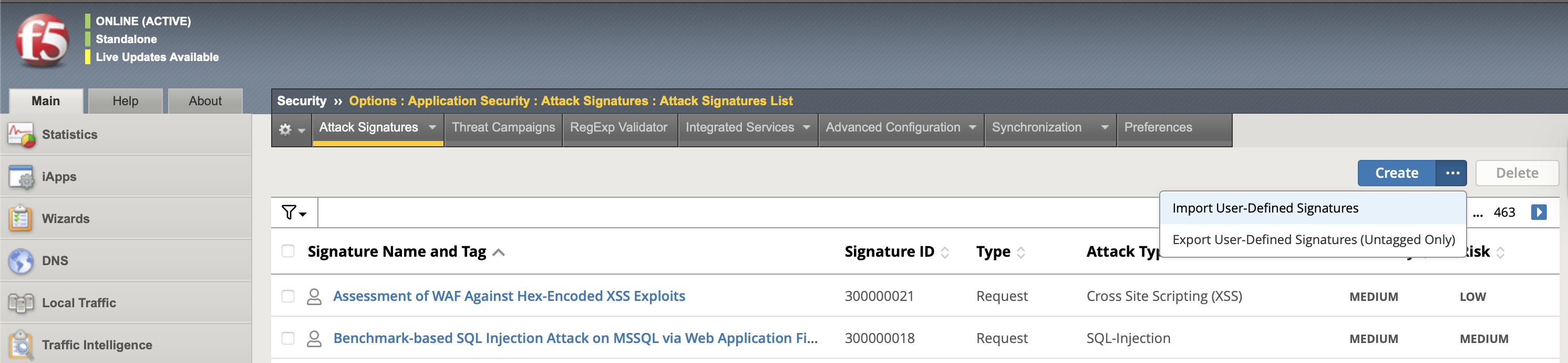
Adding the Cymulate Rules to the F5 platform via Import User-Defined Signatures 
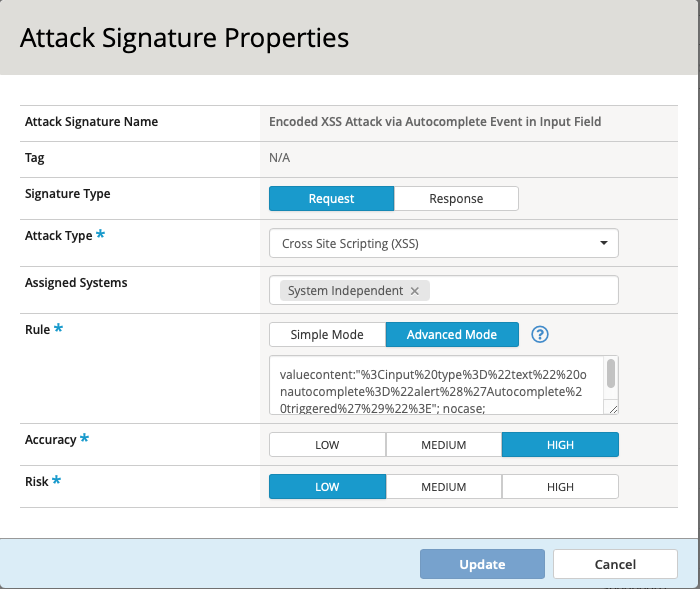
Viewing the created rule in F5 

Understanding rule quality rankings 

Every WAF Rule includes a quality ranking to help teams balance detection coverage and operational risk. 

Higher-ranked rules use more specific detection logic, targeting known malicious behavior with minimal risk of false positives. Lower-ranked rules provide broader coverage and may require tuning, especially in environments with complex or diverse application traffic. 

This transparency helps teams make informed decisions about how and when to deploy each rule. 

Built through deep research and real-world WAF expertise 

Delivering actionable WAF rules required significant research and engineering effort. The Cymulate Research Labs analyzed how WAF rules should be structured to be effective, precise and deployable across real customer environments. 

Each Cymulate WAF scenario was examined to identify the exact detection logic required to stop the simulated attack. These rules were then consolidated into a universal mitigation format and translated into vendor-specific implementations based on deep analysis of platforms such as F5 and ModSecurity. 

This approach ensures that WAF rules are not only technically accurate but also aligned with how WAFs operate in real production environments. 

Extending detection validation across layers 

Cymulate continues to expand its validation-driven approach across security controls, helping teams test and improve detection and prevention logic wherever attacks may surface, from endpoints and logs to web applications and APIs. 

For Cymulate customers, you can get started immediately using the Ask AI feature in the Cymulate Platform. Ask AI provides step-by-step guidance for reviewing WAF findings, understanding recommended detection logic and implementing improvements as part of your broader validation efforts. 

For security teams evaluating Cymulate, request a demo to see how the platform supports detection validation across multiple layers of the environment, helping teams move from test results to meaningful defensive improvements. 

The goal remains consistent: to continuously prove, prioritize and improve your cyber defenses. 

Book a Demo