
Frequently Asked Questions

AI and ML for SIEM & SOC Defense

What is AI-powered SIEM and how does it differ from traditional SIEM systems?

AI-powered SIEM integrates artificial intelligence and machine learning into traditional SIEM architectures to enhance detection capabilities, reduce alert fatigue, and optimize analyst workflows. Unlike legacy SIEMs that rely on static rules and manual correlation, AI SIEMs use algorithms trained on historical and real-time data to detect patterns, identify anomalies, and prioritize alerts based on risk. This results in more intelligent, efficient, and scalable security operations. [Source]

What are the core AI/ML capabilities within modern SIEM solutions?

Core AI/ML capabilities in modern SIEMs include anomaly detection, automated correlation of security events, adaptive learning, natural language processing (NLP), and automated triage and enrichment. These features help identify behavior outside established baselines, link related events, continuously improve detection models, extract context from unstructured data, and reduce time-to-detection. [Source]

How does AI help reduce false positives in SIEM?

AI-based SIEM solutions apply contextual analysis to suppress benign events and prioritize alerts based on behavioral risk, impact potential, and threat intelligence feeds. This reduces false positives, allowing analysts to focus on true threats and improving operational efficiency. [Source]

What are the main benefits of using AI and ML in the SOC?

Key benefits include faster incident detection and response, reduced false positives, enhanced threat intelligence integration, and optimized analyst workflows. AI SIEM tools can analyze millions of events in real time, flag threats within seconds, and automate repetitive tasks, freeing SOC teams to focus on strategic threat hunting and response planning. [Source]

How does AI-powered SIEM improve incident detection and response times?

AI SIEM tools analyze millions of events in real time and use machine learning models trained on historical data to recognize subtle indicators of compromise that static rule-based systems may miss. According to the Threat Exposure Validation Impact Report 2025, organizations using AI in exposure validation test their defenses against new threats 24 hours faster on average. [Report]

What use cases does AI and ML enable in SIEM platforms?

AI and ML enable behavioral analytics for insider threat detection, automated playbooks for incident response, and ML-powered anomaly detection and prioritization. These capabilities help detect deviations from baselines, trigger automated containment actions, and score/prioritize anomalous events for high-fidelity alerting. [Source]

How does AI change the role of SOC analysts?

AI and ML augment SOC analysts by automating alert triage and enrichment, allowing analysts to focus on strategic threat hunting, proactive security posture management, and tuning detection logic. This shift enables faster threat validation, higher-quality investigations, and more time for strategic initiatives. [Source]

What challenges should organizations consider when implementing AI and ML in SIEM?

Key challenges include ensuring data quality and normalization, addressing model bias and drift, and managing integration complexity. AI models require high-quality, representative data and continuous monitoring/retraining to maintain accuracy. Integrating AI SIEM tools with diverse data sources and security controls also requires robust architecture and skilled teams. [Source]

What is the future of AI in SOC operations?

The future of AI in SOC operations includes generative AI for alert summarization, predictive threat modeling, and decision support systems. These advancements will help analysts by providing high-level context, predicting attack likelihood, and recommending effective containment or mitigation steps. [Source]

How does Cymulate support AI-powered SIEM rule validation and detection engineering?

Cymulate offers an AI-powered detection engineering assistant for SIEM rule threat coverage validation. The platform automates and streamlines detection engineering for blue teams and SecOps, enabling building, testing, and optimizing threat detection with AI-assisted live-data attack simulations and personalized threat detection. This approach eliminates manual validation friction and provides immediate feedback on rule effectiveness. [Press Release]

Can you provide a real-world example of Cymulate's impact on SIEM detection?

Yes. Raiffeisen Bank International (RBI) used Cymulate to validate and fine-tune their SIEM rules, achieving improved detection rates and significantly reduced false positives. Cymulate assessments generated events to test new detection rules, providing immediate feedback for SIEM tuning and detection engineering. [Case Study]

How quickly can Cymulate help identify SIEM rule coverage gaps?

Cymulate enables teams to identify SIEM rule coverage gaps in minutes. The platform automates the mapping of detection rules to relevant threats, eliminating the hours-long manual process of reviewing rule logic and testing scenarios one by one. [Source]

What is detection engineering and why is it important for SIEM?

Detection engineering is the process of building, testing, and fine-tuning threat detection logic and rules within SIEM systems. It is critical for ensuring that SIEM detects relevant threats and minimizes false positives. Cymulate's detection engineering capabilities automate these tasks using AI-powered analysis and a large library of real-world attack simulations. [Glossary]

How does Cymulate's AI-powered detection engineering assistant work?

Cymulate's AI-powered detection engineering assistant automates the process of validating SIEM rule coverage by running live-data attack simulations and mapping detection rules to threats. This provides immediate, actionable feedback for blue teams and SecOps to optimize their detection logic. [Press Release]

What is the impact of AI-driven exposure validation on security operations?

AI-driven exposure validation enables organizations to test defenses against new threats faster, reduce manual overhead, and ensure SIEM rules are effective. According to the Threat Exposure Validation Impact Report 2025, organizations using AI for exposure validation test defenses 24 hours faster on average. [Report]

How does Cymulate help organizations move from reactive to proactive SOC defense?

Cymulate enables organizations to operationalize AI for threat exposure validation, rule optimization, and actionable insights. By continuously validating SIEM rules and detection logic, Cymulate helps SOC teams shift from reactive alerting to proactive defense, building a resilient, adaptive, and intelligent SOC. [Source]

What resources are available to learn more about SIEM validation and detection engineering with Cymulate?

Cymulate provides solution briefs, guides, and case studies on SIEM validation and detection engineering. Notable resources include the SIEM Observability Validation Solution Brief, the guide on Proactive, AI-Powered SIEM Rule Validation and Detection Engineering, and the RBI case study. [Solution Brief] [Guide] [Case Study]

How does Cymulate integrate with other security tools for SIEM validation?

Cymulate integrates with a wide range of security technologies, including EDR, cloud security, network security, and vulnerability management tools. This enables comprehensive SIEM validation by correlating data and automating validation across the security stack. For a full list of integrations, visit the Partnerships and Integrations page.

What is Cymulate's pricing model for SIEM validation and detection engineering?

Cymulate operates on a subscription-based pricing model tailored to each organization's requirements. Pricing depends on the chosen package, number of assets, and scenarios selected for testing and validation. For a detailed quote, you can schedule a demo with the Cymulate team.

Who can benefit from Cymulate's SIEM validation and detection engineering solutions?

Cymulate's solutions are designed for CISOs, security leaders, SecOps teams, red teams, and vulnerability management teams in organizations of all sizes and industries. The platform is especially valuable for teams seeking to automate security validation, optimize SIEM rules, and improve operational efficiency. [CISO] [SecOps] [Red Teams] [Vuln Mgmt]

What security and compliance certifications does Cymulate hold?

Cymulate holds several industry-leading certifications, including SOC2 Type II, ISO 27001:2013, ISO 27701, ISO 27017, and CSA STAR Level 1. These certifications demonstrate Cymulate's commitment to robust security and compliance standards. [Security at Cymulate]

How easy is it to implement Cymulate for SIEM validation?

Cymulate is designed for quick and easy implementation, operating in agentless mode without the need for additional hardware or complex configurations. Customers can start running simulations almost immediately, and comprehensive support is available via email, chat, and a knowledge base. [Book a Demo]

What feedback have customers given about Cymulate's ease of use?

Customers consistently praise Cymulate for its intuitive interface and ease of use. For example, Raphael Ferreira, Cybersecurity Manager, stated, "Cymulate is easy to implement and use—all you need to do is click a few buttons, and you receive a lot of practical insights into how you can improve your security posture." [Customer Quotes]

What business impact can organizations expect from using Cymulate for SIEM validation?

Organizations using Cymulate can expect improved security posture (up to 52% reduction in critical exposures), operational efficiency (60% increase in team efficiency), faster threat validation (40X faster than manual methods), and enhanced threat resilience (81% reduction in cyber risk within four months). [Source]

What pain points does Cymulate address for SOC and security teams?

Cymulate addresses pain points such as fragmented security tools, resource constraints, unclear risk prioritization, cloud complexity, communication barriers, inadequate threat simulation, operational inefficiencies in vulnerability management, and post-breach recovery challenges. [Case Studies]

How does Cymulate compare to other SIEM validation and exposure management platforms?

Cymulate stands out by offering a unified platform that integrates Breach and Attack Simulation (BAS), Continuous Automated Red Teaming (CART), and Exposure Analytics. It provides continuous threat validation, AI-powered optimization, complete kill chain coverage, and an extensive threat library. Customers have reported measurable outcomes such as a 52% reduction in critical exposures and an 81% reduction in cyber risk. [Comparison]

What integrations does Cymulate offer for SIEM and security validation?

Cymulate integrates with technologies such as Akamai Guardicore, AWS GuardDuty, BlackBerry Cylance OPTICS, Carbon Black EDR, Check Point CloudGuard, Cisco Secure Endpoint, CrowdStrike Falcon, Wiz, SentinelOne, and more. For a complete list, visit the Partnerships and Integrations page.

Where can I find Cymulate's blog, newsroom, and resource hub?

You can stay updated with the latest threats, research, and company news through Cymulate's blog, newsroom, and resource hub.

What is Cymulate's mission and vision?

Cymulate's mission is to transform cybersecurity practices by enabling organizations to proactively validate their defenses, identify vulnerabilities, and optimize their security posture. The vision is to create a collaborative environment where organizations can achieve lasting improvements in cybersecurity strategies. [About Us]

How does Cymulate ensure data security and privacy?

Cymulate ensures data security through encryption for data in transit (TLS 1.2+) and at rest (AES-256), secure AWS-hosted data centers, a tested disaster recovery plan, and compliance with GDPR. The platform also includes mandatory 2FA, RBAC, IP address restrictions, and TLS encryption for its Help Center. [Security at Cymulate]

What support options are available for Cymulate customers?

Cymulate offers comprehensive support via email ([email protected]), real-time chat, a knowledge base with technical articles and videos, webinars, e-books, and an AI chatbot for quick answers and summaries. [Webinars]

How does Cymulate address the needs of different security personas?

Cymulate tailors its solutions for CISOs (providing metrics and insights), SecOps teams (automating processes and improving efficiency), red teams (offensive testing with a large attack library), and vulnerability management teams (automated validation and prioritization). [CISO] [SecOps] [Red Teams] [Vuln Mgmt]

Where can I find definitions for cybersecurity terms used by Cymulate?

Cymulate provides a comprehensive cybersecurity glossary explaining terms, acronyms, and jargon. Visit the Cybersecurity Glossary for more information.

New: 2026 Gartner® Market Guide for Adversarial Exposure Validation
Learn More
Cymulate named a Customers' Choice in 2025 Gartner® Peer Insights™
Learn More
New Research: The Security Tradeoffs Behind AI Tooling
Learn More
An Inside Look at the Technology Behind Cymulate
Learn More

AI and ML for SIEM: The New Standard in SOC Defense 
By: Jake O’Donnell

Last Updated: February 1, 2026

cymulate blog article

Traditional SIEM systems, while foundational to enterprise security operations, can reach a limit in increasingly-complex environments. As organizations face more sophisticated threats and exponentially growing data volumes, legacy SIEMs struggle to scale.  

These SIEMs generate excessive noise, produce high false positive rates and place unsustainable burdens on teams. 

Artificial intelligence (AI) and machine learning (ML) are transforming this paradigm. AI-powered SIEM solutions enable security operations centers (SOCs) to shift from reactive to proactive defense using real-time analysis, adaptive threat detection and automation to manage complexity, reduce manual overhead and accelerate incident response. 

What Is AI-Powered SIEM? 

AI-powered SIEM integrates artificial intelligence and machine learning into traditional SIEM architectures to enhance detection capabilities, reduce alert fatigue and optimize analyst workflows. These systems leverage algorithms trained on historical and real-time data to detect patterns, identify anomalies and prioritize alerts based on risk. 

Core AI/ML capabilities within modern SIEMs include: 

  • Anomaly detection: Identifying behavior outside established baselines using unsupervised learning. 
  • Automated correlation: Linking related security events across disparate systems without predefined rules. 
  • Adaptive learning: Continuously improving detection models based on new data inputs. 
  • Natural language processing (NLP): Extracting relevant context from unstructured data like logs, tickets, and emails. 
  • Automated triage and enrichment: Reducing time-to-detection by correlating events and supplementing alerts with threat intelligence. 

The result is a more intelligent, efficient, and scalable security architecture that supports both detection and response. 

Key Benefits of AI/ML in the SOC 
Key Benefits of AI/ML in the SOC

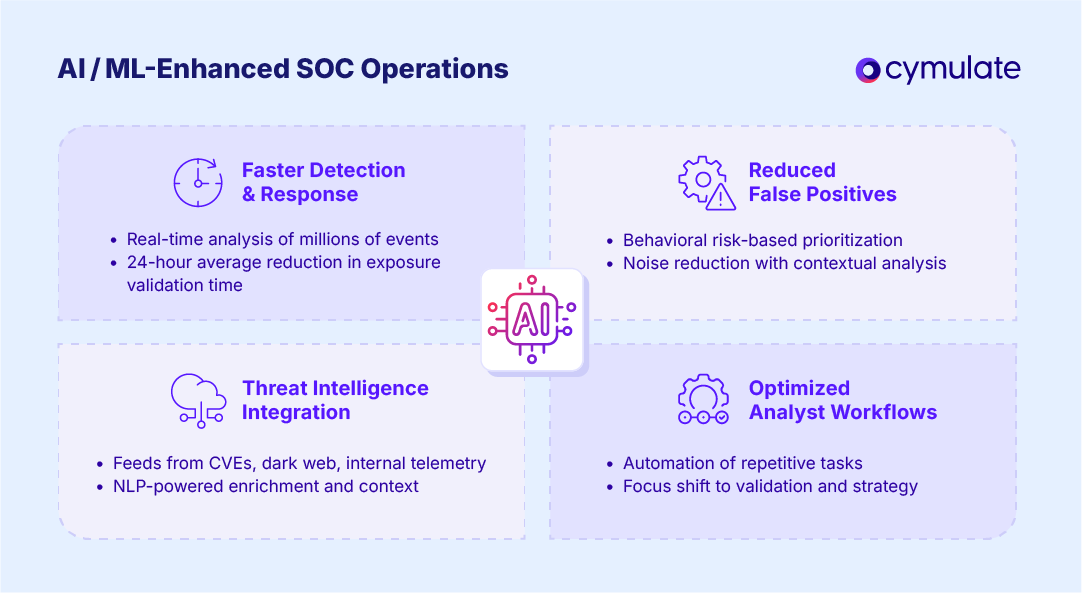
Faster Incident Detection and Response 

AI SIEM tools can analyze millions of events in real time, flagging threats within seconds. Machine learning models trained on historical data can recognize subtle indicators of compromise (IoCs) that static rule-based systems miss. 

In general, the introduction of AI into exposure validation processes has garnered positive results for organizations. According to the Threat Exposure Validation Impact Report 2025, it takes organizations who have implemented AI into their exposure validation process 24 fewer hours on average to test their defenses against newly identified cyber threats. 

For SIEM, applying AI-driven rule validation and optimization can allow organizations to detect threats faster than those relying solely on manual correlation and static rules

Reduced False Positives 

Traditional SIEMs often overwhelm SOC analysts with redundant or irrelevant alerts. AI-based SIEM solutions apply contextual analysis to suppress benign events, prioritizing alerts based on behavioral risk, impact potential and threat intelligence feeds. This can reduce false positives, freeing analysts to focus on true threats. 

Enhanced Threat Intelligence Integration 

AI SIEMs ingest data from threat feeds, CVE databases, dark web monitoring and internal telemetry to enrich alerts with actionable intelligence. NLP and deep learning models can parse this data, assess relevance, and support predictive detection. 

Optimized Analyst Workflows 

AI can automate repetitive tasks such as log parsing, event triage, IOC correlation, and incident reporting. SOC teams can interpret findings and validate detection logic, drastically improving operational efficiency. 

Use Cases of AI and ML in SIEM 

Behavioral Analytics for Insider Threat Detection 

By building behavioral baselines across users, devices, and networks, AI-powered SIEMs can detect deviations that may indicate insider threats, lateral movement or compromised accounts. Behavioral analytics SIEM models operate continuously and adapt to new behavioral patterns without manual input. 

Automated Playbooks for Incident Response 

Integrated AI enables dynamic, conditional workflows that can automatically trigger containment actions, ticketing or forensic investigations based on event severity. This level of orchestration reduces mean time to remediate (MTTR) and supports scalable security operations. 

ML-Powered Anomaly Detection and Prioritization 

AI SIEM tools use clustering and classification algorithms to detect anomalous patterns such as unusual login behaviors, privilege escalations, or uncommon data exfiltration attempts.  

These are then scored and prioritized using ML-based risk models, ensuring high-fidelity alerting. 

How AI Is Changing the Role of SOC Analysts 

AI and ML are not replacing analysts—they’re augmenting them. With intelligent automation handling alert triage and enrichment, analysts can shift focus from low-level event management to strategic threat hunting and response planning. 

This shift enables: 

  • Faster threat validation 
  • Higher-quality investigations 
  • Proactive security posture management 
  • More time for tuning detection logic and controls 

SOC analysts become orchestrators of AI-driven defense rather than passive responders to alert fatigue. 

Real-World Example: AI-Driven Exposure Validation 

AI’s role in SIEM is amplified when paired with continuous exposure management and validation. Cymulate helps SOC teams validate detection efficacy by simulating attack paths and evaluating how well existing SIEM rules and detection logic respond. 

For example, Raiffeisen Bank International (RBI) used Cymulate to validate and fine-tune their SIEM rules. They achieved improved detection rates and significantly reduced false positives. 

When they create a new detection rule in their SIEM they can’t validate with historical logs, RBI uses Cymulate assessments to generate the appropriate events and see if the rule was successful in its detection. That immediate feedback is useful when fine-tuning the SIEM and practicing detection engineering. 

This approach ensures that SIEM systems aren’t just ingesting data—they’re responding accurately to verified threats. 

Challenges and Considerations 

While the benefits of AI and ML in SIEM are substantial, implementation comes with challenges: 

Data Quality and Normalization: AI models are only as good as the data they’re trained on. Poorly normalized, incomplete, or noisy logs can lead to inaccurate detections or model drift. 

Model Bias and Drift: ML models can develop bias if trained on unrepresentative data. Continuous monitoring and retraining are essential to maintain detection quality. 

Integration Complexity: AI SIEM tools must integrate with diverse data sources, security controls, and response platforms. Organizations need a robust architecture and skilled teams to operationalize these capabilities effectively. 

The Future of AI in the SOC 

The future of AI SOC operations is trending toward: 

  • Generative AI for Alert Summarization: Providing high-level context, summaries, and recommendations in human-readable form. 
  • Predictive Threat Modeling: Using historical and environmental data to predict where attacks are likely to occur. 
  • Decision Support Systems: Recommending the most effective containment or mitigation steps based on real-time threat intelligence. 

As generative AI models improve, they will support SOC analysts not just in detection but in communicating risk to stakeholders and automating decision-making at scale. 

AI and ML are no longer experimental technologies in cybersecurity—they’re foundational to modern SIEM architectures. AI SIEM solutions deliver scalable, intelligent threat detection, enabling SOCs to operate efficiently in high-volume, high-stakes environments. 

AI-Powered SIEM Rule Validation and Detection Engineering from Cymulate 

Detection alone isn't enough. Continuous validation is critical to ensure your AI-powered SIEM detects what’s important. Detection engineering capabilities should automate the most critical and resource-intensive tasks. Using AI-powered analysis and a massive library of real-world attack simulations, teams can continuously build, test and fine-tune threat detection — so organizations can see what works, fix what doesn’t and continuously optimize detections. 

That’s where Cymulate stands out—by helping organizations operationalize AI for threat exposure validation, rule optimization and actionable insights. 

Cymulate offers an AI-powered detection engineering assistant for SIEM rule threat coverage validation. Cymulate automates and streamlines the detection engineering process for blue teams and SecOps, allowing for building, testing and optimizing threat detection with AI-assisted live-data attack simulations and personalized threat detection. 

SIEM validation

This approach eliminates the friction of manual detection validation by automating the correlation and testing process. Teams will know if their rules work and what threats are covered by the rules. 

It will only take minutes for teams to identify coverage gaps and tune rules. Without AI, mapping detection rules to relevant threats was an hours-long, tedious and manual process of reviewing rule logic, identifying threat coverage and testing scenarios one by one. 

Security teams looking to evolve from reactive alerting to proactive defense should evaluate AI-driven SIEM capabilities—supported by continuous validation—to build a resilient, adaptive and intelligent SOC. 

Cymulate Exposure Validation makes advanced security testing fast and easy. When it comes to building custom attack chains, it's all right in front of you in one place.
Mike Humbert, Cybersecurity Engineer
DARLING INGREDIENTS INC.
Learn More
Book a Demo