

Frequently Asked Questions

AI-Powered SIEM Optimization & Detection Engineering

What is AI-powered SIEM rule validation in Cymulate?

AI-powered SIEM rule validation in Cymulate is an automated capability that connects to your SIEM, retrieves existing detection rules, and uses advanced AI to map each rule to relevant attack scenarios from Cymulate’s library of over 100,000 simulations. This process automates the correlation and validation of SIEM rules, helping security teams identify coverage gaps and tune rules in minutes, rather than hours of manual effort. Source

How does Cymulate automate the process of mapping SIEM rules to attack scenarios?

Cymulate leverages a native SIEM integration and an AI correlation engine to automatically map each SIEM rule to relevant attack scenarios based on attributes like tactics, techniques, procedures (TTPs), rule name, description, and query. This eliminates manual review and testing, enabling rapid identification of detection gaps. Source

What are the main steps in Cymulate’s AI-powered SIEM rule validation workflow?

The workflow includes: 1) Integrate – connect to your SIEM and retrieve rules; 2) Correlate – AI maps rules to attack scenarios; 3) Validate – run targeted simulations to confirm rule effectiveness; 4) Tune – receive vendor-specific recommendations to close gaps; 5) Re-test – instantly revalidate updates for continuous improvement. Source

How does Cymulate help reduce the risk of cyber threats bypassing detection?

By automating the correlation between SIEM detection rules and real-world attack scenarios, Cymulate ensures that rules are continuously validated and optimized. This reduces the risk of threats slipping through detection blind spots and escalating into breaches. Source

How does Cymulate ensure the privacy and security of detection logic and customer data?

Cymulate processes all customer data within its dedicated AWS cloud environment, managed end-to-end by Cymulate. No customer data is transmitted to third-party providers or reused across tenants. All generative AI capabilities are developed and operated internally, ensuring sensitive detection logic and telemetry remain private and compliant. Source

What is the Cymulate AI Template Creator and how does it help with emergent threats?

The AI Template Creator allows SecOps teams to instantly generate assessments by uploading a threat advisory or news article. Cymulate uses AI to create a custom simulation based on the described threat, enabling teams to test controls within minutes and respond rapidly to new threats. Source

How does Cymulate help teams baseline and optimize MITRE ATT&CK coverage?

Cymulate provides a MITRE ATT&CK heatmap that visually displays detection coverage across tactics and techniques. This helps teams identify fully covered, partially detected, or missing areas, allowing them to prioritize detection engineering efforts for maximum impact. Source

Can Cymulate test SecOps processes, policies, and playbooks?

Yes, Cymulate enables organizations to simulate real-world attack scenarios in a controlled environment, testing not only detection logic but also SecOps processes, tooling, and playbooks. This helps surface operational blind spots and improve overall readiness. Source

What measurable benefits can security teams expect from using Cymulate for detection engineering?

Teams can expect optimized MITRE ATT&CK coverage, faster detection rule development, more frequent and reliable rule validation, and fewer false positives. These improvements lead to better visibility, efficiency, and security outcomes. Source

How does Cymulate support continuous improvement in detection engineering?

Cymulate enables continuous testing and refinement of detection logic against real-world threats. Teams can re-run assessments after tuning rules, ensuring ongoing optimization and confidence in their detection capabilities. Source

How does Cymulate help reduce false positives in SIEM detection?

By validating detection rules against realistic attack simulations, Cymulate helps teams fine-tune logic to reduce noise and focus on real threats, resulting in fewer false positives. Source

What is the Cymulate attack scenario workbench?

The attack scenario workbench allows SecOps teams to build custom assessments from a library of over 100,000 attack actions mapped to techniques, threat actors, and malware families. This enables tailored testing of both detection logic and operational processes. Source

How does Cymulate validate SOAR integrations and incident response processes?

Cymulate validates whether SOAR integrations properly register incidents and whether the response process functions as intended, helping teams ensure their incident response workflows are effective and reliable. Source

How does Cymulate help teams respond to new threats quickly?

With the AI Template Creator, teams can upload threat advisories or news articles to instantly generate custom simulations, test controls, and receive tailored detection rules for rapid response to emerging threats. Source

What is the value of continuous validation for SIEM rules?

Continuous validation ensures that SIEM rules remain effective against evolving threats, enabling organizations to maintain high detection coverage and reduce the risk of undetected attacks. Source

How does Cymulate help teams prioritize detection engineering efforts?

The MITRE ATT&CK heatmap and automated gap analysis help teams focus on tactics and techniques that are partially detected or missing, ensuring resources are allocated where they have the greatest impact. Source

What customer feedback is available regarding Cymulate’s detection engineering capabilities?

Mike Humbert, Cybersecurity Engineer at Darling Ingredients Inc., stated: "Cymulate Exposure Validation makes advanced security testing fast and easy. When it comes to building custom attack chains, it's all right in front of you in one place." Source

Where can I find more technical resources on detection engineering with Cymulate?

You can access the "Accelerate Detection Engineering" solution brief, webinars, and case studies such as "RBI Optimizes SIEM Detection" in the Cymulate Resource Hub.

How does Cymulate integrate with other security tools for detection engineering?

Cymulate integrates with SIEM, EDR, XDR, and SOAR platforms to automate detection rule validation, provide tailored recommendations, and validate incident response workflows. See integrations.

How does Cymulate support detection engineering for cloud environments?

Cymulate supports detection engineering in cloud environments through integrations with cloud security tools and by enabling simulation and validation of detection logic for cloud-based threats. Learn more.

What are the key capabilities and benefits of Cymulate's platform?

Cymulate offers continuous threat validation, a unified platform for BAS, CART, and Exposure Analytics, attack path discovery, automated mitigation, AI-powered optimization, complete kill chain coverage, ease of use, and an extensive threat library. Benefits include up to 52% reduction in critical exposures, 60% increase in team efficiency, and 81% reduction in cyber risk within four months. Source

What security and compliance certifications does Cymulate hold?

Cymulate holds SOC2 Type II, ISO 27001:2013, ISO 27701, ISO 27017, and CSA STAR Level 1 certifications, demonstrating robust security, privacy, and cloud compliance. Source

How does Cymulate compare to competitors like AttackIQ, Mandiant, Pentera, Picus Security, SafeBreach, and Scythe?

Cymulate differentiates itself with continuous innovation, an industry-leading threat scenario library, AI-powered automation, and comprehensive exposure validation. For example, Cymulate offers the largest attack library and full CTEM solution, while competitors may focus on narrower aspects like attack path validation or on-premise BAS. See detailed comparisons.

What is Cymulate’s pricing model?

Cymulate uses a subscription-based pricing model tailored to each organization’s needs, based on the chosen package, number of assets, and scenarios. For a custom quote, schedule a demo.

Who can benefit from using Cymulate?

Cymulate is designed for CISOs, security leaders, SecOps teams, red teams, and vulnerability management teams in organizations of all sizes and industries, including finance, healthcare, retail, media, transportation, and manufacturing. Learn more

What integrations does Cymulate offer?

Cymulate integrates with a wide range of security technologies, including Akamai Guardicore, AWS GuardDuty, BlackBerry Cylance OPTICS, Carbon Black EDR, Check Point CloudGuard, Cisco Secure Endpoint, CrowdStrike Falcon, Wiz, SentinelOne, and more. See full list

How easy is it to implement Cymulate and start using it?

Cymulate is designed for quick, agentless deployment with no need for additional hardware or complex configurations. Customers can start running simulations almost immediately, with comprehensive support and educational resources available. Book a demo

What technical documentation is available for Cymulate?

Cymulate provides guides, whitepapers, solution briefs, and data sheets covering topics like CTEM, detection engineering, exposure validation, automated mitigation, and attack path discovery. See resources

What business impact can customers expect from using Cymulate?

Customers can expect improved security posture (up to 52% reduction in critical exposures), operational efficiency (60% increase in team efficiency), faster threat validation (40X faster), cost savings, and enhanced threat resilience (81% reduction in cyber risk within four months). Source

What pain points does Cymulate solve for security teams?

Cymulate addresses fragmented tools, resource constraints, unclear risk prioritization, cloud complexity, communication barriers, inadequate threat simulation, operational inefficiencies in vulnerability management, and post-breach recovery challenges. See case studies

Are there case studies showing Cymulate’s effectiveness?

Yes. For example, Hertz Israel reduced cyber risk by 81% in four months, and RBI optimized SIEM detection with Cymulate. Hertz Israel case study, RBI case study

How does Cymulate tailor solutions for different security roles?

Cymulate provides quantifiable metrics for CISOs, automates processes for SecOps, offers automated offensive testing for red teams, and streamlines vulnerability management for dedicated teams. Learn more

What feedback have customers given about Cymulate’s ease of use?

Customers consistently praise Cymulate for its intuitive, user-friendly interface and actionable insights. For example, Raphael Ferreira, Cybersecurity Manager, said, "Cymulate is easy to implement and use—all you need to do is click a few buttons, and you receive a lot of practical insights into how you can improve your security posture." See testimonials

New: 2026 Gartner® Market Guide for Adversarial Exposure Validation
Learn More
Cymulate named a Customers' Choice in 2025 Gartner® Peer Insights™
Learn More
New Research: Azure Arc Privilege Escalation & Identity Takeover
Learn More
An Inside Look at the Technology Behind Cymulate
Learn More

A New Way to Automate and Simplify Threat Detection
Last Updated: October 30, 2025

cymulate blog article

Yoni Harris
Avigayil Stein

Detection engineering isn’t just building new rules; it's optimizing the ones you have.

Threat detection is never set-it-and-forget-it. With default settings, the average SIEM covers less than 20% of MITRE ATT&CK techniques – and 20% of detections will never fire because of missing data and other blind spots.

To bridge this gap in threat detection, the Cymulate Exposure Validation Platform introduces AI-powered security information and event management (SIEM) rule validation, a major advancement in how security teams validate, tune and strengthen their existing detection rules. This new capability highlights that, alongside building new rules, a critical part of detection engineering is making sure existing ones are effective against today’s threats.

Leveraging native SIEM integrations and advanced AI analysis, Cymulate now automatically maps your existing SIEM rules to relevant attack scenarios based on multiple attributes, including tactics, techniques and procedures (TTPs), rule name, description and query. Previously, mapping detection rules to relevant threats required hours of manual effort; reviewing rule logic, identifying threat coverage and testing scenarios one by one. Cymulate eliminates that friction by automating the correlation and validation process, enabling SecOps teams to identify coverage gaps and tune rules in minutes.

This new capability reduces the risk of cyber threats slipping through detection blind spots and escalating into material breaches. By automating the correlation between detection rules and Cymulate attack scenarios, organizations can now ensure their SIEM rules are continuously validated against real-world threats and optimized with precision.
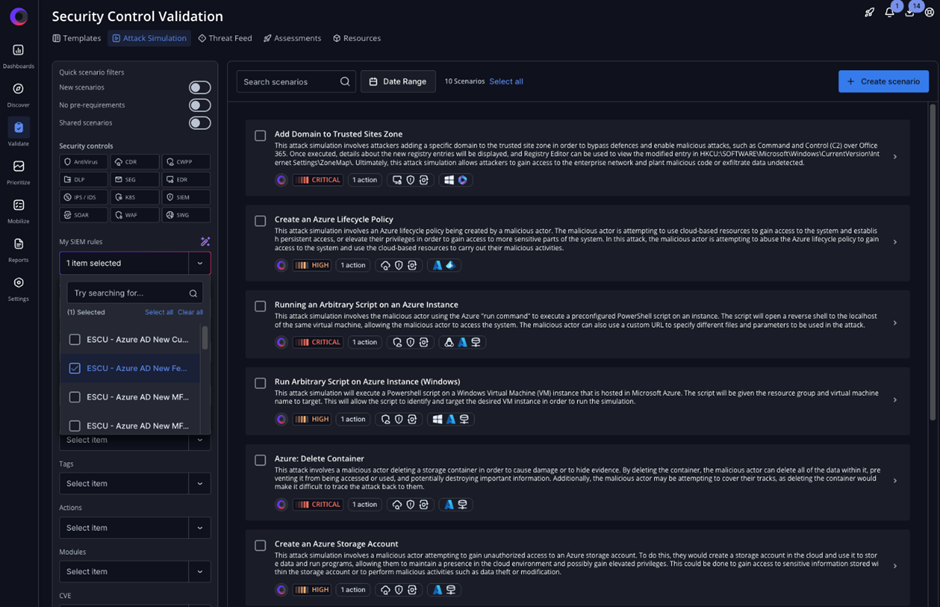
Visual representing the automation of SIEM rule validation using Cymulate attack scenarios to enhance threat detection and reduce cyber risk

A Smarter, Faster Path to Detection Confidence 

AI-powered SIEM rule validation delivers a fully automated workflow to accelerate detection engineering: 

  1. Integrate – Cymulate connects to your SIEM and automatically retrieves existing detection rules. 
  2. Correlate – An advanced AI correlation engine maps each rule to relevant attack scenarios from the platform’s extensive library of over 100,000 simulations. 
  3. Validate – Targeted simulations are run to confirm whether rules trigger as expected, revealing detection gaps. 
  4. Tune – Cymulate recommends vendor-specific detection rules to close those gaps, formatted for easy implementation. 
  5. Re-test – Updates can be instantly revalidated, enabling continuous tuning and confidence in rule performance. 

By enabling continuous testing and refinement of detection logic against real-world threats, Cymulate helps SecOps teams automate detection tuning, reduce visibility gaps and maximize the value of their SIEM investments. 

Detection Logic Remains Private and Secure 

The Cymulate commitment to proactive, secure operations extends beyond simulation and validation, it’s embedded into the very infrastructure of the platform. All customer data is handled exclusively within the platform’s dedicated AWS cloud environment, managed end-to-end by Cymulate to ensure maximum control and oversight. 

To reduce risk, Cymulate does not transmit customer data to third-party providers. All generative AI capabilities are developed and operated internally. This means sensitive detection logic, validation outputs and telemetry stay entirely within Cymulate’s ecosystem, never transmitted to third-party LLMs or APIs.  

Customer data is also strictly isolated. No data is reused across tenants or environments, and nothing is ever repurposed for training. Each organization’s insights remain theirs alone, meeting compliance obligations and reinforcing trust by design. 

More Ways Cymulate Supports Detection Engineering 

This new capability builds on the growing Cymulate suite of features designed to empower SecOps teams with automated security validation. Here are a few of the other Cymulate features designed to support detection engineering at every stage of the process: 

Build and validate new detections for emergent threats 

When new threats make headlines, speed matters. With the Cymulate AI Template Creator, SecOps teams can instantly generate assessments by uploading a threat advisory or news article. The platform uses AI to create a custom simulation based on the described threat behavior and allows teams to test current controls within minutes. 

This automated process helps teams get ahead of the newest threat and saves them hours of manual work: reviewing the advisory, identifying relevant IOCs and TTPs, performing threat modeling and impact analysis to understand how the threat maps to their environment and which systems may be at risk. And that’s all before beginning to validate detection coverage or coordinate a response. 

To accelerate this process further, if detection gaps are found, Cymulate provides tailored detection rules for your SIEM, EDR or XDR platform, making it easy to implement and test improvements. Teams can then re-run the assessment to confirm that alerts trigger correctly and enable a rapid, accurate response to evolving threats. 
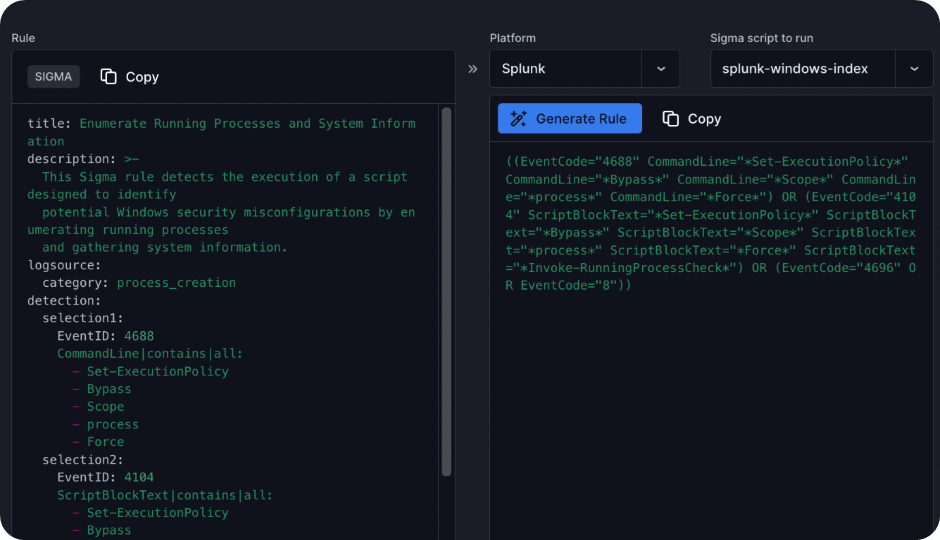
Visual illustrating how Cymulate delivers tailored detection rules to SIEM, EDR, or XDR platforms, enabling security teams to test and validate alerts for improved threat response

Baseline and optimize MITRE ATT&CK coverage 

Understanding what you can detect is as important as detecting it. The Cymulate MITRE ATT&CK heatmap gives teams a clear visual baseline of their detection coverage, mapped against real-world threat behavior. The heatmap highlights which tactics and techniques are fully covered, partially detected, or completely missing and helps teams prioritize where to create new rules or tune existing ones. With this actionable visibility, SecOps can focus their detection engineering efforts where it counts most. 
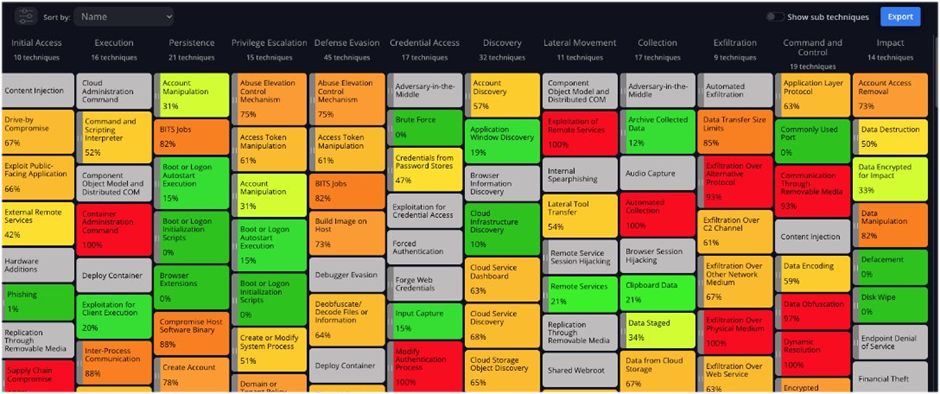
Cymulate MITRE ATT&CK heatmap visualizing detection coverage across threat tactics and techniques

Test SecOps processes, policies and playbooks 

Detection engineering isn’t just about rules, it’s also about how SecOps teams respond during an attack. Cymulate enables organizations to simulate real-world attack scenarios in a controlled environment, testing how well processes, tooling, and playbooks hold up under pressure. 

The Cymulate attack scenario workbench makes it easy for SecOps teams to build custom assessments from a library of more than 100,000 attack actions mapped to techniques, threat actors, malware families and more. These tailored assessments help teams evaluate how well their SecOps processes perform in realistic conditions. Cymulate also validates whether integrated controls are preventing, detecting and logging attacks as expected. Additionally, its SOAR integrations go one step further by verifying that incidents are properly registered and the response process is functioning as intended. 

These live exercises help surface operational blind spots (such as missing alerts, unclear handoffs, or ineffective escalation paths) before a real incident occurs. By validating not just the detection logic but the full response workflow, Cymulate helps teams improve coordination, reduce mean time to detect and respond, and boost overall operational readiness. 

Proven Results That Elevate Your SecOps 

By integrating Cymulate into the detection engineering workflow, security teams can dramatically improve both efficiency and effectiveness, and. see many measurable benefits, including: 

  • Optimized MITRE ATT&CK coverage – Continuous testing ensures better alignment with real-world adversary behaviors, improving visibility across tactics and techniques. 
  • Faster detection rule development – With automated threat simulation and tailored rule recommendations, teams significantly reduce the time required to build, test and deploy new detections. 
  • More frequent and reliable rule validation – Cymulate makes it easy to routinely test existing detections, helping teams catch logic gaps or drift before attackers do. 
  • Fewer false positives – By validating rules against realistic simulations, teams can fine-tune detection logic to reduce noise and focus on real threats. 

Ready to See it in Action? 

AI-powered SIEM rule validation brings a new level of speed, precision and automation to detection engineering. Whether you're building new detections or optimizing existing ones, Cymulate gives you the tools to stay ahead of threats and maximize your security investments. 

Request a demo today to see how Cymulate can transform your detection engineering program. 

Book a Demo