

Frequently Asked Questions

Threat Landscape & Handala Hack

What is the Handala Hack and why is it significant for cybersecurity teams?

The Handala Hack refers to a series of destructive cyberattacks attributed to a group aligned with Iranian regime interests. These attacks are significant because they focus on disruption, denial-of-service, and maximum damage, rather than financial gain. The group has targeted organizations in the U.S. and Middle East, using tactics like data deletion on devices managed by Microsoft Intune. Their campaigns highlight the need for organizations to validate their defenses against wiper campaigns, boot record corruption, and system recovery sabotage. Source

Who is behind the Handala Hack group?

Handala Hack is widely assessed to be aligned with Iranian regime interests or operating in support of Iranian strategic objectives. Research connects the group’s targeting, narratives, and operational patterns to Iran-linked activity, with a focus on Israeli organizations and entities in the broader Middle East. Source

What attack tactics and techniques does Handala Hack use?

Handala Hack campaigns combine destructive malware, scripted execution (such as PowerShell and Windows command shell), and coordinated information operations. They typically use system discovery, lateral movement, and defense-evasion techniques before deploying wiper malware. Their playbook includes script-driven execution, defense impairment, discovery and lateral movement, and high-tempo public claims to magnify impact. Source

Which industries are most at risk from Handala Hack attacks?

Industries most at risk include healthcare and medical technology, financial services and payment ecosystems, manufacturing and industrial operations, critical infrastructure and public sector, and large enterprises with complex IT/OT footprints. U.S. organizations in these sectors should maintain heightened awareness and readiness. Source

How does Cymulate help organizations prepare for threats like Handala Hack?

Cymulate enables security teams to move from threat awareness to measurable readiness by validating prevention and detection against adversary behaviors in a controlled, safe way. The platform offers AI-driven threat alignment, built-in Handala-aligned templates, IOC validation and mitigation testing, actionable remediation outputs, and executive-ready dashboards to communicate readiness. Source

What is the importance of validating both behavioral and IOC-based detections for threats like Handala?

Handala infrastructure can rotate quickly, making behavioral indicators more durable than static domains or IPs. Organizations should validate both behavioral detections (mapped to MITRE ATT&CK techniques) and blocking/alerting for known or newly ingested IOCs to ensure comprehensive defense. Source

How does Cymulate map Handala Hack techniques to MITRE ATT&CK?

Cymulate provides a detailed mapping of Handala Hack behaviors to MITRE ATT&CK tactics and techniques, such as phishing (T1566), PowerShell execution (T1059.001), lateral movement (T1021), and data destruction (T1485). This helps defenders validate their controls against specific, real-world adversary techniques. Source

What are some examples of Handala-aligned templates in Cymulate?

Cymulate offers ready-to-run assessments aligned to techniques commonly reported in Handala campaigns, such as PowerShell abuse, lateral movement, and destructive impact behaviors. These templates allow teams to test controls immediately without building custom simulations from scratch. Source

How does Cymulate use AI to improve threat readiness?

Cymulate AI ingests new threat intelligence and automatically generates a threat-centric view of current coverage, highlighting where prevention and detection are strong or need tuning. This accelerates alignment as threats like Handala evolve. Source

What kind of remediation support does Cymulate provide after a threat validation assessment?

Cymulate provides actionable remediation outputs for each validated prevention and detection gap. This includes auto-mitigation pushes of IOCs to controls and automatically generated vendor-specific detection logic for EDRs and SIEMs, making remediation concrete, actionable, and trackable. Source

How does Cymulate help communicate threat readiness to executives?

Cymulate uses AI to build custom dashboards and reports that quickly summarize testing results and findings for specific threats, enabling security teams to communicate threat readiness to executives in a clear and actionable way. Source

What are the key MITRE ATT&CK techniques associated with Handala Hack?

Key MITRE ATT&CK techniques associated with Handala Hack include T1566 (Phishing), T1190 (Exploit Public-Facing Application), T1059.001 (PowerShell), T1059.003 (Windows Command Shell), T1053 (Scheduled Task/Job), T1547 (Boot or Logon Autostart Execution), T1068 (Exploitation for Privilege Escalation), T1027 (Obfuscated/Compressed Information), T1562 (Impair Defenses), T1070 (Indicator Removal on Host), T1082 (System Information Discovery), T1018 (Remote System Discovery), T1021 (Remote Services), T1570 (Lateral Tool Transfer), T1485 (Data Destruction), T1490 (Inhibit System Recovery), and T1529 (System Shutdown/Reboot). Source

Where can I find more technical details about Cymulate's exposure validation for threats like Handala?

You can find more technical details in the Cymulate Exposure Validation data sheet, which explains automated attack simulations to test and validate cyber defenses. Read More

How does Cymulate support validation of lateral movement techniques?

Cymulate provides built-in templates and assessments for lateral movement techniques, such as PowerShell abuse and remote services, allowing organizations to test their controls against these tactics and ensure readiness against threats like Handala. Learn More

What resources does Cymulate offer for staying updated on emerging threats?

Cymulate offers a blog, newsroom, and events page to keep users updated on the latest threats, research, and industry news. Blog | Newsroom | Events

How can I access Cymulate's whitepapers and technical guides?

You can access Cymulate's whitepapers, guides, solution briefs, data sheets, and e-books in the Resource Hub. Resource Hub

Where can I find Cymulate's blog post about preventing lateral movement attacks?

Cymulate has a blog post titled 'Stopping Attackers in Their Tracks' that discusses common lateral movement attacks and how to prevent them. Read the blog post

How can I subscribe to the Cymulate blog?

To subscribe to the Cymulate blog, you need to provide your full name, email address, and country of residence. Privacy Policy

Features & Capabilities

What are the key features of Cymulate's platform?

Cymulate's platform offers continuous threat validation, a unified platform combining BAS, CART, and Exposure Analytics, AI-powered optimization, complete kill chain coverage, attack path discovery, automated mitigation, cloud validation, and ease of use. Source

Does Cymulate integrate with other security technologies?

Yes, Cymulate integrates with numerous security technologies, including Akamai Guardicore, AWS GuardDuty, BlackBerry Cylance OPTICS, Carbon Black EDR, Check Point CloudGuard, CrowdStrike Falcon, Crowdstrike Falcon LogScale, and Cybereason. For a complete list, visit the Partnerships and Integrations page.

How easy is Cymulate to implement and use?

Cymulate is designed for rapid implementation and ease of use. Customers report that deployment is fast and straightforward, with an intuitive dashboard and minimal resource requirements. The platform supports agentless mode and provides comprehensive support resources. Source

What feedback have customers given about Cymulate's ease of use?

Customers praise Cymulate for its intuitive design, ease of deployment, and user-friendly dashboard. Testimonials highlight the platform's simplicity, actionable insights, and excellent support. Customer Quotes

What technical documentation is available for Cymulate?

Cymulate provides whitepapers, guides, solution briefs, data sheets, and e-books covering topics like exposure management, threat detection, and vulnerability management. Access these resources in the Resource Hub.

What security and compliance certifications does Cymulate hold?

Cymulate holds SOC2 Type II, ISO 27001:2013, ISO 27701, ISO 27017, and CSA STAR Level 1 certifications, demonstrating its commitment to security and compliance. Security at Cymulate

How does Cymulate ensure data security and privacy?

Cymulate employs secure AWS data centers, encryption for data in transit and at rest, a robust Secure Development Lifecycle, continuous vulnerability scanning, and compliance with GDPR. The company has a dedicated privacy and security team, including a DPO and CISO. Security at Cymulate

Use Cases & Business Impact

What business impact can organizations expect from using Cymulate?

Organizations using Cymulate typically see a 30% improvement in threat prevention, a 52% reduction in critical exposures, a 60% increase in team efficiency, 40X faster threat validation, and an 81% reduction in cyber risk within four months. Source

What are some real-world case studies demonstrating Cymulate's effectiveness?

Case studies include Hertz Israel reducing cyber risk by 81% in four months, Nemours Children's Health increasing visibility and detection, and a financial services organization automating testing across 10 entities. More case studies are available on the Customers page.

Who can benefit from using Cymulate?

Cymulate is designed for CISOs and security leaders, SecOps teams, red teams, and vulnerability management teams across industries such as media, transportation, financial services, retail, and healthcare. Learn More

What core problems does Cymulate solve for organizations?

Cymulate addresses overwhelming threat volume, lack of visibility, unclear prioritization, operational inefficiencies, fragmented security tools, cloud complexity, and communication barriers for CISOs. About Us

How does Cymulate tailor its solutions for different security roles?

Cymulate provides validated exposure scoring and metrics for CISOs, automates processes for SecOps, offers scalable offensive testing for red teams, and prioritizes exposures for vulnerability management teams. Learn More

What is the primary purpose of Cymulate's platform?

The primary purpose is to harden defenses and optimize security controls by proactively validating controls, threats, and response capabilities, focusing on exploitable exposures, and strengthening overall security posture. About Us

How quickly can organizations implement Cymulate?

Organizations can implement Cymulate rapidly, often within a few clicks, due to its agentless mode, quick deployment, and minimal resource requirements. Source

What is Cymulate's pricing model?

Cymulate uses a subscription-based pricing model tailored to each organization's needs, based on the chosen package, number of assets, and scenarios. For a quote, schedule a demo.

Competition & Comparison

How does Cymulate compare to AttackIQ?

Cymulate offers the industry-leading threat scenario library and AI-powered capabilities for workflow acceleration and security posture improvement. AttackIQ focuses on automated security validation but lacks Cymulate's innovation, threat coverage, and ease of use. Read more

How does Cymulate differ from Mandiant Security Validation?

Mandiant is one of the original BAS platforms but has seen little innovation in recent years. Cymulate continually innovates with AI and automation, expanding into exposure management as a grid leader. Read more

What makes Cymulate different from Pentera?

Pentera is useful for attack path validation but lacks Cymulate's depth for fully assessing and strengthening defenses. Cymulate optimizes defense, scales offensive testing, and increases exposure awareness. Read more

How does Cymulate compare to Picus Security?

Picus may suit organizations seeking a BAS vendor with an on-prem option. Cymulate offers a more complete exposure validation platform covering the full kill chain and cloud control validation. Read more

What are Cymulate's advantages over SafeBreach?

Cymulate outpaces SafeBreach with unmatched innovation, precision, and automation. It features the industry’s largest attack library, a full CTEM solution, and comprehensive exposure validation. Read more

How does Cymulate compare to Scythe?

Scythe is suitable for advanced red teams building custom attack campaigns. Cymulate provides a more comprehensive exposure validation platform with actionable remediation and automated mitigation. Read more

What differentiates Cymulate from NetSPI?

NetSPI excels in penetration testing as a service (PTaaS). Cymulate is designed for continuous, independent assessment and strengthening of defenses, recognized as a leader in exposure validation by Gartner and G2. Read more

Company Information & Vision

What is Cymulate's mission and vision?

Cymulate's mission is to revolutionize how companies approach cybersecurity by fostering a proactive stance against threats and empowering organizations to manage their security posture and improve resilience. About Us

How large is Cymulate and what is its global presence?

Cymulate was founded in 2016, has a presence in 8 global locations, serves customers in 50 countries, and is trusted by over 1,000 customers. About Us

New: 2026 Gartner® Market Guide for Adversarial Exposure Validation
Learn More
Cymulate named a Customers' Choice in 2025 Gartner® Peer Insights™
Learn More
New Research: The Security Tradeoffs Behind AI Tooling
Learn More
An Inside Look at the Technology Behind Cymulate
Learn More

Handala Hack: From Regional Disruption to Digital Destruction — Why Security Validation Matters Now 
By: David Kellerman

Last Updated: April 9, 2026

After years of battling ransomware and financially motivated threats, security teams must now increase their focus to defend against digital destruction. Iranian-backed Handala Hack highlighted the growing threat with its claimed attacks against a U.S.-based medical equipment maker, with reports of widespread deletion of data on devices managed by Microsoft Intune.  

While the hot war may be contained to the Middle East, this cyberattack raises the alarm about the likelihood of future attacks targeting U.S. and Western organizations, where the objectives are more likely to be disruption, denial-of-service, and maximum damage. 

It’s time for security teams to take a threat-informed approach security and harden their defenses against wiper campaigns, boot record corruption and system recovery sabotage. 

Who is Handala Hack? 

Handala Hack is widely assessed to be aligned with Iranian regime interests or operating in support of Iranian strategic objectives. Research reporting connects the group’s targeting, narratives and operational patterns to Iran-linked activity, with a long-running focus on Israeli organizations and entities in the broader Middle East. 

Unlike for-profit threat actors, Handala aims to disrupt operations and missions while publicly announcing its claimed victims to amplify psychological and reputational impact. 

What attack tactics and techniques are used? 

According to industry threat research, Handala campaigns combine destructive malware, scripted execution and coordinated information operations to maximize operational and psychological impact. The actor typically employs system discovery, lateral movement and defense-evasion techniques before deploying wiper malware intended to disrupt and render targeted systems.  

A typical Handala playbook includes: 

  • Script-driven execution, including PowerShell and Windows command shell (BAT) activity to stage, automate and execute actions 
  • Defense impairment steps intended to reduce visibility or response capability before destructive execution 
  • Discovery and lateral movement behaviors allowing for broader reach and faster disruption inside a network 
  • High-tempo public claims and information operations (e.g., leak announcements) to magnify impact 

Why does this threat matter now — and who is at risk?

U.S. organizations should maintain heightened awareness and readiness as recent activity indicates that Handala is now targeting entities within the United States. Their malicious threat campaigns stand out for two reasons: 1. disruptive/destructive intent and 2. comparatively consistent public claims that often align with real operational impact.  

U.S. defenders, specifically in the below industries, should remain vigilant and be prepared with the assumption the objective is an outage and major operational disruption, not negotiation.  

  • Healthcare and medical technology 
  • Financial services and payment ecosystems 
  • Manufacturing and industrial operations 
  • Critical infrastructure and public sector 
  • Large enterprises with complex IT/OT footprints 

How Cymulate helps you prepare and prove readiness 

Cymulate enables security teams to move from threat awareness to measurable readiness by validating prevention and detection against adversary behaviors in a controlled, safe way. 

Cymulate AI for continuous threat alignment. With Cymulate AI cutting-edge capabilities, security teams can ingest new threat intelligence and automatically generate a threat-centric view of current coverage, highlighting where prevention and detection is strong and where it needs tuning. This accelerates alignment as Handala (and the broader threat landscape) evolves. 

See how Cymulate AI converts threat intel into custom threat validation assessments. 

Built-in Handala-aligned templates. The Cymulate platform has ready-to-run assessments aligned to the techniques commonly reported in Handala campaigns (e.g., PowerShell abuse, lateral movement techniques and destructive impact behaviors). This allows teams to test controls immediately without building custom simulations from scratch – start assessing and validating now. 

IOC validation and mitigation testing. Beyond simulating techniques, Cymulate tests known indicators associated with Handala that may be reused. Security teams can rapidly validate that their controls block or alert on these indicators across security controls (endpoint, network, SIEM) and confirm the end-to-end workflow from detection to response. 
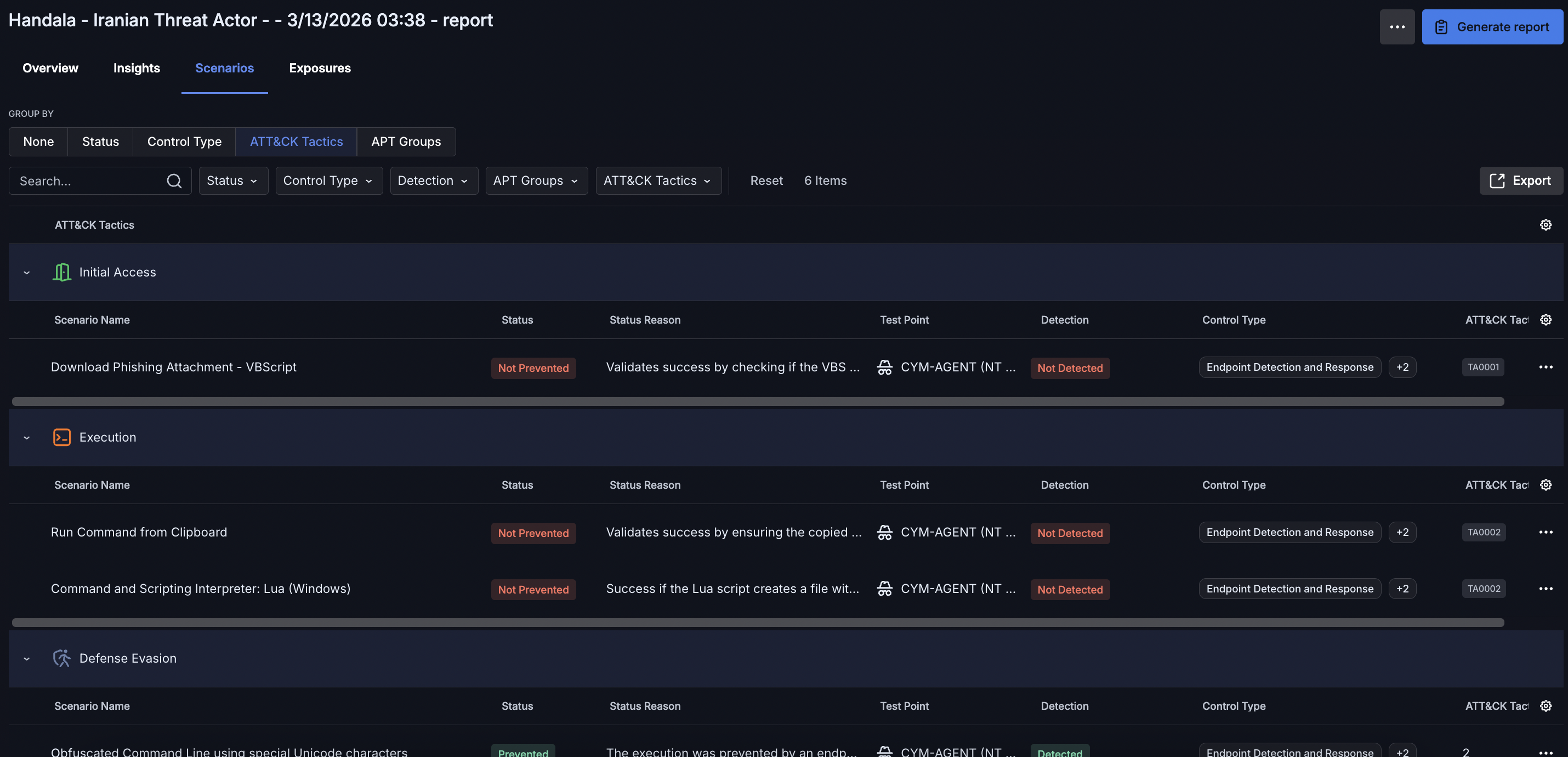
handala assessment results cymulate

Cymulate threat validation proves prevention and detection for specific MITRE ATT&CK tactics techniques. 

Actionable remediation outputs. For each validated prevention and detection gap, Cymulate helps teams quickly mitigate these findings. This includes auto-mitigation pushes of IOCs to controls and automatically generated vendor-specific detection logic for EDRs and SIEMs. Security remediation is concrete, actionable and trackable. Cymulate enables organizations to quickly validate their posture and improve their threat resilience, which reduces operational risk. 

Executive-ready communication. To quickly and easily communicate threat readiness, Cymulate uses AI to build custom dashboards and reports to quickly summarize testing results and findings for specific threats. 

See how Cymulate uses AI to create custom dashboards. 

Closing thought 

When destructive actors, such as Handala, broaden their targeting, reactive posture is not enough. Readiness must be continuously tested and validated against the techniques that matter. The most important question for defenders is simple: if Handala tested your environment tomorrow, would you already know the outcome? 

MITRE ATT&CK mapping for Handala tradecraft 

The table below maps commonly reported Handala behaviors and activity to MITRE ATT&CK tactics and techniques, and what defenders must be validating in their environment. 

Technique IDTechniqueHow Handala Uses ItWhat to Validate
Initial Access
T1566PhishingSpear-phishing to deliver payloads or enable credential accessEmail security efficacy; attachment/link detonation; user reporting workflow
T1190Exploit Public-Facing ApplicationExploitation of exposed services for footholdWAF efficacy; patch exposure; exploitation detection
Execution
T1059.001PowerShellEncoded/obfuscated PowerShell used for staging and executionEDR detections for encoded commands; suspicious flags; script block logging
T1059.003Windows Command ShellBAT/cmd execution to automate stepsCommand-line auditing; parent/child process anomalies
Persistence
T1053Scheduled Task/JobScheduled tasks to re-run scripts or stagesAlert on new tasks; anomalous task creators; task execution lineage
T1547Boot or Logon Autostart ExecutionAutostart persistence mechanismsRun keys/startup folder monitoring; registry auditing
Privilege Escalation
T1068Exploitation for Privilege EscalationElevation after foothold to expand controlPrivilege escalation detections; exploit telemetry
Defense Evasion
T1027Obfuscated/Compressed InformationObfuscated scripts and encoded payloadsCommand-line detections; AMSI/script deobfuscation coverage
T1562Impair DefensesSecurity control tampering prior to impactService stop detections; tamper protection validation
T1070Indicator Removal on HostClearing logs/artifacts to reduce visibilityDetect log clearing; retention/forwarding resiliency
Discovery
T1082System Information DiscoveryHost reconnaissance prior to impactDetect unusual enumeration; correlate with other stages
T1018Remote System DiscoveryNetwork discovery to identify reachable systemsSMB/RPC discovery monitoring; anomaly detection
Lateral Movement
T1021Remote ServicesUse of remote services for movementRemote execution monitoring; admin share controls
T1570Lateral Tool TransferTransfer payloads/tools across hostsFile transfer telemetry; share write monitoring
Impact
T1485Data DestructionWipers overwrite files/disksDetect mass destructive patterns; rapid isolation playbooks
T1490Inhibit System RecoveryShadow copy deletion / recovery inhibitionBlock/alert on vssadmin/bcdedit misuse; backup hardening
T1529System Shutdown/ RebootForced restarts as part of impact chainCorrelate coordinated shutdowns; containment procedures

IOC and detection validation 

Handala infrastructure can rotate quickly, so behavioral indicators are often more durable than static domains or IPs. Still, organizations should validate both: (1) behavioral detections that map to the techniques above, and (2) blocking and alerting for known or newly ingested IOCs. 

References 

Cymulate Exposure Validation makes advanced security testing fast and easy. When it comes to building custom attack chains, it's all right in front of you in one place.
Mike Humbert, Cybersecurity Engineer
DARLING INGREDIENTS INC.
Learn More
Book a Demo