Frequently Asked Questions

Understanding TTPs in Cybersecurity

What are Tactics, Techniques, and Procedures (TTPs) in cybersecurity?

Tactics, Techniques, and Procedures (TTPs) are the methods, approaches, and strategies used by cyber threat actors to launch attacks. Tactics describe the 'what' (objectives), techniques explain the 'how' (methods), and procedures detail the specific steps attackers follow. Understanding TTPs helps organizations anticipate attacker intent and strengthen their defenses. Learn more.

Why are TTPs important for cybersecurity professionals?

TTPs provide valuable insights into the motivations and goals of cyber attackers. By understanding TTPs, cybersecurity professionals can anticipate threats, improve incident response, and develop more effective defense strategies. Source.

How do tactics, techniques, and procedures differ from each other?

Tactics define the attacker's objectives (the 'what'), techniques describe the general methods used to achieve those objectives (the 'how'), and procedures are the detailed, step-by-step actions or tools used during an attack. This layered approach helps defenders reconstruct and understand attacks more effectively. Source.

What frameworks are built on the concept of TTPs?

Several well-known frameworks are based on TTPs, including MITRE ATT&CK, the Cyber Kill Chain, and the NIST Cybersecurity Framework. These frameworks help organizations structure their defense strategies and improve threat detection and response. Source.

How does the MITRE ATT&CK framework relate to TTPs?

The MITRE ATT&CK framework is a comprehensive repository of TTPs, categorizing them into matrices for different environments (Enterprise, Mobile, ICS). It maps real-world adversary behaviors, helping organizations enhance detection and response. Learn more.

What are the stages of the Cyber Kill Chain framework?

The Cyber Kill Chain framework outlines seven stages of a cyber attack: Reconnaissance, Weaponization, Delivery, Exploitation, Installation, Command and Control, and Actions on Objectives. Each stage helps organizations understand and prevent attacks. Source.

How does the NIST Cybersecurity Framework incorporate TTPs?

The NIST Cybersecurity Framework integrates TTPs into its guidelines for improving critical infrastructure cybersecurity. It is divided into five core functions: Identify, Protect, Detect, Respond, and Recover. Source.

How does understanding TTPs help with incident response?

Understanding TTPs allows defenders to reconstruct attacks, identify the exact methods used, and respond more effectively to incidents. This knowledge aids in forensics and helps prevent future attacks. Source.

How can organizations use TTPs to strengthen their security posture?

By analyzing TTPs, organizations can anticipate attacker behavior, implement targeted defenses, and improve employee awareness. Continuous monitoring and TTP-based strategies help future-proof cybersecurity initiatives. Source.

What is the role of TTPs in threat intelligence?

TTPs are foundational to threat intelligence, providing context for attacker behavior and enabling organizations to detect, prevent, and respond to threats more effectively. Source.

How does Cymulate utilize TTPs in its platform?

Cymulate leverages TTPs to simulate real-world attacks, validate security controls, and provide actionable insights for proactive defense. The platform uses TTPs to test against immediate threats, validate controls, customize attack scenarios, and map findings to the MITRE ATT&CK framework. Learn more.

What is Cymulate's Immediate Threats module and how does it use TTPs?

Cymulate's Immediate Threats module tests security controls against new and emerging threats. It is updated daily with attack simulations based on the latest TTPs and Indicators of Compromise (IOCs), providing insights into threat actors and attack vectors. Learn more.

How does Cymulate validate security controls using TTPs?

Cymulate continuously validates security controls by running automated tests based on TTPs. These simulations imitate real threat actor behavior across various attack vectors, helping organizations identify gaps and weaknesses in real time. Learn more.

Can Cymulate customize attack scenarios based on TTPs?

Yes, Cymulate BAS Advanced Scenarios offers customizable attack scenarios and templates based on the MITRE framework. Organizations can tailor simulations to their specific threat landscape and security objectives by incorporating relevant TTPs. Learn more.

How does Cymulate map findings to the MITRE ATT&CK framework?

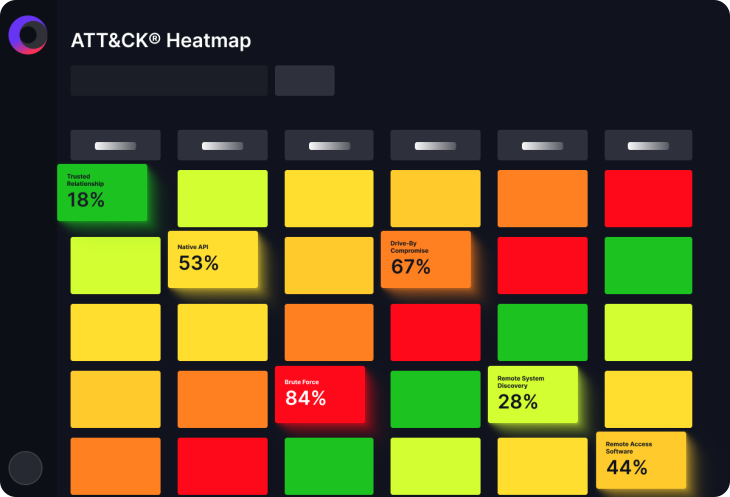
The Cymulate MITRE ATT&CK Heatmap dashboard correlates all findings from across the platform to the MITRE ATT&CK framework. Each technique and sub-technique is represented and color-coded by risk, providing instant visual cues on organizational exposure. Learn more.

What are the benefits of using TTP-based simulations in Cymulate?

TTP-based simulations in Cymulate help organizations identify vulnerabilities, validate security controls, and receive actionable insights for proactive defense. This approach ensures defenses are effective against real-world threats. Learn more.

How does Cymulate help organizations stay ahead of emerging threats?

Cymulate updates its Breach and Attack Simulation library daily with new TTPs and threat intelligence, enabling organizations to test their defenses against the latest attack methods and adapt quickly. Learn more.

How does Cymulate support compliance and regulatory requirements?

Cymulate's TTP-based validation helps organizations meet compliance and regulatory requirements by continuously testing and documenting the effectiveness of security controls against real-world threats. Learn more.

Where can I find a glossary of cybersecurity terms like TTPs?

Cymulate provides a continuously updated glossary of cybersecurity terms, acronyms, and jargon. Visit our glossary page for more information.

Does Cymulate offer educational resources on TTPs and related topics?

Yes, Cymulate offers a Resource Hub, blog, webinars, and a glossary to help users stay informed about TTPs, cybersecurity frameworks, and best practices. Explore resources at our Resource Hub.

How does Cymulate integrate with other security technologies for TTP-based validation?

Cymulate integrates with a wide range of security technologies, including Akamai Guardicore, AWS GuardDuty, CrowdStrike Falcon, SentinelOne, and more, to enhance TTP-based validation and provide a unified view of your security posture. See all integrations.

What certifications does Cymulate hold for security and compliance?

Cymulate holds several key certifications, including SOC2 Type II, ISO 27001:2013, ISO 27701, ISO 27017, and CSA STAR Level 1, demonstrating adherence to industry-leading security and compliance standards. Learn more.

What types of organizations benefit most from Cymulate's TTP-based approach?

Cymulate's TTP-based approach benefits organizations of all sizes and industries, including finance, healthcare, retail, media, transportation, and manufacturing. It is designed for CISOs, SecOps teams, Red Teams, and Vulnerability Management teams. Learn more.

How easy is it to implement Cymulate for TTP-based validation?

Cymulate is designed for quick and easy implementation, operating in agentless mode with minimal setup. Customers can start running TTP-based simulations almost immediately, with comprehensive support and educational resources available. Book a demo.

What feedback have customers given about Cymulate's TTP-based platform?

Customers consistently praise Cymulate for its ease of use, intuitive dashboard, and actionable insights. Testimonials highlight the platform's effectiveness in identifying threats and improving security posture. See customer stories.

How does Cymulate's TTP-based validation compare to traditional penetration testing?

Cymulate offers automated, continuous TTP-based validation, providing real-time insights and daily updates, whereas traditional penetration testing is typically manual and point-in-time. This enables organizations to stay ahead of emerging threats and optimize defenses more efficiently. Learn more.

What are some real-world results achieved with Cymulate's TTP-based approach?

Organizations using Cymulate have reported measurable outcomes, such as an 81% reduction in cyber risk within four months (Hertz Israel), a 52% reduction in critical exposures, and a 60% increase in team efficiency. Read the case study.

How does Cymulate's TTP-based validation help with vulnerability management?

Cymulate validates the exploitability of vulnerabilities using TTP-based simulations, helping organizations prioritize remediation efforts and focus on the most critical exposures. Learn more.

What support options are available for Cymulate users implementing TTP-based validation?

Cymulate provides comprehensive support, including email, chat, a knowledge base, webinars, and an AI chatbot to assist users with TTP-based validation and platform optimization. Contact support.

How does Cymulate's TTP-based approach foster collaboration across security teams?

Cymulate's unified platform enables collaboration between SecOps, Red Teams, and Vulnerability Management teams by providing a shared view of exposures and actionable insights based on TTPs. Learn more.

How does Cymulate's pricing model work for TTP-based validation?

Cymulate operates on a subscription-based pricing model tailored to each organization's needs, including the chosen package, number of assets, and scenarios. For a detailed quote, schedule a demo.

What makes Cymulate's TTP-based validation unique compared to competitors?

Cymulate stands out with its unified platform combining Breach and Attack Simulation, Continuous Automated Red Teaming, and Exposure Analytics. It offers continuous, AI-powered TTP-based validation, daily threat updates, and proven results such as significant reductions in cyber risk and increased team efficiency. See comparisons.

Introducing Cymulate Vero AI for Agentic Cyber Defense Engineering
Learn More
New: 2026 Gartner® Market Guide for Adversarial Exposure Validation
Learn More
New Research: Exploiting Configuration Trust in AI Coding Tools
Learn More
New Case Study: How a Financial Authority Validates Cyber Resilience
Learn More

What are TTPs in Cybersecurity?
Tactics, Techniques, and Procedures Explained

Tactics, Techniques, and Procedures (TTPs) are the methods, approaches, tools and strategies a cyber threat actor (commonly known as an unethical hacker) uses to launch a cyber attack. By having a deep understanding of TTPs, cybersecurity professionals gain valuable insights into the motivations and goals of cyber attackers, which is crucial for developing a solid security posture.

Key Points:

  • TTPs (Tactics, Techniques, and Procedures) serve as a blueprint for cyber attacks, helping organizations understand adversary behavior.
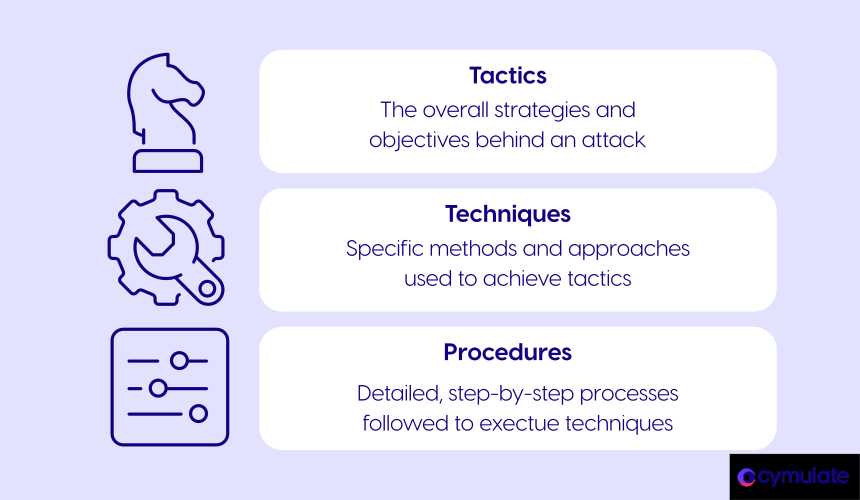
  • They consist of three layers: tactics (the “what”), techniques (the “how”), and procedures (the detailed steps).
  • Well-known frameworks such as MITRE ATT&CK, the Cyber Kill Chain, and the NIST Cybersecurity Framework are built on TTP concepts.
  • Understanding TTPs empowers defenders to anticipate attacker intent, strengthen defenses, and improve incident response.
  • Cymulate leverages TTPs to simulate real-world attacks, validate security controls, and provide actionable insights for proactive defense.
ttps in cybersecurity

What are TTPs?

TTPs serve as the blueprint for cyber attacks, helping us understand cyber attackers' motivations, goals, and attack patterns. The framework has three parts:

Tactics

The objectives behind a cyber attack. Tactics describe the "what" of an attack, such as data exfiltration or system disruption. They provide context to the attack's overall goals, allowing defenders to anticipate their intent and prepare accordingly.

Techniques

Techniques are the general methods used to achieve the tactics. They describe the "how" of an attack, such as using phishing emails, malware deployment, or exploiting software vulnerabilities. Techniques help understand the specific actions threat actors take during an attack, making it easier to identify and disrupt their activities.

Procedures

Procedures are the detailed, step-by-step actions that attackers follow to implement their techniques. This includes specific commands, tools, and scripts used during the attack. By understanding the attacker's procedures, defenders can reconstruct the attack and understand the exact methods used, aiding in incident response and forensics.

TTPs frameworks

Tactics, Techniques, and Procedures (TTPs) are not a framework but a guideline for an effective and proactive cybersecurity defense strategy. Several known frameworks have been built on the basis of TTPs, including:

MITRE ATT&CK

The MITRE ATT&CK framework is perhaps the most comprehensive repository of TTPs, categorizing them into various matrices based on different environments, such as Enterprise, Mobile, and Industrial Control Systems (ICS).

ATT&CK provides a detailed mapping of real-world adversary behaviors, helping organizations enhance their threat detection and response capabilities. It includes tactics like initial access, execution, persistence, privilege escalation, defense evasion, and more, each with corresponding techniques and procedures.

Cyber Kill-Chain

The Cyber Kill-Chain framework, developed by Lockheed Martin is another model based on TTPs. It outlines the different stages of a cyber attack, from reconnaissance to actions on objectives, providing a structured approach to understanding and preventing cyber attacks. The seven stages are:

  1. Reconnaissance: Gathering information about the target.
  2. Weaponization: Developing malware based on the gathered information.
  3. Delivery: Transmitting the malware to the target.
  4. Exploitation: Exploiting vulnerabilities to execute the malware.
  5. Installation: Installing the malware on the target system.
  6. Command and Control: Establishing communication with the compromised system.
  7. Actions on Objectives: Performing the intended malicious activities.

NIST Cybersecurity Framework

The National Institute of Standards and Technology (NIST) Cybersecurity Framework include TTPs into its guidelines for improving critical infrastructure cybersecurity. The framework is divided into five core functions:

  1. Identify: Understanding the organization's risk environment.
  2. Protect: Implementing safeguards to protect critical infrastructure.
  3. Detect: Developing activities to identify cybersecurity events.
  4. Respond: Taking action regarding detected cybersecurity events.
  5. Recover: Implementing plans for resilience and recovery from cybersecurity incidents.

How Cymulate Utilizes TTPs

The Cymulate platform uses Tactics, Techniques, and Procedures (TTPs) to help organizations assess, optimize, and improve their security posture. By simulating real-world cyber attacks, Cymulate provides actionable insights into vulnerabilities and the effectiveness of existing security measures, enabling proactive defense strategies.

1. Test Against Immediate Threats:

Cymulate Immediate Threats tests security controls against new and emerging cyber threats. The Breach and Attack Simulation is updated daily with attack simulations based on the latest threats that require urgent attention and action. Threat and simulation updates use the exact Indicators of Compromise (IOCs) and TTPs of that threat and include insights into threat actors and attack vectors.

2. Validate Security Controls:

Cymulate continuously validates security controls by running automated tests based on TTPs. These simulations imitate the behavior of real threat actors and cover various attack vectors such as email, web, endpoint, and lateral movement. By using TTPs, Cymulate can simulate sophisticated attack scenarios to test an organization’s defenses. This helps organizations identify gaps and weaknesses in real-time, making sure that security measures are always up-to-date and effective against new threats.

3. Customize Attack Scenarios:

Cymulate BAS Advanced Scenarios prioritizes safety by offering a range of out-of-the-box executions and templates based on the MITRE framework for simulating Tactics, Techniques, and Procedures (TTPs). Organizations can customize attack scenarios based on their specific cyber threat landscape and security objectives. By incorporating TTPs relevant to their industry or region, they can focus on the most pertinent threats and tailor their defense strategies accordingly.

4. Map to the MITRE ATT&CK Framework:

As mentioned, the MITRE ATT&CK framework represents a globally accessible knowledge base detailing the tactics, techniques, and procedures (TTPs) used by threat actors. The Cymulate MITRE ATT&CK Heatmap dashboard correlates all findings from across the Cymulate platform to map to the framework and visualize exposure to each technique.

cymulate mitre attack framework

Each technique and sub-technique from the MITRE framework is represented and color-coded by risk, providing an instant visual cue on an organization’s susceptibility to various attack types. The clear and actionable insights from the Cymulate MITRE ATT&CK integration streamline and enhance an organization's cybersecurity defenses.

Key Takeaways

Understanding TTPs in cybersecurity is crucial for staying ahead of the growing number of cyber threats. By dissecting tactics, techniques, and procedures, organizations can strenghten their defenses effectively.

Implementing TTP-based strategies, leveraging threat intelligence platforms, and enhancing employee awareness are key steps toward a robust cyber defense. Continuous monitoring, incident response, and staying updated on emerging threats are essential for future-proofing cybersecurity initiatives. Embracing TTPs empowers organizations to navigate the evolving cyber landscape with confidence.

Book a Demo