
Frequently Asked Questions

NIST Compliance & Framework

What is the NIST Cybersecurity Framework (CSF) and why is it important?

The NIST Cybersecurity Framework (CSF) is a globally recognized set of voluntary guidelines introduced to improve critical infrastructure cybersecurity in the U.S. It helps organizations of all sizes manage and mitigate cybersecurity risk, and its adoption can also help satisfy broader compliance requirements such as GDPR, HIPAA, and CMMC. (Source: Original Webpage)

Which organizations should consider aligning with the NIST CSF?

The NIST CSF is relevant for federal agencies, defense contractors, healthcare organizations, financial institutions, and any company managing sensitive or regulated data. Its broad applicability makes it a cornerstone for structured cybersecurity improvement. (Source: Original Webpage)

What are the five core functions of the NIST Cybersecurity Framework?

The five core functions of the NIST CSF are: Identify, Protect, Detect, Respond, and Recover. These provide a strategic view of the lifecycle of cybersecurity risk and guide organizations in building a robust cybersecurity program. (Source: Original Webpage)

What are the key NIST publications for compliance?

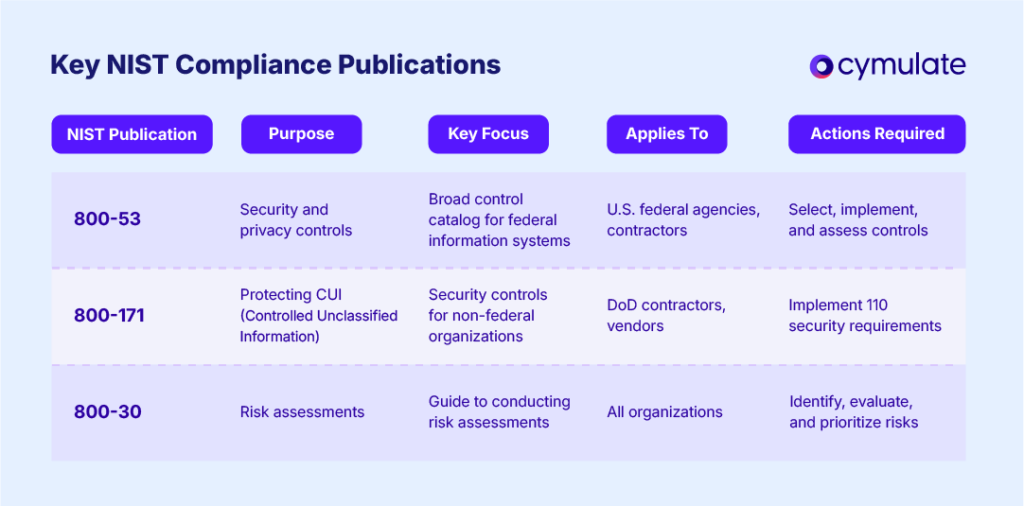
Key NIST publications include NIST SP 800-53 (Security and Privacy Controls), NIST SP 800-171 (Protecting Controlled Unclassified Information), and NIST SP 800-30 (Risk Assessment). Each standard contributes foundational guidance for building a comprehensive cybersecurity framework. (Source: Original Webpage)

What steps should organizations follow to achieve NIST compliance?

Organizations should: 1) Identify applicable NIST standards, 2) Perform a gap assessment, 3) Define and document risk management policies, 4) Manage and classify assets and data, 5) Implement safeguards, 6) Deploy detection mechanisms, 7) Develop and test incident response plans, 8) Establish recovery processes, 9) Manage third-party risk, 10) Continuously monitor and validate controls, 11) Prepare for audits, 12) Conduct employee training, and 13) Regularly review and update compliance strategies. (Source: Original Webpage)

How does Cymulate support NIST compliance efforts?

Cymulate helps organizations stay NIST compliant by providing continuous validation and improvement of security controls. The platform aligns with NIST CSF functions by offering real-time asset exposure mapping, validating security controls, evaluating detection and alerting capabilities, testing incident response, and refining recovery procedures. (Source: Original Webpage)

What is included in a NIST compliance checklist?

A NIST compliance checklist includes understanding applicable standards, performing gap assessments, defining risk management policies, managing assets and data, implementing safeguards, deploying detection mechanisms, developing incident response plans, establishing recovery processes, managing third-party risk, continuous monitoring, audit preparation, employee training, and regular strategy updates. (Source: Original Webpage)

How does Cymulate map to the five NIST CSF functions?

Cymulate maps to the NIST CSF functions as follows: Identify (asset exposure mapping), Protect (validating security controls), Detect (evaluating detection and alerting), Respond (testing incident response), and Recover (refining recovery procedures with post-exercise reports). (Source: Original Webpage)

How can Cymulate help with NIST audit preparation?

Cymulate supports NIST audit preparation by enabling continuous monitoring and validation of security controls, maintaining documentation and evidence, and providing actionable insights that align with NIST guidelines. (Source: Original Webpage)

What are the benefits of using Cymulate for NIST compliance?

Using Cymulate for NIST compliance helps organizations strengthen their cybersecurity posture, satisfy regulatory obligations, minimize the impact of cyber incidents, and be fully prepared for audits and reviews. (Source: Original Webpage)

How does Cymulate help with continuous monitoring and validation for NIST compliance?

Cymulate enables continuous monitoring and validation by automating testing, audits, and assessments to verify the effectiveness of security controls, ensuring ongoing alignment with NIST requirements. (Source: Original Webpage)

What role does employee training play in NIST compliance?

Employee training is essential for NIST compliance. Organizations should conduct regular training and awareness programs on security best practices, phishing resistance, and compliance responsibilities. (Source: Original Webpage)

How does Cymulate support risk quantification and compliance mapping?

Cymulate supports risk quantification and compliance mapping by helping teams directly align security validation results with NIST guidelines and compliance requirements, making it easier to demonstrate compliance. (Source: Original Webpage)

What are the advantages of using automated tools like Cymulate for NIST compliance?

Automated tools like Cymulate streamline compliance by providing continuous validation, actionable insights, and real-time reporting, reducing manual effort and improving the effectiveness of security controls. (Source: Original Webpage)

How can organizations manage third-party risk as part of NIST compliance?

Organizations should use a NIST third-party compliance checklist to evaluate vendors and partners, ensuring that third-party risks are identified and managed according to NIST guidelines. (Source: Original Webpage)

Why is continuous improvement important for NIST compliance?

NIST compliance is not a one-time exercise; it requires continuous validation and improvement to adapt to evolving threats, technologies, and regulations. (Source: Original Webpage)

Where can I find more resources on NIST compliance and Cymulate's approach?

You can find more resources, including guides, checklists, and case studies, on the Cymulate Resource Hub and the Cymulate Blog. (Source: Original Webpage)

How does Cymulate help organizations prepare for regulatory audits?

Cymulate helps organizations prepare for regulatory audits by maintaining documentation, providing evidence of control effectiveness, and aligning validation results with NIST and other compliance frameworks. (Source: Original Webpage)

What is the value of post-incident reviews in the NIST framework?

Post-incident reviews are essential for learning from cybersecurity incidents and planning future improvements, as recommended in the NIST framework's Recover function. (Source: Original Webpage)

Features & Capabilities

What are the key capabilities of Cymulate's platform?

Cymulate offers continuous threat validation, a unified platform combining Breach and Attack Simulation (BAS), Continuous Automated Red Teaming (CART), and Exposure Analytics, attack path discovery, automated mitigation, AI-powered optimization, complete kill chain coverage, ease of use, and an extensive threat library with over 100,000 attack actions updated daily. (Source: Knowledge Base)

Does Cymulate integrate with other security technologies?

Yes, Cymulate integrates with a wide range of security technologies, including Akamai Guardicore, AWS GuardDuty, BlackBerry Cylance OPTICS, Carbon Black EDR, Check Point CloudGuard, Cisco Secure Endpoint, CrowdStrike Falcon, Wiz, SentinelOne, and more. For a complete list, visit the Cymulate Partnerships and Integrations page. (Source: Knowledge Base)

How easy is Cymulate to implement and use?

Cymulate is designed for quick and easy implementation, operating in agentless mode with no need for additional hardware or complex configurations. Customers can start running simulations almost immediately, and the platform is praised for its intuitive, user-friendly interface. (Source: Knowledge Base)

What feedback have customers given about Cymulate's ease of use?

Customers consistently praise Cymulate for its ease of use, intuitive dashboard, and actionable insights. Testimonials highlight its user-friendly portal, excellent support, and immediate value in identifying security gaps. (Source: Knowledge Base)

What security and compliance certifications does Cymulate hold?

Cymulate holds several key certifications, including SOC2 Type II, ISO 27001:2013, ISO 27701, ISO 27017, and CSA STAR Level 1, demonstrating adherence to industry-leading security and compliance standards. (Source: Knowledge Base)

How does Cymulate ensure data security and privacy?

Cymulate ensures data security through encryption for data in transit (TLS 1.2+) and at rest (AES-256), secure AWS-hosted data centers, a tested disaster recovery plan, and compliance with GDPR. The platform also includes 2FA, RBAC, and IP address restrictions. (Source: Knowledge Base)

What is Cymulate's pricing model?

Cymulate uses a subscription-based pricing model tailored to each organization's requirements. Pricing depends on the chosen package, number of assets, and scenarios selected. For a detailed quote, organizations can schedule a demo with the Cymulate team. (Source: Knowledge Base)

How does Cymulate differ from other security validation platforms?

Cymulate stands out with its unified platform combining BAS, CART, and Exposure Analytics, continuous 24/7 threat validation, AI-powered optimization, complete kill chain coverage, ease of use, and an extensive, frequently updated threat library. (Source: Knowledge Base)

What business impact can customers expect from using Cymulate?

Customers can expect up to a 52% reduction in critical exposures, a 60% increase in team efficiency, 40X faster threat validation, and an 81% reduction in cyber risk within four months, as reported in customer case studies. (Source: Knowledge Base)

Who is the target audience for Cymulate?

Cymulate is designed for CISOs and security leaders, SecOps teams, Red Teams, and Vulnerability Management teams in organizations of all sizes and industries, including finance, healthcare, retail, media, transportation, and manufacturing. (Source: Knowledge Base)

What pain points does Cymulate address for security teams?

Cymulate addresses fragmented security tools, resource constraints, unclear risk prioritization, cloud complexity, communication barriers, inadequate threat simulation, operational inefficiencies in vulnerability management, and post-breach recovery challenges. (Source: Knowledge Base)

Are there case studies showing Cymulate's effectiveness?

Yes, case studies include Hertz Israel reducing cyber risk by 81% in four months, a sustainable energy company scaling pen testing, and a credit union optimizing SecOps with proactive security validation. See more on the Cymulate Customers page. (Source: Knowledge Base)

How does Cymulate support different security personas?

Cymulate tailors solutions for CISOs (metrics and risk prioritization), SecOps (automation and efficiency), Red Teams (automated offensive testing), and Vulnerability Management teams (in-house validation and prioritization). (Source: Knowledge Base)

What is Cymulate's approach to continuous innovation?

Cymulate updates its SaaS platform every two weeks with new features such as AI-powered SIEM rule mapping and advanced exposure prioritization, ensuring customers have access to the latest capabilities. (Source: Knowledge Base)

Where can I find Cymulate's blog, newsroom, and resource hub?

You can find the latest insights, news, and resources on the Cymulate Blog, Newsroom, and Resource Hub. (Source: Knowledge Base)

What is Cymulate's overarching vision and mission?

Cymulate's vision is to transform cybersecurity practices by enabling organizations to proactively validate defenses, identify vulnerabilities, and optimize their security posture, fostering a collaborative environment for lasting improvements. (Source: Knowledge Base)

Cymulate named a Customers' Choice in 2025 Gartner® Peer Insights™
Learn More
New Case Study: Credit Union Boosts Threat Prevention & Detection with Cymulate
Learn More
New Research: Cymulate Research Labs Discovers Token Validation Flaw
Learn More
An Inside Look at the Technology Behind Cymulate
Learn More

NIST Compliance Checklist: A Practical Guide to Cybersecurity Alignment 

By: Jake O’Donnell

Last Updated: November 27, 2025

cymulate blog article

Threats are everywhere in digital business. As such, regulatory alignment can’t just be a best practice. It’s time for a reality check: these regulations exist to keep your business and the ecosystem at large safe. 

If you’re looking to bolster your cybersecurity resilience, align with federal standards, or prepare for rigorous audits, the National Institute of Standards and Technology (NIST) Cyber Security Framework (CSF) is a cornerstone for structured improvement.  

The CSF can help you build, manage and continuously validate a robust cybersecurity program. 

This guide breaks down essential NIST publications, walks through the five steps to compliance, provides a detailed checklist and explains how Cymulate can empower your compliance journey. 

Understanding the NIST Framework 

The NIST CSF was introduced to improve critical infrastructure cybersecurity in the U.S. and has since become a global standard. Rooted in voluntary guidance, it supports organizations of all sizes in managing and mitigating cybersecurity risk. 

The framework reaches beyond federal agencies and impacts defense contractors, healthcare organizations, financial institutions and any company managing sensitive or regulated data. Adopting CSF not only improves security posture but often satisfies broader compliance requirements, including those related to GDPR, HIPAA and CMMC. 

Key NIST Compliance Publications 

Understanding which NIST publications apply to your organization is essential. Here's a breakdown of the most referenced standards: 
key nist compliance publications

Each of these standards contributes a foundational layer to a well-rounded cybersecurity framework and should be part of your NIST compliance strategy. 

The Five Steps to Achieve NIST Compliance 

NIST’s Cybersecurity Framework is organized around five core functions that provide a strategic view of the lifecycle of cybersecurity risk: 

1. Identify 

Establish an understanding of your business environment, assets, data and associated risks. Conduct asset inventory, understand fully your governance and compliance requirements and undergo necessary risk assessments (per NIST 800-30).  

2. Protect 

Implement safeguards to limit or contain the impact of cybersecurity events. Get a clear handle on your access controls, cybersecurity awareness training practices, data security policies and endpoint hardening based on NIST hardening standards. 

3. Detect 

Develop and implement mechanisms to identify cybersecurity incidents. There are a number of ways organizations can approach this, but you’ll need to ensure your threat detection systems, security information and event management (SIEM) and continuous monitoring capabilities meet your needs. 

4. Respond 

Take action when a cybersecurity incident is detected. Develop and understand your incident response plans, communication protocols and mitigation strategies. Attacks and breaches can happen no matter how strong your security posture. It’s critical to have these processes in place as a result. 

5. Recover 

Restore capabilities and services impacted by cybersecurity incidents. To do this effectively, you’ll need to ensure your recovery planning is up to date, your backup procedures are in place and you conduct post-incident reviews to learn and plan for the future. 

NIST Compliance Checklist 

Use the following NIST compliance checklist to guide your program implementation. Each item is an actionable step tied to best practices and NIST guidance: 

  1. Understand applicable NIST standards 
    Identify which publications (e.g., 800-53, 800-171, 800-30) apply to your organization based on industry and data handled. 
  2. Perform a gap assessment 
    Conduct a detailed comparison between your current controls and NIST requirements. 
  3. Define and document risk management policies 
    Establish formalized policies that map to the risk management framework outlined by NIST. 
  4. Manage and classify assets and data 
    Create a comprehensive asset inventory and classify data based on sensitivity and value. 
  5. Implement safeguards (Protect Function) 
    Deploy protective technologies and practices, including encryption, MFA, access controls, and secure configurations. 
  6. Deploy detection mechanisms 
    Integrate real-time monitoring and alerting systems for anomaly and intrusion detection. 
  7. Develop and test incident response plans 
    Create and regularly rehearse playbooks for breach response and communication. 
  8. Establish recovery processes 
    Implement systems for data backup, disaster recovery, and business continuity. 
  9. Manage third-party risk 
    Use a NIST third-party compliance checklist to evaluate vendors and partners. 
  10. Continuously monitor and validate security controls 
    Use automated testing, audits, and assessments to verify control effectiveness. 
  11. Prepare for audits 
    Maintain documentation and evidence to support a NIST audit checklist review. 
  12. Conduct employee training and awareness programs 
    Train staff on security best practices, phishing resistance, and compliance responsibilities. 
  13. Review and update compliance strategies regularly
    Treat compliance as a living process that evolves with threats, technologies, and regulations. 

How Cymulate Helps Organizations Stay NIST Compliant 

Achieving and maintaining NIST compliance is not a one-time exercise—it requires continuous validation and improvement. That’s where the Cymulate Exposure Validation platform excels. 

Here’s how Cymulate aligns with and supports the NIST CSF: 

  • Identify: Cymulate provides a real-time view of asset exposure through automated discovery and attack surface mapping. 
  • Protect: The platform validates the effectiveness of deployed security controls through simulated attacks based on NIST-compliant scenarios. 
  • Detect: Cymulate evaluates detection and alerting capabilities, enabling organizations to tune SIEMs and SOCs accordingly. 
  • Respond: By testing incident response capabilities, Cymulate ensures teams can detect, analyze and mitigate threats quickly. 
  • Recover: Post-exercise reports help refine recovery procedures and improve resilience. 

Additionally, Cymulate supports risk quantification and compliance mapping, helping teams directly align results with NIST guidelines and compliance requirements.

Key Takeaways 

Implementing a NIST-compliant cybersecurity strategy may seem daunting but the benefits greatly outweigh the downside of going through these exercises. By following a structured framework, referencing the correct publications and using tools like Cymulate to validate and enhance your controls, your organization can: 

  • Strengthen its cybersecurity posture 
  • Satisfy regulatory obligations 
  • Minimize the impact of cyber incidents 
  • Be fully prepared for audits and reviews 

Security and compliance professionals don’t need to go it alone. Explore how Cymulate can support your NIST compliance journey and deliver actionable insights that drive measurable improvements. 

Cymulate Exposure Validation makes advanced security testing fast and easy. When it comes to building custom attack chains, it's all right in front of you in one place.
Mike Humbert, Cybersecurity Engineer
DARLING INGREDIENTS INC.
Learn More
Book a Demo