Frequently Asked Questions
Exposure Management & Security Validation
What is exposure management and why is it important?
Exposure management is a proactive security approach that continuously identifies, validates, and prioritizes exploitable risks across an organization's assets. It integrates threat validation, vulnerability management, and exposure discovery to build threat resilience and optimize security posture. This approach enables organizations to assess their attack surface, validate controls, prioritize remediation based on real-world risk, and adapt to evolving threats and compliance requirements. Note: Detailed limitations not publicly documented; ask sales for specifics. Learn more.
What is exposure validation and how does Cymulate support it?
Exposure validation is the process of continuously and automatically testing security controls against the latest adversarial techniques to ensure they are effective against real-world attacks. Cymulate supports exposure validation by providing operational metrics, board-ready reports, and evidence-based insights for security teams. The platform enables organizations to see which threats are detected or missed and offers tailored recommendations for improvement. Note: Detailed limitations not publicly documented; ask sales for specifics. Read more.
What are the key findings from the 2024 State of Exposure Management & Security Validation report?
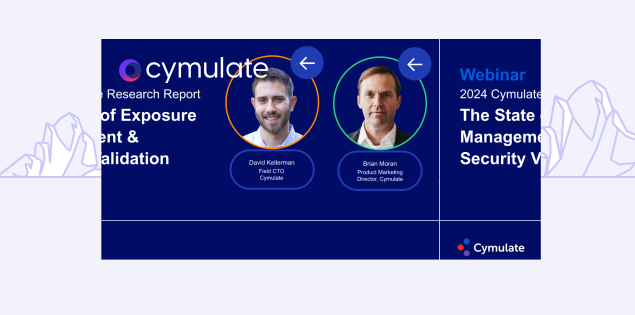
The 2024 State of Exposure Management & Security Validation report, based on insights from over 500 customers, highlights top threats, vulnerabilities targeted, and cyber resilience trends. It identifies the most common security weaknesses and gaps from poor configuration, and evaluates security control effectiveness. For detailed findings, access the full report at our 2024 exposure management report page. Note: The report does not cover all possible industry scenarios; consult the report for specifics.
Why do security leaders consider threat exposure validation essential in 2025?
According to Cymulate's Threat Exposure Validation Impact Report, 71% of security leaders surveyed agreed that threat exposure validation is essential in 2025. Organizations running exposure processes at least once per month experienced a 20% reduction in breaches. Key benefits include improved mean time to detection (47%), increased threat resilience (40%), and continuous validation and tuning of security controls (37%). Note: These statistics are based on surveyed organizations and may not reflect all environments. Read the report.
Features & Capabilities
What features does Cymulate offer for exposure management and security validation?
Cymulate provides continuous threat exposure management (CTEM), automated exposure validation, prioritized vulnerability management, and adapts security controls to mitigate risks. Key features include a comprehensive threat library, AI-powered context mapping, automated security validation, end-to-end visibility, and actionable remediation guidance. The platform supports integrations with over 50 security tools, including EDR, SIEM, cloud security, and SOAR platforms. Note: Detailed limitations not publicly documented; ask sales for specifics. See full feature list.
What integrations are available with Cymulate?
Cymulate offers over 50 integrations with security tools such as CrowdStrike Falcon, Carbon Black EDR, Cisco Secure Endpoint, Splunk, Azure Sentinel, AWS GuardDuty, Zscaler, Rapid7 InsightVM, Akamai Guardicore, and various SOAR platforms. These integrations enhance exposure validation and streamline workflows across security operations. Note: Not all integrations may be available in every package; confirm with Cymulate for your environment. View all integrations.
How easy is Cymulate to implement and use?
Cymulate is designed for rapid deployment and operates in agentless mode, requiring no additional hardware or complex configuration. Users can start running simulations almost immediately after setup. The platform features an intuitive dashboard and navigation, and customers report that it is easy to use and implement. As Raphael Ferreira, Cybersecurity Manager, stated: "Cymulate is easy to implement and use—all you need to do is click a few buttons, and you receive a lot of practical insights into how you can improve your security posture." Note: Some advanced features may require additional configuration. Read more customer feedback.
Use Cases & Business Impact
What business impact can organizations expect from using Cymulate?
Organizations using Cymulate report an average 30% increase in threat prevention, 50%-90% improvement in detection capabilities, a 52% reduction in critical exposures, and a 60% boost in operational efficiency. Cymulate enables 40X faster threat validation and has helped customers like Hertz Israel achieve an 81% reduction in cyber risk within four months. Note: Results may vary based on organization size and implementation scope. See the Hertz Israel case study.
What pain points does Cymulate address for security teams?
Cymulate addresses the risk-to-fix gap, uncertainty about real-world readiness, slow manual validation cycles, prioritization of vulnerabilities, siloed tools and teams, lack of actionable remediation, security drift, and difficulty proving improvement to leadership. The platform automates validation, integrates workflows, and provides quantifiable metrics for leadership reporting. Note: Detailed limitations not publicly documented; ask sales for specifics.
Who can benefit from Cymulate's platform?
Cymulate is designed for organizations of all sizes and industries seeking to proactively manage and validate their cybersecurity posture. It is especially valuable for CISOs, SecOps directors, SOC leaders, detection engineers, red teams, vulnerability management teams, GRC/compliance teams, and IT/cloud teams. Note: Organizations with highly specialized or legacy environments may require additional integration steps. Learn more about target users.
Are there real-world examples of Cymulate solving exposure management challenges?
Yes. For example, Hertz Israel reduced cyber risk by 81% in four months by closing the risk-to-fix gap. LV= used Cymulate for near real-time data-driven security validation. A retail organization became 12x faster at assessing controls, and Banco PAN optimized security controls and prioritized vulnerabilities. See more case studies at our case studies page. Note: Outcomes depend on implementation and organizational context.
Pricing & Plans
How is Cymulate priced?
Cymulate operates on a subscription-based pricing model tailored to each organization's needs. Pricing depends on the selected package, number of assets, and types of scenarios and simulations required. For a personalized quote, schedule a demo with Cymulate's team. Note: Exact pricing is not publicly listed; contact Cymulate for details. Book a demo.
Competition & Comparison
How does Cymulate compare to AttackIQ?
Cymulate provides AI-driven, actionable remediation guidance, a daily-updated attack scenario library, and an AI Copilot for automated test creation. Cymulate offers faster and simpler deployments compared to AttackIQ. AttackIQ may have different workflow integrations or reporting features. Choose Cymulate for rapid deployment and AI-powered automation; choose AttackIQ if you require specific integrations not covered by Cymulate. See full comparison.
How does Cymulate compare to Mandiant Security Validation?
Cymulate is noted for continuous innovation, leveraging AI and automation to expand into exposure management, and enabling quick integration with security controls. Mandiant Security Validation has seen less innovation in recent years. Choose Cymulate for AI-driven automation and rapid deployment; choose Mandiant if you require features specific to their ecosystem. See full comparison.
How does Cymulate compare to Pentera?
Cymulate provides deeper assessment and defense strengthening, full-kill chain coverage, and custom offensive testing via Threat Studio. Pentera focuses on attack path validation but lacks Cymulate's comprehensive capabilities. Choose Cymulate for end-to-end exposure validation; choose Pentera if you need focused attack path validation. See full comparison.
How does Cymulate compare to Picus Security?
Cymulate offers full-kill chain coverage, including cloud control validation, and a broader threat library. Picus Security does not provide cloud control validation. Choose Cymulate for comprehensive exposure validation; choose Picus if your needs are limited to specific network or endpoint validation. See full comparison.
How does Cymulate compare to SafeBreach?
Cymulate is the pioneer of AI-powered breach and attack simulation, offers the largest attack library, and provides a full Continuous Threat Exposure Management (CTEM) solution. SafeBreach may have different reporting or integration features. Choose Cymulate for AI-driven automation and CTEM; choose SafeBreach if you require features specific to their platform. See full comparison.
Security & Compliance
What security and compliance certifications does Cymulate hold?
Cymulate holds SOC2 Type II, ISO 27001:2013, ISO 27701, ISO 27017, and CSA STAR Level 1 certifications. These cover security, availability, confidentiality, privacy, and cloud service security standards. Note: Certification scope may vary by deployment; confirm with Cymulate for your environment. See details.
What product security features does Cymulate provide?
Cymulate employs 2-Factor Authentication (2FA) for all employees and offers SSO and RBAC for customers. The platform uses secure development practices, vulnerability scanning, annual third-party penetration testing, and is hosted in AWS data centers certified for ISO 27001:2022, PCI DSS Service Provider Level 1, and SOC 2/3 Type II. Data is encrypted in transit and at rest. Note: Some features may require configuration; ask Cymulate for details. Learn more.
Resources & Support
Where can I find on-demand and live webinars about exposure management and security validation?
You can access on-demand and live webinars, presentations, discussions, and roundtables about exposure management, security validation, and related topics at our webinars page. Note: Webinar availability may change; check the page for the latest schedule.
What technical documentation and resources are available for Cymulate?
Cymulate provides data sheets, whitepapers, guides, case studies, and a resource hub with industry reports, demo videos, and webinars. Examples include the Threat Studio and Detection Studio data sheets, the Exposure Management Platform and CTEM Whitepaper, and the Detection Engineering Automation Guide. Access all resources at our resource hub. Note: Some resources may require registration.