Frequently Asked Questions

AI Threat Detection & Platform Capabilities

What is AI threat detection and how does it differ from traditional methods?

AI threat detection uses machine learning, anomaly scoring, behavioral analytics, natural language processing (NLP), and pattern recognition to intelligently identify threats at scale. Unlike traditional detection, which relies on static rules and signature updates, AI continuously analyzes vast data streams (logs, network telemetry, user behavior) to distinguish normal from malicious activity. This enables earlier and more accurate detection of both known and unknown threats, automating alerting and initial response for faster mitigation. Source

What types of threats can AI-powered detection identify?

AI-powered detection can identify a wide range of threats, including malware and ransomware (even new variants), phishing and social engineering attacks, network intrusions, behavioral anomalies (such as insider threats and zero-day attacks), and access control violations. AI analyzes behavior and context, not just signatures, making it effective against sophisticated and previously unknown threats. Source

How does Cymulate use AI to enhance threat detection?

Cymulate integrates AI into its Exposure Validation platform to automate security testing, correlate test results with live telemetry, and dynamically adjust simulations as defenses change. AI-powered detection engineering validates SIEM rules, optimizes detection logic, and continuously recalibrates models to close gaps in real time. This approach ensures continuous, intelligent validation across all MITRE ATT&CK tactics and attack surfaces. Source

What are the main benefits of using AI for threat detection?

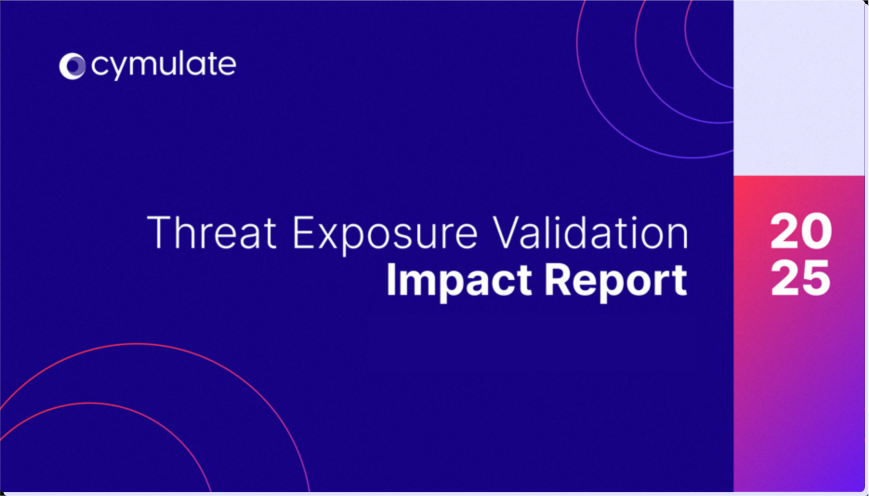
AI for threat detection enables earlier identification of threats, reduces false positives, automates repetitive tasks, and prioritizes genuine risks. According to the Cymulate Threat Exposure Validation Impact Report 2025, organizations using AI can test 230X more threats, reduce response time by 24 hours, and see measurable improvements in security posture and operational efficiency. Source

How does Cymulate's platform validate security controls using AI?

Cymulate's platform uses AI to run continuous, MITRE ATT&CK-based simulations across email, web, network, endpoint, Active Directory, and cloud controls. AI correlates simulation results with live telemetry, detects control drift, and prioritizes exposures for remediation. This feedback loop ensures defenses are always tested against the latest threats and configurations. Source

What is security drift and how does Cymulate address it?

Security drift refers to the degradation of security control effectiveness over time due to configuration changes or evolving threats. Cymulate addresses security drift by continuously validating controls with AI-driven simulations and recalibrating detection models, ensuring that defenses remain effective as environments change. Source

How does Cymulate help reduce alert fatigue for security teams?

Cymulate's AI-powered validation prioritizes genuine threats and curbs false positives, allowing security teams to focus on actionable alerts. By automating detection and validation, Cymulate shifts teams from reactive alert handling to proactive defense, reducing alert fatigue and blind spots. Source

What is the role of MITRE ATT&CK in Cymulate's platform?

Cymulate's platform leverages the MITRE ATT&CK framework to map simulations and validations to real-world attack tactics and techniques. This ensures comprehensive coverage of the attack lifecycle and enables organizations to test their defenses against the latest adversary behaviors. Source

How does Cymulate's AI Copilot support detection engineering?

Cymulate's AI Copilot automates custom threat assessments, validates SIEM rule coverage, and helps build, test, and fine-tune detection logic. This enables security teams to optimize their detection engineering processes and respond to new threats in minutes. Source

What is the Cymulate Threat Exposure Validation Impact Report 2025 and what are its key findings?

The Cymulate Threat Exposure Validation Impact Report 2025 is a research report highlighting the impact of AI and automation on security validation. Key findings include: organizations can test 230X more threats, reduce response time by 24 hours, and 97% of those using automated validation report positive impact on cyber program effectiveness. Source

How does Cymulate support continuous security validation?

Cymulate delivers continuous security exposure validation by running ongoing, AI-driven simulations and correlating results with live telemetry. This approach ensures that security controls are always tested against the latest threats and configurations, closing gaps before attackers can exploit them. Source

What is the value of automating threat detection and validation?

Automating threat detection and validation allows organizations to test more threats, respond faster, and reduce manual workload. According to Cymulate's research, automation enables 230X more threats to be tested and shrinks response time by 24 hours, leading to improved security outcomes and operational efficiency. Source

How does Cymulate help with SIEM rule validation?

Cymulate's AI-powered detection engineering assistant automates SIEM rule threat coverage validation, enabling fast creation and optimization of high-fidelity detection logic. This ensures that SIEM rules are effective against real-world threats and continuously updated as the threat landscape evolves. Source

What is Breach & Attack Simulation (BAS) and how does Cymulate implement it?

Breach & Attack Simulation (BAS) is the autonomous execution of real-world attack techniques against an organization's environment to test defenses. Cymulate implements BAS by running continuous, MITRE ATT&CK-mapped simulations across multiple attack surfaces, providing actionable insights and validation of security controls. Source

How does Cymulate's AI-powered platform help prioritize exposures?

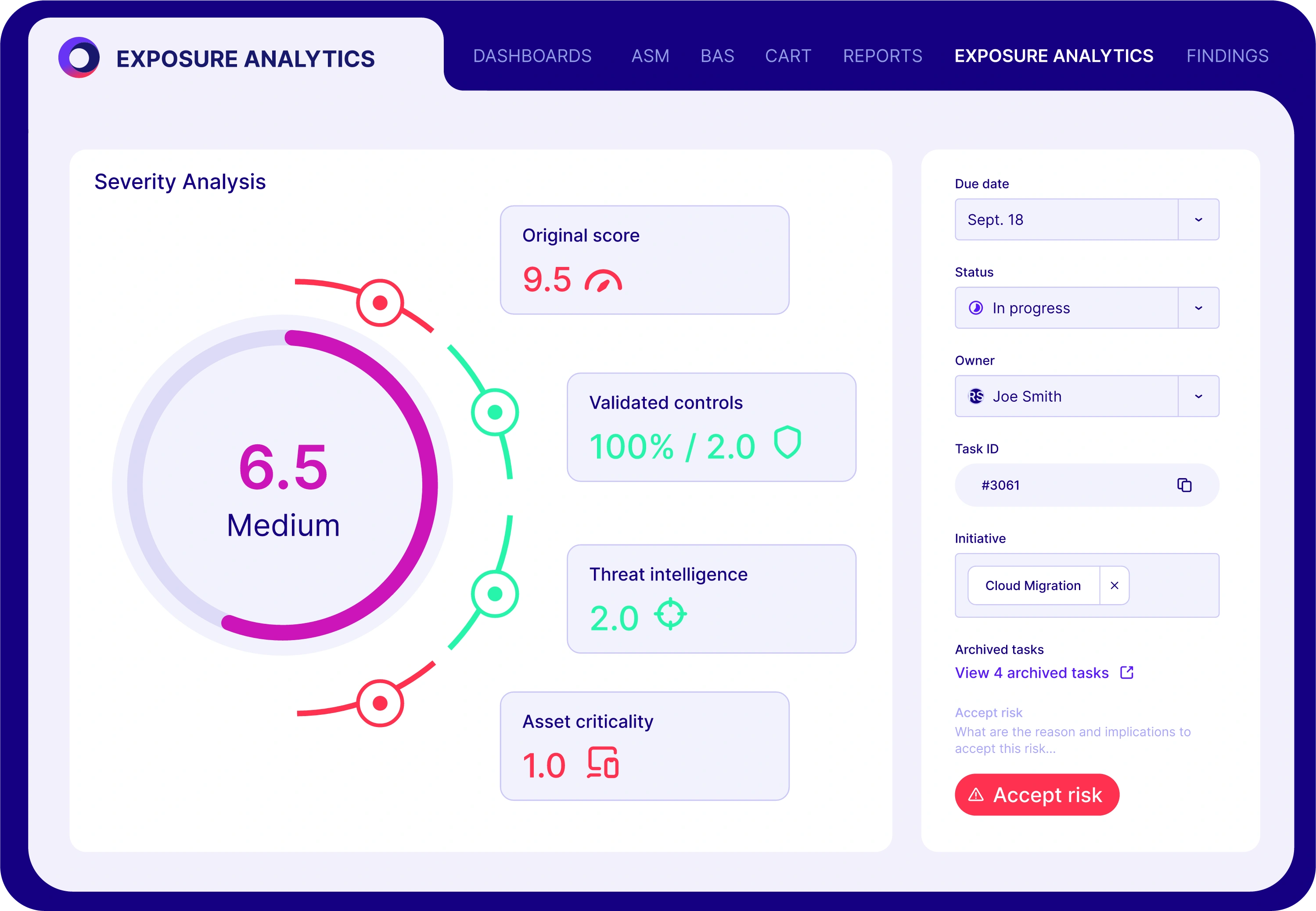
Cymulate's AI analyzes simulation results, live telemetry, and business context to prioritize exposures based on exploitability and risk. This ensures that security teams focus their resources on the most critical vulnerabilities and threats. Source

What are the main processes AI empowers in threat detection?

AI empowers anomaly detection, natural language processing for phishing detection, machine learning for pattern recognition, and image/video analysis for physical security. These processes enable early identification of cyberattacks, insider threats, and unauthorized access. Source

How does Cymulate integrate with SIEM platforms?

Cymulate offers deep integrations with leading SIEM platforms, enabling automated validation of detection rules, continuous optimization, and real-time mapping to MITRE ATT&CK. This transforms detection engineering into a measurable, repeatable process. Source

What is the impact of AI on exposure validation according to Cymulate's research?

According to Cymulate's Threat Exposure Validation Impact Report 2025, organizations using AI for exposure validation can test 230X more threats, reduce response time by 24 hours, and 97% report a positive impact on cyber program effectiveness. Source

How does Cymulate help organizations move from reactive to proactive security?

Cymulate enables organizations to shift from reactive alert handling to proactive defense by continuously validating controls, prioritizing exposures, and automating detection and response with AI. This approach reduces risk and improves overall security posture. Source

Features & Capabilities

What features does Cymulate offer for exposure management and threat validation?

Cymulate offers continuous threat validation, unified platform capabilities (BAS, CART, Exposure Analytics), attack path discovery, automated mitigation, AI-powered optimization, complete kill chain coverage, ease of use, and an extensive threat library with over 100,000 attack actions updated daily. Source

Does Cymulate support integration with other security tools?

Yes, Cymulate integrates with a wide range of security technologies, including Akamai Guardicore, AWS GuardDuty, BlackBerry Cylance OPTICS, Carbon Black EDR, Check Point CloudGuard, Cisco Secure Endpoint, CrowdStrike Falcon, Wiz, SentinelOne, and more. For a complete list, visit the Partnerships and Integrations page.

How easy is Cymulate to implement and use?

Cymulate is designed for quick, agentless deployment with no need for additional hardware or complex configurations. Customers report that implementation is fast and the platform is intuitive, with actionable insights available after just a few clicks. Comprehensive support and educational resources are also available. Source

What feedback have customers given about Cymulate's ease of use?

Customers consistently praise Cymulate for its intuitive interface, user-friendly dashboard, and actionable insights. Testimonials highlight the platform's ease of implementation, excellent support, and immediate value in identifying and mitigating security gaps. Source

Use Cases & Business Impact

Who can benefit from using Cymulate?

Cymulate is designed for CISOs, security leaders, SecOps teams, red teams, and vulnerability management teams in organizations of all sizes and industries, including finance, healthcare, retail, media, transportation, and manufacturing. Source

What business impact can organizations expect from Cymulate?

Organizations using Cymulate can achieve up to a 52% reduction in critical exposures, a 60% increase in team efficiency, 40X faster threat validation, and an 81% reduction in cyber risk within four months, as reported by customers and case studies. Source

Are there case studies showing Cymulate's effectiveness?

Yes, for example, Hertz Israel reduced cyber risk by 81% in four months using Cymulate. Other case studies include improved detection and response for Nemours Children's Health and cost-effective scaling for a sustainable energy company. See more at the Case Studies page.

What pain points does Cymulate address for security teams?

Cymulate addresses fragmented security tools, resource constraints, unclear risk prioritization, cloud complexity, communication barriers, inadequate threat simulation, operational inefficiencies in vulnerability management, and post-breach recovery challenges. Source

How does Cymulate tailor solutions for different security roles?

Cymulate provides quantifiable metrics for CISOs, automates processes for SecOps teams, offers advanced offensive testing for red teams, and enables efficient vulnerability management for vulnerability teams. Solutions are tailored to the unique needs of each persona. Source

Security, Compliance & Integrations

What security and compliance certifications does Cymulate hold?

Cymulate holds SOC2 Type II, ISO 27001:2013, ISO 27701, ISO 27017, and CSA STAR Level 1 certifications, demonstrating adherence to industry-leading security and privacy standards. Source

How does Cymulate ensure data security and privacy?

Cymulate ensures data security through encryption in transit (TLS 1.2+) and at rest (AES-256), secure AWS-hosted data centers, a tested disaster recovery plan, and compliance with GDPR. The platform also features 2FA, RBAC, and IP address restrictions. Source

What application security practices does Cymulate follow?

Cymulate follows a secure development lifecycle (SDLC), conducts continuous vulnerability scanning, annual third-party penetration tests, and provides ongoing security awareness training for employees. Source

Pricing & Plans

What is Cymulate's pricing model?

Cymulate uses a subscription-based pricing model tailored to each organization's needs. Pricing depends on the chosen package, number of assets, and scenarios selected. For a detailed quote, organizations can schedule a demo with the Cymulate team. Source

Company, Resources & Support

What is Cymulate's mission and vision?

Cymulate's mission is to transform cybersecurity practices by enabling organizations to proactively validate defenses, identify vulnerabilities, and optimize security posture. The vision is to create a collaborative environment for lasting improvements in cybersecurity strategies. Source

Where can I find Cymulate's blog, newsroom, and resources?

You can find the latest threats, research, and company news on the Cymulate blog, newsroom, and Resource Hub.

Does Cymulate offer educational resources and support?

Yes, Cymulate provides a knowledge base, webinars, e-books, and an AI chatbot for support and learning. Customers can also access email and chat support for troubleshooting and guidance. Source

New: 2026 Gartner® Market Guide for Adversarial Exposure Validation
Learn More
Cymulate named a Customers' Choice in 2025 Gartner® Peer Insights™
Learn More
New Research: Azure Arc Privilege Escalation & Identity Takeover
Learn More
An Inside Look at the Technology Behind Cymulate
Learn More

AI Threat Detection: Supercharging Cyber Defenses with Intelligence & Scale 

By: Jake O’Donnell

Last Updated: February 1, 2026

cymulate blog article

Security teams face an onslaught of ever-evolving threats, bloated alert queues and sprawling attack surfaces.  

Manual detection and periodic pen tests simply can’t keep pace. There are now more options to meet the challenges presented by today’s threat landscape, and that includes the integration of AI into your tech stack.  

AI threat detection flips the script, analyzing vast data streams in real time, uncovering subtle anomalies and automating detection with speed and precision. It surfaces threats earlier and with far greater accuracy than traditional methods. 

What Is AI Threat Detection? 

AI threat detection harnesses machine learning, anomaly scoring, behavioral analytics, natural language processing (NLP) and pattern recognition to identify threats intelligently and at scale. It absorbs vast data sets (logs, network telemetry, user behavior logs, threat intel) and trains itself to distinguish normal activity from malicious. 

Traditional detection relies on static rules, signature updates, and periodic investigations—often reactive and limited in scope. AI adds dynamism and adaptability: it scans continuously, tweaks its models with each new anomaly and uncovers subtle, sophisticated threats that manual methods miss. 

Unlike traditional systems, which often rely on static rules or known signatures, AI continuously analyzes network traffic, user activity, and system behavior to uncover both familiar and previously unknown threats. 

One of the biggest advantages of AI in this domain is its ability to detect anomalies early in the attack cycle before significant damage occurs. By automating the detection, alerting and even initial response processes, AI significantly improves the speed and efficiency of threat mitigation. 

Five Key Threats AI Can Detect and Prevent 

AI-backed systems are equipped with advanced machine learning and deep learning algorithms that can identify a wide variety of threats across digital, physical and behavioral environments. Here are some of the primary types of threats AI is helping to combat: 

1. Malware and Ransomware Detection 

AI-powered systems analyze how files interact with systems rather than relying solely on known malware signatures. This behavior-based approach allows systems to detect new and evolving malware variants traditional methods often miss, especially those designed to evade signature-based detection. 

2. Phishing and Social Engineering 

AI excels at identifying phishing attempts and social engineering tactics by examining email content, sender behavior and metadata. It can detect subtle signs of manipulation, helping prevent sensitive data leaks caused by users falling for deceptive communications. 

3. Cyber Threats and Network Intrusions 

AI helps secure cloud-based environments by monitoring real-time network activity for suspicious patterns. This is so critical at a time when more and more data is moving into less-structured, ephemeral cloud environments. It’s especially effective against complex, highly-mature threat actors and unauthorized access that traditional tools might miss. 

4. Behavioral Anomalies 

AI uses behavioral analytics to create a baseline for what "normal" looks like across users, systems and networks. When abnormal activity is detected such as unusual login times or file access, the well-trained AI flags them immediately. When it comes to identifying insider threats and zero-day attacks, AI can provide critical assistance.  

5. Access Control Violations 

Modern access control systems powered by AI can detect when someone tries to access resources or locations they shouldn’t. By learning from users’ typical access behavior, AI can quickly spot anomalies such as logins from unknown devices or geographic locations and take preventive action. 

Threat Detection Processes Empowered by AI 

The true strength of AI in cybersecurity lies in its adaptability, learning capability, and automation. Below are some of the most impactful ways AI contributes to threat detection: 

Anomaly Detection 

AI algorithms use time-series and statistical analysis to monitor changes over time. When behavior or activity diverges from the baseline, it triggers alerts for further investigation. This technique is essential for detecting stealthy or slow-moving attacks. 

Natural Language Processing (NLP) 

NLP allows AI systems to understand and analyze human language, which is critical in identifying phishing messages, malicious emails or risky communications. Trained on large volumes of text data, NLP models can detect intent and flag messages that attempt to manipulate users. 

Machine Learning & Pattern Recognition 

Machine learning algorithms are trained by large, sprawling data sets that include network traffic, user patterns and behavior and much more. These models can accurately pinpoint distinctions between safe and suspicious activities. These machine learning models enable early identification of cyberattacks, insider threats or malware as the models become more intelligent over time. 

Image and Video Analysis 

In security camera footage or access point monitoring, AI can identify unauthorized individuals, detect suspicious packages or even recognize threatening behaviors. Technologies like convolutional neural networks (CNNs) are central to these visual recognition capabilities. 

Why Manual Threat Detection Falls Short 

Manual detection is slow, narrow, and labor-intensive. A few key statistics from the Cymulate Threat Exposure Validation Impact Report 2025 underline these hurdles: 

  • 67% of organizations cite infrequent testing as a major security weakness 
  • Manual penetration testing suffers from limited scope, missed vulnerabilities, and scheduling bottlenecks 
  • Care teams drown in alert volume, but only a fraction are actionable, leading to alert fatigue and blind spots 

Periodic reviews leave too much time for drift between controls. By the time an issue is uncovered, attackers may already have exploited it. 

The AI Advantage: Easier, Faster, Smarter 

The Impact report reveals the profound impact of embedding AI into threat detection: 

  • 230X more threats can be tested using automated security validation compared to manual methods 
  • Response time shrinks by 24 hours, dramatically reducing the window of risk 
  • 89% of organizations are implementing AI for exposure validation 
  • 97% of respondents who use automated security control validation and measure cyber program effectiveness have seen a positive impact since implementation 

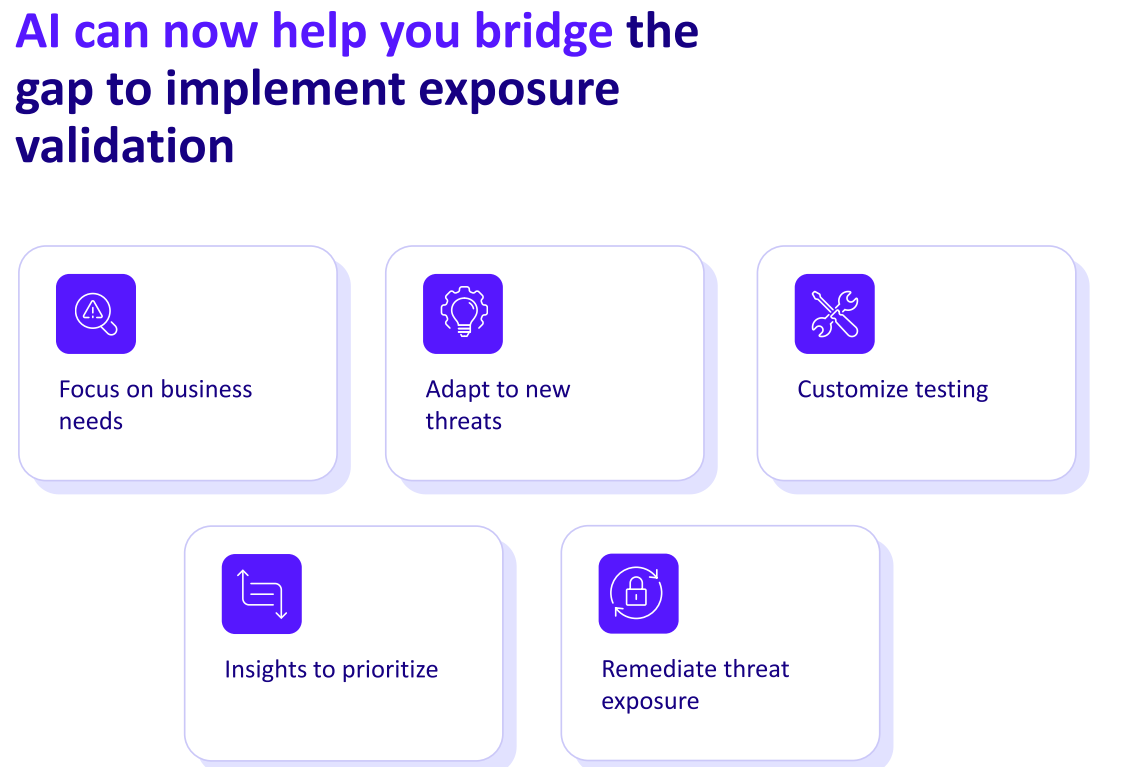
These gains don’t just improve metrics—they transform capabilities. AI-driven solutions prioritize genuine threats, curb false positives, and shift teams from reactive firefighting to proactive defense. 
ai threat detection benefits

The Cymulate AI + Threat Exposure Validation Value Proposition 

What sets AI-powered validation apart is its ability to continually and intelligently test your actual defenses - not just scan your perimeter. The Cymulate platform integrates expansive MITRE ATT&CK–based simulations across: 

  • Email 
  • Web 
  • Network 
  • Endpoint 
  • Active Directory 
  • Cloud-based controls 

Rather than one-off pen tests, Cymulate delivers continuous security exposure validation. AI correlates test results with live telemetry, identifying where controls have drifted or degraded. As defenses shift, the platform dynamically adjusts simulations, runs fresh tests and recalibrates AI detection models. 

This intel-driven feedback loop closes gaps automatically so there are no more stale assessments or stale rules. 

Cymulate empowers security teams to: 

  • Automate testing and validation, freeing analysts from repetitive tasks 
  • Detect control drift in real time, surfacing unseen weaknesses 
  • Prioritize exposures with AI, focusing limited resources where they matter most 
  • Reduce breach frequency and impact, as validated by the Impact Report 

Cymulate spans all MITRE ATT&CK tactics, combining active threat emulation with AI to continuously challenge and refine defenses. 

The Cymulate Exposure Validation platform has also added an AI-powered detection engineering assistant for security information and event management (SIEM) rule threat coverage validation.  

Using AI-powered analysis and a massive library of real-world attack simulations, you can continuously build, test and fine-tune threat detection so you can see what works, fix what doesn’t and continuously optimize your detections. 

With deep integrations into leading SIEM platforms and a continuously updated MITRE ATT&CK heatmap, Cymulate transforms detection engineering from a black-box guessing game into a measurable, repeatable science. You get: 

  • Automated validation of existing detection rules  
  • Fast creation of new, high-fidelity detection logic 
  • Ongoing optimization based on real threat behaviors   
cymulate exposure analytics

A Smarter Way to Secure Your Environment 

Security professionals deserve tools that scale with the threat landscape. Cymulate’s AI-powered exposure validation delivers precisely that. 

Experience it firsthand: 

What to Know and What to Do Next 

  • AI threat detection – Leveraging machine learning and analytics to identify and respond to security incidents in real time. 
  • Exposure validation – Actively testing controls using simulations mapped to MITRE ATT&CK to measure effectiveness. 
  • Security drift – Degradation of security control efficacy over time due to configuration changes or evolving threats. 
  • Breach & Attack Simulation (BAS) – Autonomous execution of real-world attack techniques against an organization’s environment. 

By delivering more coverage, faster detection and real-time prioritization, AI threat detection represents a seismic shift in cybersecurity. Manual methods can’t keep up—but with AI-powered threat exposure validation, your defenses grow stronger every minute. 

Secure with intelligence and trust. Secure your cyber defenses proactively. Request a Cymulate demo today. 

Cymulate Exposure Validation makes advanced security testing fast and easy. When it comes to building custom attack chains, it's all right in front of you in one place.
Mike Humbert, Cybersecurity Engineer
DARLING INGREDIENTS INC.
Learn More
Book a Demo