

Combating Rogue AI: A CISO's Guide to Detecting, Governing and Securing Unauthorized AI
Artificial Intelligence (AI) is transforming how employees work, but it is also creating one of the fastest-growing enterprise security risks: unauthorized AI adoption and use.
Across organizations, employees are increasingly using personal AI assistants, AI coding tools, browser extensions and autonomous AI agents without security knowledge and approval. While these tools improve productivity, they also introduce new attack paths, expose sensitive data and create governance challenges that traditional security controls were never designed to address.
For CISOs, the challenge is no longer whether AI will be adopted. It is how to enable AI safely for employee use while maintaining visibility, governance and continuous validation of security controls.
In this blog, we'll dive into:
- What Rogue AI is and how it differs from Shadow AI
- Why unauthorized AI has become a significant enterprise security challenge
- How Rogue AI impacts security across applications, identities, cloud environments and sensitive data
- How the NIST AI Risk Management Framework helps organizations govern AI
- A practical roadmap for CISOs to establish AI governance and reduce enterprise risk
- Why continuous exposure validation is becoming essential for securing AI environments
What is Rogue AI?
Rogue AI refers to AI tools, applications, models, agents and autonomous workflows operating outside an organization's approved governance, security or compliance processes.
AI use is not the problem itself. The problem is AI operating without visibility, governance or security controls. Unlike traditional cybersecurity threats, Rogue AI often begins with good intentions. The table below is common employee examples and the associated security risks.
| Employee Example | Security Risk |
| Employees using personal ChatGPT accounts to summarize confidential documents | Sensitive data leakage, loss of control over proprietary information, potential regulatory and compliance violations, and exposure of intellectual property if data is retained or used for model training. |
| Developers installing unauthorized AI coding assistants | Exposure of proprietary source code, API keys, credentials, and software architecture; introduction of insecure or AI-generated code; increased software supply chain risk. |
| Marketing teams connecting AI content tools directly into CRM platforms | Unauthorized access to customer data, excessive OAuth permissions, accidental disclosure of personally identifiable information (PII), and potential violations of privacy regulations. |
| Employees deploying AI agents that automate email or business workflows | Autonomous AI agents may gain excessive privileges, access sensitive systems, execute unintended actions, or create automated attack paths between business applications. |
| Teams running local LLMs without IT oversight | Unpatched or vulnerable AI models, unmanaged infrastructure, lack of monitoring and governance, unauthorized data processing, and expanded internal attack surface. |
| Browser extensions that automatically access corporate data | Browser extensions may read emails, documents, web applications, or form data, resulting in credential theft, sensitive data exposure, excessive permissions, and unmonitored third-party access. |
Table: Rogue AI Employee Examples and Security Risk
There is also Shadow AI, which is often used interchangeably with Rogue AI, but they describe different problems. Shadow AI focuses on unauthorized use of AI technologies, which is primarily a governance issue; whereas, Rogue AI focuses on unauthorized use of AI technologies, which is primarily a security and risk management issue.
Every Rogue AI instance is Shadow AI. Not every Shadow AI instance becomes Rogue AI.
The Growing Enterprise AI Problem
Enterprise AI adoption has reached a tipping point. Recent industry research highlights just how quickly AI usage is expanding and how little visibility organizations often have into it.
Some notable statistics include:
- 75% of knowledge workers now use AI at work (Microsoft & LinkedIn Work Trend Index)
- 78% of AI users bring their own AI tools rather than using approved enterprise solutions
- 47% of enterprise AI users still access personal AI applications (Netskope Cloud & Threat Report 2026)
- Average prompts sent to enterprise AI tools increased from 3,000 to 18,000 per month
- Organizations now experience an average of 223 AI data policy violations every month, double the previous year
These statistics reveal a simple reality that AI adoption is significantly outpacing AI governance.
Business Impact: Why CISOs Should Care
Unauthorized AI dramatically expands the enterprise attack surface. Instead of protecting only endpoints and applications, security teams must now secure AI agents, LLMs, AI APIs, browser extensions, SaaS AI features, third-party AI integrations and autonomous workflows.
Without proper governance, organizations face several key risks, described in the table below.
| Organization Example | Security and Risk Impact |
| Sensitive Data Leakage | |
| Employees upload sensitive business information to public unauthorized AI tools, such as source code, customer records, financial reports, contracts, product roadmaps, and intellectual property. | Organizations lose visibility and control over where data is stored, how long it is retained, whether it is used for model training and who can access it. This can result in intellectual property loss, data exposure, regulatory violations and reputational damage. |
| Identity & Permission Risks | |
| AI applications request OAuth access to enterprise services such as Microsoft 365, Google Workspace, SharePoint, GitHub, Salesforce, and corporate email. | Excessive permissions for enabled AI tools present risk for privilege abuse, unauthorized access, account compromise and lateral movement across enterprise systems. |
| AI Attacker Exploits | |
| Attackers exploit AI organization systems using prompt injection, indirect prompt injection, data poisoning, model abuse and AI plugin exploitation. | For AI-enabled applications, organizations face increased risks of credential theft, unauthorized data access, compromised AI workflows and exploitation of connected systems. |
| Compliance & Regulatory Exposure | |
| Employees use unauthorized AI services to process regulated or sensitive information subject to GDPR, HIPAA, PCI DSS, SOC 2, industry-specific regulations, or internal governance policies. | Organizations may violate data privacy regulations, contractual obligations, and corporate governance requirements, resulting in regulatory penalties, audit findings, legal liability and loss of customer trust. yeah |
Without strict governance, adherence and visibility into AI usage, organizations cannot accurately assess their level of actual risk.
Using the NIST AI Risk Management Framework
The NIST AI Risk Management Framework (AI RMF 1.0) is availability for organizations as the most widely adopted approaches for governing enterprise AI. Rather than prescribing specific technologies, the framework helps organizations build repeatable AI governance processes across the entire AI lifecycle.
The framework consists of four core functions as depicted in the figure below.

Successful implementation of the NIST AI RMF provides CISOs with a structured, risk-based approach to governing and securing AI across the enterprise. It helps establish clear policies, accountability and executive oversight while improving visibility into AI systems, data flows, vendors, and integrations. By continuously identifying, measuring, and managing AI-related risks, organizations can reduce security exposure, strengthen regulatory compliance, and improve decision-making around AI adoption. The framework also supports ongoing monitoring and governance as AI technologies evolve, enabling CISOs to communicate AI risk more effectively to executive leadership and the board. Ultimately, the NIST AI RMF allows organizations to accelerate AI innovation and improve business processes while maintaining strong security, compliance and operational resilience.
CISO Roadmap: Building an Enterprise Rogue AI Program
Building an Enterprise Rogue AI Program is not a one-time initiative, but an ongoing strategy that balances AI innovation with governance and security. CISOs should adopt a phased approach that begins with gaining visibility into AI usage, establishes governance and policies, implements technical controls, and evolves into continuous monitoring and risk management. This example roadmap provides a practical framework for reducing Rogue AI risk while safely embracing AI technologies.
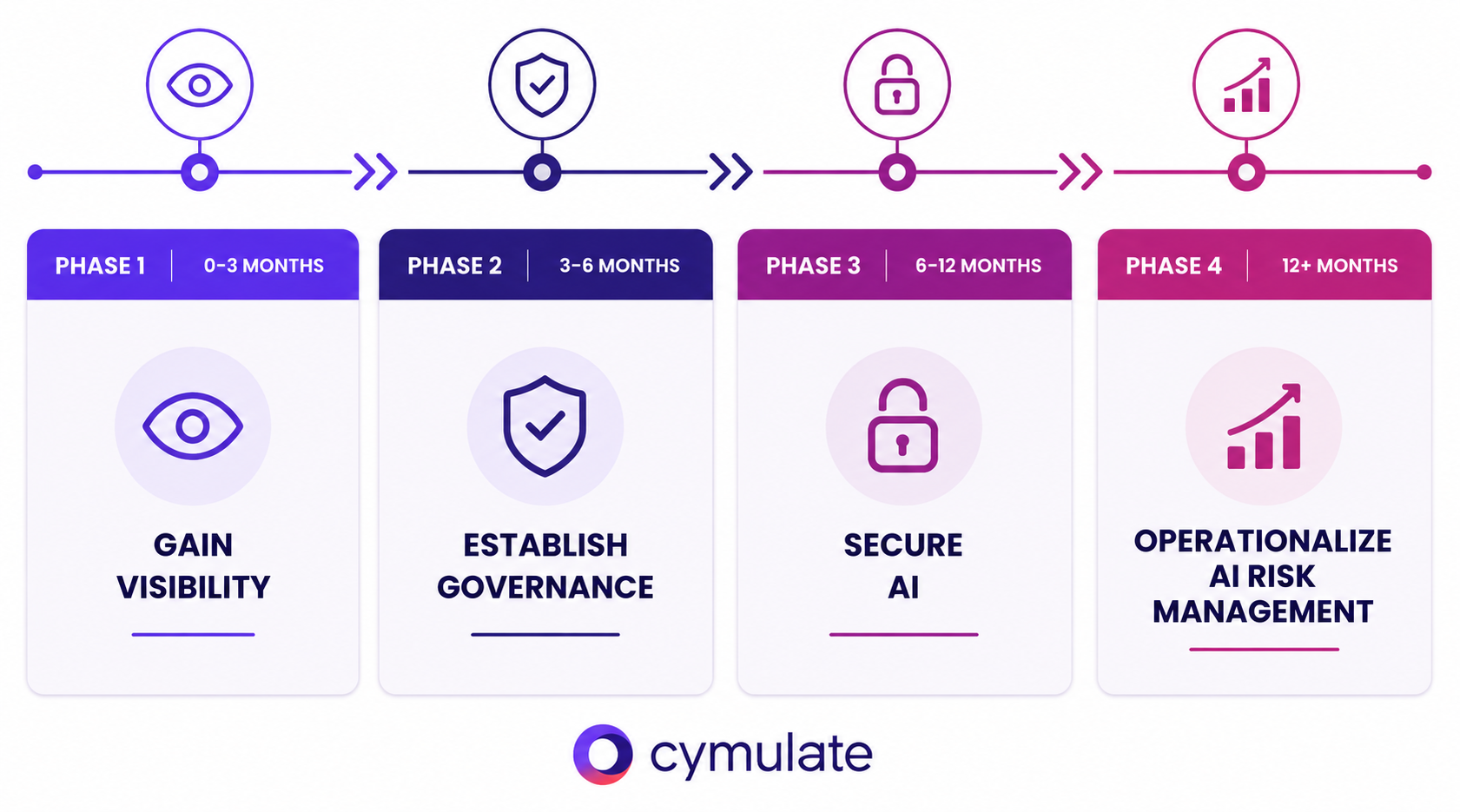
Phase 1 (0–3 Months): Gain Visibility
In phase 1, the goal is for organizations to gain complete visibility into the AI usage. CISOs should inventory all AI applications, discover Shadow AI, identify AI agents and autonomous workflows, assess OAuth permissions and classify how AI tools access and process sensitive data. This foundational phase provides an enterprise-wide AI inventory and an initial risk assessment, enabling security teams to understand their AI attack surface and prioritize governance and remediation efforts.
Phase 2 (3–6 Months): Establish Governance
Once visibility is established, the next step is to implement a formal AI governance program. CISOs should develop clear AI usage policies, define approved AI platforms, establish data handling guidelines and create standardized AI approval workflows. It is paramount that clear governance responsibilities across security, IT, legal, and business stakeholders are assigned and understood. This phase results in a comprehensive AI governance framework, an enterprise AI risk register and a cross-functional AI review board to ensure AI adoption aligns with organizational risk, compliance and business objectives.
Phase 3 (6–12 Months): Secure AI
Once governance is in place, organizations should strengthen their security posture by implementing technical controls that protect AI systems and the data they access. CISOs should enforce least-privilege access for AI applications and agents, review AI integrations and connected services, monitor AI-related traffic, implement data loss prevention (DLP) policies and continuously validate AI attack paths through exposure validation testing of security controls. This phase establishes the core AI security controls, provides operational visibility through monitoring dashboards and introduces continuous testing to ensure defenses remain effective as AI technologies and threats evolve.
Phase 4 (12+ Months): Operationalize AI Risk Management
The final phase focuses on making AI risk management a continuous business capability rather than a one-time initiative. CISOs should continuously discover new AI technologies, validate the effectiveness of security controls, evolve governance as AI capabilities and regulations change, integrate AI risk into the broader enterprise risk management program, and provide regular reporting to executive leadership and the board. This results in a mature AI governance program supported by continuous exposure validation and meaningful board-level metrics that demonstrate the organization's AI security posture and risk over time.
Exposure Validation: A Critical Component of Operationalizing AI Risk Management
As organizations mature their AI governance programs, continuous exposure validation becomes essential for maintaining an effective AI security posture. Governance frameworks and security controls establish the foundation, but organizations also need continuous evidence that those controls can detect, prevent, and respond to real-world AI attack scenarios.
Cymulate Platform delivers Exposure Validation, enabling organizations to continuously assess the effectiveness of their AI security controls by validating defenses against realistic attack techniques. Security teams can:
- Validate Data Loss Prevention (DLP) controls
- Test prompt injection and AI-specific attack scenarios
- Assess AI attack paths across identities, applications, and data
- Measure detection and response effectiveness
- Prioritize remediation based on exploitability and business impact
- Continuously evaluate security as AI environments evolve
Rather than relying on assumptions or point-in-time assessments, continuous exposure validation provides measurable evidence that AI security controls are working as intended. This enables CISOs to reduce risk proactively, strengthen resilience, and confidently support AI adoption as technologies, threats, and business requirements continue to evolve.
In Summary: Secure AI with Governance and Continuous Validation
AI adoption is accelerating across every organization, making effective governance and continuous security validation essential. CISOs must move beyond simply discovering AI to implementing governance frameworks, enforcing security controls and continuously validating that those controls protect against the latest real-world AI threats.
Organizations that combine strong AI governance with continuous exposure validation will be best positioned to reduce Rogue AI risk while enabling secure AI innovation.
Ready to see how your organization can continuously validate AI security controls and reduce Rogue AI exposure?
Schedule a Cymulate demo today to learn how continuous exposure validation helps you identify control gaps, prioritize remediation, and strengthen your AI security posture.

Featured Resources
View More Resources
Cymulate Detection Studio
Scale detection engineering to continuously expand coverage and automate the detection life cycle.
Cymulate Vero AI
See how Cymulate Vero AI tailors validation to your environment and automates the path to remediation.
Beyond Validation. The Future is Agentic Cyber Defense Engineering.
Cymulate’s Vero AI powers agentic cyber defense engineering to prove, prioritize and adapt security.