
Frequently Asked Questions

Cloud Security Validation & Best Practices

What is cloud security validation and why is it important?

Cloud security validation is the process of continuously testing and verifying that security controls across all layers of your cloud architecture are operating as intended to stop cloud-based threats. This is crucial because cloud environments are dynamic, and misconfigurations or gaps can expose critical workloads to risk. Regular validation ensures resilience and helps maintain an acceptable level of risk over time. [Source]

Why do organizations invest in cloud transformation?

Organizations invest in cloud transformation to achieve scalability, flexibility, innovation, agility, operational and cost efficiency, and a competitive advantage through faster deployment of new products and services. However, these benefits come with new security challenges that require continuous validation of cloud security controls. [Source]

What are the main layers of cloud architecture that require security validation?

The main layers of cloud architecture that require security validation include cloud-hosted applications, containers and Kubernetes environments, cloud workloads (such as VMs and data storage), and cloud infrastructure and services. Each layer requires specific security controls and validation techniques to ensure comprehensive protection. [Source]

How does Cymulate validate Web Application Firewalls (WAFs) in the cloud?

Cymulate's WAF validation tests and validates that the application security control (the WAF) is operating as intended. During assessments, Cymulate sends thousands of payloads from the OWASP Top 10 list and analyzes HTTP/S responses to determine whether the payload was blocked or penetrated, ensuring the WAF is effective against real-world threats. [Source]

How does Cymulate assess container and Kubernetes security in the cloud?

Cymulate enables testing of container security controls using cloud-native malicious scenarios and privileged activities, such as container escaping and secrets listing. Assessments focus on Kubernetes environments (Azure, AWS, Google Cloud, and on-premises) and cover both pre-exploitation (e.g., pod escape attempts) and post-exploitation (e.g., command-and-control connections, crypto mining) scenarios. [Source]

What types of cloud workloads does Cymulate test?

Cymulate tests the security robustness of various cloud workloads, including compute workloads (virtual machines), data-centric workloads (file/data storage, databases), and application workloads (web apps, SaaS). It simulates attacks like crypto mining, data exfiltration, and application-targeted threats to validate the effectiveness of security controls. [Source]

How does Cymulate validate SIEM effectiveness in cloud environments?

Cymulate evaluates SIEM effectiveness by simulating high-privileged activities typical of a cloud breach, such as data exfiltration through unauthenticated S3 buckets or unauthorized user additions. The platform checks if these activities trigger SIEM events and alerts, ensuring your SIEM is properly configured to detect post-exploitation threats. [Source]

How often should cloud security validation tests be run?

Due to the dynamic nature of cloud environments, it is highly recommended that cloud security validation tests be run weekly or whenever significant changes are made to the cloud environment. This ensures that security controls remain effective against evolving threats. [Source]

What are some common threats to cloud security that Cymulate helps address?

Cymulate helps address threats such as misconfigurations, unauthorized access, data breaches, runtime attacks in containers, crypto mining operations, data exfiltration, and attacks targeting cloud-hosted applications. The platform simulates these threats to validate the effectiveness of your security controls. [Source]

What cloud-native security controls does Cymulate integrate with for validation?

Cymulate integrates with cloud-native security controls such as Azure Defender for Cloud, AWS GuardDuty, and Google Cloud Command Center, as well as CWPP, CNAPP, SIEM, and firewall/IPS solutions to validate the effectiveness of your cloud security posture. [Source]

How does Cymulate test for data exfiltration risks in cloud storage?

Cymulate uses its Data Exfiltration Validation solution to test whether data loss controls can prevent data from leaving cloud storage environments, such as cloud storage buckets. This helps ensure that sensitive data is protected against unauthorized exfiltration. [Source]

What is the recommended approach for validating cloud security controls after changes?

It is recommended to run validation tests whenever changes are made to the cloud environment, such as new deployments, configuration updates, or changes in access controls. This ensures that new vulnerabilities are identified and addressed promptly. [Source]

How does Cymulate help organizations maintain compliance in the cloud?

Cymulate helps organizations maintain compliance by continuously validating that security controls are operating as intended, providing evidence for regulatory requirements, and supporting frameworks such as ISO 27001, SOC2, and CSA STAR. [Source]

Where can I find more resources on cloud security validation best practices?

You can find more resources, including solution briefs, e-books, and guides, on the Cymulate Resource Hub at https://cymulate.com/resources/. For specific cloud security validation content, see the Cloud Security Validation Solution Brief.

How can I schedule a demo of Cymulate's cloud security validation?

You can schedule a personalized demo of Cymulate's cloud security validation platform by visiting https://cymulate.com/schedule-a-demo/.

What is the principle of security validation according to Cymulate?

The principle of security validation, as defined by Cymulate, is to ensure that systems, applications, and processes are secure and operate as intended. This principle underpins all of Cymulate's validation methodologies. [Source]

How does Cymulate support validation for hybrid and multi-cloud environments?

Cymulate supports validation for hybrid and multi-cloud environments by providing assessments for Azure, AWS, Google Cloud, and on-premises Kubernetes deployments, ensuring comprehensive coverage across diverse cloud infrastructures. [Source]

What is the role of SIEM validation in cloud security?

SIEM validation in cloud security ensures that your SIEM platform can detect and alert on high-privileged activities and post-exploitation behaviors typical of cloud breaches. Cymulate simulates these activities to verify SIEM effectiveness and configuration. [Source]

How does Cymulate help with Kubernetes misconfiguration testing?

Cymulate provides scanners to test common Kubernetes misconfigurations on Azure, AWS, and Google Cloud, as well as advanced scenarios to assess your Kubernetes security posture against real-world attack techniques. [Source]

What is the business impact of using Cymulate for cloud security validation?

Using Cymulate for cloud security validation can lead to measurable improvements such as up to a 52% reduction in critical exposures, a 60% increase in team efficiency, and an 81% reduction in cyber risk within four months, as reported by customers. [Source]

Features & Capabilities

What features does Cymulate offer for cloud security validation?

Cymulate offers continuous threat validation, automated attack simulations, WAF validation, container and Kubernetes security assessments, SIEM validation, data exfiltration testing, and integration with cloud-native security controls. The platform provides actionable insights and quantifiable metrics to improve your cloud security posture. [Source]

Does Cymulate support integration with other security tools?

Yes, Cymulate integrates with a wide range of security technologies, including Akamai Guardicore, AWS GuardDuty, BlackBerry Cylance OPTICS, Carbon Black EDR, Check Point CloudGuard, Cisco Secure Endpoint, CrowdStrike Falcon, Wiz, SentinelOne, and more. For a complete list, visit the Partnerships and Integrations page.

What compliance certifications does Cymulate hold?

Cymulate holds several key security and compliance certifications, including SOC2 Type II, ISO 27001:2013, ISO 27701, ISO 27017, and CSA STAR Level 1. These certifications demonstrate Cymulate's commitment to industry-leading security and privacy standards. [Source]

How easy is it to implement Cymulate for cloud security validation?

Cymulate is designed for quick and easy implementation, operating in agentless mode with no need for additional hardware or complex configurations. Customers can start running simulations almost immediately after deployment. [Source]

What feedback have customers given about Cymulate's ease of use?

Customers consistently praise Cymulate for its intuitive, user-friendly interface and ease of use. Testimonials highlight quick implementation, actionable insights, and accessible support. For example, Raphael Ferreira, Cybersecurity Manager, stated, "Cymulate is easy to implement and use—all you need to do is click a few buttons, and you receive a lot of practical insights into how you can improve your security posture." [Source]

What is Cymulate's pricing model?

Cymulate operates on a subscription-based pricing model tailored to each organization's requirements. Pricing depends on the chosen package, number of assets, and scenarios selected for testing. For a detailed quote, you can schedule a demo with the Cymulate team.

Use Cases & Benefits

Who can benefit from Cymulate's cloud security validation?

Cymulate's cloud security validation is designed for CISOs, security leaders, SecOps teams, red teams, and vulnerability management teams in organizations of all sizes and industries, including finance, healthcare, retail, media, transportation, and manufacturing. [Source]

What pain points does Cymulate solve for cloud security teams?

Cymulate addresses pain points such as fragmented security tools, resource constraints, unclear risk prioritization, cloud complexity, communication barriers, inadequate threat simulation, operational inefficiencies, and post-breach recovery challenges. [Source]

Are there case studies showing Cymulate's impact on cloud security?

Yes, for example, Hertz Israel reduced cyber risk by 81% in four months using Cymulate. Nemours Children's Health improved detection and response in hybrid and cloud environments. More case studies are available on the Cymulate Customers page.

How does Cymulate help with operational efficiency for cloud security teams?

Cymulate automates security validation processes, saving up to 60 hours per month in testing new threats and increasing team efficiency by 60%. This allows teams to focus on strategic initiatives rather than manual tasks. [Source]

How does Cymulate compare to traditional penetration testing for cloud security?

Cymulate provides continuous, automated attack simulations and validation, enabling threat validation 40 times faster than manual penetration testing. This approach ensures ongoing resilience and rapid identification of vulnerabilities. [Source]

Support & Implementation

What support options are available for Cymulate customers?

Cymulate offers email support, real-time chat support, a knowledge base with technical articles and videos, webinars, e-books, and an AI chatbot for quick answers and best practices. [Source]

Where can I find Cymulate's blog, newsroom, and event information?

You can stay updated on the latest threats, research, and company news through the Cymulate Blog, Newsroom, and Events & Webinars page.

Does Cymulate provide educational resources for cloud security validation?

Yes, Cymulate provides a variety of educational resources, including webinars, e-books, guides, and a comprehensive Resource Hub to help users optimize their cloud security validation practices. [Source]

Cymulate named a Customers' Choice in 2025 Gartner® Peer Insights™
Learn More
New Case Study: Credit Union Boosts Threat Prevention & Detection with Cymulate
Learn More
New Research: Cymulate Research Labs Discovers Token Validation Flaw
Learn More
An Inside Look at the Technology Behind Cymulate
Learn More

Cloud Security Validation: Best Practices & Key Insights

By: Brian Moran, VP of Product Marketing

Last Updated: February 15, 2026

image

Cloud security threats evolve rapidly, and misconfigurations can expose critical workloads. To ensure resilience, organizations must validate security controls across all layers of the cloud architecture. This guide outlines key best practices for continuous cloud security validation.

Before we look at cloud security, let us recall the principle of security validation as defined by Cymulate.

Based on our principle, the goal is to ensure that the applications and workloads running in a cloud environment are secure and that the controls used to secure the different layers of the cloud architecture operate as intended to stop cloud-based threats. 

Why Organizations Invest in Cloud Transformation

Organizations are making significant investments in moving applications and workloads to the cloud, enabling them to scale their operations to the needs of their business. Cloud transformation offers organizations:  

  • Scalability and flexibility based on business demand 
  • Innovation and agility leveraging advanced technologies 
  • Operational and cost efficiency by reducing complexity and capital expenditure 
  • Competitive advantage for faster deployment of new products and services 

However, this new cloud frontier and the very dynamic nature of cloud platforms can make it difficult to optimize cloud security and get it right the first time and equally difficult to maintain cloud security at an acceptable level of risk over time.  

In addition, cloud platforms can be used for a variety of different purposes – from running applications in secure containers, hosting virtual machines as endpoint devices, or using cloud for data storage and backup.  

This makes continuous validation of cloud security controls an essential best practice to ensure that the controls defending our cloud applications and workloads are operating as intended. And depending on how the cloud platform is being used determines the type of security controls needed to protect whatever is hosted on it. 

image
Further reading
Cloud Security Validation

See how Cymulate tests every layer of your cloud defenses to prove which controls withstand real threats.

Read More

Securing Different Layers of Cloud Architecture 

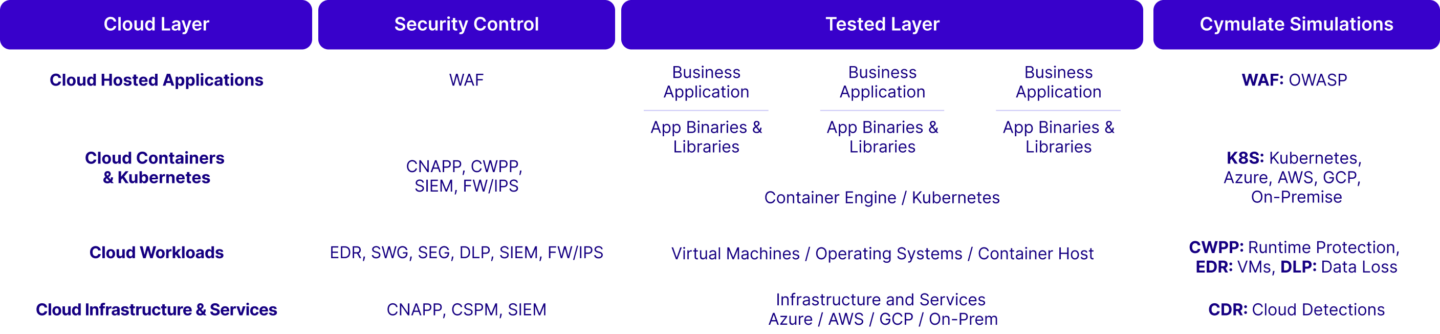
The diagram below highlights different types of security controls used across the different layers of a cloud architecture.  
image

Cloud Hosted Applications

When it comes to applications hosted in the cloud, Web Application Firewalls (WAFs) (which can also be hosted in the cloud or delivered as part of the content delivery network) are used to protect the application the same way we would for the application running on-premises.  

The Cymulate Web App Firewall validation is used to test and validate that the application security control (the WAF) is operating as intended. During the WAF assessments, Cymulate sends thousands of payloads from the OWASP top 10 list and based on the HTTP/S response received by the Cymulate attack server, determines whether the payload was blocked or penetrated. 

Cloud Containers & Kubernetes

Testing the effectiveness of container security is essential for ensuring the security of cloud applications and workloads. Continuous validation helps identify threats specific to containers, such as unauthorized access, data breaches, and runtime attacks, ensuring robust protection across your cloud environment.  

These controls prevent or detect malicious activities within containerized environments and Kubernetes platforms, ensuring the security of applications and workloads inside containers. These controls include: 

1. Cloud-native Security Controls

  • Azure Defender for Cloud 
  • AWS GuardDuty 
  • Google Cloud Command Center 

2. Cloud Workload Protection Platform (CWPP) 
3. Cloud-Native Application Protection Platform (CNAPP) 
4. Security Information and Event Management (SIEM) 
5. Firewall (FW) / Intrusion Prevention Systems (IPS) 

Cymulate enables you to test your container security controls using cloud-native malicious scenarios and privileged activities, such as container escaping, secrets listing, clear history, and other persistent and evasive techniques. Cymulate container security assessments focus on Kubernetes environments and are available for Azure, AWS, and Google Cloud-managed Kubernetes and on-premises deployments. Assessments are available for both pre and post-exploitation: 

  • Pre-Exploitation: Simulates an attacker executing malicious actions from within a container or Kubernetes platform. This type of assessment includes test cases such as attempts to escape from the pod to the host to evaluate if such actions are detected and prevented by the cloud security controls. 
    • Scanners: Test common Kubernetes misconfigurations on Azure, AWS, and Google Cloud. 
    • Advanced Scenarios: Simulate advanced attack scenarios to assess your Kubernetes security posture. 
  • Post-Exploitation: Assumes an attacker has escaped the container and runs malicious activities on the host. This type of assessment includes test cases such as connection to command-and-control servers, file encryption, and deployment of crypto mining operations. 

Cloud Workloads

Cloud platforms are used to host different types of workloads including compute workloads like virtual machines (endpoints), data centric workloads like file / data storage, databases, and big data / data lakes, and application workloads like web apps and enterprise SaaS applications to name a few. 

Cymulate tests the security robustness of cloud workloads running on EC2 instances, Azure VMs, and GCP compute instances by simulating common attack scenarios like crypto mining operations on a cloud workload, cloud data exfiltration from a data centric workload, and attacks targeting cloud-hosted applications.  

We test and validate different types of cloud workloads using the different assessments for key security controls like: 

  • Windows Virtual Machines (VMs) hosted on a cloud platform would use our Endpoint Security Validation solution to test that the endpoint security controls can stop known malicious file samples and behaviors the same way we would for a physical Windows endpoint.  
  • File and Data Storage hosted in a cloud storage bucket would use our Data Exfiltration Validation solution to test that the data loss controls can stop data from leaving the cloud environment. 
  • Enterprise SaaS Application hosted in a cloud container would use our WAF Validation solution to test that the WAF security controls can stop malicious activity targeting the application. 

Cloud Infrastructure & Services

When threat actors obtain access to cloud infrastructure and services, we need to be able to detect their presence through the existence of events in the SIEM platform. To validate that the SIEM can detect potential threat activity, we adopt an “assume breach” post-exploitation approach that simulates an attacker who has already gained credentials and access to the cloud environment.

Rather than looking for outright malicious activities, we test the effectiveness of your SIEM configuration by simulating high-privileged activities that a threat actor would typically execute during a cloud breach. This exercise aims to gauge which activities trigger SIEM events and whether those events correctly lead to alerts

  • Post-exploitation: Execution of malicious behavior test cases involving simulating cloud infrastructure high-privileged activities including data exfiltration through unauthenticated S3 buckets, unauthorized user additions, or exposure of sensitive ports.  

Cymulate cloud security assessments evaluate the effectiveness of SIEM solutions in correlation with cloud logs, CSPM, and CNAPP security controls. 

The goal of these best practices is to thoroughly test the effectiveness of an organization's cloud security controls and policies by simulating a wide variety of cloud-based threats and malicious, high-privileged behaviors. 

Due to the very dynamic nature of cloud environments, it is highly recommended that these validation tests be run weekly or whenever changes are made to the cloud environment. 

Cloud security is a strategic component of your security program and one that requires multiple forms of attack simulation to continuously test and validate that your security controls are operating effectively to protect your cloud applications and workloads. 

For more information, download our solution brief and schedule a demo of our cloud security assessments. 

Cymulate Exposure Validation makes advanced security testing fast and easy. When it comes to building custom attack chains, it's all right in front of you in one place.
Mike Humbert, Cybersecurity Engineer
DARLING INGREDIENTS INC.
Learn More
Book a Demo