

Frequently Asked Questions

Product Overview & Security Validation in Banking

What is security segmentation validation in the banking industry?

Security segmentation validation in the banking industry refers to the process of testing and verifying that network segmentation controls are effective in preventing lateral movement and unauthorized access within a bank's IT environment. This ensures that sensitive assets are properly isolated and that security policies are enforced, reducing the risk of breaches and regulatory non-compliance.

Why is security validation important for banks and financial institutions?

Banks and financial institutions are prime targets for cyberattacks due to the sensitive data and assets they manage. Security validation helps these organizations proactively identify vulnerabilities, test defenses against real-world threats, and ensure compliance with industry regulations. This reduces the risk of data breaches, financial loss, and reputational damage.

How does Cymulate support security validation for the banking industry?

Cymulate provides automated, continuous security validation solutions that simulate real-world attacks across the entire kill chain. For banks, this means validating segmentation controls, detecting lateral movement risks, and ensuring that defenses are effective against the latest threats. The platform offers out-of-the-box assessments, continuous control validation, and quantifiable metrics to benchmark and improve security resilience over time. See how a credit union boosted threat prevention with Cymulate.

What are the main challenges banks face in security segmentation?

Banks often struggle with complex IT environments, legacy systems, and regulatory requirements. Common challenges include ensuring proper network segmentation, preventing lateral movement by attackers, maintaining visibility across hybrid environments, and validating that segmentation controls are working as intended. Cymulate addresses these challenges with automated attack path discovery and continuous validation.

How does Cymulate help prevent lateral movement attacks in banking environments?

Cymulate's Attack Path Discovery module automates the testing of lateral movement scenarios, identifying potential attack paths and privilege escalation risks. The platform provides actionable insights and mitigation recommendations to strengthen segmentation controls and reduce the risk of attackers moving laterally within the network. For more, read our blog post on preventing lateral movement attacks.

What is the primary purpose of Cymulate's platform?

The primary purpose of Cymulate's platform is to help organizations proactively validate their cybersecurity defenses, identify vulnerabilities, and optimize their security posture. It empowers security teams to stay ahead of emerging threats and improve overall resilience through continuous threat validation and exposure management. Learn more about Cymulate's mission.

How does Cymulate address regulatory compliance for banks?

Cymulate helps banks meet regulatory requirements by providing continuous validation of security controls, automated compliance testing, and detailed reporting. The platform supports frameworks such as ISO 27001, SOC2, and CSA STAR, ensuring that banks can demonstrate adherence to industry standards and pass audits with confidence. See Cymulate's certifications.

What specific requirements did a financial services organization have for a security validation solution?

A financial services organization required a cost-efficient solution to automate security validation across multiple entities. Their requirements included out-of-the-box assessments based on best practices, continuous control validation, and metrics to benchmark and improve security resilience over time. Read the case study.

How does Cymulate's platform help banks benchmark and improve security resilience?

Cymulate provides quantifiable metrics and continuous assessments, enabling banks to benchmark their security posture against industry standards and track improvements over time. The platform delivers actionable insights for remediation and supports ongoing optimization of defenses.

What are the benefits of using Cymulate for security validation in banking?

Benefits include improved threat resilience, reduced risk of lateral movement, enhanced compliance, actionable insights for remediation, and measurable improvements in security posture. Banks can automate validation, reduce manual effort, and ensure defenses are effective against evolving threats.

Features & Capabilities

What features does Cymulate offer for exposure management and validation?

Cymulate offers a unified platform that includes Breach and Attack Simulation (BAS), Continuous Automated Red Teaming (CART), Exposure Analytics, Attack Path Discovery, Automated Mitigation, and AI-powered optimization. The platform provides 24/7 automated attack simulations, complete kill chain coverage, and an extensive threat library with over 100,000 attack actions updated daily. Explore Cymulate's platform.

Does Cymulate support automated mitigation of threats?

Yes, Cymulate integrates with security controls to push updates for immediate prevention of threats. Automated mitigation helps organizations respond quickly to validated exposures and reduce risk without manual intervention. Learn more about automated mitigation.

How does Cymulate prioritize exposures and vulnerabilities?

Cymulate validates exploitability and ranks exposures based on prevention and detection capabilities, business context, and threat intelligence. This enables organizations to focus remediation efforts on the most critical vulnerabilities and optimize their security posture. Read about exposure prioritization.

What is Cymulate's threat library and how is it maintained?

Cymulate's threat library contains over 100,000 attack actions aligned to MITRE ATT&CK, with daily updates based on the latest threat intelligence. This ensures that simulations reflect current attack techniques and help organizations stay ahead of emerging risks.

Does Cymulate provide attack path discovery for lateral movement testing?

Yes, Cymulate's Attack Path Discovery module automates the identification of potential attack paths, privilege escalation, and lateral movement risks within the network. This helps organizations proactively address segmentation gaps and strengthen defenses. Learn about attack path discovery.

How does Cymulate integrate with existing security tools?

Cymulate integrates with a wide range of security technologies, including EDR, SIEM, vulnerability management, and cloud security solutions. Examples include Akamai Guardicore, AWS GuardDuty, BlackBerry Cylance OPTICS, Carbon Black EDR, Check Point CloudGuard, CrowdStrike Falcon, Wiz, and SentinelOne. See the full list of integrations.

What educational resources does Cymulate provide?

Cymulate offers a Resource Hub with whitepapers, product information, and thought leadership articles, as well as a blog, glossary, webinars, and case studies. These resources help users stay informed about the latest threats, research, and best practices. Visit the Resource Hub.

How often is Cymulate's SaaS platform updated?

Cymulate updates its SaaS platform every two weeks, introducing new features such as AI-powered SIEM rule mapping and advanced exposure prioritization. This ensures customers always have access to the latest capabilities and threat intelligence.

Implementation & Ease of Use

How easy is it to implement Cymulate in a banking environment?

Cymulate is designed for quick and easy implementation. It operates in agentless mode, requiring no additional hardware or complex configurations. Customers can start running simulations almost immediately, with minimal resources required. Comprehensive support and educational resources are available to assist with onboarding.

What feedback have customers given about Cymulate's ease of use?

Customers consistently praise Cymulate for its intuitive interface and ease of use. Testimonials highlight the platform's user-friendly dashboard, quick implementation, and accessible support. For example, a Cybersecurity Manager noted, "Cymulate is easy to implement and use—all you need to do is click a few buttons, and you receive a lot of practical insights into how you can improve your security posture." Read more testimonials.

What support options are available for Cymulate customers?

Cymulate provides comprehensive support, including email support, real-time chat, a knowledge base with technical articles and videos, webinars, e-books, and an AI chatbot for quick answers and guidance. Contact support or start a chat.

How long does it take to start using Cymulate?

Most organizations can start running simulations and receiving actionable insights within hours of deployment, thanks to Cymulate's agentless architecture and intuitive setup process.

Security & Compliance

What security and compliance certifications does Cymulate hold?

Cymulate holds several key certifications, including SOC2 Type II (covering security, availability, confidentiality, and privacy), ISO 27001:2013 (Information Security Management), ISO 27701 (Privacy Information Management), ISO 27017 (Cloud Services Security Controls), and CSA STAR Level 1. See all certifications.

How does Cymulate ensure data security and privacy?

Cymulate ensures data security through encryption in transit (TLS 1.2+) and at rest (AES-256), secure AWS-hosted data centers, and a tested disaster recovery plan. The platform is developed using a secure development lifecycle, with continuous vulnerability scanning and annual third-party penetration tests. GDPR compliance is built in, with a dedicated privacy and security team, including a Data Protection Officer (DPO) and Chief Information Security Officer (CISO).

What product security features does Cymulate offer?

Cymulate's platform includes mandatory 2-Factor Authentication (2FA), Role-Based Access Controls (RBAC), IP address restrictions, and TLS encryption for its Help Center, ensuring robust access control and data protection.

Is Cymulate compliant with GDPR?

Yes, Cymulate is GDPR-compliant, incorporating data protection by design and maintaining a dedicated privacy and security team. The company has a Data Protection Officer (DPO) and Chief Information Security Officer (CISO) to oversee compliance and privacy practices.

Use Cases & Customer Success

Who can benefit from using Cymulate?

Cymulate is designed for CISOs, security leaders, SecOps teams, Red Teams, and vulnerability management teams in organizations of all sizes and industries, including banking, finance, healthcare, retail, media, transportation, and manufacturing. See solutions by role.

What are some real-world results achieved with Cymulate?

Customers have reported measurable outcomes, such as an 81% reduction in cyber risk for Hertz Israel within four months, a 52% reduction in critical exposures, a 60% increase in team efficiency, and an 81% reduction in cyber risk. Read the Hertz Israel case study.

Are there case studies relevant to banking and financial services?

Yes, Cymulate has several case studies in the banking and financial services sector, including a credit union that boosted threat prevention and detection, and a financial services organization that automated testing to measure security risk across over 10 entities. Read the credit union case study.

How does Cymulate tailor solutions for different roles within a bank?

Cymulate provides tailored solutions for CISOs (strategic oversight and risk management), SecOps teams (operational validation and response), Red Teams (offensive testing), and vulnerability management teams (prioritization and remediation). Each persona receives tools and insights relevant to their responsibilities. Learn more.

What pain points does Cymulate solve for banks and financial institutions?

Cymulate addresses fragmented security tools, resource constraints, unclear risk prioritization, cloud complexity, communication barriers, inadequate threat simulation, operational inefficiencies in vulnerability management, and post-breach recovery challenges. See customer stories.

Pricing & Plans

What is Cymulate's pricing model?

Cymulate operates on a subscription-based pricing model tailored to each organization's requirements. Pricing depends on the chosen package, number of assets, and scenarios selected for testing and validation. For a detailed quote, schedule a demo with the Cymulate team.

How can I get a quote for Cymulate?

You can receive a customized quote by scheduling a demo with Cymulate. The team will assess your organization's needs and recommend the most suitable package and pricing. Request a demo.

Competition & Differentiation

How does Cymulate differ from other security validation platforms?

Cymulate stands out with its unified platform combining BAS, CART, and Exposure Analytics, continuous 24/7 threat validation, AI-powered optimization, complete kill chain coverage, ease of use, and proven customer results. The platform is updated every two weeks and features an extensive, daily-updated threat library. See Cymulate vs competitors.

What advantages does Cymulate offer for banks compared to traditional security validation methods?

Cymulate automates offensive testing, provides continuous validation, and delivers actionable insights much faster than manual penetration tests. This results in improved efficiency, reduced costs, and better alignment with regulatory requirements for banks.

Resources & Further Information

Where can I find Cymulate's blog and newsroom?

You can stay updated with the latest threats, research, and company news by visiting Cymulate's blog and newsroom.

Where can I find a central hub for Cymulate's insights and resources?

All of Cymulate's resources, including insights, thought leadership, and product information, are available in the Resource Hub.

Does Cymulate provide a glossary of cybersecurity terms?

Yes, Cymulate offers an expanding glossary of cybersecurity terms, acronyms, and jargon explained for users. Visit the glossary.

How can I stay updated with Cymulate's latest news and research?

You can stay informed by visiting Cymulate's company blog for the latest threats and research, and the newsroom for media mentions and press releases.

Cymulate named a Customers' Choice in 2025 Gartner® Peer Insights™
Learn More
New Case Study: Credit Union Boosts Threat Prevention & Detection with Cymulate
Learn More
New Research: Cymulate Research Labs Discovers Token Validation Flaw
Learn More
An Inside Look at the Technology Behind Cymulate
Learn More

Security Segmentation Validation in the Banking Industry

By: Cymulate

Last Updated: January 29, 2025

cymulate blog article

Banking firms have cybersecurity needs that blend traditional financial concerns with retail concerns. This leads to unique cybersecurity issues as IT and Security teams attempt to determine how an attacker could leverage well-known infiltration points (phishing, USB devices, etc.) with industry-specific entry areas such as ATM’s.

Lateral Movement Simulation enables thorough testing of security controls and segmentation policies that are designed to prevent network propagation of a threat actor between secured network zones. Let’s look at the most common Lateral Movement threat methods relevant to the banking industry.

Attack Spread Beyond the DMZ

A Demilitarized Zone (DMZ) is a vulnerable point in the security controls of any organization since by nature, it bridges the greater Internet and internal platforms that hold and control company confidential and sensitive data.

Web servers and services located within the DMZ must be accessible to the general public and 3rd party entities. DMZ systems must often communicate with protected resources to facilitate business processes. This combination makes the DMZ a primary target of threat actors, as finding a method to enter a DMZ is much easier than attempting to directly infiltrate more protected networks and systems within the security perimeter.

Communications between systems in the DMZ and internal systems are restricted through strict security controls and policies, combined with physical networking segregation wherever possible. Due to the nature of a DMZ; however, it is possible for both purposeful and accidental connectivity to exist between the DMZ and sensitive network segments - especially when changes to the overall business platforms, networking hardware, and application systems occur as a normal result of upgrades and business development.

Additionally, DMZ and related inter-networking systems can suffer from vulnerabilities in operating systems and software platforms, creating potential security gaps even when all the operational controls and policies are perfectly enforced.

Attacks Spreading from User Systems

Through social engineering or brute force, an attacker may gain a foothold on one or more user devices within the general user network of the bank’s central operations systems. Through these compromised devices, an attacker can attempt to intercept credential sets and survey the overall environment to determine the location of valuable resources. Moving laterally with this obtained information, the attacker can attempt to compromise Domain Controllers or attempt a business email compromise to gain further access to secure systems and data.

While user networks are generally separated from critical infrastructure in banking environments, having the right credentials or control over a Domain Controller can allow an attacker to overcome this segmentation by masquerading as a legitimate user with access to additional subnets and systems.  A business email compromise can pave the way for attackers to instruct technical teams to grant them additional access. Through these techniques, an attacker can compromise DMZ systems, ATM networks, and other direct platforms to create disruptions or steal funds.

From a Branch to the Main Network

Attackers are aware that critical data systems and facilities will have significantly higher security protocols and monitoring than some branch operations.  This makes branch operations a regular target for many threat actors. By moving laterally from an initial compromise of one branch system, an attacker can attempt to compromise more critical systems that manage intercommunication between the branch and centralized data processing or operations locations.

If the attacker is able to gain sufficient credentials or perform a business email compromise of the correct branch operations, they can masquerade as a legitimate employee or data system to piggyback their way into the main data systems - moving laterally to further compromise operations and perform financial or data theft.

ATM Networks are Another Key Target

As many ATMs, especially older models, are designed around embedded operating systems that may not receive updates and upgrades as often as other systems, attackers view these machines as a primary starting point for Lateral Movement.

An ATM is both a data system and a physical appliance - and both are directly accessible to the public.  While well-fortified and closely monitored, if an attacker can compromise an ATM physically or digitally; the now compromised platform becomes a starting point for Lateral Movement into the ATM’s back-end systems.

From here, an attacker can propagate control into additional secured systems, or simply interact with the ATM network to produce the desired goal directly - such as theft of funds or alteration of transactions.

Using Security Systems to Attack

One often-overlooked system that threat actors have begun to target more directly is security cameras. Cameras are networked over Internet Protocol (IP) links, and therefore have connectivity to other networked resources in the same way as DMZ servers and other public-facing platforms.

Unfortunately, the Operating Systems of security cameras are significantly more simplistic - and therefore more difficult to secure than servers and ATMs. Techniques used to compromise Internet of Things (IoT) devices can be utilized to compromise the cameras themselves, allowing an attacker to move laterally into security monitoring network segments.

From here, and by masquerading as command and control traffic for the camera network - an attacker can move throughout additional networks and gain more sensitive credentials to perpetrate an attack on more significant data systems.

If the attacker does not render the camera offline, their activity may go undetected by network security tools as the events and logs provided by the cameras themselves (as opposed to their control platforms) is limited.

Difficulties in Preventing Lateral Movement Attacks

Network classification and segmentation of users and data based on trust is a best practice for building a secure network architecture. Preventing lateral movement between differently classified networks is a critical issue for banking organizations to address; though with more potential points of initial compromise it can be a difficult issue to address completely.

Due to the significant amount of systems that are either accessible to the public (websites, ATMs, etc.) or that interact with public and 3rd party systems (data platforms, wire transfer systems, etc.), there is a wealth of targets for attackers to begin infiltration from.

Once a foothold is established, attackers can move within an organization by masquerading as legitimate users and systems to gain higher privileges until they can achieve their goal. With so many different network segments managed by many different tools, platforms, and users; it can be easy to accidentally weaken critical security segmentation between them; allowing an avenue for Lateral Movement to span across networks and systems.
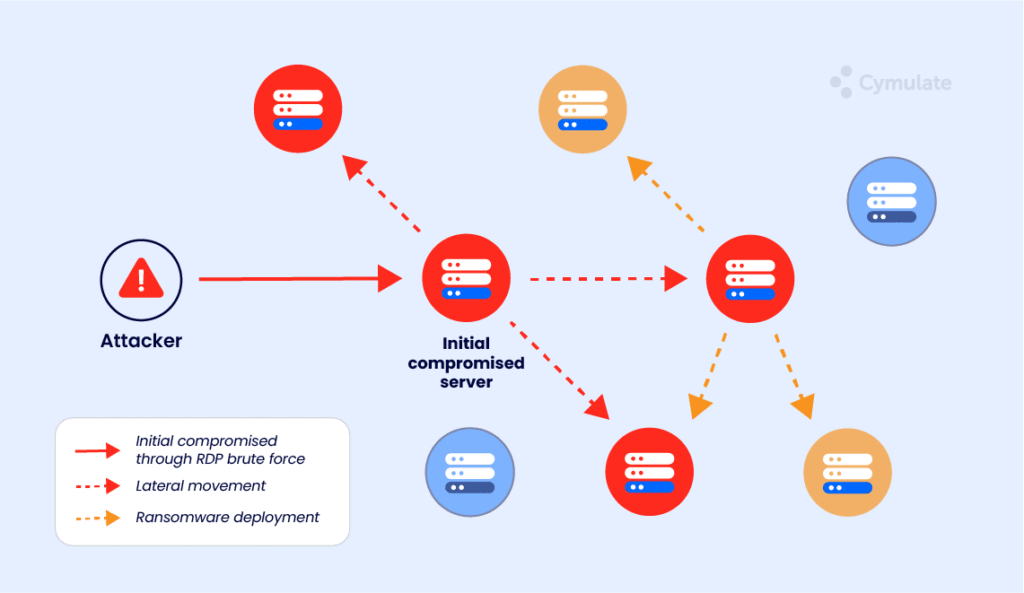
Cymulate’s Lateral Movement Test Vector Simulation

Lateral Movement Simulation (LMS) can show the bank when and where segmentation and access control weaknesses exist. Performing LMS at different times during production operations and across different network segments allows the bank to gain a much better picture of avenues of attack, and work to close those avenues without disruption of business operations.

Cymulate’s Lateral Movement vector challenges internal networks against different techniques and methods used by attackers to gain access, escalate privileges and control additional systems on a network, following the initial compromise of a single system.

Cymulate Exposure Validation makes advanced security testing fast and easy. When it comes to building custom attack chains, it's all right in front of you in one place.
Mike Humbert, Cybersecurity Engineer
DARLING INGREDIENTS INC.
Learn More
Book a Demo