
Frequently Asked Questions

Cyber Risk Mitigation & Strategy

What is cybersecurity risk mitigation and why is it important?

Cybersecurity risk mitigation refers to the systematic identification, evaluation, and reduction of risks that could negatively impact an organization's information systems. It is essential for minimizing exposure to cyber threats, ensuring operational continuity, regulatory compliance, and business resilience. In today's landscape, proactive risk mitigation is critical for protecting brand reputation, customer trust, and the bottom line. (source)

Why are continuous risk assessments necessary for effective cyber risk mitigation?

Continuous risk assessments are necessary because periodic assessments are no longer sufficient to keep up with evolving threats. Organizations must identify new vulnerabilities, attack surfaces, and misconfigurations as they emerge. Automated tools and ongoing analysis help prioritize critical risks and maintain a strong security posture. (source)

What are the top strategies for mitigating cybersecurity risk?

The top strategies include: conducting continuous risk assessments, implementing layered security controls (defense in depth), prioritizing threat intelligence and threat hunting, regularly validating security controls with automated testing, patch management and vulnerability prioritization, employee training and phishing simulations, enforcing strong access controls and least privilege, backing up critical data and validating recovery plans, monitoring third-party and supply chain risks, and developing and testing incident response plans regularly. (source)

How does Cymulate support proactive cyber risk mitigation?

Cymulate supports proactive cyber risk mitigation by providing automated security validation and exposure management. The platform enables organizations to continuously test and optimize their security controls, identify and prioritize exposures, validate effectiveness in real-time, and support risk-informed decision-making. (source)

Why is automated Breach and Attack Simulation (BAS) important for risk mitigation?

Automated Breach and Attack Simulation (BAS) is important because it allows organizations to safely test how their environment would respond to real-world attack scenarios. This ensures that security controls are functioning as intended and helps identify gaps before attackers can exploit them. (source)

How does Cymulate help organizations move from periodic assessments to continuous exposure validation?

Cymulate enables organizations to shift from periodic assessments to continuous exposure validation by automating Breach and Attack Simulation (BAS), validating security controls in real-time, mapping exposures to business impact, and providing attack path mapping and exposure analytics. (source)

What role does threat intelligence play in effective risk mitigation?

Threat intelligence enables security teams to understand attacker tactics, techniques, and procedures (TTPs). Actionable threat intelligence and proactive threat hunting help uncover hidden threats and inform defense strategies. Cymulate integrates immediate threat intelligence to enhance visibility and response. (source)

How can organizations prioritize vulnerabilities for patch management?

Organizations should implement a risk-based vulnerability management strategy that prioritizes vulnerabilities based on exploitability, asset value, and business impact, rather than just severity. This approach reduces actual exposure and improves security. (source)

Why is employee training and phishing simulation important for cyber risk mitigation?

Human error is a leading cause of data breaches. Ongoing security awareness training and regular phishing simulations help employees recognize and respond to social engineering attacks, building a security-first culture. (source)

How does Cymulate Exposure Validation contribute to risk mitigation?

Cymulate Exposure Validation enables organizations to identify and prioritize exposures, validate the effectiveness of security controls in real-time, support risk-informed decision-making, and enhance cyber resilience with attack path mapping and exposure analytics. (source)

Features & Capabilities

What are the key capabilities of Cymulate's platform?

Cymulate's platform offers continuous threat validation, a unified platform combining Breach and Attack Simulation (BAS), Continuous Automated Red Teaming (CART), and Exposure Analytics, attack path discovery, automated mitigation, AI-powered optimization, complete kill chain coverage, ease of use, and an extensive threat library with over 100,000 attack actions updated daily. (source)

Does Cymulate support integration with other security tools?

Yes, Cymulate integrates with a wide range of security technologies, including Akamai Guardicore, AWS GuardDuty, BlackBerry Cylance OPTICS, Carbon Black EDR, Check Point CloudGuard, Cisco Secure Endpoint, CrowdStrike Falcon, Wiz, SentinelOne, and more. For a complete list, visit the Partnerships and Integrations page.

How does Cymulate automate security validation?

Cymulate automates security validation by running 24/7 attack simulations, integrating with security controls to push updates, and using machine learning to prioritize remediation efforts. This automation allows organizations to validate defenses in real-time and focus on high-risk vulnerabilities. (source)

What is Cymulate's approach to exposure prioritization?

Cymulate validates exploitability and ranks exposures based on prevention and detection capabilities, business context, and threat intelligence. This helps organizations focus on the most critical vulnerabilities and optimize their security posture. (source)

How easy is Cymulate to implement and use?

Cymulate is designed for ease of use and quick implementation. It operates in agentless mode, requires minimal resources, and can be deployed rapidly. Customers report that the platform is intuitive, user-friendly, and provides actionable insights with just a few clicks. (source)

What kind of support and resources does Cymulate provide?

Cymulate offers comprehensive support, including email and chat support, a knowledge base with technical articles and videos, webinars, e-books, and an AI chatbot for quick answers. (source)

What compliance and security certifications does Cymulate hold?

Cymulate holds several key certifications, including SOC2 Type II, ISO 27001:2013, ISO 27701, ISO 27017, and CSA STAR Level 1. These certifications demonstrate Cymulate's commitment to robust security and compliance standards. (source)

How does Cymulate ensure data security and privacy?

Cymulate ensures data security through encryption for data in transit (TLS 1.2+) and at rest (AES-256), secure AWS-hosted data centers, a tested disaster recovery plan, and compliance with GDPR. The platform also includes mandatory 2FA, RBAC, IP address restrictions, and secure development practices. (source)

Use Cases & Benefits

Who can benefit from using Cymulate?

Cymulate is designed for CISOs and security leaders, SecOps teams, red teams, vulnerability management teams, and organizations of all sizes and industries, including finance, healthcare, retail, media, transportation, and manufacturing. (source)

What business impact can customers expect from using Cymulate?

Customers can expect improved security posture (up to 52% reduction in critical exposures), a 20-point improvement in threat prevention, 60% increase in team efficiency, up to 60 hours per month saved in testing, 40X faster threat validation, cost savings, and up to 81% reduction in cyber risk within four months. (source)

Are there case studies showing Cymulate's effectiveness?

Yes, for example, Hertz Israel reduced cyber risk by 81% in four months, a sustainable energy company scaled penetration testing cost-effectively, and a credit union improved threat prevention and detection. More case studies are available on the Cymulate Customers page.

How does Cymulate address the pain point of fragmented security tools?

Cymulate integrates exposure data and automates validation to provide a unified view of the security posture, addressing the challenge of disconnected tools and gaps in visibility and control. (source)

How does Cymulate help with resource constraints in security teams?

Cymulate automates processes, improving efficiency and operational effectiveness, allowing security teams to focus on strategic initiatives rather than manual tasks. (source)

How does Cymulate improve communication for CISOs and security leaders?

Cymulate provides quantifiable metrics and insights to justify investments, align security strategies with business objectives, and deliver validated data for prioritizing exposures. (source)

How does Cymulate help with cloud security and hybrid environments?

Cymulate secures hybrid and cloud infrastructures through automated compliance and regulatory testing, increasing visibility and improving detection and response capabilities. (source)

How does Cymulate support vulnerability management teams?

Cymulate automates in-house validation between pen tests and prioritizes vulnerabilities effectively, improving operational efficiency for vulnerability management teams. (source)

How does Cymulate help organizations recover after a breach?

Cymulate enhances visibility and detection capabilities, ensuring faster recovery and improved protection by replacing manual processes with automated validation. (source)

Pricing & Plans

What is Cymulate's pricing model?

Cymulate operates on a subscription-based pricing model tailored to each organization's requirements. Pricing depends on the chosen package, number of assets, and scenarios selected. For a detailed quote, you can schedule a demo with the Cymulate team. (source: internal manual)

Competition & Differentiation

How does Cymulate differ from other cybersecurity validation platforms?

Cymulate stands out with its unified platform combining BAS, CART, and Exposure Analytics, continuous 24/7 threat validation, AI-powered optimization, complete kill chain coverage, ease of use, and proven results such as a 52% reduction in critical exposures and 81% reduction in cyber risk within four months. (source)

What advantages does Cymulate offer for different user segments?

CISOs and security leaders benefit from quantifiable metrics and insights; SecOps teams gain operational efficiency and faster threat validation; red teams access automated offensive testing with a large attack library; vulnerability management teams automate validation and prioritization. (source)

Resources & Support

Where can I find Cymulate's blog and latest research?

You can stay updated on the latest threats, research, and more by visiting the Cymulate blog.

Where can I find Cymulate's newsroom and event information?

Media mentions, press releases, and event information are available in the Cymulate newsroom and on the Events & Webinars page.

Is there a central resource hub for Cymulate insights and product information?

Yes, the Cymulate Resource Hub contains insights, thought leadership, and product information.

Does Cymulate provide a cybersecurity glossary?

Yes, Cymulate offers a cybersecurity glossary with definitions for terms, acronyms, and jargon.

New: 2026 Gartner® Market Guide for Adversarial Exposure Validation
Learn More
Cymulate named a Customers' Choice in 2025 Gartner® Peer Insights™
Learn More
New Research: The Security Tradeoffs Behind AI Tooling
Learn More
An Inside Look at the Technology Behind Cymulate
Learn More

10 Strategies for Effective Cybersecurity Risk Mitigation 

By: Jake O’Donnell

Last Updated: February 1, 2026

cymulate blog article

As digital infrastructures expand and threat actors grow more sophisticated, organizations must move beyond reactive defense and adopt proactive, risk-informed strategies to protect their critical assets. 

Cybersecurity risk mitigation refers to the systematic identification, evaluation and reduction of risks that could negatively impact an organization's information systems. The goal is to minimize exposure to cyber threats and ensure operational continuity, regulatory compliance and business resilience. 

Effective cyber risk mitigation isn’t optional—it’s essential for protecting brand reputation, customer trust, and the bottom line. 

The Importance of Cyber Risk Mitigation in Today’s Threat Landscape 

Cybercriminals are leveraging AI-driven malware, ransomware-as-a-service models and increasingly targeting supply chains and cloud environments. The days of relying on annual assessments or static defenses are long gone. 

Organizations like yours face mounting pressure not only from threat actors but also from compliance bodies. Standards like NIST, ISO 27001, HIPAA and PCI-DSS demand comprehensive cyber risk mitigation plans as part of broader governance and security programs. 

Moreover, risk assessment in cybersecurity must evolve into a continuous, data-driven practice. Without real-time visibility into your security posture, it's nearly impossible to keep pace with emerging threats or confidently make risk-based decisions. With that in mind, we’re offering 10 ways your organization can approach, consider and implement effective cybersecurity risk mitigation strategies to keep your critical systems safe. 

10 Strategies for Effective Cybersecurity Risk Mitigation 

1. Conduct Continuous Risk Assessments 

Periodic assessments are no longer enough. Organizations must adopt continuous risk assessment practices to identify new vulnerabilities, evolving attack surfaces and misconfigurations as they emerge. 

Tip: Use automated tools to scan networks and assets regularly. Integrate threat modeling and business impact analysis to prioritize critical risks. 

2. Implement Layered Security Controls (Defense in Depth) 

A single security solution won’t suffice. A Defense in Depth strategy uses overlapping layers of protection across endpoints, networks, applications, and identities. 

Example: Combine firewalls, endpoint detection and response (EDR), network segmentation and multi-factor authentication (MFA) for robust coverage. 

3. Prioritize Threat Intelligence and Threat Hunting 

Actionable threat intelligence enables security teams to understand attacker tactics, techniques, and procedures (TTPs). Threat hunting takes a proactive approach to uncover hidden threats already inside your environment. 

Tip: Subscribe to real-time threat intelligence feeds and implement threat hunting playbooks based on MITRE ATT&CK techniques. 

Learn more: Exposure Validation from Cymulate

4. Regularly Validate Security Controls with Automated Testing 

Security controls can degrade over time or fail silently. Regular validation ensures your defenses are operating as intended. 

Solution: Use automated Breach and Attack Simulation (BAS) to safely test how your environment would respond to real-world attack scenarios. 

See how: Threat Validation from Cymulate 

5. Patch Management and Vulnerability Prioritization 

Unpatched systems are one of the most exploited attack vectors. But with thousands of vulnerabilities disclosed each year, not all are equally critical. 

Approach: Implement a risk-based vulnerability management strategy that prioritizes vulnerabilities based on exploitability, asset value and business impact. 

image
Further reading
Unlock Success with Risk-Based Vulnerability Management

Shift from severity-only fixes to risk-based vulnerability management to reduce actual exposure and improve security.

Read More

6. Employee Training and Phishing Simulations 

Human error remains the leading cause of data breaches. Ongoing security awareness training empowers employees to recognize and respond to social engineering attacks. 

Tip: Conduct regular phishing simulations and track improvements over time to build a security-first culture. 

7. Enforce Strong Access Controls and Least Privilege 

Limit access to systems and data based on user roles and responsibilities. The principle of least privilege minimizes the potential damage from compromised credentials. 

Example: Implement Just-in-Time (JIT) access and regularly review privilege escalations. 

8. Backup Critical Data and Validate Recovery Plans 

Backups are a last line of defense, especially in the event of ransomware. But they’re only effective if tested. 

Strategy: Maintain offline, encrypted backups and regularly perform disaster recovery drills to ensure data restoration processes work under pressure. 

9. Monitor Third-Party and Supply Chain Risks 

Vulnerabilities in partner systems or software vendors can introduce significant exposure. 

Actionable Step: Implement a third-party risk management program to assess and monitor vendor security practices and include them in incident response plans. 

10. Develop and Test an Incident Response Plan Regularly 

An untested incident response (IR) plan is only marginally better than none. Your IR plan should outline clear roles, escalation paths, and playbooks for various attack scenarios. 

Best Practice: Conduct tabletop exercises and red team engagements more than once a year to keep your team prepared. 

Cymulate’s Role in Risk Mitigation 

Cybersecurity risk mitigation strategies are only as effective as their implementation—and verification. That’s where Cymulate can make a major difference. 

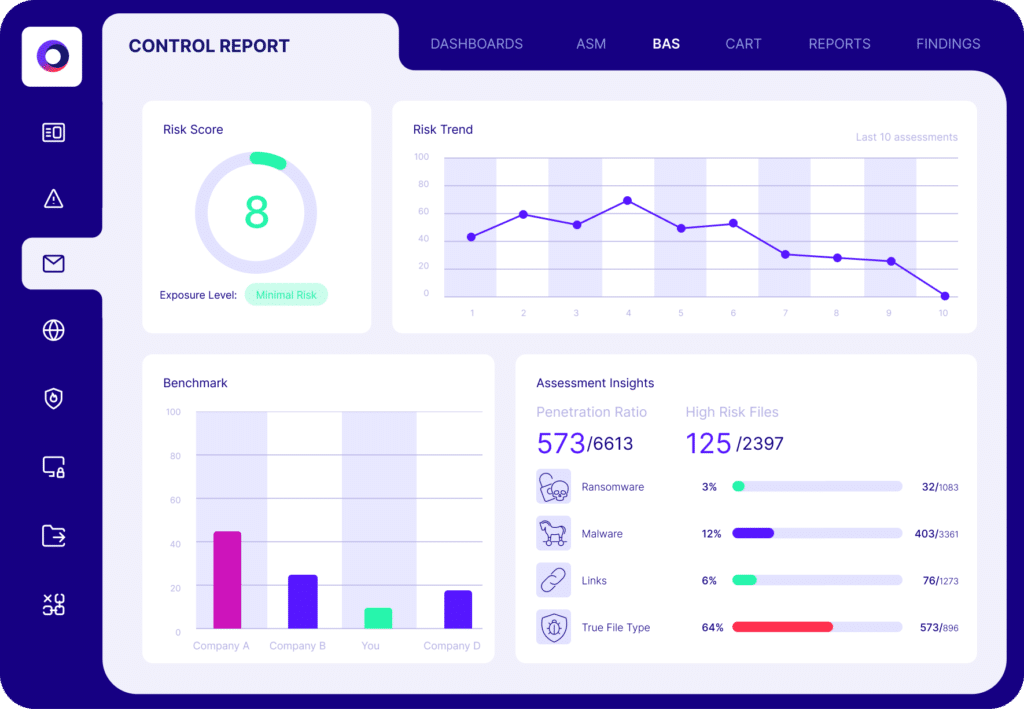
Cymulate combines the best of automated security validation with a focus on threat exposure to continuously test and optimize your security. Integrate Cymulate into your exposure management program to focus on the exploitable. 
cymulate control report risk score

Organizations can move from periodic assessments to exposure validation thanks to Cymulate, helping security leaders: 

  • Identify and prioritize exposures through automated Breach and Attack Simulation (BAS) 
  • Validate the effectiveness of security controls in real-time 
  • Support risk-informed decision-making by mapping findings to business impact 
  • Enhance cyber resilience with attack path mapping and exposure analytics 

By integrating Cymulate Exposure Validation and Immediate Threat Intelligence solutions, organizations gain clear visibility into their current security posture and can take action before attackers do. 

Key Takeaways 

  • Cybersecurity risk mitigation must be proactive, not reactive. 
  • The modern threat landscape demands continuous assessment, validation and adaptation
  • Layered defenses, strong access policies, threat intelligence and employee training are key pillars. 
  • Automated tools like Cymulate provide real-time insights and validation to support decision-making and reduce cyber exposure. 
  • Building a comprehensive cyber risk mitigation plan strengthens your compliance posture and boosts resilience. 

Ready to Proactively Manage Cyber Risk? 

Traditional cybersecurity approaches can’t keep pace with modern threats. Cymulate empowers you to validate defenses, uncover exposures and reduce cyber risk with confidence. 

Start your risk-informed journey with Cymulate’s proactive security solutions by booking a demo today. 

Cymulate Exposure Validation makes advanced security testing fast and easy. When it comes to building custom attack chains, it's all right in front of you in one place.
Mike Humbert, Cybersecurity Engineer
DARLING INGREDIENTS INC.
Learn More
Book a Demo