

Threat Detection Engineering: Sigma and YARA Rules Guide
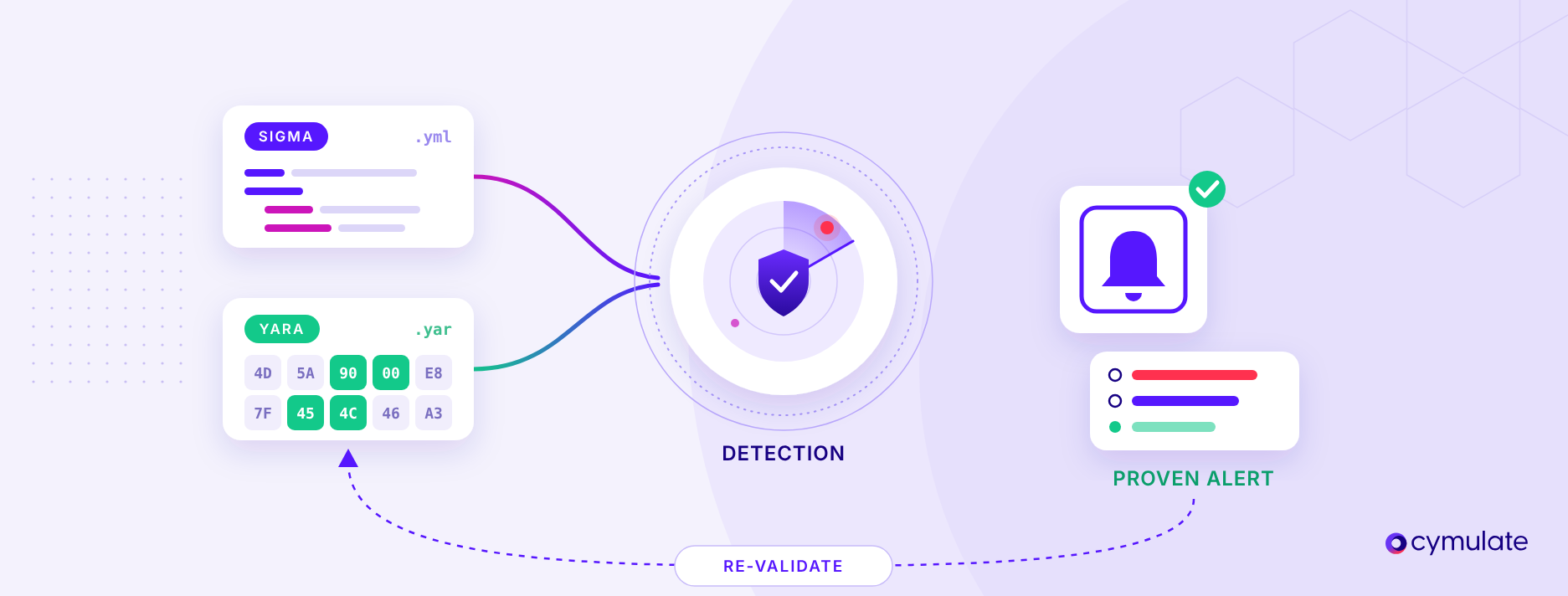
Most security teams do not lack alerts. They lack confidence that the right alerts will fire when a real attack happens. Vendor rule packs are written for generic environments, attackers keep changing their tradecraft, and the data pipelines that feed detections change underneath them. A rule can look healthy on a dashboard while the logs it depends on have stopped arriving. This is where continuously validating that alerts are working properly is essential.
What is threat detection engineering, and why is it needed?
Threat detection engineering is the practice of designing, building, testing and maintaining detection logic as an engineered product rather than a one-time configuration. Every detection follows the same lifecycle: define the threat, confirm the data, test against realistic behavior and maintain it as the environment changes.
It is needed because detections fail in ways that are hard to see:
- Coverage gaps. New techniques and campaigns appear faster than default content is updated, so relevant behavior goes undetected.
- Silent failures. A disabled log source, a parser change or an agent update can break a rule without producing any error.
- Noise. Rules that are not tuned to the environment generate false positives that bury real signals and consume analyst time.
- Unproven coverage. Installed rules and ATT&CK tags show intent, not evidence that a detection works.
Detection engineering addresses these problems with a repeatable process and portable rule formats that can be reviewed, versioned and tested like code. Two of the most widely used open formats are Sigma and YARA.
How threat detection evolved into a security engineering discipline
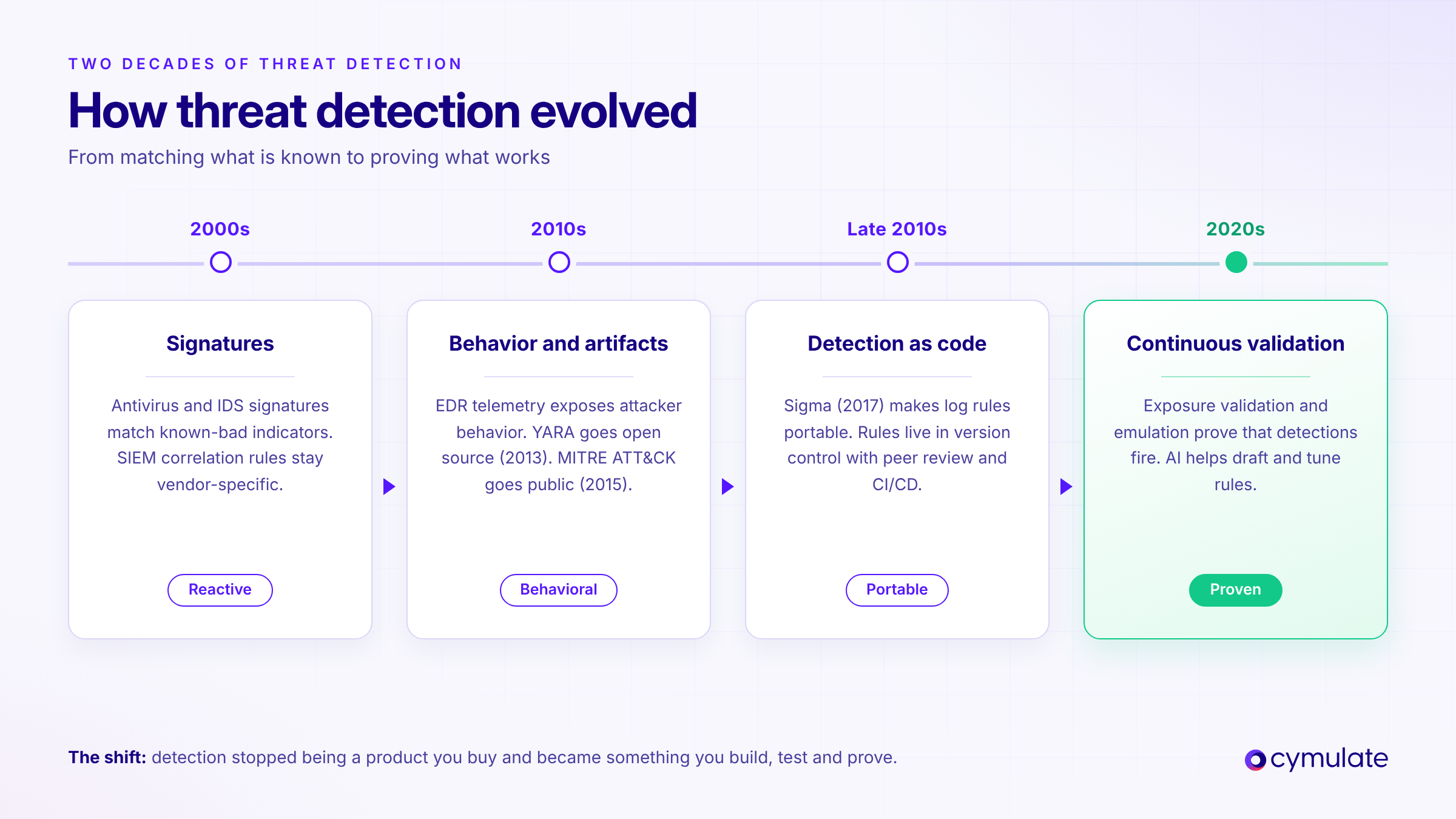
Threat detection has shifted from matching known indicators to engineering and proving detections. Antivirus and intrusion detection signatures dominated the 2000s. In the 2010s, endpoint detection and response (EDR) telemetry, YARA and the MITRE ATT&CK framework moved the focus to attacker behavior and artifacts. Sigma, released in 2017, made log-based rules portable and helped turn detections into version-controlled code. Today, teams continuously validate that their existing detections fire in their own environments.
Sigma and YARA: two complementary rule formats
Sigma is a vendor-neutral, YAML-based format for describing suspicious activity in log data. A converter translates a Sigma rule into the query language of a specific security information and event management (SIEM) platform, data lake or endpoint detection and response (EDR) tool, such as Splunk or CrowdStrike.
YARA describes patterns in files and process memory, such as strings, byte sequences and structural conditions. Scanners, sandboxes, EDR tools and threat hunting tools use YARA rules to identify malware families and other distinctive artifacts.
Together, they connect behavioral detection (what an attacker does) with artifact identification (what an attacker leaves behind). Choose the format based on the evidence available:
| Criterion | Sigma | YARA |
| What it matches | Conditions in log events | Strings, byte patterns and structural conditions |
| Data source | Endpoint, network, cloud and application logs, such as Windows event logs, Sysmon, Linux auditd, cloud audit logs and EDR telemetry | File contents and accessible process memory |
| Where it runs | SIEM, data lake and EDR query languages through backend conversion | Compatible scanners, EDR tools, sandboxes and threat hunting tools |
| Best for | Suspicious activity and behavioral analytics | Malware-family artifacts and distinctive content |
| Typical ATT&CK fit | Behaviors and techniques | Artifacts associated with malware and techniques |
| Maintenance risk | Changed fields, parsers and telemetry | Changed artifacts, broad strings and scanning cost |
You will often write both formats for the same threat. Support for each format in EDR products varies by vendor. For syntax and rule anatomy, see the Sigma specification, the SigmaHQ getting started guide and the YARA documentation on writing rules.
A practical detection engineering workflow
Writing a rule is only one part of detection engineering. A rule that has never been tested against the behavior it targets, or that depends on data the environment does not collect, offers false assurance. This workflow closes those gaps: it ties every rule to a defined threat, confirms the data before any logic is written and treats validation and maintenance as part of the job rather than an afterthought.
The workflow applies to any technique and to either rule format. It has six steps:
- Define the threat and map it to MITRE ATT&CK.
- Confirm the telemetry the detection needs.
- Write the rule.
- Convert, review and deploy as code.
- Validate against realistic attacker behavior.
- Tune and re-validate.
Success means proving that the intended rule fires, produces useful evidence and keeps working after changes. Each step is described in general terms below, followed by examples.
Step 1: Define the threat and map it to ATT&CK
Start from threat intelligence relevant to your organization: an advisory, an incident, a red team finding or a campaign targeting your industry. Define the observable behavior or artifact, the affected systems and the evidence a detection should produce. Map the behavior to the MITRE ATT&CK® Framework so coverage can be tracked consistently.
Define acceptance criteria before writing. For a behavioral rule, a test should produce an alert that can be attributed to that test. For an artifact rule, the rule should match positive test files (fixtures) and reject negative ones. Assign one owner and document known blind spots and the scope the rule is meant to cover.
Step 2: Confirm you have the telemetry
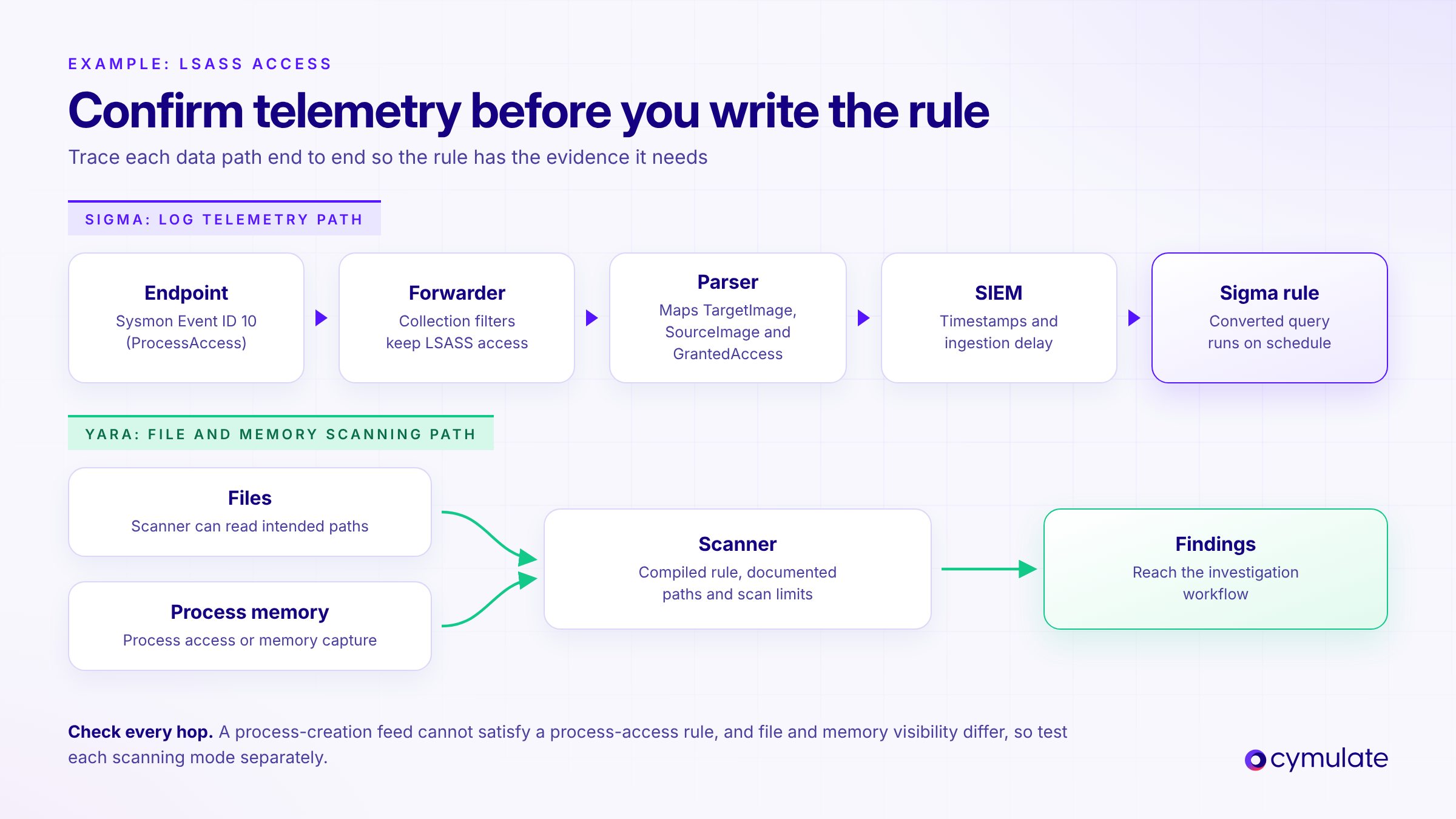
A rule can only detect what the environment records. Identify the exact event types and fields the logic needs, then confirm they are collected on the systems in scope. Check that collection filters, sampling and audit policies do not discard the relevant events.
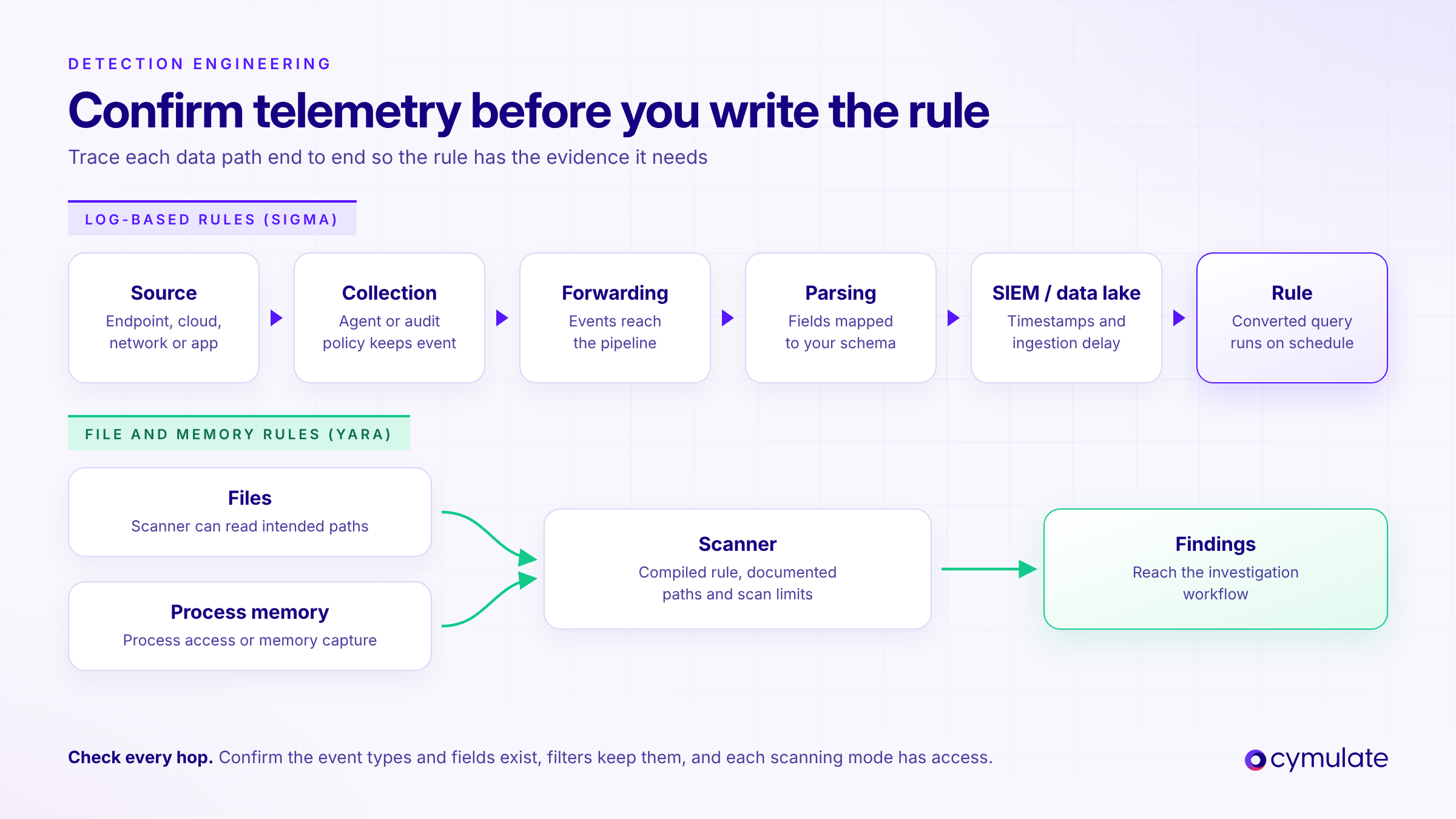
For log-based rules, trace events from the source through forwarding, parsing and storage in the SIEM. Check field names, timestamps and ingestion delay. For file and memory rules, confirm the scanner can read the intended paths or processes. Memory scanning requires appropriate access to the target process or a memory capture. File and memory visibility differ, so test each scanning mode separately.
Step 3: Write the rule
Write the narrowest logic that reliably captures the defined behavior or artifact, using field names and values observed in real telemetry or samples. Record the metadata that keeps a rule maintainable: a unique ID, ATT&CK tags, references, known false positives, severity and status.
Community rules, such as those in the SigmaHQ rule repository, are a useful starting point, but check their assumptions against local data. Treat every new rule as experimental until it passes validation.
Step 4: Convert, review and deploy as code
Convert Sigma rules with a tool such as sigma-cli (built on pySigma), a backend for the target platform and a processing pipeline that maps Sigma log sources and field names to your schema. Review the generated query for escaping, case handling and logically equivalent conditions. Compile YARA rules and deploy them to the intended scanners with documented paths, permissions and scan limits. Automated security validation platforms, such as Cymulate, auto-configure the detection rule for your specific tool and can also auto-push the new rule.
Store rules, conversion pipelines and test fixtures in version control. Require peer review, automated checks such as syntax validation and conversion tests, and a rollback version. This detection-as-code approach makes dependencies reviewable. A parser or pipeline change can alter detection as much as a rule edit, so include those changes in the same review process.
Conversion produces a query, not an operational alert. Configure scheduling, severity, suppression and routing in the target platform. Record engine, backend and pipeline versions for reproducibility.
Step 5: Validate against realistic attacker behavior
Detection rule validation must go beyond syntax. On an approved test system, safely reproduce the behavior the rule targets. Options include open-source emulation tools such as Atomic Red Team and MITRE Caldera, and exposure validation platforms (formerly called breach and attack simulation, or BAS). Open-source tools give precise, per-technique tests you control. Exposure validation platforms, such as Cymulate, add production-safe scenarios, scheduling and coverage reporting at scale. Whichever you use, choose scenarios that do not expose real credentials or data.
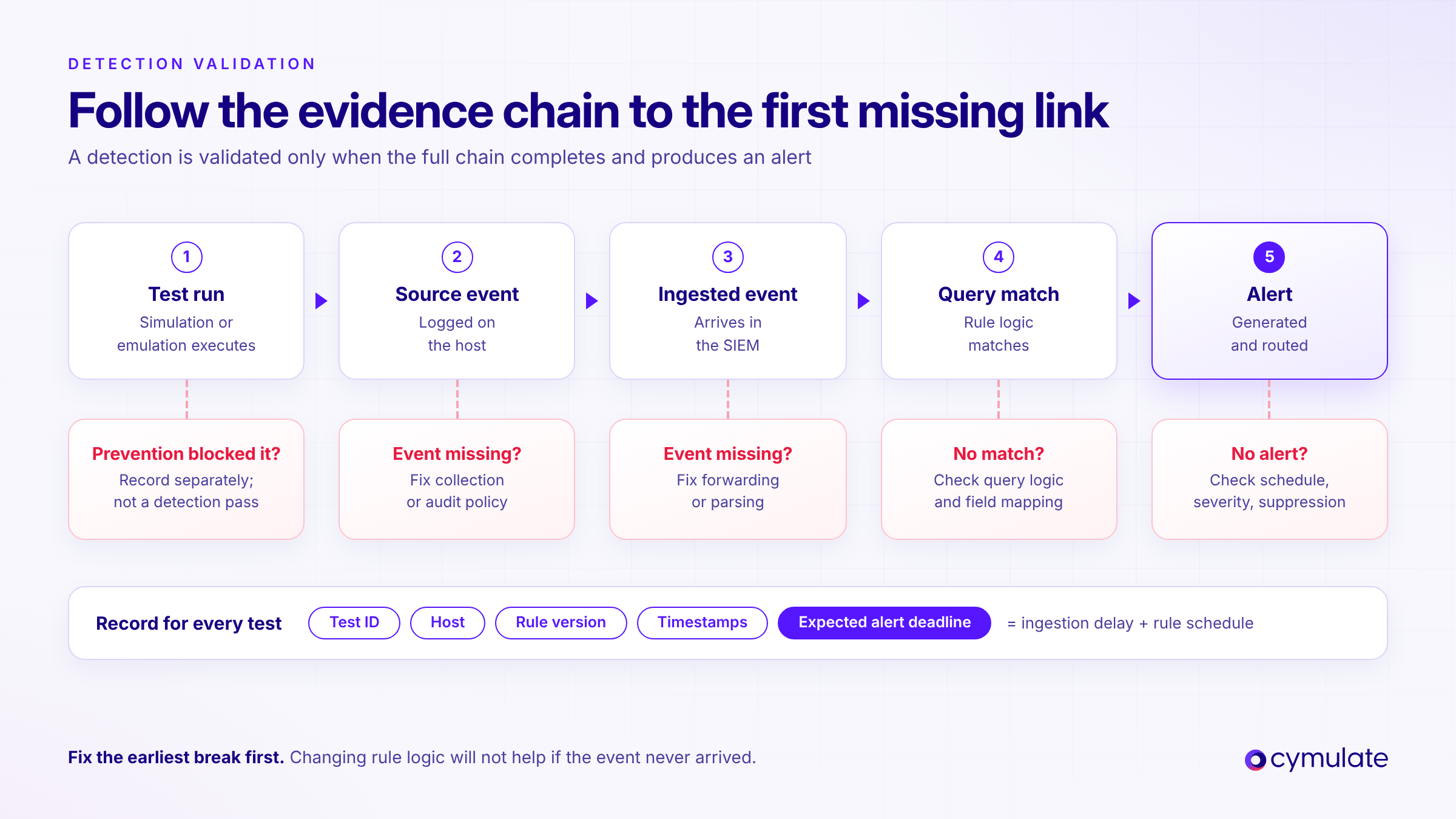
Follow the evidence through the complete chain: test execution, source event, ingested event, query match and generated alert. Record the test identifier, host, rule version and timestamps, and set an expected alert deadline based on ingestion delay and the rule schedule. When a test misses, inspect the earliest missing link before changing logic. A missing source event calls for a log collection fix; an ingested event with no match calls for query investigation. If prevention stops the behavior before the required event occurs, record that outcome separately; it does not prove the detection works.
For artifact rules, scan benign positive fixtures, negative fixtures and a representative clean corpus, and confirm that scanner findings reach the investigation workflow. Synthetic fixtures prove matching and integration. Accuracy against a real malware family requires authorized samples in an isolated analysis environment.
Step 6: Tune and re-validate
Investigate false positives and false negatives before changing logic. Prefer scoped exceptions based on context, such as process identity, signer, path or host role, over broad suppression. Give each exception an owner, a reason and a review date. For artifact rules, evaluate string specificity, encoding and scan duration. Rerun the original tests after every adjustment.
Trigger regression testing after rule edits, parser updates, endpoint agent changes and scanner upgrades. Schedule repeat validation to catch detection drift, including missing telemetry and rule rot. Keep previous results so teams can identify when performance changed.
Threat detection engineering examples
The following examples apply the workflow to one behavioral detection and one artifact detection. Both are illustrative and require detection engineer review and environment-specific validation before production use.
Example 1: Sigma rule for credential dumping from LSASS memory
Threat and mapping. Attackers often read the memory of the Local Security Authority Subsystem Service (LSASS) to extract credentials. This maps to MITRE ATT&CK T1003.001, OS Credential Dumping: LSASS Memory.
Telemetry. The rule needs process-access events, such as Sysmon Event ID 10 (ProcessAccess), with the TargetImage, SourceImage and GrantedAccess fields. Microsoft documents that this event records one process opening another. Because this event is high-volume, many Sysmon configurations filter it heavily, so confirm that accesses to lsass.exe are retained. A process-creation feed alone cannot satisfy this rule.
Rule
title: Suspicious Process Access to LSASS Memory
id: 77c9e49c-288d-4270-b9c4-2fd6b41fcdca
status: experimental
description: Illustrative. One access mask used to read LSASS.
references:
  - https://attack.mitre.org/techniques/T1003/001/
author: Ida Nasko
date: 2026-11-18
tags:
  - attack.credential-access
  - attack.t1003.001
logsource:
  category: process_access
  product: windows
detection:
  selection:
    TargetImage|endswith: '\lsass.exe'
    GrantedAccess: '0x1010'  # One illustrative access mask
  condition: selection
falsepositives:
  - Security and backup tools that legitimately read LSASS
level: medium The selection combines the target process with one access mask. The mask 0x1010 (PROCESS_QUERY_LIMITED_INFORMATION plus PROCESS_VM_READ) is requested by some credential-dumping tools, but legitimate software also uses it, and attackers can request other masks or use other techniques. Use observed telemetry to develop additional logic and scoped exceptions.
Convert and deploy. After installing the security tool backend, such as Splunk, check the rule and convert it:
sigma plugin install splunk
sigma check lsass_access.yml
sigma convert -t splunk -p ./pipelines/windows.yml lsass_access.yml Here, windows.yml is a pipeline you supply. It must select the correct data source, scope the rule to process-access events and map fields to your SIEM schema.
Validate and tune. Simulate LSASS access attacks on an approved test endpoint, using a test that does not dump real credentials, and follow the evidence chain from the event to the alert. To reduce false positives, separate legitimate access by security, backup and monitoring tools from suspicious activity using source-process identity, signer and path.
Example 2: YARA rule for ransomware artifact identification
Threat and mapping. During a ransomware investigation, such as a suspected LockBit incident, responders scan hosts for files linked to the family. Associate those artifacts with MITRE ATT&CK technique, T1486, Data Encrypted for Impact, only as investigation context: a file match alone does not prove encryption occurred. In reporting, keep a family-level artifact rule distinct from broader ransomware behavior coverage.
Telemetry. Confirm that the scanner can read the intended directories, and decide whether memory scanning is in scope.
Rule. The fixture below uses invented markers so the workflow can be tested safely. It is not a real malware signature.
rule Ransomware_Training_Fixture
{
    meta:
        description = "Synthetic fixture; not a malware signature"
        attack_context = "T1486"
        author = "Ida Nasko"
        date = "2026-11-18"
    strings:
        $a = "TRAINING_ONLY_FAMILY_MARKER"
        $b = "TRAINING_ONLY_NOTE_MARKER"
    condition:
        all of them
} The condition requires both markers. Metadata records context and does not affect matching.
Validate. Create a harmless text file containing both markers and run yara ransomware_training.yar positive.txt. Expect the rule name in the output. Scan files containing only one marker, and unrelated clean text; expect no matches. A real family signature needs independently verified artifacts, authorized samples and a representative clean corpus. Automated validation platforms, such as Cymulate, has a library of over 100,000 attack scenarios and custom resources such as files and links can be uploaded.
Additional examples across security controls
The same six steps apply across platforms and techniques. What changes is the telemetry to confirm, the rule format and the test method:
| Threat behavior | ATT&CK | Telemetry to confirm | Rule format |
| Encoded PowerShell commands | T1059.001 | Process creation with command line (Sysmon Event ID 1, or Windows Security Event ID 4688 with command-line auditing enabled) | Sigma |
| Scheduled task persistence on Windows | T1053.005 | Windows Security Event ID 4698, or process creation for schtasks.exe | Sigma |
| Cron persistence on Linux | T1053.003 | auditd file-write events for cron directories | Sigma |
| AWS CloudTrail logging disabled | T1562.008 | CloudTrail StopLogging and DeleteTrail events | Sigma |
| Web shell on a web server | T1505.003 | File contents in web directories, plus process creation from the web server | YARA for the file; Sigma for child processes |
How to measure detection engineering quality
Define test scope and denominators before comparing results.
| Metric | What it shows | How to calculate |
| Validated ATT&CK coverage | Tested visibility across relevant techniques | Techniques with successful detection tests ÷ in-scope techniques × 100% |
| Detection ratio | Whether expected alerts fired | Expected alert outcomes observed ÷ alert outcomes expected in testing × 100% |
| False positive rate | How often benign test cases trigger | False positives ÷ all known-benign test cases × 100% |
| Mean time to detect (MTTD) | Detection speed | Sum of (first-alert time − test-start time) ÷ detected tests |
| Advisory-to-validation time | Speed of operationalizing intelligence | Validated deployment time minus advisory receipt time |
| Silent or stale rules | Maintenance and validation backlog | Count rules overdue for validation or failing expected tests |
For example, eight successful outcomes from 10 expected outcomes produce an 80% detection ratio. Duplicate alerts do not increase the numerator. Report missed tests alongside MTTD, since undetected activity has no first-alert timestamp.
A successful test validates a specific scenario and environment, not every implementation of an ATT&CK technique. Keep false positive rate separate from the share of alerts analysts dismiss, which uses a different denominator. A quiet rule also needs investigation before retirement: it may be silent because the threat is absent or because its telemetry is missing.
Common Sigma and YARA pitfalls
- Writing rules for telemetry the environment does not collect.
- Counting installed rules or ATT&CK tags as validated coverage.
- Importing community rules without checking assumptions and local behavior.
- Accepting Sigma conversions without verifying equivalent logic across backends.
- Choosing broad YARA strings that create false positives or expensive scans.
- Publishing rules without acceptance criteria or a named owner.
- Skipping regression tests after rule, telemetry or environment changes.
Where AI fits in detection engineering
AI can draft rules from a threat advisory, suggest ATT&CK mappings and propose tuning. Supply actual field schemas, representative events and detection requirements so drafts reflect available evidence.
Engineers should review every rule, confirm mappings and test proposed exclusions. Generated logic can reference nonexistent fields or suppress useful signals. Keep the same review and validation requirements for human-written and AI-generated content.
Agentic AI systems can also coordinate validation tasks, such as running tests and collecting evidence, within approved boundaries and with a human in the loop. Engineers remain responsible for deployment decisions, while observed test results establish whether the detection works.
Making validation continuous
Detection engineering is a loop, not a project. Mature programs automate parts of the cycle: they track every existing detection rule, run syntax and conversion checks whenever a rule changes in version control, schedule exposure validation scenarios for high-priority techniques, and feed the results into a coverage map that shows which detections were validated, when, and which are overdue. Whether the loop is built from open-source tools, an exposure validation platform or both, the principle is the same: a detection counts as coverage only when recent evidence proves it works in the current environment.
Key takeaways
- Detection engineering treats detections as products that are designed, tested and maintained, not one-time configurations.
- Use Sigma for behavior in logs and YARA for patterns in files and memory. Many threats need both.
- Start with a threat, map the technique and confirm telemetry before writing.
- Count coverage only after successful validation, with the tested scope documented.
- Re-validate after changes to catch detection drift.
Frequently asked questions
Sigma expresses detection conditions for log events in a portable YAML format. A converter translates those conditions into a supported platform query. YARA matches content and structural patterns in files or memory. Teams often combine behavioral Sigma detections with YARA artifact matches during the same investigation.
Sigma needs a compatible conversion backend and suitable telemetry. Field mappings, supported operators and correlation capabilities vary across platforms. Review the converted query and configure alert scheduling in the destination platform. Portability reduces rewriting, but each deployment still requires local validation with representative events and expected alerts.
Check the rule syntax, convert it with the intended backend and test the generated query against positive and negative events. Then emulate the target behavior safely, with an open-source tool or an exposure validation platform, and verify the source event, ingestion and actual alert. Preserve test evidence and rerun the scenario after tuning or pipeline changes.
Compile the rule and scan benign fixtures carrying its intended test patterns. Include negative fixtures with missing patterns and a representative clean corpus. Verify scanner reporting as well as matching. Synthetic markers validate mechanics; testing a real malware-family signature requires authorized samples and an appropriately isolated analysis environment.
Map Sigma logic to the behavior it observes, such as LSASS memory access associated with T1003.001, and record technique identifiers in rule tags. YARA metadata can document an artifact’s technique association, but matching a file does not prove that behavior occurred. Preserve the mapping rationale and validate behavioral coverage separately.
Re-validate after changes to detection logic, telemetry, parsers, platform configuration or scanning engines. Also schedule recurring tests according to threat relevance, asset importance and environment change frequency. Frequently changing, high-priority detections need more frequent checks. Give every rule an owner, a last-validation date and a defined review interval.

Featured Resources
View More Resources
Build, Validate and Optimize Threat Detections at Scale
Turn noisy alerts and broken SIEM rules into reliable, validated detections fast with automation and continuous validation.
Proactive, AI-Powered SIEM Rule Validation and Detection Engineering
Save time and resources by automating the most critical tasks in modern SecOps

Cymulate Detection Studio
Cymulate Detection Studio automates SIEM rule validation and detection tuning against real-world attacks.