Frequently Asked Questions

Data Drift Basics

What is data drift in the context of cybersecurity and machine learning?

Data drift refers to changes in the statistical properties of input data over time, which can impact the performance of machine learning (ML) models, automated systems, and cybersecurity frameworks. In cybersecurity, data drift can erode the effectiveness of detection and prevention mechanisms, making it harder to identify new or evolving threats.

What are the main types of data drift?

The two primary types of data drift are concept drift and feature drift. Concept drift occurs when the relationship between input data and the target variable changes, while feature drift happens when the distribution of individual input features changes without altering the underlying relationship to the target variable.

Why is data drift detection important for cybersecurity teams?

Data drift detection is crucial for cybersecurity teams because undetected drift can render static models ineffective against new or evolving threats. By identifying and addressing drift, teams ensure their systems remain resilient and capable of defending against dynamic adversaries and changing attack techniques.

How can data drift impact industries beyond cybersecurity?

Data drift can affect industries such as finance and healthcare, where predictive models must adapt to real-world changes. If not addressed, drift can lead to inaccurate predictions, missed fraud detection, or compromised patient outcomes.

Causes and Detection of Data Drift

What causes data drift in machine learning and cybersecurity systems?

Data drift can be caused by developing real-world conditions (such as changes in user behavior or attack techniques), outdated models that are not retrained, and bias in training data. These factors can lead to misalignment between current data and the assumptions of deployed models.

How does concept drift differ from feature drift?

Concept drift refers to changes in the relationship between input data and the target variable, while feature drift involves changes in the distribution of individual input features without altering their relationship to the target variable. Both can degrade model performance if not detected and addressed.

What statistical techniques are used to detect data drift?

Common statistical techniques for detecting data drift include Kullback-Leibler divergence, Jensen-Shannon divergence, and Kolmogorov-Smirnov tests. These methods quantitatively measure changes in data distributions over time.

How can baseline comparisons help in detecting drift?

Baseline comparisons involve monitoring deviations from established data baselines using statistical thresholds or manual evaluation. Sudden changes, such as spikes in anomaly rates, can indicate the presence of drift and prompt further investigation.

What role does performance monitoring play in drift detection?

Performance monitoring tracks metrics like accuracy, precision, or recall over time. A consistent drop in these metrics can signal that a model's predictive capabilities are being undermined by drift, prompting the need for retraining or adjustment.

What tools are available for automated drift detection?

Automated drift detection tools include ML monitoring platforms and cybersecurity validation systems that integrate statistical techniques, performance monitoring, and real-time alerts. Examples mentioned include Evidently AI and Arize AI, which specialize in tracking model performance and identifying distribution changes.

Prevention and Mitigation of Data Drift

How can continuous monitoring help prevent data drift?

Continuous monitoring involves regular validation cycles to assess model and system performance. Real-time monitoring tools can quickly identify and address drift, minimizing the risk of prolonged exposure to vulnerabilities caused by undetected drift.

What are data validation pipelines and how do they reduce drift?

Data validation pipelines are automated processes that flag inconsistent or outdated data, ensuring high-quality and up-to-date inputs. These pipelines help preserve data integrity and reduce the risk of drift affecting model performance.

Why is model retraining important for preventing data drift?

Periodic model retraining with fresh datasets ensures that models remain aligned with evolving data distributions. Retraining schedules should be based on model criticality and observed drift patterns, especially in high-stakes environments like finance or healthcare.

How does security control testing help mitigate data drift?

Security control testing, such as regular penetration testing and red teaming exercises, helps uncover gaps in security postures that may result from drift. Adaptive security controls validated through continuous testing can preempt weaknesses introduced by changing data or threats.

What is the role of feedback loops in preventing drift?

Feedback loops between deployed models and development environments provide insights into changes in data distributions. These loops help teams identify trends and proactively address potential drift before it impacts model performance.

How does diversified training data reduce the risk of drift?

Incorporating diverse and representative data during the training phase helps models generalize better and remain robust in dynamic environments, minimizing the risk of drift caused by narrow or biased datasets.

Cymulate Platform & Data Drift Detection

How does Cymulate help organizations detect and mitigate data drift?

Cymulate's Continuous Security Validation platform empowers organizations to detect and mitigate data drift by simulating real-world attack scenarios and validating security controls. The platform provides actionable insights, continuous validation, and tailored recommendations to help security teams stay ahead of evolving threats and maintain robust defenses.

What are the key features of Cymulate's drift detection capabilities?

Cymulate offers continuous validation of security controls, drift detection in threat models, and actionable recommendations for retraining models and updating security protocols. The platform integrates seamlessly with existing security ecosystems and supports automated simulations to test readiness against both known and emerging threats.

How does Cymulate provide actionable recommendations for addressing drift?

Cymulate analyzes threat models and attack techniques to identify drift and provides tailored recommendations for retraining models, updating security protocols, and enhancing system configurations. These insights help organizations maintain robust defenses against dynamic threats.

How does Cymulate's continuous validation approach help with data drift?

Cymulate's continuous validation approach ensures that security controls are regularly tested against the latest attack vectors and threat models. This proactive strategy helps organizations quickly identify and address weaknesses caused by data drift, maintaining resilience even as external conditions change.

What types of organizations benefit most from Cymulate's drift detection?

Organizations with dynamic data environments, such as those in cybersecurity, finance, and healthcare, benefit most from Cymulate's drift detection. The platform is designed for CISOs, security leaders, SecOps teams, red teams, and vulnerability management teams who need to ensure their defenses adapt to evolving threats and data changes.

Integrations & Technical Requirements

What integrations does Cymulate offer for security validation and drift detection?

Cymulate integrates with a wide range of security technologies, including Akamai Guardicore (network security), AWS GuardDuty (cloud security), BlackBerry Cylance OPTICS, Carbon Black EDR, Check Point CloudGuard, Cisco Secure Endpoint, CrowdStrike Falcon, Wiz, SentinelOne, and more. For a complete list, visit our Partnerships and Integrations page.

How easy is it to implement Cymulate for drift detection?

Cymulate is designed for quick and easy implementation, operating in agentless mode with no need for additional hardware or complex configurations. Customers can start running simulations almost immediately, and comprehensive support is available via email, chat, and educational resources.

What technical resources are required to deploy Cymulate?

Customers are responsible for providing the necessary equipment, infrastructure, and third-party software as per Cymulate’s prerequisites. However, the platform is designed to integrate seamlessly into existing workflows with minimal resource requirements.

Security, Compliance & Trust

What security and compliance certifications does Cymulate hold?

Cymulate holds several industry-leading certifications, including SOC2 Type II (covering security, availability, confidentiality, and privacy), ISO 27001:2013 (Information Security Management), ISO 27701 (Privacy Information Management), ISO 27017 (Cloud Services Security Controls), and CSA STAR Level 1. For more details, visit Security at Cymulate.

How does Cymulate ensure data security and privacy?

Cymulate ensures data security through encryption for data in transit (TLS 1.2+) and at rest (AES-256), secure AWS-hosted data centers, and a tested disaster recovery plan. The platform also includes mandatory 2-Factor Authentication (2FA), Role-Based Access Controls (RBAC), and IP address restrictions.

Is Cymulate GDPR compliant?

Yes, Cymulate incorporates data protection by design and has a dedicated privacy and security team, including a Data Protection Officer (DPO) and Chief Information Security Officer (CISO), ensuring GDPR compliance.

How does Cymulate maintain application security?

Cymulate follows a strict Secure Development Lifecycle (SDLC), including secure code training, continuous vulnerability scanning, and annual third-party penetration tests. Employees undergo ongoing security awareness training and phishing tests.

Pricing & Plans

What is Cymulate's pricing model?

Cymulate operates on a subscription-based pricing model tailored to each organization's requirements. Pricing depends on the chosen package, number of assets, and scenarios selected for testing and validation. For a detailed quote, you can schedule a demo with the Cymulate team.

Use Cases & Customer Success

Who is the target audience for Cymulate's platform?

Cymulate is designed for CISOs, security leaders, SecOps teams, red teams, and vulnerability management teams across organizations of all sizes and industries, including finance, healthcare, retail, media, transportation, and manufacturing.

What are some real-world use cases for Cymulate's drift detection and validation?

Use cases include reducing cyber risk (e.g., Hertz Israel achieved an 81% reduction in four months), scaling penetration testing, improving detection and response in hybrid/cloud environments, and proving compliance for financial regulators. See more case studies at our Case Studies page.

What feedback have customers given about Cymulate's ease of use?

Customers consistently praise Cymulate for its intuitive, user-friendly interface and actionable insights. Testimonials highlight easy implementation, accessible support, and immediate value in identifying security gaps and mitigation options. See more at Cymulate Customer Quotes.

What measurable outcomes have organizations achieved with Cymulate?

Organizations using Cymulate have reported a 52% reduction in critical exposures, a 60% increase in team efficiency, and an 81% reduction in cyber risk within four months. These outcomes are documented in customer case studies and reports.

Features & Capabilities

What are the core features of Cymulate's platform?

Cymulate's platform features continuous threat validation, unified BAS/CART/Exposure Analytics, attack path discovery, automated mitigation, AI-powered optimization, complete kill chain coverage, and an extensive threat library with over 100,000 attack actions updated daily.

How does Cymulate support exposure prioritization?

Cymulate validates exploitability and ranks exposures based on prevention and detection capabilities, business context, and threat intelligence, helping organizations focus on the most critical vulnerabilities.

Does Cymulate provide educational resources like a blog, glossary, or resource hub?

Yes, Cymulate offers a Resource Hub, a continuously updated Cybersecurity Glossary, a blog, case studies, reports, and more. Access these resources at our Resource Hub and our Glossary.

Where can I find a glossary of cybersecurity terms?

Cymulate provides a comprehensive glossary of cybersecurity terms, acronyms, and jargon. You can access it at our Glossary page, which is continuously updated.

Company, Vision & Differentiation

What is Cymulate's mission and vision?

Cymulate's mission is to transform cybersecurity practices by enabling organizations to proactively validate their defenses, identify vulnerabilities, and optimize their security posture. The vision is to create a collaborative environment for lasting improvements in cybersecurity strategies. Learn more at About Us.

How does Cymulate differ from other security validation platforms?

Cymulate stands out with its unified platform combining BAS, CART, and Exposure Analytics, continuous 24/7 threat validation, AI-powered optimization, complete kill chain coverage, ease of use, and measurable outcomes. It is recognized as a market leader by Frost & Sullivan and a Customers' Choice in Gartner Peer Insights 2025.

What pain points does Cymulate address for security teams?

Cymulate addresses fragmented security tools, resource constraints, unclear risk prioritization, cloud complexity, communication barriers, inadequate threat simulation, operational inefficiencies in vulnerability management, and post-breach recovery challenges.

How does Cymulate tailor solutions for different security roles?

Cymulate provides quantifiable metrics and insights for CISOs, automates processes for SecOps teams, offers automated offensive testing for red teams, and enables efficient vulnerability prioritization for vulnerability management teams. Solutions are tailored to the unique needs of each role.

New: 2026 Gartner® Market Guide for Adversarial Exposure Validation
Learn More
Cymulate named a Customers' Choice in 2025 Gartner® Peer Insights™
Learn More
New Research: Azure Arc Privilege Escalation & Identity Takeover
Learn More
An Inside Look at the Technology Behind Cymulate
Learn More

Data Drift Detection

cymulate blog post

Drift Detection Explained: How to Identify and Prevent Data Drift

Data drift can silently erode the performance of AI and ML systems, leaving organizations vulnerable to undetected threats. In cybersecurity, machine learning (ML), and artificial intelligence (AI) domains,  maintaining system performance is a critical priority.  

A significant challenge to achieving this lies in detecting and mitigating data drift—a phenomenon where changes in data distributions compromise the reliability and accuracy of models.  

With increasing reliance on automation to secure assets, drift detection has become indispensable for IT security teams, DevOps engineers, security analysts, and CISOs. By identifying and addressing this hidden threat, teams can make sure the resilience of their systems against dynamic data environments and adversaries. 

What is Data Drift? 

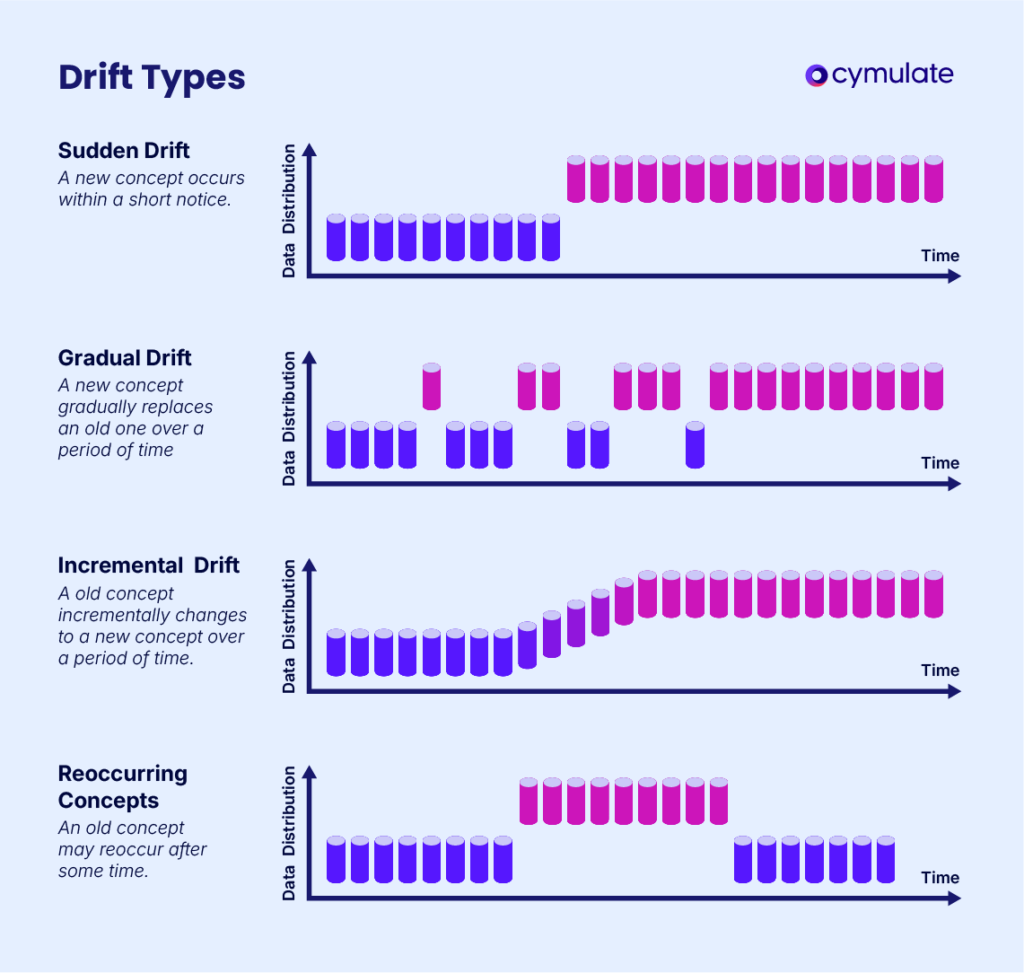
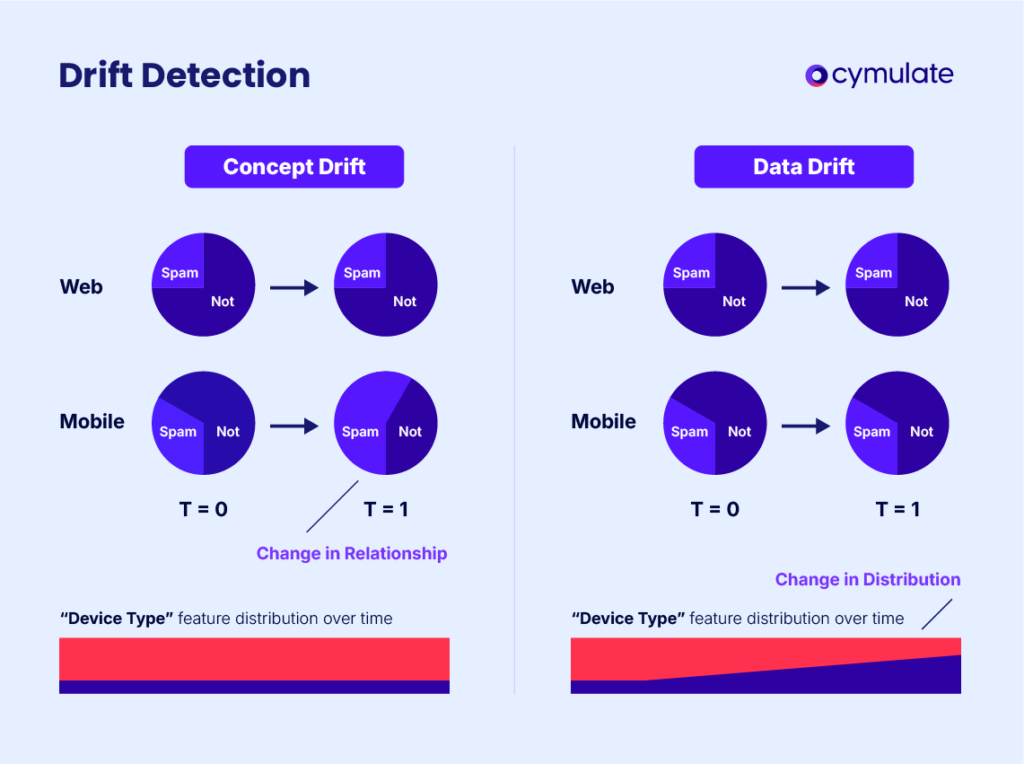
Data drift refers to changes in the statistical properties of input data over time, which can impact the performance of ML models, automated systems, and cybersecurity frameworks. There are two primary types of data drift: 

  • Concept Drift: Occurs when the relationship between input data and the target variable changes. For instance, a fraud detection system trained on past transaction patterns may struggle to identify new fraudulent behaviors. 
  • Feature Drift: Happens when the distribution of individual input features changes without altering the underlying relationship to the target variable. For example, a change in user demographics could skew feature importance in an ML model. 

Data drift can pose serious risks to security operations, as static models become ineffective in detecting or mitigating new threats.  
Drift detection - different types of data drift

For security teams relying on automation, identifying and addressing drift is essential to ensure continued protection against sophisticated adversaries.  

This phenomenon can also impact industries outside cybersecurity, from finance to healthcare, where predictive models need to keep pace with real-world changes. 

How Does Drift Occur? 

Drift arises from several factors, many of which reflect the dynamic nature of real-world conditions. Common causes include: 

Developing real-world conditions 

As user behavior, external environments, or operational contexts change, input data may no longer align with the assumptions underpinning your ML or AI models.  

For example, changes in attack techniques could invalidate threat detection algorithms. The shifting nature of adversarial strategies, such as new malware variants or phishing tactics, demands that systems adapt swiftly to retain their effectiveness. 

Outdated models 

Static models that fail to adapt to dynamic data environments are highly susceptible to drift. Without regular updates or retraining, these models become less accurate and less effective at identifying anomalies.  

Even models designed for long-term use must be evaluated periodically to ensure they remain relevant to current data trends. 

Bias in training data 

Skewed or incomplete datasets can introduce inaccuracies, leading to unforeseen performance degradation over time.  

For instance, security systems trained exclusively on historical attack patterns may overlook new vulnerabilities or tactics used by adversaries. Addressing such biases early in the model development phase can help reduce drift risks in production environments. 

Drift Detection Techniques 

Proactively detecting drift is key to maintaining system integrity and performance. Several methodologies help identify data drift effectively: 

Statistical techniques 

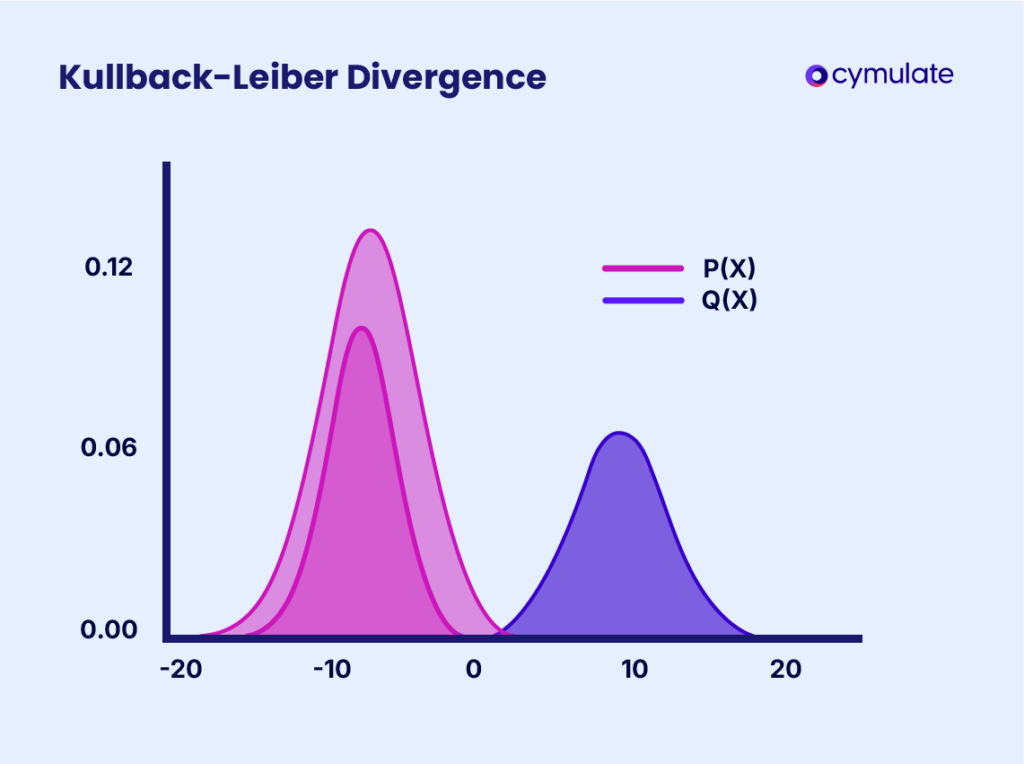
Metrics like Kullback-Leibler divergence, Jensen-Shannon divergence, or Kolmogorov-Smirnov tests are commonly used to detect changes in data distributions.  
Kullback-Leibler divergence data drift

These techniques provide quantitative insights into how far the current data deviates from historical baselines. They are particularly effective when implemented in real-time monitoring tools that flag deviations as soon as they occur. 

Baseline comparisons 

Monitoring deviations from established baselines—whether through statistical thresholds or manual evaluation—can help flag instances of drift.  

For example, a sudden spike in anomaly rates could signal feature drift. These baselines should be periodically recalibrated to account for natural variations in data over time. 

Performance monitoring 

Tracking performance metrics such as accuracy, precision, or recall over time can serve as indicators of drift. A consistent drop in these metrics suggests that the model’s predictive capabilities are being undermined.  

Combining performance monitoring with statistical techniques provides a comprehensive approach to drift detection. 

Tools for drift detection 

Numerous tools support automated drift detection, including ML monitoring platforms and cybersecurity validation systems.  

These solutions integrate statistical techniques, performance monitoring, and real-time alerts to ensure early identification of drift. Examples include platforms like Evidently AI and Arize AI, which specialize in tracking ML model performance and identifying distribution changes. 

Concept drift analysis  

Concept drift analysis specifically targets changes in the relationship between input features and target variables.  
concept drift and data drift

This method identifies shifts in how certain input data contributes to predictions, which is particularly critical for systems where relationships evolve over time.  

By modeling expected dependencies, concept drift analysis can pinpoint deviations that might otherwise go unnoticed. 

Ensemble model monitoring 

Using ensemble models for drift detection involves comparing the outputs of multiple models trained on different versions of the data.  

Discrepancies in their predictions can indicate potential drift. This approach is particularly valuable in scenarios where continuous data updates are impractical, as it offers a comparison across varying data conditions. 

How Do You Prevent Data Drift? 

While detection is crucial, prevention strategies play an equally vital role in mitigating the impact of drift. Here are actionable approaches: 

Continuous monitoring 

Implement regular validation cycles to assess both model and system performance. Tools that offer real-time monitoring ensure that potential drift is identified and addressed promptly. This approach minimizes the risk of prolonged exposure to vulnerabilities caused by undetected drift. 

Data validation pipelines 

High-quality and up-to-date data inputs are foundational to reducing drift. Automated pipelines can flag inconsistent or outdated data, preserving the integrity of inputs.  

These pipelines can also include preprocessing steps to normalize data and eliminate biases before they affect model performance. 

Model retraining 

Periodic retraining using fresh datasets ensures that models remain aligned with evolving data distributions. Retraining schedules should be based on the model’s criticality and observed drift patterns.  

Frequent retraining is especially important for systems operating in high-stakes environments, such as financial fraud detection or healthcare diagnostics. 

Security control testing 

Cybersecurity frameworks must improve alongside newer and many technical threats. Adaptive security controls, validated through continuous testing, can preempt the weaknesses introduced by drift.  

Regular penetration testing and red teaming exercises complement drift prevention efforts by uncovering gaps in security postures. 

Regular feedback loops  

Using feedback loops between your deployed models and their development environments can provide valuable insights into the changes in data distributions.  

These loops allow teams to identify trends and proactively address potential drift before it impacts model performance. 

Diversified training data 

Incorporating diverse and representative data during the training phase minimizes the risk of drift. By including varied scenarios and conditions, models can better generalize and remain robust in dynamic environments.  

By modeling expected dependencies, concept drift analysis can pinpoint deviations that might otherwise go unnoticed. 

Cymulate and Drift Detection 

The Cymulate Continuous Security Validation platform empowers organizations to detect and mitigate the challenges associated with data drift.  

By simulating real-world attack scenarios and validating security controls, Cymulate provides actionable insights to help security teams stay ahead of evolving threats. 

  • Continuous validation: Cymulate continuously validates security controls, identifying weaknesses caused by outdated assumptions or changes in attack vectors. This proactive approach allows systems to remain resilient even as external conditions shift. Through automated simulations, organizations can test their readiness against both known and emerging threats. 
  • Drift detection in threat models: By analyzing threat models and attack techniques, Cymulate identifies instances of drift that could compromise the effectiveness of cybersecurity frameworks. For example, emerging attack patterns are flagged and incorporated into validation tests. This ensures that security protocols remain effective against a constantly evolving threat landscape. 
  • Actionable recommendations: Through tailored recommendations, Cymulate guides organizations in retraining models, updating security protocols, and enhancing system configurations to address drift. These insights help security teams maintain robust defenses against dynamic threats. Cymulate’s platform also integrates seamlessly with existing security ecosystems, making it easier for teams to implement changes without significant operational disruptions. 

To Conclude 

Drift detection is necessary in cybersecurity to make sure that machine learning and AI systems maintain performance while adapting to evolving environments. 

By understanding the causes and implementing proper detection and prevention strategies, organizations can protect and potentially secure their systems from vulnerabilities introduced by dynamic data environments.  

With Cymulate’s expertise in continuous validation and exposure management, businesses can stay resilient in the face of such technical threats.  

Book a Demo