

YARA Rules
YARA Rules Explained: Definition, Structure, and Applications in Threat Detection
YARA rules provide an open-source standard for pattern matching used to identify and classify malware based on textual or binary characteristics. The core purpose of YARA rules is to enhance malware analysis, improve threat detection capabilities, and support proactive threat hunting.
Initially developed by Victor Alvarez at Google, YARA enables SOC analysts, threat hunters, detection engineers and incident responders to identify and create descriptions, or rules, for malware families or specific threats.
YARA Essentials: Quick Reference
- Definition: YARA is a pattern-matching tool designed for security professionals to identify and classify malicious code
- Core Function: Creates "fingerprints" of malicious code for detecting specific threats and their variants
- Structure: Rules contain metadata, string definitions and condition logic
- Components: Rule name, metadata, strings section, condition section, optional modules
- Primary Users: SOC analysts, threat hunters, detection engineers, forensic investigators
- Applications: Malware detection, threat hunting, incident response, memory forensics
- Efficiency: Optimized for high-speed scanning of large file sets through atom-based scanning
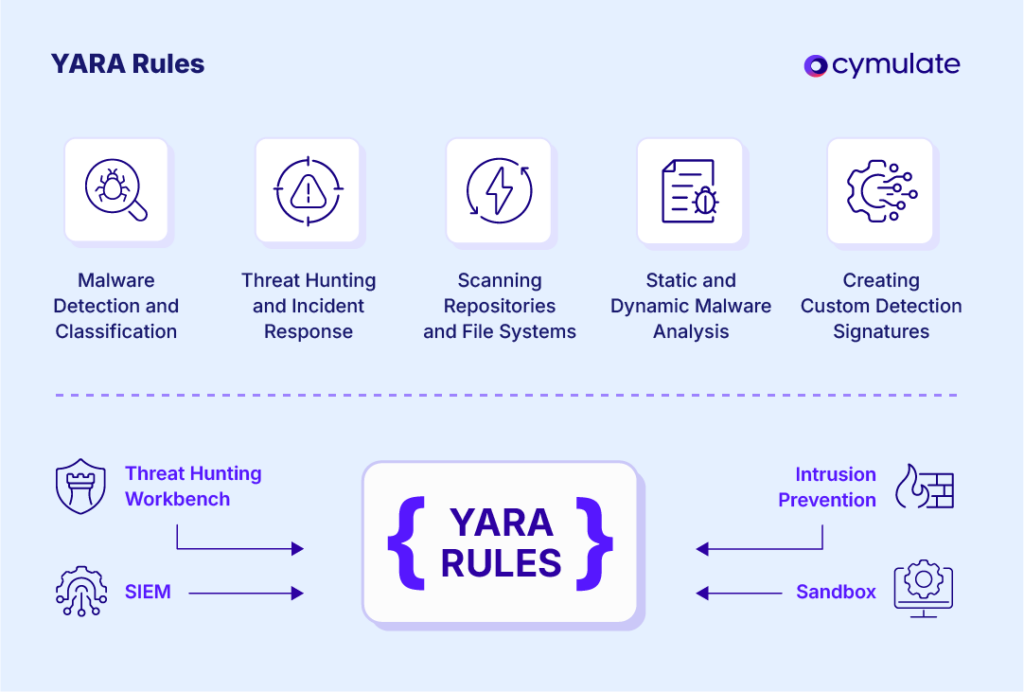
What Are YARA Rules? Understanding Core Concepts
YARA rules allow security professionals to create structured definitions based on observed characteristics of malware, malicious files, or code. Consider YARA as a specialized search language for pinpointing specific file attributes across malware analysis techniques. Its primary function is pattern matching: files matching the rule's defined criteria are flagged for further investigation.
This capability enables analysts to create detailed "fingerprints" of malicious code, identify specific malware families and their variants, classify new threats based on similarities to known samples and detect threats even when traditional signatures fail. The flexibility of YARA allows for detecting both exact matches and partial patterns, making it valuable for identifying modified versions of known threats.
For instance, security teams can use this capability to test whether an organization's security controls can properly detect threats identifiable through YARA-based detection methods, ensuring operational readiness against emerging malware variants.
Anatomy of a YARA Rule: Key Components
Writing YARA rules (rule identifier [tags] { ... }) involves using a C-like syntax with several key components working together to create effective detection patterns:
- condition: Mandatory section defining the matching logic.
- strings: Optional section defining text, hex or regex patterns.
- meta: Optional (but recommended) section for rule context (description, author).
- tags: Optional identifiers declared with the rule name for categorization.
- import: Optional statements (before any rules) to load external modules.
Rule Structure and Imports
The import statement enables access to YARA modules that extend functionality beyond basic pattern matching, such as analyzing Windows executable characteristics with the PE module.
import "pe" // Optional module import
rule MalwareExample { // Rule name
meta: // Optional metadata
description = "Detects example malware variant"
author = "Security Analyst"
strings: // Patterns to match
$suspicious_string = "malicious_function()"
$hex_pattern = { 4D 5A 90 00 }
condition: // Logical requirements for detection
(suspicious_string or hex_pattern) and
defined pe.number_of_sections and pe.number_of_sections > 5
}
When creating effective YARA rules, imports should be specified at the beginning of the file, before any rule definitions.
Metadata Section
The metadata section provides essential context without affecting execution logic.
meta:
description = "Detects Emotet malware variant"
author = "Security Researcher"
date = "2025-04-08"
reference = "https://example.com/threat-report"
This information aids in rule attribution, version tracking and management across security teams. Well-structured metadata is crucial for rule management across security teams and provides context for writing YARA rules effectively.
Common fields include description (preferably starting with "Detects..."), author information, date in YYYY-MM-DD format and references to threat intelligence or internal research. Additional fields might include severity ratings, MITRE ATT&CK technique mappings or false positive guidance.
Strings Section
The strings section defines the patterns YARA searches for when scanning files or memory. Key definition types include:
- Text strings: Match literal ASCII or UTF-16 text (using wide/ascii), identifying names or commands.
- Hex strings: Match specific sequences of raw bytes, essential for finding known malware code patterns.
- Regular expressions: Match complex patterns using regex syntax, useful for structured data formats.
- XORed strings: Find strings obfuscated via single-byte XOR operations using the xor modifier.
- Base64 strings: Find Base64-encoded content using the base64 or base64wide modifiers.
strings:
// Text string examples
$text1 = "CreateRemoteThread" // Basic ASCII
$text2 = "powershell" nocase wide // Case-insensitive, Unicode
$text3 = "cmd.exe" fullword ascii // Whole word, ASCII/Unicode
// Hex string example - specific byte pattern
$hex1 = { 4D 5A 90 00 03 00 00 00 } // MZ header + specific bytes
// Regular expression example - matches patterns
$regex1 = /md5: [0-9a-fA-F]{32}/ // Matches MD5 hash pattern
// Obfuscated string examples
$xor_string = "payload" xor // Finds XOR-obfuscated "payload"
$b64_string = "RXZpbFRvb2w=" base64 // Finds Base64 encoded "EvilTool"
// Private string example - used only in condition, not reported
private $helper = "Internal Flag"
Modifiers like nocase, wide, ascii, fullword, xor, base64, and private alter matching behavior to increase detection accuracy and handle obfuscation. For a full list and details on modifiers, please refer to the String Modifier Summary. Strategic string selection significantly impacts rule performance, as YARA uses an algorithm prioritizing unique fixed substrings (atoms) for efficient scanning.
Condition Section
The condition section forms the logical core of the rule, determining when it triggers:
- Boolean operators: and, or, not for combining match requirements
- String references: $string_name or #string_name (for counting occurrences)
- File properties: filesize, entrypoint for context-aware checks
- Positional operators: at, in for location-specific matching
- Mathematical expressions: For numerical comparisons and threshold calculations
You can find a complete list of conditions in the documentation. Here's a sample:
condition:
// Simple string presence check
$suspicious_string or
// Boolean logic combining multiple strings
(shellcode and encryption_function) or
// String counting - triggers if "http://" appears 5+ times
#http_string > 5 or
// File property check with size constraint
($possible_dropper and filesize < 200KB) or
// Positional operators for specific locations
mz_header at 0 and pe_signature at 0x80 or
// Range specification with 'in' operator
$shellcode in (0..1024) or
// Mathematical expressions and thresholds
(#obfuscation_marker / #total_functions) > 0.5 or
// Complex nested logic for specific malware family
(
$unique_string and
any of ($suspicious_api*) and
2 of ($behavior_indicator*) and
filesize > 20KB and filesize < 400KB
)
Effective conditions balance specificity (to avoid false positives) with flexibility (to catch variants). They can range from simple string presence checks to complex logical formulas combining multiple criteria to identify sophisticated malware.
Rule Tags
Rule tags are optional identifiers used to categorize or group YARA rules, making them easier to manage and filter. Tags are declared after the rule name and before the opening curly brace {, and a rule can have multiple tags.
rule ExampleRuleWithTags : Malware Banking CVE2025_12345 Urgent
{
meta:
description = "Example rule demonstrating multiple tags"
author = "Security Team"
strings:
$payload = { 01 02 03 04 }
condition:
$payload
}
rule AnotherRule : Tool Legitimate
{
strings:
$text = "AdminTool.exe" nocase
condition:
$text
}
Using tags allows you to run specific subsets of your ruleset, for example, executing only rules tagged as Malware or those related to a specific threat like CVE2025_12345.
YARA Modules: Extending Detection Capabilities
YARA modules significantly extend detection beyond basic pattern matching. These modules function as plugins that provide specialized capabilities for the analysis of files and processes, enhancing open-source threat detection capabilities.
Key Built-in Modules
| Module | Purpose | Example Use |
| PE | Analyze Windows executables | Check import tables, section properties |
| ELF | Examine Linux executables | Analyze Linux malware characteristics |
| Math | Perform mathematical operations | Calculate entropy to detect packing |
| Hash | Generate cryptographic hashes | Compare file sections against known values |
| Cuckoo | Interface with sandbox analysis | Match based on behavioral analysis |
| DotNet | Analyze .NET assemblies | Examine .NET metadata and structures |
When implementing rules using either standard YARA modules or your own custom-written modules, ensure their resilience by checking attribute existence with the defined operator. This practice prevents rule failures when scanning unsupported file formats or data lacking the specific module properties.
Best Practices for Writing YARA Rules
Creating effective YARA rules requires balancing several key factors to ensure accuracy, performance and maintainability when developing custom detection rules.
- Balance specificity and generality: Rules should be precise enough to avoid false positives yet broad enough to catch variations
- Select unique string patterns: Choose distinct patterns (4+ bytes) to leverage YARA's efficient atom-based scanning
- Optimize performance: Place faster checks (e.g., filesize) before computationally expensive operations
- Provide clear metadata: Include detailed descriptions starting with "Detects...", author information and dates
- Test thoroughly: Validate rules against diverse malicious and benign samples
- Use the triad approach: Organize strings into high-confidence indicators, contextual patterns and file-type selection
- Implement version control: Maintain rules in repositories with proper versioning and change documentation
Pro Tip: Avoid excessive wildcards, unbounded regex patterns (.*, .+) or very short patterns as they can create performance bottlenecks or "too many matches" errors
Cymulate's platform allows security teams to test these custom YARA rules against simulated threats, validating their effectiveness before deployment to production environments.
YARA vs. Sigma Rules: Complementary Detection Approaches
| Feature | YARA Rules | Sigma Rules |
| Primary Focus | File/memory pattern matching | Log event detection |
| Target | File content, memory dumps | SIEM logs, event data |
| Use Case | Malware identification | Suspicious behavior detection |
| Format | C-like syntax | YAML-based |
| Implementation | File scanners, sandboxes | SIEM platforms, log analyzers |
| Detection Level | Content-based | Behavior-based |
| Typical Users | Malware analysts, researchers | SOC analysts, blue teams |
Both technologies enhance intrusion detection methods when used together—YARA focusing on identifying malicious content, while Sigma addresses the detection of suspicious behavior.
Organizations using Cymulate can validate both types of rules by simulating attacks that generate both the file artifacts (for YARA) and the behavioral indicators (for Sigma).
Practical Applications of YARA Rules
YARA rules power various cybersecurity workflows, enhancing malware analysis techniques across different scenarios.
Malware Detection and Classification
YARA excels at identifying malicious code through matching unique strings or byte sequences at specific file offsets, detecting distinctive patterns of established malware families and classifying samples based on packers or obfuscation techniques.
Cymulate's platform validates YARA-based detection controls against simulated malware, ensuring that rules effectively identify threats before they impact production environments. This allows security teams to refine detection logic based on real-world simulations.
Proactive Threat Hunting
Threat hunters leverage custom YARA rules for scanning endpoints for patterns associated with specific MITRE ATT&CK techniques, identifying unique command-and-control protocols or configuration artifacts and detecting artifacts from advanced persistent threats.
These custom hunting rules can be tested within Cymulate's environment by simulating sophisticated attacks, confirming effectiveness before deployment across the enterprise. This validation process minimizes false positives while ensuring true threats are detected.
Incident Response and Forensics
During incident response, YARA accelerates analysis by scanning live system memory for injected code or unpacked malware, examining disk images for malicious executables or scripts, and identifying specific data patterns tied to breaches.
Cymulate's breach simulation platform allows teams to practice these incident response techniques, fine-tuning YARA rules for optimal detection during actual incidents and ensuring rapid threat identification during critical situations.
YARA's Limitations and Challenges
While powerful for endpoint detection techniques, YARA has important limitations to consider:
- Evasion techniques: Heavily obfuscated, encrypted or polymorphic malware may evade detection by constantly changing their observable patterns
- Performance impacts: Inefficient rules with broad patterns can cause significant resource consumption, particularly when scanning large file sets
- Maintenance requirements: Rules need regular updates to detect evolving threats and prevent false positives as software evolves
- Binary-only focus: YARA primarily analyzes static content, missing dynamic behaviors that might indicate malicious intent
- Learning curve: Writing effective rules requires an in-depth understanding of both YARA syntax and malware techniques
Organizations using Cymulate can continuously validate their YARA-based detection capabilities against emerging threats, ensuring that rules remain effective despite these limitations and adapting quickly to changing threat landscapes.
YARA Rules in Modern Cybersecurity
YARA rules are a powerful and flexible tool for threat detection, enabling security professionals to identify malware, hunt for indicators of compromise and analyze suspicious artifacts with precision. Their adaptability makes them indispensable for open-source threat detection and malware analysis workflows.
However, detection alone isn't enough—combining YARA's pattern-matching capabilities with the Cymulate Continuous Exposure Validation Platform ensures that security controls effectively respond to evolving threats. Together, these technologies empower organizations to strengthen their defenses, bridging the gap between threat identification and operational security readiness.
By implementing custom YARA rules and continuously testing them against simulated attacks, organizations can build resilient detection capabilities that adapt to emerging threats while minimizing both false positives and false negatives. This comprehensive approach creates a more robust security posture ready to face tomorrow's challenges.
Featured Resources
View More Resources
Sigma Rules: Revolutionizing SOC Efficiency and Lightening Engineers' Workloads
With SOC operations consistently burdened by heavy workloads, sigma rules are a boon to accelerate their operation, potentially even allowing

Accelerate Detection Engineering
Automate detection engineering with AI-powered attack simulations to close gaps, cut false positives, and stop threats faster.