

Security Posture Assessment: Steps, Checklist and Validation
A security posture assessment is a structured review of how well your security controls, policies and processes protect your organization against real cyber threats. It shows where your defenses hold, where they fail and what to fix first. The most useful assessments also validate controls against real attacker behavior and feed the results straight into mitigation.
Your security posture is your organization's overall ability to prevent, detect and respond to cyber threats, and it changes every time assets, configurations or attacker techniques change.

What is Cyber Security Posture?
A cybersecurity posture assessment evaluates your security controls, policies and processes to find the gaps attackers could exploit and to prioritize the fixes that reduce the most risk.
A typical assessment answers four questions:
- What assets do we have, and which ones matter most?
- Which security controls protect them, and are they configured correctly?
- Which threats and exposures put them at risk?
- What should we fix first, and how do we know the fix worked?
The output is a prioritized list of gaps, recommended mitigations and a baseline you can measure against over time.
Security posture assessment vs. security posture validation
A security posture assessment tells you which controls you have and how they're configured. Security posture validation proves whether those controls stop real attacks. Validation runs safe simulations of attacker techniques mapped to the MITRE ATT&CK® Framework and records how each control responds: prevented, detected or missed.
The difference matters because configuration reviews describe intent, while validation shows results. A firewall rule or endpoint detection and response (EDR) policy can look correct on paper and still let a technique through after an update or an environment change.
| Security posture assessment | Security posture validation | |
| What it measures | Controls, policies, configurations and asset coverage | How controls respond to real attacker techniques |
| Method | Reviews, interviews, scans and audits | Safe attack simulation and automated testing |
| Typical frequency | Quarterly or annual | Continuous |
| Output | Gap list and recommendations | Evidence of prevention and detection, prioritized exposures and control updates |
Mature programs combine the two: assess to understand scope, validate to prove effectiveness, then mitigate and re-test.
Security posture assessment vs. risk assessment
A risk assessment estimates the likelihood and business impact of threats to your organization. A security posture assessment measures how well your current defenses hold up against those threats. Risk assessment tells you what to protect and why; posture assessment tells you whether it's protected.
| Risk assessment | Security posture assessment | |
| Focus | Business risk: likelihood and impact | Defensive readiness: controls, configurations and coverage |
| Key question | What could hurt us, and how badly? | Can our defenses stop it? |
| Typical owner | Risk, governance or compliance teams | Security operations and security engineering |
| Output | Risk register and risk ratings | Control gaps, exposures and mitigations |
The two feed each other. Risk assessment ranks the assets and threats that matter most, and posture assessment and validation prove whether they're covered.
How to conduct a security posture assessment in 6 steps
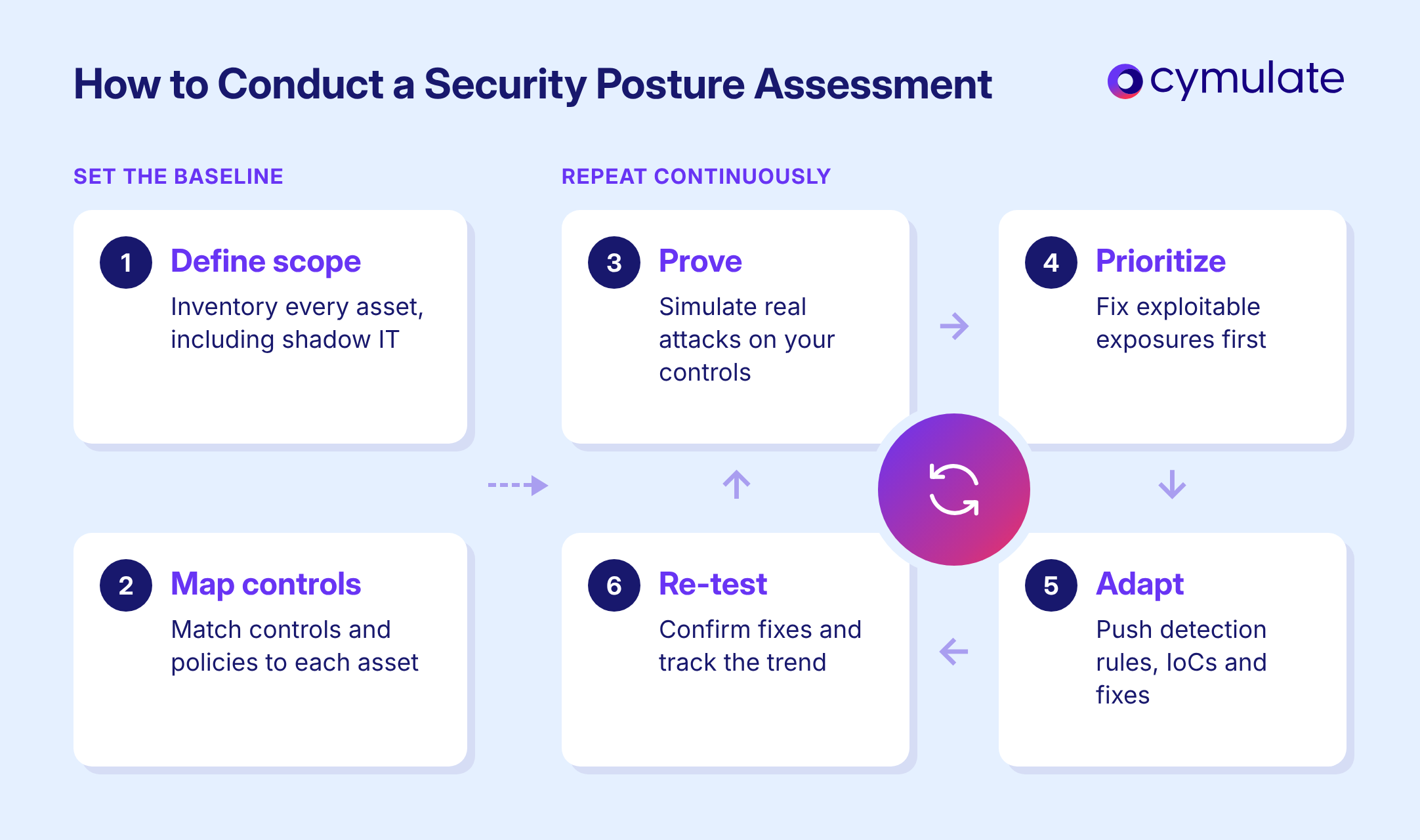
- Define scope and inventory assets. List endpoints, servers, cloud workloads, identities, applications and third-party connections. Include unmanaged assets and shadow IT, because you can only protect what you know about.
- Map controls and policies to those assets. Document which controls cover each asset (EDR, firewalls, web and email gateways, security information and event management (SIEM), identity) and which policies govern access, patching and incident response.
- Prove control effectiveness against real threats. Run attack simulations across the cyber kill chain, from initial access to lateral movement and data exfiltration. Measure prevention and detection rates per control and per MITRE ATT&CK technique.
- Prioritize exploitable exposures. Combine validation results with vulnerability data, asset criticality and threat intelligence. Fix first the exposures that are exploitable in your environment and not covered by a compensating control.
- Adapt defenses with targeted mitigations. Close each gap with a specific change: SIEM detection rules, indicators of compromise (IoCs) and policy updates for EDR, configuration fixes or patches. Give every fix an owner and a deadline.
- Re-test and measure over time. Re-run the same tests to confirm each fix worked, then track prevention and detection rates over time. Continuous re-testing turns a one-time assessment into a security posture program.
Steps three through six follow a simple loop: prove what works, prioritize what's exploitable and adapt defenses until the gap is closed.
Security posture assessment checklist
Use this checklist to scope your next assessment:
- Asset inventory is complete and current, including cloud assets and shadow IT
- Critical assets and their business owners are identified
- Every critical asset has prevention and detection controls in place
- Controls are tested against current threats and MITRE ATT&CK techniques, in addition to configuration reviews
- SIEM detection rules are validated against real attack scenarios
- Vulnerabilities are prioritized by exploitability and compensating controls
- Identity and access privileges follow least privilege
- Email and web gateways are tested against current phishing and malware techniques
- The incident response plan is documented and exercised
- Every gap has an owner, a mitigation and a re-test date
- Posture metrics are reported to leadership on a regular cadence
Security posture assessment methods
| Method | What it does well | Where it falls short |
| Manual reviews (interviews, policy reviews, audits) | Context on process, ownership and compliance alignment | Time-intensive, point-in-time and describes intent rather than results |
| Automated scanning (vulnerability and configuration scanners) | Broad coverage of known vulnerabilities and misconfigurations | Shows what might be exploitable, without proving what is |
| Penetration testing | Deep, expert-led testing of specific systems | Narrow scope and periodic |
| Breach and attack simulation and exposure validation | Continuous, safe testing of controls against real attacker techniques at scale | Delivers the most value when connected to your controls so results turn into fixes |
Security posture assessment vs. penetration testing
Penetration testing is a point-in-time exercise in which testers try to breach specific systems. A security posture assessment looks across all your controls, policies and assets. Pen tests go deep on a narrow scope, while posture assessments and continuous validation give you breadth and a measurable baseline. Most programs use both.

How to measure security posture
Measure security posture with validation results, which show how your security controls perform against real attacks. Four metrics give you a baseline you can track after every assessment:
| Metric | What it shows | How to calculate it |
| Prevention rate | Share of simulated attacks your controls blocked | Attacks prevented ÷ attacks run |
| Detection rate | Share of simulated attacks that triggered an alert in your SIEM or EDR | Attacks detected ÷ attacks run |
| MITRE ATT&CK coverage | Techniques you can prevent or detect | Techniques covered ÷ techniques relevant to your threat profile |
| Time to mitigate | How fast a validated gap is closed | Days from finding to a successful re-test |
Example: you run 200 attack simulations against your endpoint controls and 150 are blocked, so your endpoint prevention rate is 75%. Of the 50 that got through, 30 trigger an alert. The remaining 20 were neither blocked nor detected, so they're your first fixes.
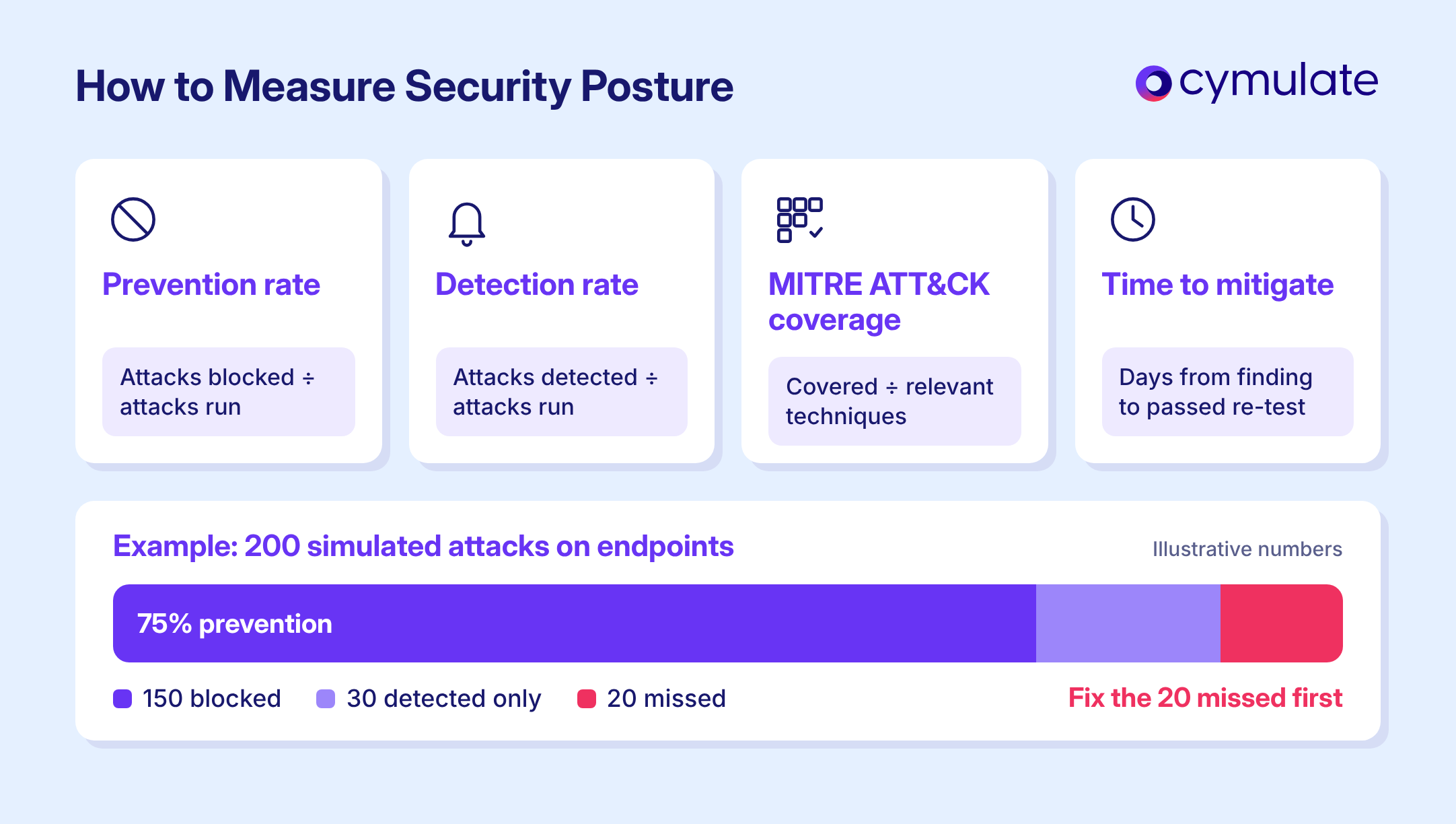
Re-run the same tests after each fix and report the trend. A rising prevention and detection rate is clear evidence for leadership that the program is reducing risk.
Common security posture gaps
- Controls deployed with default settings and never tuned
- SIEM rules that were never tested against real attack scenarios
- Detection gaps for specific MITRE ATT&CK techniques, often lateral movement and exfiltration
- Unknown or unpatched assets outside the inventory
- Excessive privileges and weak identity controls
- Findings that sit in a queue without an owner or a re-test
The last gap is often the costliest. The time between finding an exposure and fixing it, the risk-to-fix gap, grows as new threats and exposures appear faster than teams can adapt their defenses.
For a longer-term roadmap to close these gaps, see how to improve your cybersecurity posture.
How Cymulate validates and improves your security posture
Cymulate turns security posture assessment into a continuous, closed-loop process with agentic cyber defense engineering. The Cymulate Platform proves, prioritizes and adapts your defenses against real attacker behavior:
- Prove: Cymulate Exposure Validation runs safe attack simulations tailored to your environment, using a daily feed of new threats and an attack library mapped to MITRE ATT&CK. It tests endpoint, network, email, web, cloud and identity controls.
- Prioritize: Cymulate CTEM integrates with vulnerability scanners and asset management tools to validate which exposures are exploitable in your environment and rank what to fix first.
- Adapt: Cymulate Auto Mitigation pushes vendor-specific updates, such as EDR detection rules and IoCs, to your security controls. Cymulate then re-tests to confirm the gap is closed.
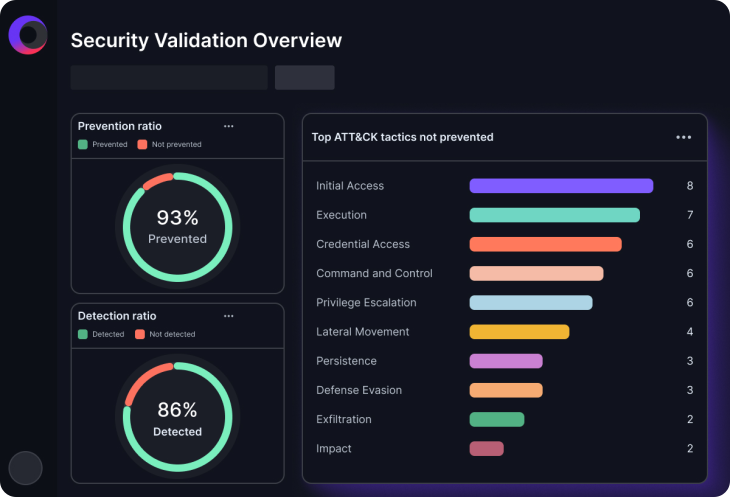
Cymulate Vero AI powers the agents that build assessments, analyze results and recommend action. With Cymulate Cowork, teams run these workflows from plain-language prompts and recurring schedules.
On average, Cymulate customers improve threat prevention from about 70% to more than 90%, as measured by Cymulate best practices assessments. Customers also report more than 50% better threat detection, as measured by validated coverage of MITRE ATT&CK.
See it in action: Book a Demo
FAQs
Run a full assessment at least once a year and after major changes, such as a cloud migration, an acquisition or a new security tool rollout. Between full assessments, validate controls continuously and fix the gaps you find, because configurations drift and new threats appear every week.
Security operations, security engineering and vulnerability management teams usually lead it, with input from IT, cloud and risk owners. Some organizations bring in a third party for an independent view, then use automated validation to keep results current between reviews.
No. A vulnerability assessment finds known weaknesses in systems and software. A security posture assessment is broader: it also checks whether your security controls, policies and processes stop the attacks that target those weaknesses.
Common choices are the NIST Cybersecurity Framework, CIS Critical Security Controls, ISO 27001 and the MITRE ATT&CK® Framework. NIST, CIS and ISO help you define which controls should exist. MITRE ATT&CK helps you test whether those controls stop real attacker techniques.
Yes. Many regulations and directives expect organizations to test their defenses and show evidence that their security measures work. Examples include the Digital Operational Resilience Act (DORA) and the NIS2 Directive. Assessment and validation results give auditors that evidence.
An assessment is a structured review of your whole program. Posture management tools, such as cloud security posture management (CSPM) and data security posture management (DSPM), monitor configurations continuously within one domain. Validation adds a third layer: it tests whether those configurations stop real attacks and shows which gaps to close first.
Cymulate keeps your security posture assessment current between reviews with agentic cyber defense engineering. We continuously simulate real-world attacks tailored to your environment, show which exposures attackers can exploit and prioritize the gaps to fix first. Then we push updates, such as detection rules and indicators of compromise (IoCs), to your security controls and re-test to prove they work. That closed loop helps you prove, prioritize and adapt your defenses as threats change.
Featured Resources
View More Resources
Measure and Baseline Cyber Resilience
Use Cymulate to assess baseline cyber resilience, uncover weaknesses, and improve your organization’s security posture.

Security Validation Essentials
Learn security validation essentials to uncover gaps, measure risk, and strengthen your overall security posture.
2026 Gartner® Market Guide for Adversarial Exposure Validation
The guide covers AEV use cases, key features, and market trends to improve threat exposure visibility and defenses.