
Frequently Asked Questions

Vulnerability Scanning Fundamentals

What is vulnerability scanning in cybersecurity?

Vulnerability scanning is the automated process of identifying, analyzing, and assessing security weaknesses in computer systems, networks, and applications. It helps organizations detect potential threats before attackers can exploit them, reducing risks and improving overall security posture.

Why is vulnerability scanning important for organizations?

Vulnerability scanning is important because it enables organizations to proactively detect security flaws and weaknesses before they can be exploited by threat actors. This proactive approach helps mitigate risks, strengthen security posture, and prevent costly data breaches or attacks.

How does vulnerability scanning help with compliance requirements?

Regular vulnerability scans help organizations meet compliance requirements such as PCI DSS, ISO 27001, and HIPAA by ensuring that security standards are followed and gaps are identified and addressed for regulatory compliance.

What are the main steps involved in vulnerability scanning?

The main steps in vulnerability scanning include: 1) Planning and scope definition, 2) Scanning and discovery, 3) Vulnerability detection and analysis, 4) Risk prioritization, 5) Reporting and documentation, 6) Remediation and mitigation, and 7) Rescanning and continuous monitoring.

What types of vulnerability scanning are there?

There are two primary types: authenticated scans (using valid credentials for deeper inspection) and unauthenticated scans (simulating external attacks without credentials). Both are essential for comprehensive security coverage.

What are the different focus areas for vulnerability scanning?

Vulnerability scanning can focus on networks, hosts, web applications, databases, and cloud environments. Each type targets specific risks, such as unpatched systems, misconfigurations, or web application vulnerabilities like SQL injection and XSS.

What is the ideal outcome of a vulnerability scan?

The ideal outcome is a prioritized list of vulnerabilities, actionable remediation steps, compliance alignment, and recommendations for continuous monitoring to maintain a strong security posture.

What are the limitations of traditional vulnerability scanning?

Limitations include false positives and negatives, lack of context for exploitability, no validation of security controls, limited scope (missing zero-days or lateral movement risks), and challenges with complex or custom applications.

How can organizations address the limitations of vulnerability scanning?

Organizations should combine vulnerability scanning with security control validation and breach simulation to test if defenses work against real threats and to identify exploitable weaknesses beyond what scanners detect.

How does Cymulate enhance vulnerability scanning?

Cymulate goes beyond traditional scanning by continuously validating defenses against real cyber threats using Breach and Attack Simulation (BAS). It tests exploitability, validates security controls, provides exposure-based risk assessments, and enables ongoing, automated security validation.

What is the difference between vulnerability scanning and breach and attack simulation (BAS)?

Vulnerability scanning identifies potential weaknesses, while BAS (like Cymulate) simulates real attack scenarios to validate if vulnerabilities are exploitable and if security controls are effective, providing actionable insights for remediation.

How does Cymulate prioritize vulnerabilities differently than traditional scanners?

Cymulate prioritizes vulnerabilities based on real-world exploitability, business context, and actual attack outcomes, rather than just theoretical risk scores from scanners. This helps organizations focus on the most critical threats.

What are some related resources for learning more about vulnerability scanning?

You can explore related resources such as the Cymulate blog on best practices, webinars like "Hey, Blue Teams: Stop Waiting for Pen Tests to Find Gaps," and the cybersecurity glossary for definitions and concepts. Visit the Resource Hub for more.

How does vulnerability scanning fit into a broader cybersecurity strategy?

Vulnerability scanning is a foundational element, but it should be combined with continuous security validation, exposure management, and breach simulation to ensure comprehensive protection against evolving threats.

What is the role of continuous monitoring in vulnerability management?

Continuous monitoring ensures that new vulnerabilities are detected promptly and that remediation efforts are effective, maintaining a strong security posture over time.

What are common challenges organizations face with vulnerability scanning?

Common challenges include managing false positives, prioritizing real threats, integrating scanning with other security tools, and ensuring scans cover all assets, including cloud and custom applications.

How does Cymulate help organizations go beyond vulnerability scanning?

Cymulate enables organizations to validate security controls, simulate real-world attacks, and prioritize remediation based on actual risk, providing a more comprehensive and proactive approach to cybersecurity.

What is the relationship between vulnerability scanning and exposure validation?

Vulnerability scanning identifies potential weaknesses, while exposure validation (as offered by Cymulate) tests whether those weaknesses can actually be exploited, providing a more accurate assessment of risk.

How does Cymulate integrate with other security tools for vulnerability management?

Cymulate integrates with a wide range of security technologies, including EDR, cloud security, and vulnerability management tools, to enhance the overall security ecosystem. For a full list, visit the Partnerships and Integrations page.

Features & Capabilities

What are the key capabilities of Cymulate's platform?

Cymulate offers continuous threat validation, a unified platform combining BAS, CART, and Exposure Analytics, attack path discovery, automated mitigation, AI-powered optimization, complete kill chain coverage, ease of use, and an extensive threat library with over 100,000 attack actions updated daily.

How does Cymulate automate vulnerability validation and remediation?

Cymulate automates vulnerability validation by simulating real-world attacks and integrates with security controls to push updates for immediate prevention, reducing manual effort and improving operational efficiency.

Does Cymulate support continuous security validation?

Yes, Cymulate enables ongoing, automated vulnerability scanning and attack simulations, helping security teams stay ahead of emerging threats and maintain a resilient security posture.

How does Cymulate's platform help with exposure prioritization?

Cymulate validates exploitability and ranks exposures based on prevention and detection capabilities, business context, and threat intelligence, enabling organizations to focus on the most critical vulnerabilities.

What integrations does Cymulate offer for vulnerability management?

Cymulate integrates with leading security technologies such as Akamai Guardicore, AWS GuardDuty, BlackBerry Cylance OPTICS, Carbon Black EDR, Check Point CloudGuard, CrowdStrike Falcon, Wiz, SentinelOne, and more. See the full list of integrations for details.

How easy is it to implement Cymulate for vulnerability validation?

Cymulate is designed for quick, agentless deployment with minimal resources required. Customers can start running simulations almost immediately, and comprehensive support is available via email, chat, and educational resources.

What feedback have customers given about Cymulate's ease of use?

Customers consistently praise Cymulate for its intuitive, user-friendly interface and actionable insights. For example, Raphael Ferreira, Cybersecurity Manager, noted, "Cymulate is easy to implement and use—all you need to do is click a few buttons, and you receive a lot of practical insights into how you can improve your security posture." (Source)

Use Cases & Benefits

Who can benefit from using Cymulate for vulnerability validation?

Cymulate is designed for CISOs, security leaders, SecOps teams, red teams, and vulnerability management teams across organizations of all sizes and industries, including finance, healthcare, retail, media, transportation, and manufacturing.

What problems does Cymulate solve that traditional vulnerability scanning does not?

Cymulate addresses fragmented security tools, resource constraints, unclear risk prioritization, cloud complexity, communication barriers, inadequate threat simulation, operational inefficiencies, and post-breach recovery challenges by automating validation and providing actionable, prioritized insights.

Are there case studies showing Cymulate's impact on vulnerability management?

Yes. For example, Hertz Israel reduced cyber risk by 81% in four months using Cymulate. Other case studies include organizations improving compliance, operational efficiency, and post-breach recovery. See the Case Studies page for more.

How does Cymulate help organizations meet compliance standards?

Cymulate's continuous validation and reporting help organizations align with standards like PCI DSS, ISO 27001, and HIPAA by identifying and addressing compliance gaps.

What measurable outcomes have Cymulate customers achieved?

Customers have reported a 52% reduction in critical exposures, a 60% increase in team efficiency, and an 81% reduction in cyber risk within four months. These outcomes are documented in public case studies.

How does Cymulate support different security roles in vulnerability management?

Cymulate provides tailored solutions for CISOs (metrics and insights), SecOps (automation and efficiency), red teams (offensive testing), and vulnerability management teams (validation and prioritization). Each role benefits from actionable data and improved collaboration.

What educational resources does Cymulate offer for vulnerability management?

Cymulate offers a Resource Hub, blog, webinars, e-books, and a continuously updated cybersecurity glossary to help users stay informed about best practices and platform capabilities. Visit the Resource Hub for details.

Where can I find a glossary of cybersecurity terms related to vulnerability scanning?

Cymulate provides a comprehensive, continuously updated Cybersecurity Glossary that explains terms, acronyms, and jargon relevant to vulnerability scanning and cybersecurity in general.

Security, Compliance & Trust

What security and compliance certifications does Cymulate hold?

Cymulate holds SOC2 Type II, ISO 27001:2013, ISO 27701, ISO 27017, and CSA STAR Level 1 certifications, demonstrating adherence to industry-leading security and privacy standards. (Source)

How does Cymulate ensure data security and privacy?

Cymulate ensures data security through encryption in transit (TLS 1.2+) and at rest (AES-256), secure AWS-hosted data centers, a tested disaster recovery plan, and compliance with GDPR, supported by a dedicated privacy and security team.

What application security practices does Cymulate follow?

Cymulate follows a strict Secure Development Lifecycle (SDLC), including secure code training, continuous vulnerability scanning, and annual third-party penetration tests to ensure robust application security.

How does Cymulate support GDPR compliance?

Cymulate incorporates data protection by design and has a dedicated privacy and security team, including a Data Protection Officer (DPO) and Chief Information Security Officer (CISO), to ensure GDPR compliance.

What product security features does Cymulate offer?

Cymulate's platform includes mandatory 2-Factor Authentication (2FA), Role-Based Access Controls (RBAC), IP address restrictions, and TLS encryption for its Help Center to enhance product security.

Pricing & Plans

What is Cymulate's pricing model for vulnerability validation?

Cymulate operates on a subscription-based pricing model tailored to each organization's requirements. Pricing depends on the chosen package, number of assets, and scenarios selected. For a detailed quote, schedule a demo with the Cymulate team.

Competition & Differentiation

How does Cymulate differ from other vulnerability management solutions?

Cymulate stands out with its unified platform (combining BAS, CART, and Exposure Analytics), continuous threat validation, AI-powered optimization, complete kill chain coverage, ease of use, and measurable outcomes such as significant reductions in risk and increased efficiency. It is recognized as a market leader by Frost & Sullivan and a Customers' Choice in Gartner Peer Insights 2025.

What are the advantages of Cymulate for different user segments?

CISOs benefit from quantifiable metrics and strategic alignment; SecOps teams gain automation and efficiency; red teams access advanced offensive testing; and vulnerability management teams improve validation and prioritization. Each segment receives tailored solutions for their needs.

Introducing Cymulate Vero AI for Agentic Cyber Defense Engineering
Learn More
New: 2026 Gartner® Market Guide for Adversarial Exposure Validation
Learn More
New Research: Exploiting Configuration Trust in AI Coding Tools
Learn More
New Case Study: How a Financial Authority Validates Cyber Resilience
Learn More

Vulnerability Scanning

Vulnerability scanning is the automated process of identifying, analyzing and assessing security weaknesses in computer systems, networks, and applications. Organizations use it to detect potential threats before attackers can exploit them, reducing risks and improving security.  

The goal of conducting a vulnerability scan is to proactively detect security flaws and weaknesses before they can be exploited by a threat actor. By identifying these vulnerabilities early, organizations can take the necessary steps to mitigate risks, strengthen their security posture and prevent a potentially costly data breach or attack.  

Regular scans can help meet compliance requirements, such as PCI DSS, ISO 27001, and Health Insurance Portability and Accountability Act (HIPAA), ensuring businesses follow industry security standards. 
Vulnerability Scanning

How Does Vulnerability Scanning Work? 

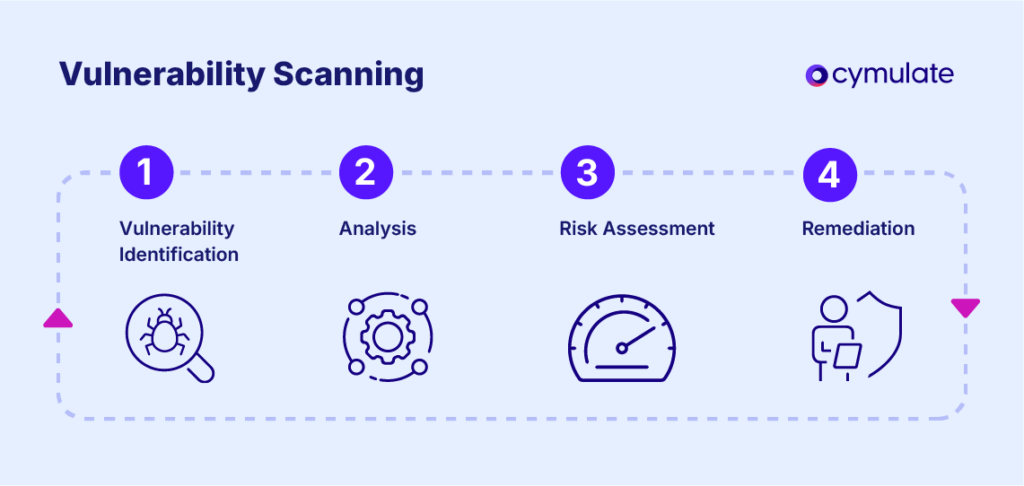
Vulnerability scanning follows a structured process to detect security risks and provide actionable solutions. The process consists of several key steps: 

1. Planning and Scope Definition 

  • Identify the assets to be scanned (e.g., networks, applications, cloud environments). 
  • Define the scope of the scan (internal, external, cloud, containerized environments, etc.). 
  • Determine the frequency and compliance requirements for scanning. 

2. Scanning and Discovery 

  • Use automated vulnerability scanners to probe systems for known vulnerabilities. 
  • Identify active devices, open ports, operating systems, and installed software. 
  • Map the network and assess potential attack vectors. 

3. Vulnerability Detection and Analysis 

  • Compare identified assets against known vulnerabilities in databases like CVE (Common Vulnerabilities and Exposures) and NVD (National Vulnerability Database)
  • Categorize vulnerabilities based on severity (e.g., CVSS score). 
  • Identify false positives and eliminate redundant findings. 

4. Risk Prioritization 

  • Prioritize vulnerabilities based on risk factors, such as exploitability, impact, and criticality of the affected systems. 
  • Use context-aware analysis to focus on exploitable vulnerabilities rather than theoretical risks. 

5. Reporting and Documentation 

  • Generate detailed reports with findings, risk levels, and remediation recommendations. 
  • Customize reports based on the audience (e.g., executive summaries for management, technical details for security teams). 
  • Maintain records for compliance with regulations (e.g., PCI DSS, HIPAA, ISO 27001). 

6. Remediation and Mitigation 

  • Work with security teams to patch or mitigate vulnerabilities. 
  • Apply security controls, such as network segmentation, application whitelisting, or disabling vulnerable services. 
  • Implement compensating controls if patches are unavailable. 

7. Rescanning and Continuous Monitoring 

  • Perform a follow-up scan to ensure vulnerabilities have been mitigated. 
  • Establish a regular scanning schedule to detect new vulnerabilities. 

Integrate continuous security validation through tools like Breach and Attack Simulation (BAS) to ensure protection against evolving threats. 

Types of Vulnerability Scanning 

There are two primary types of vulnerability scanning: 

  1. Authenticated scans: These scans use valid login credentials to access systems. It allows a deeper inspection of security settings, installed software, and misconfigurations that an attacker with access might exploit. 
  2. Unauthenticated scans: These scans simulate an external attack by assessing systems without login credentials. They help identify vulnerabilities visible to outsiders, such as exposed ports, weak encryption, or publicly accessible services.  

Both scanning methods are essential for a comprehensive security strategy. By regularly conducting vulnerability scans, organizations can proactively detect and fix weaknesses before attackers exploit them. 

Different types of scans focus on specific areas, ensuring comprehensive security coverage. 

1. Network-based vulnerability scanning 
Identifies security weaknesses in internal and external networks by detecting unpatched systems, open ports, outdated protocols, and misconfigurations in firewalls and network devices. 

2. Host-based vulnerability scanning 

Assesses individual devices like servers and endpoints to find missing patches, outdated software, insecure configurations, and local privilege escalation risks. 

3. Web application vulnerability scanning 

Identifies web application threats such as SQL injection, cross-site scripting (XSS), and weak authentication while ensuring protection against OWASP Top 10 vulnerabilities. 

4. Database vulnerability scanning 

Detects misconfigurations, weak encryption, and insecure permissions in databases to prevent unauthorized access and ensure compliance with security standards. 

5. Cloud vulnerability scanning 

Finds misconfigurations, weak IAM settings, and exposed resources in cloud environments while assessing security controls for AWS, Azure, and Google Cloud. 

Each type of vulnerability scanning plays a crucial role in securing an organization’s digital assets. By using a combination of these scans, businesses can strengthen their cybersecurity posture, minimize risks, and comply with industry standards. 

The Ideal Outcome of a Vulnerability Scan 

A successful vulnerability scan provides organizations with clear insights into their security risks and actionable steps to improve protection. The key outcomes include: 

  1. A prioritized list of vulnerabilities: The scan generates a detailed report ranking vulnerabilities by severity, helping organizations focus on the most critical threats first. High-risk issues, such as exploitable weaknesses or unpatched software, receive immediate attention. 
  2. Actionable remediation steps: The report includes specific recommendations to fix vulnerabilities, such as applying security patches, updating configurations, or disabling unnecessary services. These steps ensure a proactive approach to reducing risk. 
  3. Compliance alignment: The scan helps organizations meet industry security standards, such as PCI DSS, ISO 27001, and HIPAA, by identifying gaps that need to be addressed for regulatory compliance. 
  4. Continuous monitoring recommendations: A vulnerability scan is not a one-time fix. The report often suggests continuous vulnerability assessment and security best practices, such as automated patch management and regular security assessments, to maintain a strong security posture. 

By taking steps to act on the results of a vulnerability scan, organizations can strengthen their defenses, reduce the risk of cyber threats, and maintain compliance with industry regulations.

The Limitations of Vulnerability Scanning 

Relying on scanning alone is not enough to maintain a strong security posture. Organizations should understand these challenges to strengthen their overall cybersecurity strategy. 

False positives and false negatives 

Vulnerability scanners sometimes generate false positives, flagging non-critical issues that don’t pose real threats. Security teams may waste time investigating harmless findings instead of addressing actual risks.  

On the other hand, false negatives occur when scanners fail to detect advanced threats, leaving organizations exposed to hidden vulnerabilities. 

Lack of context 

Scanners identify vulnerabilities but do not assess their exploitability. A flagged issue might not be a real threat if it requires complex attack conditions. Without proper risk analysis, organizations may prioritize low-risk vulnerabilities while overlooking more significant security gaps. 

No validation of security controls 

Vulnerability scans detect weaknesses but do not test whether security defenses are effective. For example, a scanner may report an open port as a risk, but if a firewall or intrusion prevention system (IPS) effectively blocks attacks, the real-world impact is minimal. 

Limited scope 

Vulnerability scanning tools primarily focus on known vulnerabilities, meaning they may overlook zero-day threats or lateral movement risks, where attackers exploit multiple weak points within a network.  

Additionally, some security testing tools may struggle with complex or custom-built applications. 

To strengthen security, organizations should go beyond scanning and incorporate security control validation and breach simulation. Security validation tests whether defenses work against threats, while breach simulations mimic real-world attacks to identify exploitable weaknesses.  

Combining these approaches with vulnerability scanning provides a more comprehensive and proactive cybersecurity strategy. 

How Cymulate Enhances Vulnerability Scanning 

Traditional vulnerability scanning helps identify weaknesses, but it does not test whether these vulnerabilities can be exploited or if security controls effectively block real-world attacks. Cymulate Breach and Attack Simulation (BAS) goes beyond scanning by continuously validating an organization’s defenses against real cyber threats. 

Key areas Traditional vulnerability scanning Cymulate BAS 
Validating exploitability Traditional scanners detect vulnerabilities but do not determine if they can actually be exploited. Cymulate simulates real attack scenarios, allowing security teams to see which vulnerabilities pose a real risk and require immediate action. 
Testing security controls Scanners flag potential weaknesses, but they don’t test how well-existing security measures mitigate threats. Cymulate validates security controls by running full kill-chain attack simulations, ensuring firewalls, endpoint protection, and detection systems are working as intended. 
Exposure-based risk assessments Instead of relying solely on theoretical risk scores, Cymulate analyzes exposure in real time, providing actionable insights on security gaps. Organizations can prioritize remediation based on actual attack outcomes, rather than just scanner-generated severity ratings. 
Continuous security validation Cyber threats evolve daily, and a one-time vulnerability scan is not enough to maintain security. Cymulate enables ongoing, automated vulnerability scanning and attack simulations, helping security teams stay ahead of emerging threats. 

Book a Demo