
Vulnerability Management Lifecycle: The 6-Step Lifecycle Explained
The vulnerability management process is a continuous lifecycle for finding, prioritizing, fixing and verifying security weaknesses across an organization’s assets. It runs in six steps: assess, prioritize, remediate, validate, report and improve. Each pass through the cycle feeds the next, so risk drops over time instead of resetting with every scan.
- The vulnerability management lifecycle has six phases and repeats continuously.
- Prioritization works best when it starts with proven exploitability and uses severity scores as one input.
- Validation confirms a fix or compensating control actually stops the attack.
- The goal is to close the risk-to-fix gap: the time between finding an exposure and confirming it’s resolved.
What is vulnerability management?
Vulnerability management is the ongoing practice of identifying, evaluating, treating and reporting security weaknesses in software, systems, cloud resources and configurations.
It covers the tools, people and workflows a security team uses to reduce exposure before attackers exploit it.
A common vulnerabilities and exposures (CVE) entry is the most familiar unit of work, but misconfigurations and weak controls belong in scope too.
What is the vulnerability management lifecycle?
The vulnerability management lifecycle is the repeatable cycle that moves each weakness from discovery to verified resolution. Teams call it the vulnerability management cycle or vulnerability lifecycle management. It loops because new assets, new CVEs and new attack techniques appear every day, so last month’s clean scan says little about today’s risk.
The Verizon 2026 Data Breach Investigations Report found vulnerability exploitation was the top initial access vector, at 31% of breaches. The median time to fully fix a known exploited vulnerability rose from 32 to 43 days.
The 6 steps of the vulnerability management process
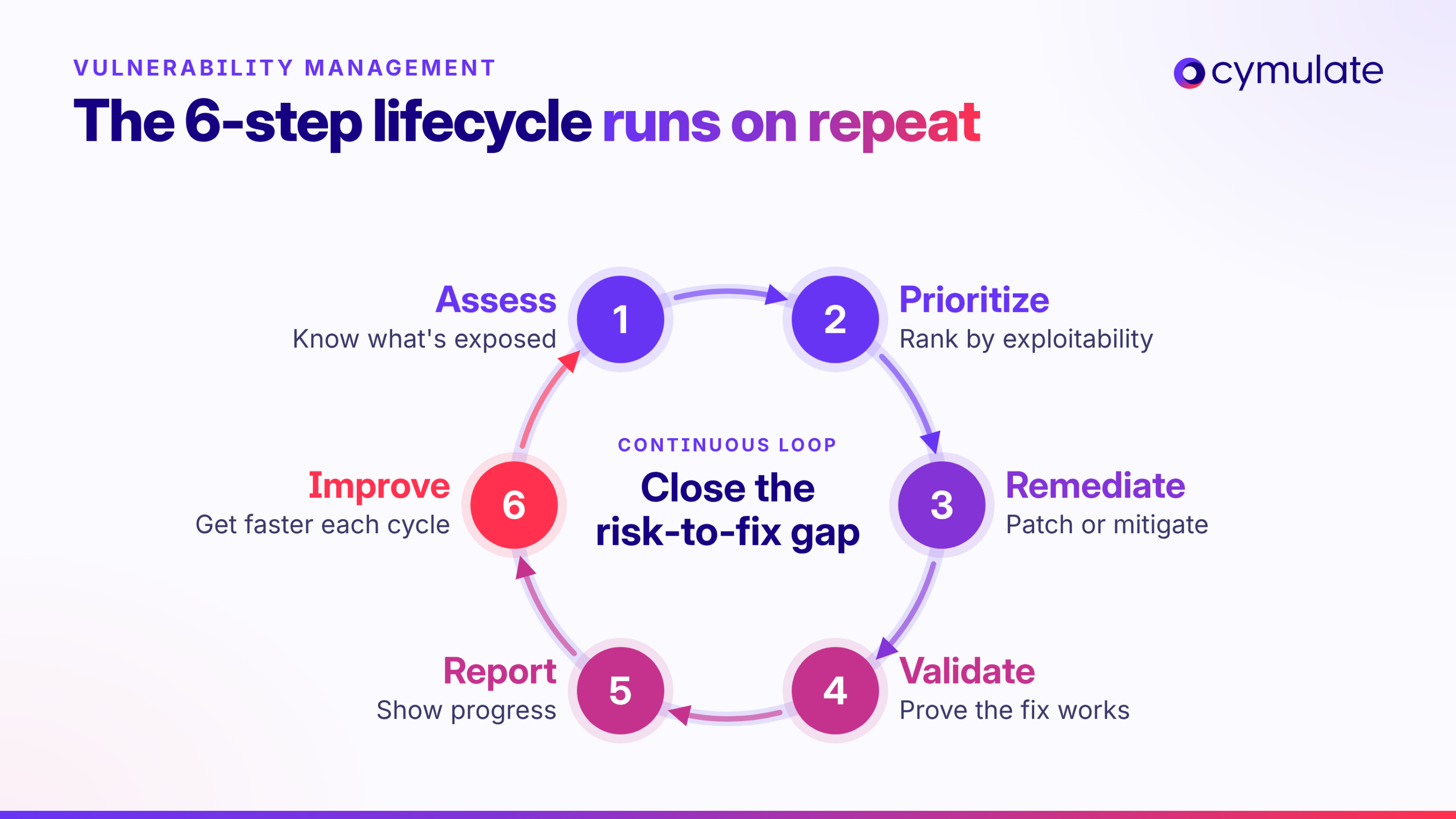
The six vulnerability management steps are assessment, prioritization, remediation, validation, reporting and improvement. The table summarizes each phase. The sections below explain them.
| Phase | Goal | Key activities | Output |
|---|---|---|---|
| 1. Assessment | Know what’s exposed | Asset inventory, vulnerability scanning, configuration review | List of vulnerabilities by asset |
| 2. Prioritization | Decide what to fix first | Score by exploitability, asset criticality and control coverage | Ranked remediation queue |
| 3. Remediation | Reduce the risk | Patch, reconfigure or apply compensating controls | Fixes and mitigations deployed |
| 4. Validation | Prove the fix works | Re-test with attack simulation, rescan | Confirmed closure or reopened ticket |
| 5. Reporting and monitoring | Show progress | Track service-level agreements (SLAs), mean time to remediate, open exposure | Dashboards and audit evidence |
| 6. Improvement | Get faster each cycle | Review misses, tune processes and tooling | Updated policies and SLAs |
Step 1: Assessment
Assessment finds and catalogs vulnerabilities across every asset in scope. Before the first scan, define scope, asset owners and remediation SLAs. Then combine an asset inventory with vulnerability scanning and configuration reviews.
Step 2: Prioritization
Prioritization ranks vulnerabilities by the real risk each one poses to your environment. Common Vulnerability Scoring System (CVSS) scores describe severity in general. They don’t show whether an attacker can exploit the flaw past your controls. Add exploitability, asset criticality and control effectiveness to the ranking. Vulnerability prioritization explains the scoring models in more depth.
Step 3: Remediation and mitigation
Remediation removes the vulnerability. Mitigation reduces the chance it can be exploited. Patching is the default fix. When a patch isn’t available or can’t be deployed quickly, teams apply compensating controls such as detection rules, indicators of compromise (IoCs) or policy changes on the controls already in place.
Step 4: Validation
Validation confirms that a fix or mitigation actually stops the attack. A rescan shows a patch is installed. Attack simulation shows whether the exposure is still exploitable. Validation closes the loop and reopens anything that failed.
Step 5: Reporting and monitoring
Reporting turns lifecycle activity into evidence for leadership and auditors. Track open exposures by criticality, SLA adherence and mean time to remediate. Continuous monitoring catches new assets and new vulnerabilities between cycles.
Step 6: Improvement
Improvement uses each cycle’s results to make the next one faster. Review what slipped through, adjust SLAs and tune scanning, prioritization and remediation workflows.
Continuous vulnerability assessment vs one-time scanning
Continuous vulnerability assessment and remediation keeps the full lifecycle running. A one-time scan captures a single point in time.
| One-time scan | Continuous lifecycle | |
|---|---|---|
| Frequency | Periodic, often quarterly | Ongoing |
| Covers new assets and CVEs | Only at the next scan | As they appear |
| Confirms fixes work | No | Yes, through validation |
| Audit evidence | Snapshot | Trend over time |
How to build a vulnerability management program
A vulnerability management program is the policy, ownership and tooling that keeps the lifecycle running. Use this checklist as a starting plan template:
- Define scope: asset types, environments and business-critical systems.
- Assign owners for each asset group and each lifecycle step.
- Set remediation SLAs by risk tier.
- Choose tools for discovery, prioritization, remediation and validation.
- Agree on metrics and a reporting cadence.
- Schedule a review after each cycle to update the plan.
Where risk-based prioritization and automation fit
Risk-based vulnerability management applies to step 2. It ranks vulnerabilities by exploitability and business impact rather than severity alone, which shrinks the remediation queue to what matters.
Automated vulnerability remediation applies to steps 3 and 4. It pushes fixes and compensating controls as soon as an exposure is confirmed, then re-tests them, which shortens the risk-to-fix gap.
Aligning frameworks with the vulnerability management lifecycle
Vulnerability lifecycle management does two jobs: it hardens security and it shows compliance with global regulatory frameworks. Standards such as the National Institute of Standards and Technology Cybersecurity Framework (NIST CSF), the Payment Card Industry Data Security Standard (PCI DSS), the Health Insurance Portability and Accountability Act (HIPAA) and the General Data Protection Regulation (GDPR) expect organizations to show ongoing oversight and proactive mitigation of exposure risk.
| Security framework | Core regulatory mandates | Vulnerability management alignment |
|---|---|---|
| PCI DSS | Continuous protection against vulnerabilities and malicious software | Remediation and validation verify critical patches are applied within mandated windows to secure cardholder data. |
| HIPAA | Periodic risk analysis and implementation of technical safeguards | Assessment and prioritization provide the technical documentation required for formal risk evaluations. |
| NIST CSF | Asset identification, risk assessment and continuous monitoring | Assessment and remediation fulfill protocols for identifying critical assets and establishing protection policies. |
| GDPR | Regular testing, assessment and evaluation of technical security effectiveness | Monitoring and improvement demonstrate a formal process for identifying gaps and maintaining resilience. |
Common challenges in the vulnerability management process
Most programs fall behind on the same few problems: too many findings, too few people and too many disconnected tools. Each one makes the risk-to-fix gap wider. The fix that runs through all four challenges is to focus effort on the exposures attackers can actually exploit. Cymulate CTEM based on validated risk turns a long scanner backlog into a short list your team can work through.
- Volume: Scanners produce more findings than teams can fix. Prioritize by proven exploitability.
- Limited resources: Remediation competes with other work. Use compensating controls where patching lags.
- Tool overlap: Separate scanners, ticketing and testing tools hide the full picture. Integrate findings into one queue.
- Skills gaps: Validation and detection tuning take specialist time. Automate the repeatable steps.
How Cymulate supports the vulnerability management process
Cymulate supports the vulnerability management process with agentic cyber defense engineering: a closed loop that continuously proves what’s exploitable, prioritizes what matters and adapts defenses to close the risk-to-fix gap.
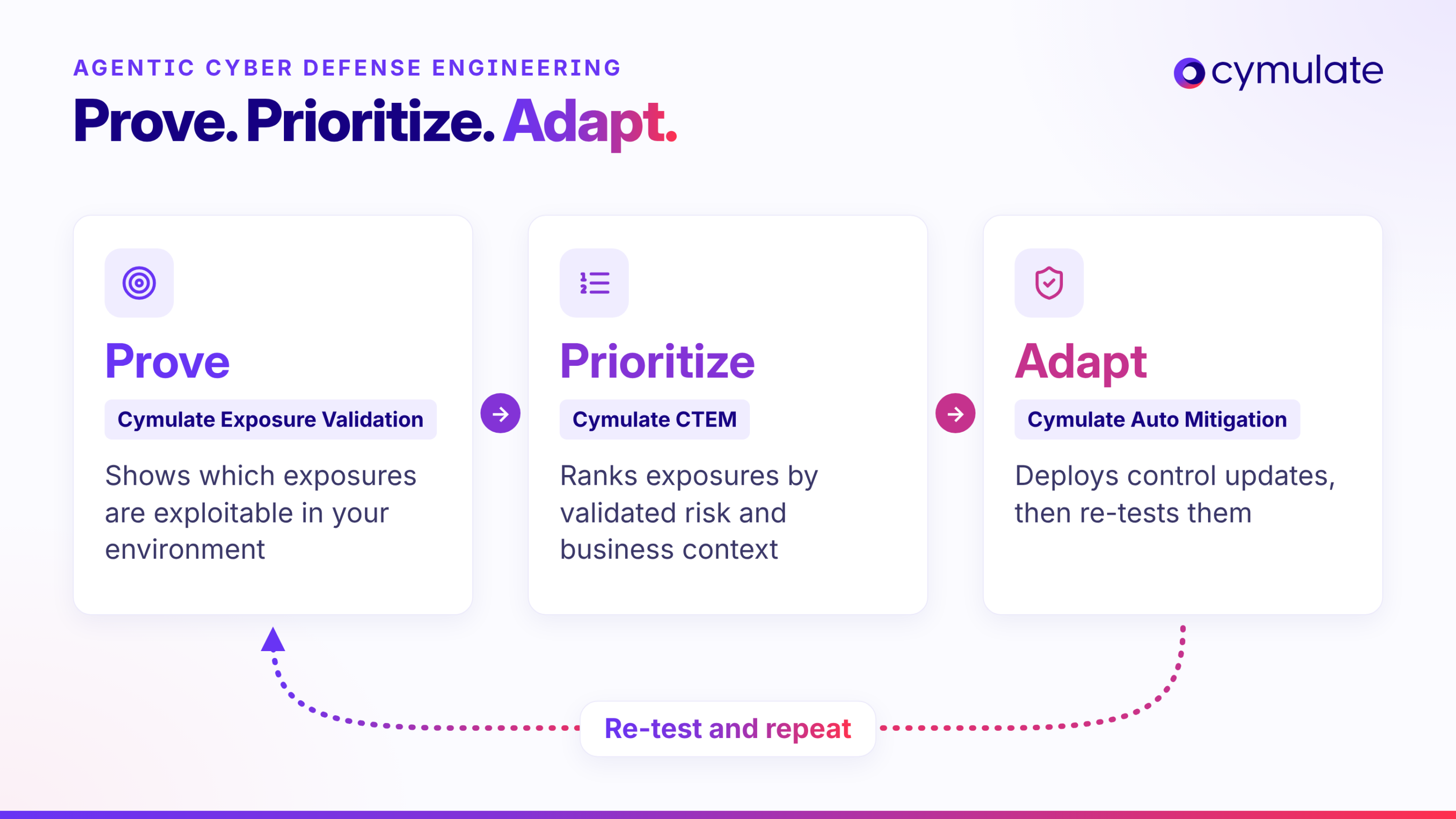
- Prove: Cymulate Exposure Validation tests security controls against advanced threats and MITRE ATT&CK techniques, using a daily threat feed, to show which exposures are exploitable in your environment. Cymulate Vero AI tailors each assessment by mapping the techniques an attacker would use to exploit the exposure.
- Prioritize: Cymulate CTEM integrates with vulnerability scanners and asset management to rank exposures by validated exploitability, control effectiveness and business context.
- Adapt: Cymulate Auto Mitigation deploys vendor-specific updates such as endpoint detection and response (EDR) detection rules and IoCs to integrated controls, then re-tests them. The Cymulate mitigation hub recommends the next best action, including patching and policy updates.
FAQs
The vulnerability management process is a continuous cycle for finding, prioritizing, fixing and verifying security weaknesses. It runs in six steps: assessment, prioritization, remediation, validation, reporting and improvement.
The six phases are assessment, prioritization, remediation and mitigation, validation, reporting and monitoring, and improvement. Each cycle’s results feed the next.
Vulnerability assessment finds and rates weaknesses at a point in time. Vulnerability management is the full lifecycle around it, including prioritization, remediation, validation and reporting.
A one-time scan captures a single snapshot. The lifecycle runs continuously, catches new assets and CVEs as they appear and confirms that fixes work.
A vulnerability management program is the policy, ownership, SLAs and tooling that keep the lifecycle running across an organization.
Rank them by real risk: whether attackers can exploit them in your environment, how critical the affected asset is and whether your controls already stop the attack. Severity scores alone overstate some risks and miss others. Learn more about risk-based vulnerability management.
Remediation removes the vulnerability, usually with a patch. Mitigation lowers the chance of exploitation, for example with a detection rule or configuration change, when a patch isn’t available yet.
More on Vulnerability Management
View More Resources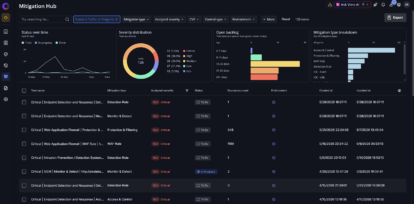
Cymulate for Vulnerability Management Teams
Cut through the noise to prioritize validated exposure and improve threat resilience.
Vulnerability Management Must Evolve to CTEM
Discover how CTEM helps VM teams decide what to patch now, verify existing mitigations, and proactively strengthen threat resilience.
Vulnerability Management Requires Exposure Validation
Cut through vulnerability noise by validating, prioritizing, and focusing on real exploitable risks.