Frequently Asked Questions
Features & Capabilities
What is Cymulate's Exposure Management Platform and how does it work?
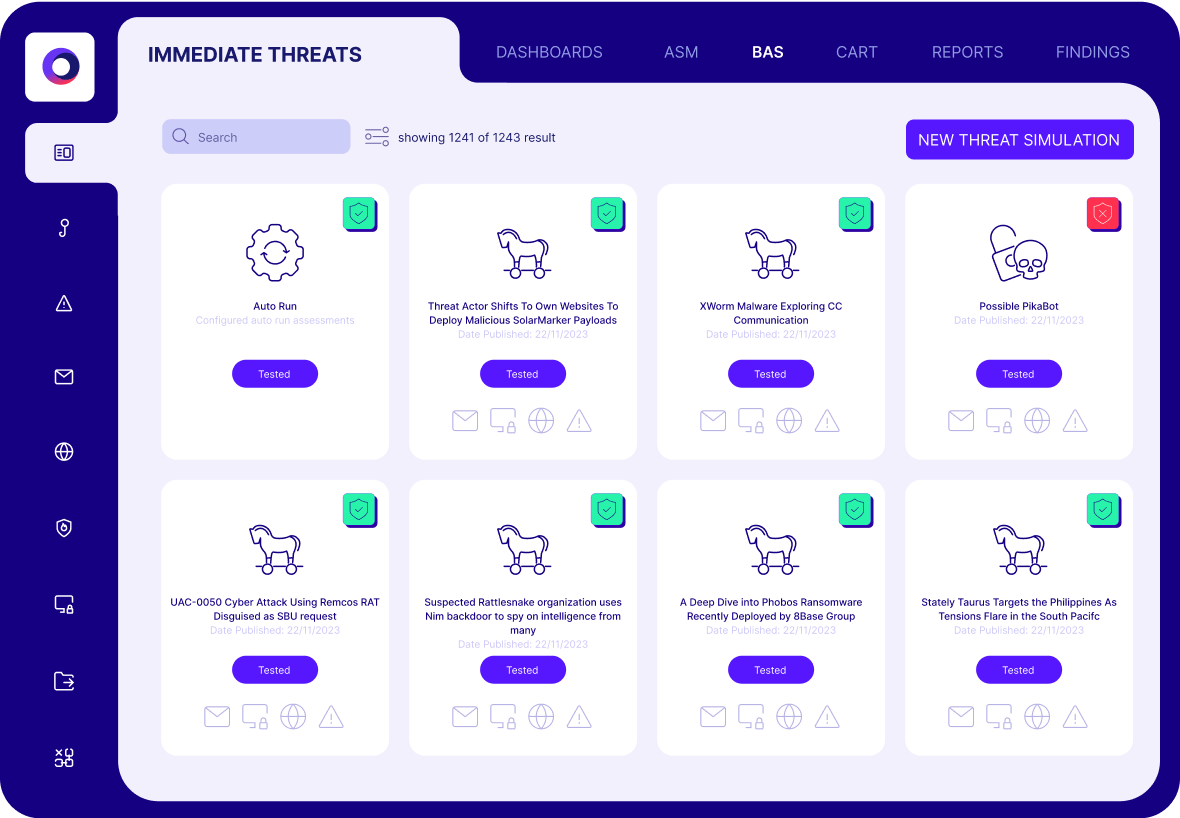
Cymulate's Exposure Management Platform enables organizations to proactively validate their cybersecurity defenses, identify vulnerabilities, and optimize their security posture. It combines breach and attack simulation, automated red teaming, and exposure analytics to deliver continuous threat validation and actionable insights. Learn more.
How does Cymulate validate security controls?
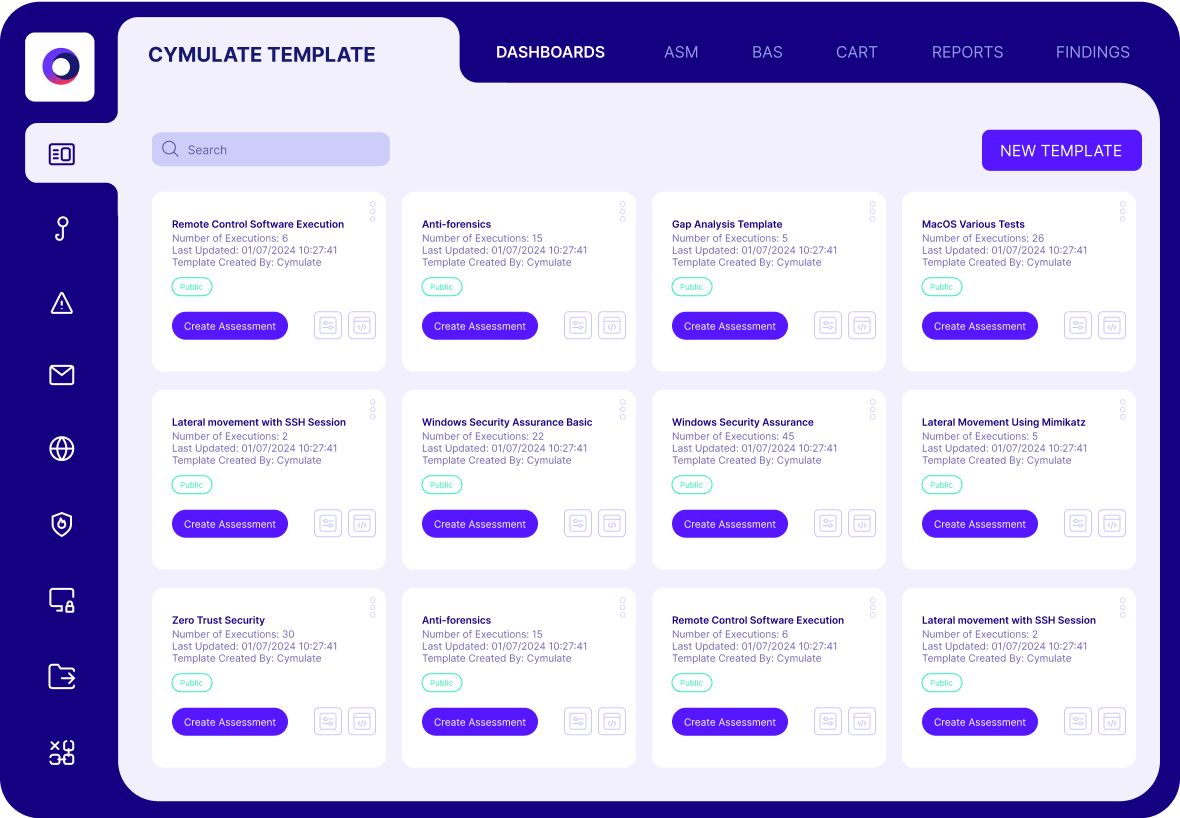
Cymulate provides out-of-the-box assessments to validate best practices for security controls such as endpoint protection, web application firewall, email gateway, network, data loss prevention, cloud workload protection, SIEM, and more. This helps organizations find and fix security gaps before an attack occurs. Read more.
Can Cymulate build custom attack chains for testing?
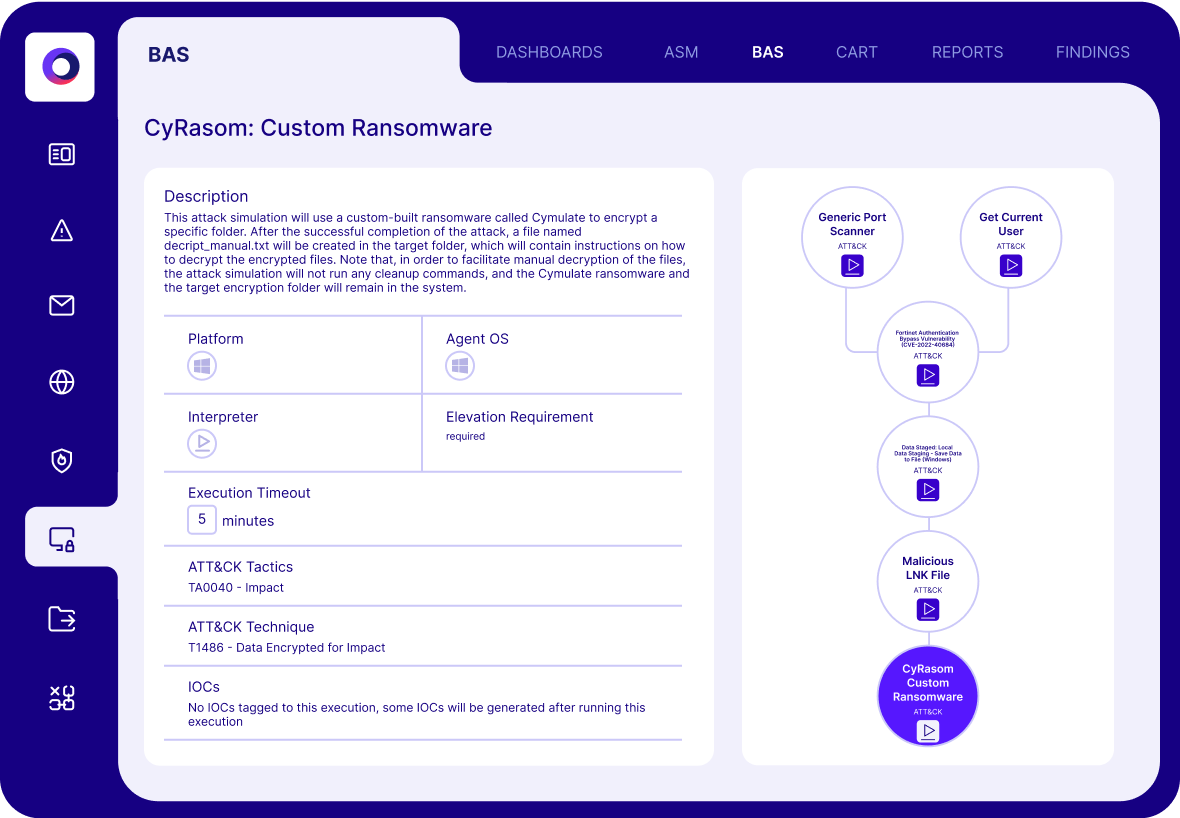
Yes, Cymulate offers simple no-code workflows to build attack chains from a library of more than 100,000 attack actions. Users can upload and create custom threat scenarios, enabling tailored offensive testing for their environment. Explore Red Teaming.
How does Cymulate help optimize security controls?
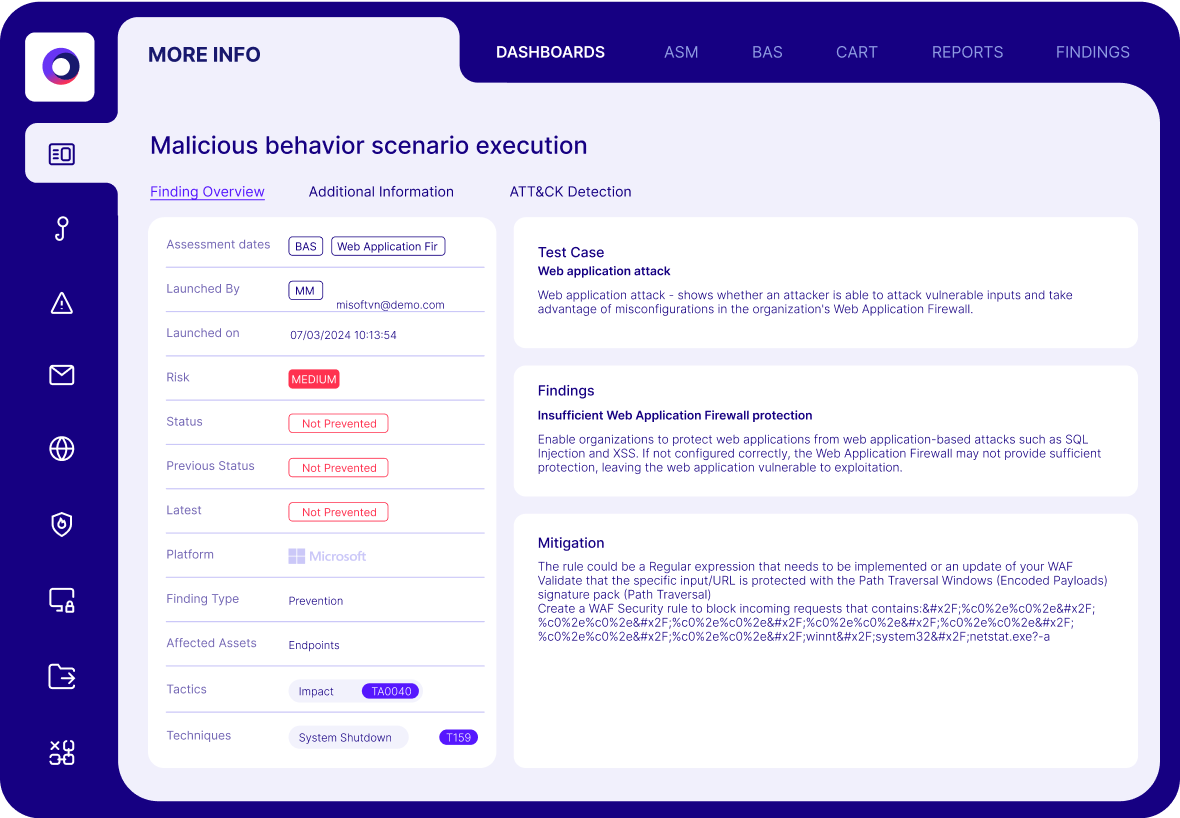
Cymulate provides remediation guidance, automated IoC updates, and recommended detection rules to configure and fine-tune security controls. This ensures organizations can strengthen their defenses and reduce exposure risk. Automated Mitigation.
Does Cymulate provide daily threat updates?
Yes, Cymulate delivers daily updates of the latest threats identified across the threat intelligence community, with a 24-hour SLA for new CISA alerts and advisories. This ensures organizations are always testing against current threats. Read the Blog.
What integrations does Cymulate support?
Cymulate integrates with a wide range of security technologies, including Akamai Guardicore, AWS GuardDuty, BlackBerry Cylance OPTICS, Carbon Black EDR, Check Point CloudGuard, Cisco Secure Endpoint, CrowdStrike Falcon, Wiz, SentinelOne, and more. For a complete list, visit our Partnerships and Integrations page.
How does Cymulate automate mitigation and response?
Cymulate integrates with security controls to push updates for immediate threat prevention, provides custom detection rules, and offers actionable guidance to optimize prevention and detection capabilities. Learn more.
What is Cymulate's threat scenario library?
Cymulate offers the most advanced library of attack simulations, with over 100,000 attack actions aligned to MITRE ATT&CK and daily updates. This enables organizations to test against a wide range of real-world threats. MITRE ATT&CK Framework.
How does Cymulate support cloud security validation?
Cymulate validates cloud security controls, including cloud workload protection and Kubernetes security, through automated testing and integrations with leading cloud security vendors. Cloud Security Validation.
Competition & Comparison
How does Cymulate compare to Scythe?
Cymulate offers a more complete exposure validation solution than Scythe, with unified breach and attack simulation, automated red teaming, daily threat updates, and comprehensive control validation. Scythe excels at custom attack campaigns for advanced red teams but lacks remediation guidance and comprehensive control scoring. See the comparison.
What are the key differentiators between Cymulate and Scythe?
Cymulate differentiates itself with daily threat updates, production-safe testing, unified exposure validation, and automated remediation guidance. Scythe provides technical tools for red teams but requires manual conversion of detection rules and offers less frequent threat updates. View details.
Why do organizations choose Cymulate over Scythe?
Organizations choose Cymulate for its comprehensive exposure validation platform, ease of use, daily threat updates, and proven production-safe testing. Cymulate enables scalable testing and actionable remediation, while Scythe is more suited for advanced red teamers requiring custom attack campaigns. Learn more.
Where can I find a comparison of Cymulate versus its competitors?
You can find a competitive comparison on our 'Why Cymulate' page, which outlines key differentiators and strengths against platforms like Scythe, AttackIQ, Mandiant Security Validation, Pentera, Picus, and SafeBreach.
How does Cymulate compare to AttackIQ?
While AttackIQ provides automated security validation through attack simulation, Cymulate stands out with the industry's leading threat scenario library, advanced AI-powered capabilities, and a user-friendly interface. For a detailed breakdown, see our AttackIQ comparison page.
What are Cymulate's top competitors?
Cymulate's top competitors include Scythe, AttackIQ, Mandiant Security Validation, Pentera, Picus, and SafeBreach. Each platform offers different strengths; Cymulate is recognized for its innovation, threat coverage, and ease of use. See competitor comparisons.
Is upgrading from Scythe to Cymulate easy?
Yes, Cymulate has helped clients upgrade from Scythe by building and customizing production-safe assessments, optimizing controls, and reducing exposure risk. The transition is supported by Cymulate's team to ensure seamless adoption. Book a Demo.
Use Cases & Benefits
Who can benefit from Cymulate's platform?
Cymulate is designed for CISOs, security leaders, SecOps teams, red teams, and vulnerability management teams in organizations of all sizes and industries, including finance, healthcare, retail, media, transportation, and manufacturing. Learn more.
What are the key benefits of using Cymulate?
Cymulate delivers improved security posture, operational efficiency, faster threat validation, cost savings, enhanced threat resilience, and better decision-making. Customers report up to a 52% reduction in critical exposures, 60% increase in team efficiency, and 81% reduction in cyber risk within four months. Optimize Threat Resilience.
How does Cymulate help organizations prioritize exposures?
Cymulate validates exploitability and ranks exposures based on prevention and detection capabilities, business context, and threat intelligence, enabling organizations to focus on the most critical vulnerabilities. Exposure Prioritization & Remediation.
What customer success stories demonstrate Cymulate's impact?
Hertz Israel reduced cyber risk by 81% in four months using Cymulate. RBI increased efficiency and improved SIEM detection. Globeleq automated in-house validation between pen tests. These case studies highlight measurable improvements in security and operational efficiency. Read case studies.
How does Cymulate address fragmented security tools?
Cymulate integrates exposure data and automates validation to provide a unified view of the security posture, addressing gaps caused by disconnected tools. Learn more.
How does Cymulate help organizations with resource constraints?
Cymulate automates processes, improving efficiency and operational effectiveness for security teams that are stretched thin. This allows teams to focus on strategic initiatives rather than manual tasks. Optimize Threat Resilience.
How does Cymulate improve post-breach recovery?
Cymulate enhances visibility and detection capabilities after a breach, ensuring faster recovery and improved protection by replacing manual processes with automated validation. Read Nedbank case study.
Pricing & Plans
What is Cymulate's pricing model?
Cymulate operates on a subscription-based pricing model tailored to each organization's requirements. Pricing is determined by the chosen package, number of assets, and scenarios selected for testing and validation. For a detailed quote, schedule a demo.
Technical Requirements
How easy is it to implement Cymulate?
Cymulate is designed for quick and easy implementation, operating in agentless mode with no need for additional hardware or complex configurations. Customers can start running simulations almost immediately after deployment. Book a Demo.
What support resources are available for Cymulate users?
Cymulate offers email and chat support, a knowledge base with technical articles and videos, webinars, e-books, and an AI chatbot for querying the knowledge base and creating AI templates. Contact support or view webinars.
Security & Compliance
What security and compliance certifications does Cymulate hold?
Cymulate holds SOC2 Type II, ISO 27001:2013, ISO 27701, ISO 27017, and CSA STAR Level 1 certifications, demonstrating robust security and compliance standards. Security at Cymulate.
How does Cymulate ensure data security?
Cymulate ensures data security through encryption for data in transit (TLS 1.2+) and at rest (AES-256), secure AWS-hosted data centers, and a tested disaster recovery plan. Learn more.
Is Cymulate GDPR compliant?
Yes, Cymulate incorporates data protection by design and has a dedicated privacy and security team, including a Data Protection Officer (DPO) and Chief Information Security Officer (CISO), ensuring GDPR compliance. Read more.
Customer Proof & Reviews
What feedback have customers given about Cymulate's ease of use?
Customers consistently praise Cymulate for its intuitive interface and ease of use. Testimonials highlight quick implementation, user-friendly dashboards, and accessible support. For example, Raphael Ferreira, Cybersecurity Manager, said, "Cymulate is easy to implement and use—all you need to do is click a few buttons, and you receive a lot of practical insights." Read more testimonials.
How is Cymulate rated by industry analysts and review platforms?
Cymulate is rated #1 in Exposure Management by G2 and named a Customers' Choice in the 2025 Gartner Peer Insights Voice of the Customer for Adversarial Exposure Validation. Read more.
What are some real-world use cases for Cymulate?
Organizations use Cymulate for security control validation, automated pen testing, scaling red team activities, and visualizing MITRE ATT&CK coverage. Case studies include RBI optimizing SIEM detection and Globeleq automating in-house validation. View case studies.
How does Cymulate help visualize MITRE ATT&CK coverage?
Cymulate's MITRE ATT&CK Heatmap helps organizations easily visualize gaps and coverage of the MITRE framework, enabling targeted resource allocation for better protection. Learn more.