

Frequently Asked Questions

Pyramid of Pain Framework & Cybersecurity Concepts

What is the Pyramid of Pain in cybersecurity?

The Pyramid of Pain is a cybersecurity framework developed by David Bianco in 2013. It illustrates how different types of indicators of compromise (IoCs) impact the difficulty of detecting and disrupting threat actors. Each layer of the pyramid, from hash values and IP addresses to tactics, techniques, and procedures (TTPs), represents a different level of challenge for attackers, with higher levels causing greater disruption when defenders respond effectively.

What are the six levels of indicators in the Pyramid of Pain?

The six levels of indicators of compromise (IoCs) in the Pyramid of Pain, from least to most disruptive for attackers, are: 1) Hash Values, 2) IP Addresses, 3) Domain Names, 4) Network/Host Artifacts, 5) Tools, and 6) Tactics, Techniques, and Procedures (TTPs). Each level represents a different challenge for attackers to overcome when defenders detect or block them.

How does the Pyramid of Pain help security teams prioritize detection and response?

The Pyramid of Pain helps security teams focus their detection and response efforts on indicators that most hinder adversaries. By targeting higher levels of the pyramid, such as TTPs and tools, defenders can cause greater disruption to attackers, improving organizational resilience and making it more difficult for threat actors to succeed.

Why are Tactics, Techniques, and Procedures (TTPs) considered the most disruptive indicator in the Pyramid of Pain?

TTPs are at the top of the Pyramid of Pain because they represent the underlying methods and strategies used by attackers, not just specific tools or signatures. Detecting and disrupting TTPs forces attackers to fundamentally change their approach, which is costly and time-consuming, making it the most effective long-term defense strategy.

How can organizations use the Pyramid of Pain to validate their security controls?

Organizations can use the Pyramid of Pain to validate security controls by assessing how well their defenses detect and respond to threats at each level. This includes testing detection of file hashes, IP addresses, domain names, network/host artifacts, tools, and TTPs through simulations, red team exercises, and continuous monitoring.

What are some challenges in detecting indicators at the lower levels of the Pyramid of Pain?

Indicators at the lower levels, such as hash values and IP addresses, are easy for attackers to change. This makes them less effective for long-term defense, as attackers can quickly alter files or switch IP addresses to evade detection. Security teams must ensure their systems are updated with the latest threat intelligence to remain effective.

How does Cymulate help operationalize the Pyramid of Pain?

Cymulate’s Exposure Management and Breach & Attack Simulation (BAS) platform empowers organizations to operationalize the Pyramid of Pain by continuously testing and optimizing defenses across all levels of indicators. The platform enables red teaming, simulations, and integrated monitoring to ensure defenses remain adaptive against evolving threats.

What are network and host artifacts in the context of the Pyramid of Pain?

Network and host artifacts are signs of malicious activity produced as a result of an adversary’s interaction with a network or host machine. These artifacts can include unusual network traffic patterns or changes in host configurations, and detecting them can help catch attackers earlier and disrupt their activities more effectively.

How can red team exercises improve an organization’s preparedness using the Pyramid of Pain?

Red team exercises simulate attacks that use various indicators across all layers of the Pyramid of Pain. By evaluating how well security controls detect and respond to each type of indicator, organizations can identify gaps and improve their overall security posture and resilience.

What role does continuous monitoring play in the Pyramid of Pain framework?

Continuous monitoring and logging are essential for detecting anomalies and potential indicators of compromise in real-time. This proactive approach helps organizations respond quickly to threats at any level of the Pyramid of Pain, enhancing overall defense capabilities.

How can security teams stay ahead of evolving threats using the Pyramid of Pain?

Security teams can stay ahead of evolving threats by regularly updating threat intelligence feeds, detection rules, and response strategies. Conducting regular penetration tests, simulations, and threat hunting exercises ensures that defenses remain effective against new and sophisticated attack methods.

What is the importance of training and awareness in the context of the Pyramid of Pain?

Training and awareness are crucial for enabling security teams to recognize and respond to indicators at all levels of the Pyramid of Pain. Ongoing education helps teams adapt to new threats and improves the organization’s overall security posture.

How does Cymulate’s platform support continuous validation of security controls?

Cymulate’s platform supports continuous validation by enabling automated simulations, red team exercises, and integrated monitoring. This ensures that security controls are regularly tested and optimized to detect and respond to threats across all levels of the Pyramid of Pain.

What are some related cybersecurity frameworks to the Pyramid of Pain?

Related frameworks include the MITRE ATT&CK® Framework, Cyber Kill Chain, and Attack Path Analysis. These frameworks complement the Pyramid of Pain by providing structured approaches to understanding and defending against cyber threats. Learn more on Cymulate’s MITRE ATT&CK® page.

Where can I find a glossary of cybersecurity terms like IoCs and TTPs?

Cymulate provides a comprehensive Cybersecurity Glossary that explains terms, acronyms, and jargon, including IoCs and TTPs. This resource is continuously updated for your reference.

What is the role of behavioral analysis in detecting TTPs?

Behavioral analysis involves monitoring and analyzing patterns of activity to identify attacker tactics, techniques, and procedures (TTPs). This approach goes beyond signature-based detection and is essential for identifying sophisticated threats at the highest level of the Pyramid of Pain.

How does Cymulate’s Exposure Management Platform relate to the Pyramid of Pain?

Cymulate’s Exposure Management Platform enables organizations to continuously validate their defenses against threats at all levels of the Pyramid of Pain. By simulating real-world attacks and providing actionable insights, the platform helps organizations improve detection, response, and overall resilience.

What are some best practices for implementing the Pyramid of Pain in an organization?

Best practices include conducting regular red team exercises, updating threat intelligence feeds, implementing continuous monitoring, integrating multiple security tools, and providing ongoing training and awareness for security teams. These steps help ensure comprehensive coverage across all levels of the Pyramid of Pain.

How does Cymulate’s platform integrate with other security tools for Pyramid of Pain validation?

Cymulate integrates with a wide range of security technologies, including EDR, SIEM, vulnerability management, and cloud security tools. This integration enables comprehensive validation across all layers of the Pyramid of Pain. For a full list of integrations, visit our Partnerships and Integrations page.

Features & Capabilities

What features does Cymulate offer for threat validation and exposure management?

Cymulate offers continuous threat validation, unified Breach and Attack Simulation (BAS), Continuous Automated Red Teaming (CART), exposure analytics, attack path discovery, automated mitigation, AI-powered optimization, and an extensive threat library with over 100,000 attack actions updated daily. These features help organizations validate and optimize their security posture in real-time. Learn more.

Does Cymulate support automated security validation?

Yes, Cymulate supports automated security validation through continuous simulations, red teaming, and exposure analytics. The platform automates the process of testing security controls, enabling organizations to identify and remediate vulnerabilities efficiently.

How does Cymulate help with exposure prioritization?

Cymulate validates exploitability and ranks exposures based on prevention and detection capabilities, business context, and threat intelligence. This helps organizations focus on the most critical vulnerabilities and optimize remediation efforts. Learn more.

What integrations does Cymulate offer?

Cymulate integrates with a wide range of security technologies, including Akamai Guardicore, AWS GuardDuty, BlackBerry Cylance OPTICS, Carbon Black EDR, Check Point CloudGuard, Cisco Secure Endpoint, CrowdStrike Falcon, Wiz, SentinelOne, and more. For a complete list, visit our Partnerships and Integrations page.

How easy is it to implement Cymulate?

Cymulate is designed for quick and easy implementation, operating in agentless mode with no need for additional hardware or complex configurations. Customers can start running simulations almost immediately, and comprehensive support is available via email, chat, and educational resources. Schedule a demo to learn more.

What feedback have customers given about Cymulate’s ease of use?

Customers consistently praise Cymulate for its intuitive and user-friendly interface. Testimonials highlight the platform’s ease of implementation, actionable insights, and accessible support. For example, Raphael Ferreira, Cybersecurity Manager, stated, “Cymulate is easy to implement and use—all you need to do is click a few buttons, and you receive a lot of practical insights into how you can improve your security posture.” Read more customer stories.

What security and compliance certifications does Cymulate hold?

Cymulate holds several key certifications, including SOC2 Type II, ISO 27001:2013, ISO 27701, ISO 27017, and CSA STAR Level 1. These certifications demonstrate Cymulate’s commitment to robust security and compliance standards. Learn more.

How does Cymulate ensure data security and privacy?

Cymulate ensures data security through encryption for data in transit (TLS 1.2+) and at rest (AES-256), secure AWS-hosted data centers, a tested disaster recovery plan, and compliance with GDPR. The platform also includes mandatory 2FA, RBAC, IP address restrictions, and a dedicated privacy and security team. More details.

What is Cymulate’s pricing model?

Cymulate operates on a subscription-based pricing model tailored to each organization’s requirements. Pricing depends on the chosen package, number of assets, and scenarios selected. For a detailed quote, schedule a demo with the Cymulate team.

What business impact can customers expect from using Cymulate?

Customers can expect up to a 52% reduction in critical exposures, a 60% increase in team efficiency, and an 81% reduction in cyber risk within four months. Cymulate also enables faster threat validation (40X faster than manual methods) and cost savings by consolidating tools. See more metrics.

Who can benefit from using Cymulate?

Cymulate is designed for CISOs, security leaders, SecOps teams, red teams, and vulnerability management teams in organizations of all sizes and industries, including finance, healthcare, retail, media, transportation, and manufacturing. Learn more about roles.

How does Cymulate compare to other security validation platforms?

Cymulate stands out with its unified platform combining BAS, CART, and exposure analytics, continuous threat validation, AI-powered optimization, and ease of use. Customers report measurable outcomes such as a 52% reduction in critical exposures and an 81% reduction in cyber risk. For more, see Cymulate vs. competitors.

What educational resources does Cymulate provide?

Cymulate offers a Resource Hub, blog, webinars, e-books, case studies, and a continuously updated cybersecurity glossary. These resources help users stay informed about the latest threats, best practices, and platform updates. Explore resources.

Where can I find case studies and customer success stories for Cymulate?

You can find case studies and customer success stories on Cymulate’s Customers page. These stories cover a range of industries and demonstrate measurable improvements in security posture and operational efficiency.

How does Cymulate support different security personas?

Cymulate tailors its solutions for CISOs and security leaders (providing metrics and insights), SecOps teams (automating processes), red teams (offensive testing), and vulnerability management teams (prioritizing exposures). Each persona benefits from features designed to address their specific challenges. Learn more.

What is Cymulate’s mission and vision?

Cymulate’s mission is to transform cybersecurity practices by enabling organizations to proactively validate their defenses, identify vulnerabilities, and optimize their security posture. The vision is to create a collaborative environment for lasting improvements in cybersecurity strategies. About Cymulate.

New: 2026 Gartner® Market Guide for Adversarial Exposure Validation
Learn More
Cymulate named a Customers' Choice in 2025 Gartner® Peer Insights™
Learn More
New Research: The Security Tradeoffs Behind AI Tooling
Learn More
An Inside Look at the Technology Behind Cymulate
Learn More

The Pyramid of Pain in Cybersecurity Threat Analysis

Understanding the Pyramid of Pain and how to outsmart threat actors

With organizations facing more cyber threats today than ever before, in addition to having mass attack surfaces, companies must find ways to stay ahead, stay vigilant and stay secure. One way of tackling that is by understanding the Pyramid of Pain. Security expert, David Bianco developed this concept in 2013, that illustrates how different types of indicators of compromise (IoCs) could potentially impact an organization’s threat detection and mitigation.

Key Highlights

  • The Pyramid of Pain is a cybersecurity framework by David Bianco that shows how different types of indicators of compromise (IoCs) impact the difficulty of detecting and disrupting threat actors.
  • Each layer of the pyramid, from hash values and IP addresses to tactics, techniques, and procedures (TTPs), represents a different level of challenge for attackers, with higher levels causing greater disruption when defenders respond effectively.
  • Applying the Pyramid helps security teams prioritize detection and response, focusing efforts where they most hinder adversaries and improve organizational resilience.
  • Continuous validation through red teaming, simulations, and integrated monitoring ensures defenses remain adaptive against evolving threats.
  • Cymulate’s Exposure Management and Breach & Attack Simulation (BAS) platform empowers organizations to operationalize the Pyramid of Pain, continuously testing and optimizing defenses to outsmart threat actors and stay ahead of emerging risks.

The 6 levels of indicators in the Pyramid of Pain

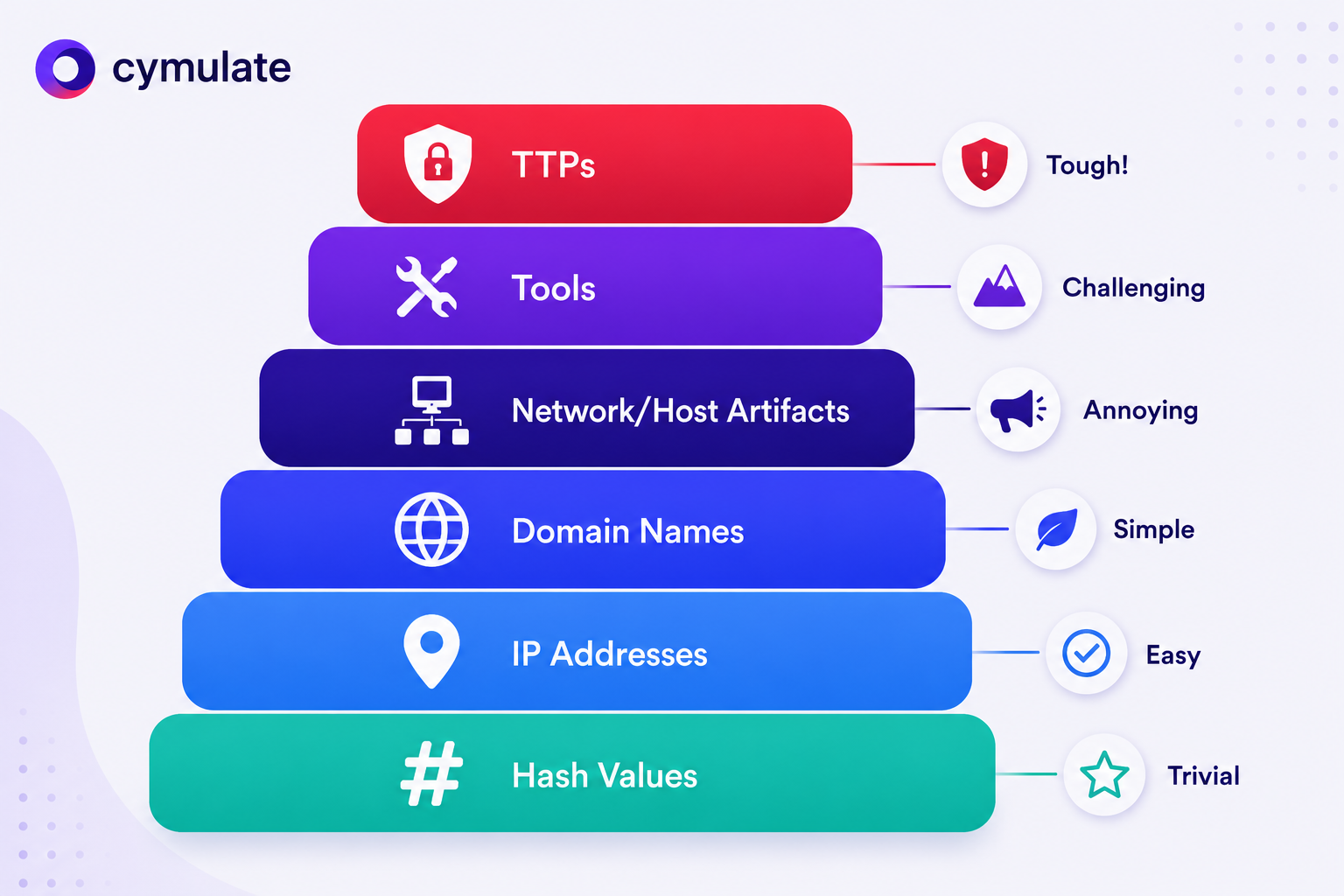
There are six levels of IoCs defined within the Pyramid of Pain that are from the bottom to the top, the least painful to the most painful. In this instance, “painful” is defined by how challenging or difficult it would be for an attacker to take these levels on.

At the base of the pyramid are simple indicators like hash values and IP addresses, which attackers can easily change. As you move up, it gets harder for them to alter domain names, network and host artifacts, tools, and finally their tactics, techniques, and procedures (TTPs).

By integrating the Pyramid of Pain into threat mitigation strategies, security teams can improve early detection, response capabilities, and overall cybersecurity resilience.

The six levels of IoCs are:
Pyramid of Pain in Cybersecurity

1. Hash Values

At the base of the pyramid, and therefore one of the easier and more vulnerable targets to a threat actor, are a type of software or file “signature” digital fingerprint. Hash values are the output of a complex cryptographic hash function, such as, SHA-a and MD5; between these two functions, they can nearly guarantee that two different files will not have the same hash value.

2. IP Addresses

The next level up from the bottom is Internet Protocol (IP) Addresses, which uniquely identify a computer, or any other device connected to the internet. Blocking IP addresses can help be a preventative measure, however, they remain an easy target for threat actors to break through and change, making them less effective long-term.

3. Domain Names

In the middle of the pyramid, Domain Names offer more intricacies, with its ability to block malicious domains can be much more effective than blocking IP addresses. Yet, attackers can still have the upper hand here with the ease of registering different domains or using domain generation algorithms (DGAs).

4. Network/Host Artifacts

In the upper portion of the pyramid, threat actors should have a more challenging time against Network/Host Artifacts. Every byte that goes through a network as a result of an adversary’s interaction could be an artifact, and those pieces can be distinguished as signs of malicious activity, catching an attacker much earlier in their endeavor and with greater disruptions. Network artifacts are produced as the result of some network activity or interference, where as host artifacts are produced from activity on a host machine.

5. Tools

With a variety of tools in place, threat actors often have various software tools and platforms at their disposal to carry out their targets, such as, backdoors and password crackers. This would allow them to move laterally, extract data and exploit organizational vulnerabilities. However, this would require the attacker to have replace or develop new tools that can beat the secure organization, making it a costly and time-consuming mission.

6. Tactics, Techniques and Procedures (TTPs)

At the top of the pyramid, the most difficult point of entry for a threat actor sits the tactics, techniques and procedures (TTPs). The TTPs are critical in understanding and defending against the slyest attacker, involving recognizing the methods and strategies used by them, not just the specific tools or indicators. This is the most effective long-term approach, as it addresses the underlying methods used in attacks, rather than pieces of signatures or artifacts.

Using the Pyramid to outsmart an attacker

Implementing the Pyramid of Pain into cybersecurity strategies is crucial for enhancing threat detection, incident response, and overall defense capabilities. This approach focuses on targeting areas that significantly disrupt adversaries, thereby strengthening defenses against complex cyber attacks. The indicators are only one form of threat detection in cybersecurity.

Staying on top of an organization’s behavioral threat analysis, signature-based detection, heuristic-based detection, machine learning and AI-based detections can be the difference between a reputational and data breach nightmare and a good nights’ sleep.

Keeping an eye on where things fall within this pyramid framework allows the cybersecurity teams to focus their efforts more effectively against potential dangers in their environment.

Ways to use the Pyramid to Validate your Security Controls

The Pyramid of Pain is an effective framework for validating your security controls by assessing how well they detect and respond to various threats:

File Hashes (Bottom Layer)

Validation: Test if your security system can detect and block known malicious file hashes.

Challenge: Since attackers can easily change the hash by altering the file, ensure your system is updated with the latest threat intelligence feeds.

IP Addresses and Domain Names

Validation: Implement IP and domain blacklists to see if your system can block communications with known malicious servers.

Challenge: Attackers frequently change IP addresses and domains. Validate if your system can quickly update and respond to these changes.

Network/Host Artifacts

Validation: Check if your security controls can identify patterns in network traffic or host configurations indicative of malicious activity.

Challenge: This requires more sophisticated detection mechanisms. Conduct regular penetration tests and simulations to ensure your controls can identify these artifacts.

Tools

Validation: Detect and block the use of specific malicious tools and utilities commonly used by attackers.

Challenge: Attackers can switch tools or modify existing ones. Ensure your controls can adapt and detect new or altered tools.

Tactics, Techniques, and Procedures (TTPs)

Validation: Assess if your security measures can identify and disrupt the specific methods attackers use, such as, phishing attempts or lateral movement within a network.

Challenge: This involves behavioral analysis and requires a deep understanding of attacker methodologies. Regularly update your detection rules and conduct threat hunting exercises to refine your capabilities.

Practice makes a better prepared organization

  • Conduct Red Team Exercises: Simulate attacks that use various IoCs across all layers of the Pyramid of Pain. Evaluate how well your security controls detect and respond to each type of indicator.
  • Regular Updates: Ensure your threat intelligence feeds, detection rules, and response strategies are regularly updated to address new and evolving threats.
  • Continuous Monitoring: Implement continuous monitoring and logging to detect anomalies and potential indicators of compromise in real-time.
  • Integration of Security Tools: Use a combination of security tools that cover different layers of the pyramid. For example, antivirus software for file hashes, intrusion detection systems for network artifacts, and behavioral analytics for TTPs.
  • Training and Awareness: Train your security team to recognize and respond to indicators at all levels of the pyramid. Awareness and education can significantly improve your overall security posture.
Book a Demo