

Frequently Asked Questions

Golden Ticket Attack: Fundamentals & Execution

What is a Golden Ticket attack in cybersecurity?

A Golden Ticket attack is a sophisticated cyberattack targeting the Kerberos authentication system, primarily used in Windows Active Directory environments. It allows attackers to generate forged authentication tokens (Ticket-Granting Tickets, or TGTs), granting them unrestricted access to any resource in the target network. This is achieved by compromising the hash of the krbtgt account, enabling attackers to impersonate any user, including privileged accounts, and maintain persistent, often undetectable, access to domain resources.

How is a Golden Ticket attack executed?

The attack begins with the attacker gaining administrative privileges in the domain, often through phishing, privilege escalation, or lateral movement. Once they have domain admin access, they extract the krbtgt account hash from the domain controller using tools like Mimikatz. With this hash, attackers can forge valid TGTs (Golden Tickets) that allow them to impersonate any user and access sensitive systems without detection. The attacker can then maintain persistence by creating backdoors and evading removal efforts.

What are the main steps involved in a Golden Ticket attack?

The main steps are: 1) Gaining domain admin access, 2) Dumping the krbtgt hash or harvesting credentials, 3) Creating the Golden Ticket (forged TGT), 4) Using the ticket for unrestricted network access, and 5) Maintaining persistence through backdoors and stealth techniques.

What is the krbtgt account and why is it important in Golden Ticket attacks?

The krbtgt account is a special account in Active Directory responsible for issuing Ticket-Granting Tickets (TGTs) in the Kerberos authentication process. If an attacker compromises the krbtgt account hash, they can forge valid TGTs, enabling them to impersonate any user and gain unrestricted access to domain resources.

How does a Golden Ticket attack differ from Kerberoasting?

Kerberoasting targets service accounts by requesting Kerberos service tickets, which are encrypted with the service account’s password hash. Attackers then attempt to crack the password offline to access that specific service. In contrast, a Golden Ticket attack allows an attacker to forge a TGT and impersonate any user, including privileged accounts, granting total domain control.

What is the difference between Pass-the-Hash and Golden Ticket attacks?

Pass-the-Hash attacks allow attackers to authenticate using a hashed password, but access is limited to the compromised account. Golden Ticket attacks, however, enable attackers to forge TGTs and impersonate any account in the domain, including administrators, providing indefinite and broad access without needing actual credentials.

What are some real-world examples of Golden Ticket attacks?

Notable examples include the Sony Pictures Hack (2014), where attackers used Golden Ticket attacks to maintain persistent access and exfiltrate sensitive data, and the NotPetya attack (2017), which leveraged Golden Ticket techniques to spread across networks and deploy destructive malware. Sony breach source, NotPetya source.

Why are Golden Ticket attacks difficult to detect?

Golden Ticket attacks are hard to detect because the forged Kerberos tickets are cryptographically valid and mimic legitimate tickets. Attackers can set extended ticket lifetimes and use normal authentication channels, making their activity blend in with regular network traffic and evade standard monitoring tools.

What are the signs that you may have been a victim of a Golden Ticket attack?

Indicators include Kerberos tickets with unusually long expiration periods, anomalous administrative activity (such as privileged accounts accessing unfamiliar systems), and inconsistent logon events from unrecognized locations or devices. Monitoring for these anomalies can help detect potential Golden Ticket attacks.

How long can a Golden Ticket remain valid?

Golden Tickets can remain valid for extended periods, often until the krbtgt account password is changed. By default, Kerberos tickets have a 10-hour lifespan, but attackers can set much longer expiration times, making detection and remediation more challenging.

Prevention & Detection Strategies

What are the best practices for preventing Golden Ticket attacks?

Key prevention methods include regularly resetting the krbtgt account password, enforcing least privilege access for domain admin accounts, enabling strong monitoring with SIEM systems, implementing multi-factor authentication (MFA) for privileged accounts, and segmenting the network to limit lateral movement.

How does resetting the krbtgt account password help prevent Golden Ticket attacks?

Resetting the krbtgt account password invalidates any previously stolen hashes, rendering existing Golden Tickets useless. This is a critical step in mitigating ongoing or potential Golden Ticket attacks.

Why is least privilege access important for defending against Golden Ticket attacks?

Enforcing least privilege access ensures that only a minimal number of users have domain admin privileges. This reduces the attack surface and makes it harder for attackers to escalate privileges and compromise the krbtgt account.

How can SIEM systems help detect Golden Ticket attacks?

Security Information and Event Management (SIEM) systems can monitor account activity for unusual authentication events, extended ticket lifetimes, and suspicious administrative behavior. These systems help identify anomalies that may indicate a Golden Ticket attack in progress.

What role does multi-factor authentication (MFA) play in preventing Golden Ticket attacks?

Implementing MFA for all privileged accounts adds an additional layer of security, making it more difficult for attackers to leverage stolen credentials or forged tickets to gain unauthorized access.

How does network segmentation help mitigate the impact of Golden Ticket attacks?

Network segmentation limits the spread of an attack by isolating critical systems and resources. Even if an attacker gains access to one part of the network, segmentation can prevent them from moving laterally and accessing other sensitive areas.

What tools are commonly used by attackers to perform Golden Ticket attacks?

Attackers often use tools like Mimikatz to extract the krbtgt account hash from the domain controller, which is then used to forge Golden Tickets for unauthorized access.

How can organizations respond if they suspect a Golden Ticket attack?

Organizations should immediately reset the krbtgt account password (twice, as per Microsoft guidance), review and monitor privileged account activity, and conduct a thorough investigation using SIEM and endpoint detection tools to identify and remediate any persistence mechanisms or backdoors.

Cymulate Platform & Security Validation

How does Cymulate help organizations defend against Golden Ticket attacks?

Cymulate’s Breach and Attack Simulation (BAS) platform continuously tests security controls by simulating attack methods, including Kerberos exploitation techniques like Golden Ticket attacks. This helps organizations identify vulnerabilities, monitor for abnormal Kerberos traffic, and detect early signs of suspicious activity, enabling rapid response and mitigation.

What Cymulate features are relevant for detecting Golden Ticket attacks?

Cymulate’s platform offers continuous threat validation, attack path discovery, and integration with SIEM systems to monitor for abnormal Kerberos activity. These features help detect and respond to Golden Ticket and similar attacks more effectively.

Can Cymulate simulate Kerberos-based attacks like Golden Ticket?

Yes, Cymulate’s Breach and Attack Simulation platform can simulate Kerberos-based attacks, including Golden Ticket techniques, to assess the effectiveness of your security controls and help you identify and remediate vulnerabilities before attackers can exploit them.

How does Cymulate’s continuous validation improve resilience against Golden Ticket attacks?

Continuous validation ensures that your security controls are regularly tested against the latest attack techniques, including Golden Ticket attacks. This proactive approach helps organizations stay ahead of emerging threats and maintain a strong security posture.

What types of organizations benefit most from Cymulate’s Golden Ticket attack simulations?

Organizations using Windows Active Directory environments, especially those with complex or large-scale networks, benefit from Cymulate’s simulations. Security teams, CISOs, SecOps, and Red Teams can use these simulations to validate defenses and improve incident response capabilities.

How easy is it to implement Cymulate for Golden Ticket attack testing?

Cymulate is designed for quick and easy implementation, operating in agentless mode without the need for additional hardware or complex configurations. Customers can start running simulations almost immediately and access comprehensive support and educational resources for optimal use.

What customer feedback has Cymulate received regarding ease of use for attack simulations?

Customers consistently praise Cymulate for its intuitive interface and ease of use. Security professionals highlight the platform’s user-friendly dashboard, actionable insights, and accessible support, making it suitable for users of all skill levels. (See testimonials on Cymulate's customer page.)

What certifications does Cymulate hold to ensure product security and compliance?

Cymulate holds several industry-leading certifications, including SOC2 Type II, ISO 27001:2013, ISO 27701, ISO 27017, and CSA STAR Level 1. These certifications demonstrate Cymulate’s commitment to robust security, privacy, and compliance standards. Learn more.

How does Cymulate integrate with other security tools for attack detection?

Cymulate integrates with a wide range of security technologies, including SIEM, EDR, and cloud security solutions from partners like Akamai Guardicore, AWS GuardDuty, CrowdStrike Falcon, SentinelOne, and Wiz. This enhances detection and response capabilities for attacks like Golden Ticket. See full list.

Where can I find a glossary of cybersecurity terms related to Golden Ticket attacks?

Cymulate provides a comprehensive, continuously updated cybersecurity glossary explaining terms, acronyms, and jargon relevant to Golden Ticket attacks and other threats.

What resources does Cymulate offer for learning about Golden Ticket and related attacks?

Cymulate offers a Resource Hub with reports, case studies, a blog, and a glossary. These resources provide insights into Golden Ticket attacks, detection, prevention, and broader cybersecurity best practices. Resource Hub

How does Cymulate’s approach compare to traditional penetration testing for Golden Ticket attacks?

Unlike traditional penetration tests, which are point-in-time and often manual, Cymulate provides continuous, automated simulations of attacks like Golden Ticket. This enables organizations to validate defenses in real-time and respond more quickly to emerging threats.

What is Cymulate’s pricing model for organizations interested in attack simulation?

Cymulate operates on a subscription-based pricing model tailored to each organization’s needs. Pricing depends on the chosen package, number of assets, and scenarios required. For a detailed quote, organizations can schedule a demo with Cymulate’s team.

What is Cymulate’s mission and how does it relate to defending against attacks like Golden Ticket?

Cymulate’s mission is to transform cybersecurity practices by enabling organizations to proactively validate defenses, identify vulnerabilities, and optimize their security posture. By providing tools for continuous threat validation, Cymulate helps organizations stay ahead of advanced attacks like Golden Ticket. About Cymulate

Where can I find case studies of organizations using Cymulate to defend against advanced attacks?

Cymulate’s case studies page features real-world examples of organizations improving their security posture and defending against advanced attacks, including Golden Ticket techniques.

New: 2026 Gartner® Market Guide for Adversarial Exposure Validation
Learn More
Cymulate named a Customers' Choice in 2025 Gartner® Peer Insights™
Learn More
New Research: Azure Arc Privilege Escalation & Identity Takeover
Learn More
An Inside Look at the Technology Behind Cymulate
Learn More

Golden Ticket Attack

The term "golden ticket attack" originates from the children’s story “Willy Wonka & the Chocolate Factory” by Roald Dahl. The winner of the golden ticket, just as in the children’s book, gains unrestricted access, only in this case we reference a cyber threat actor as obtaining full access to an often undetectable and now compromised network and claiming the Golden Ticket.

What is a Golden Ticket Attack?

A Golden Ticket attack is a sophisticated and highly dangerous cyberattack targeting the Kerberos authentication system, primarily used in Windows Active Directory environments. This attack allows hackers to generate forged authentication tokens, granting them unrestricted access to any resource in the target network.

This attack leverages a vulnerability in the way Kerberos issues Ticket-Granting Tickets (TGTs), specifically by exploiting the encryption keys used by the Kerberos Key Distribution Center (KDC) to validate these tickets.

Once an attacker has compromised the hash of the krbtgt account, which is responsible for issuing TGTs, they can forge valid authentication tickets that provide access to domain-level resources for any user within the system. These forged tickets often remain valid for an extended period, making detection and remediation challenging.
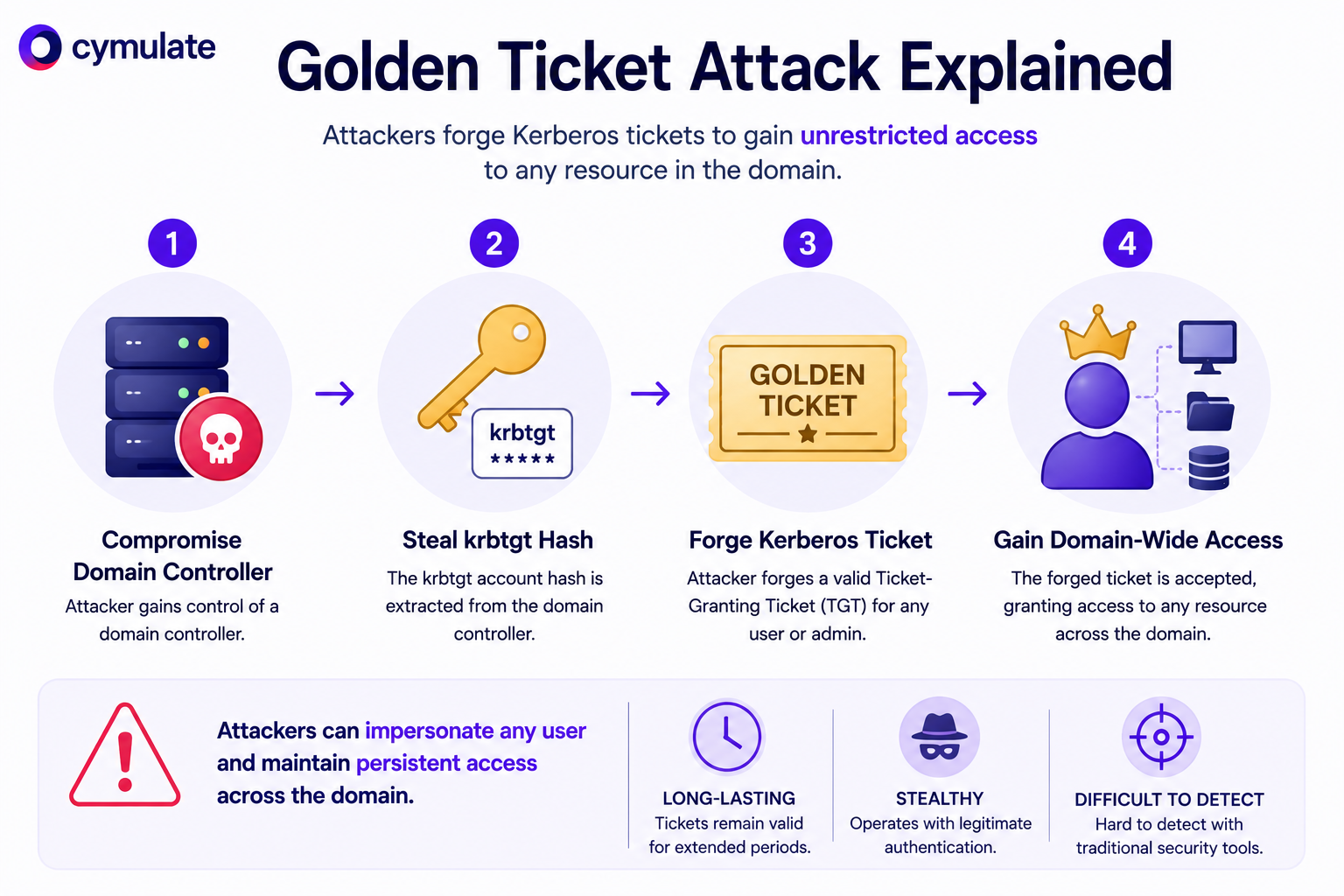
How Is a Golden Ticket Attack Executed?

This attack hinges on the attacker gaining access to the domain controller and retrieving the hash of the krbtgt account. Here’s a breakdown of the process:

  1. Gaining Domain Admin Access: To initiate the attack, cybercriminals first need to obtain administrative privileges in the domain, exploiting system vulnerabilities. This can be achieved through various methods such as phishing, privilege escalation, or lateral movement attacks. Once the attacker has domain admin privileges, they can move to the next phase.
  2. Dumping the krbtgt Hash or Harvesting Credentials: The krbtgt account in the Kerberos system is responsible for issuing TGTs. By using tools like Mimikatz, attackers extract the krbtgt account hash from the domain controller. This hash is critical because it allows the attacker to create valid, albeit forged, TGTs.
  3. Creating the Golden Ticket: Armed with the krbtgt hash, the attacker uses tools to forge a TGT (golden ticket) that can impersonate any user on the domain, including privileged accounts like domain administrators.
  4. Unrestricted Network Access: With the golden ticket, the attacker can now impersonate an administrator empowering them to access unauthorized sensitive systems, files or applications without raising any alarms. This access typically goes undetected because the forged tickets are cryptographically valid and appear legitimate to network monitoring systems.
  5. Maintaining Persistence: With the golden ticket now in place, the attacker can now create backdoors, making it harder for administrators to detect or remove their presence.

How Do You Know if You’ve Been a Victim of a Golden Ticket Attack?

Detecting Golden Ticket attacks can be challenging because the forged tickets mimic legitimate Kerberos tickets. However, there are several signs that could indicate an attack:

  • Extended Ticket Validity: Kerberos tickets typically have a limited lifespan (10 hours by default). If you notice tickets with unusually long expiration periods, this may be a sign of tampering.
  • Anomalous Administrative Activity: Sudden and unexpected behavior from high-privilege accounts, such as accessing systems they don’t usually interact with, could signal unauthorized access.
  • Inconsistent Logon Events: These attacks often involve logins from unrecognized or unusual locations or devices. Monitoring account logon events and correlating IP addresses or device IDs can help detect abnormal patterns.

Known Examples

Golden Ticket attacks have been used in several high-profile cyber incidents, often enabling long-term infiltration into corporate networks:

Sony Pictures Hack (2014): The Sony breach involved a combination of techniques, including a Golden Ticket attack that allowed hackers to maintain persistent access to Sony’s internal systems. By creating forged tickets, attackers were able to evade detection for an extended period, accessing confidential emails, business strategies, and sensitive employee data.

NotPetya Attack (2017): Although primarily known as a destructive malware attack, the NotPetya incident involved the use of a Golden Ticket to manipulate Kerberos authentication, allowing the attackers to spread across networks and deploy malicious payloads.

What is the Difference Between Kerberoasting and Golden Ticket Attacks?

While both Golden Ticket attacks and Kerberoasting exploit weaknesses in Kerberos, they differ in their objectives and methods. In Kerberoasting, attackers target service accounts by requesting Kerberos service tickets, which are encrypted with the service account’s password hash. The goal is to crack the password offline and gain access to that specific service. In contrast, a Golden Ticket attack grants an attacker total domain control by forging a TGT that impersonates any user, including privileged accounts.

What is the Difference Between Pass-the-Hash and Golden Ticket Attacks?

Pass-the-hash attacks allow attackers to authenticate by using a hashed version of a password, rather than the actual plaintext password. While both attacks provide unauthorized access, pass-the-hash is limited to the account whose hash is compromised. In contrast, a Golden Ticket attack grants indefinite access across the entire domain, allowing attackers to impersonate any account, including domain administrators, without requiring their actual credentials.

Prevention Methods

While Golden Ticket attacks are highly destructive, there are several preventive measures organizations can implement to reduce the risk:

  • Reset the krbtgt Account Password Regularly: Changing the password for the krbtgt account periodically renders any previously stolen hashes invalid, limiting the attacker’s ability to reuse a golden ticket.
  • Enforce Least Privilege Access: Ensure that only a minimal number of users have domain admin privileges. Reducing the number of privileged accounts makes it harder for attackers to escalate their access.
  • Enable Strong Monitoring: Use security information and event management (SIEM) systems to monitor account activity, including unusual authentication events, extended ticket lifetimes, and suspicious admin behavior.
  • Implement Multi-Factor Authentication (MFA): Requiring MFA for all privileged accounts adds an additional layer of security, making it more difficult for attackers to leverage stolen credentials or golden tickets.
  • Network Segmentation: By segmenting your network, you can limit the spread of an attack, even if an attacker gains access to one part of the network.

How Cymulate Can Help

Cymulate’s Breach and Attack Simulation (BAS) platform continuously tests your organization’s security controls to identify weaknesses that could be exploited by attacks like Golden Ticket. By simulating various attack methods, including Kerberos exploitation, Cymulate helps security teams understand their current vulnerabilities and improve their defenses.

Cymulate’s platform can also monitor for abnormal Kerberos traffic and detect early signs of suspicious activity that might be related to a Golden Ticket attack, enabling rapid response and mitigation.

Key Takeaways

  • A Golden Ticket attack gives cybercriminals virtually unlimited access to a Windows domain by forging Kerberos authentication tickets.
  • The attack requires administrative access to the domain and the extraction of the krbtgt account hash, after which attackers can impersonate any user.
  • Regular krbtgt password changes, strong monitoring, and implementing least privilege access are crucial for defending against this attack.
  • Cymulate’s BAS platform offers continuous validation of your security posture, helping organizations defend against Golden Ticket and similar attacks.
Book a Demo