

Kerberoasting
Kerberoasting is a cyberattack technique that targets the Kerberos authentication protocol within Active Directory environments. Exploiting this protocol allows attackers to extract encrypted service tickets and subsequently crack them offline to gain unauthorized access to sensitive accounts.
This method is commonly used for privilege escalation and identity theft in enterprise networks. With the complexity and high dependence on Active Directory systems across industries, Kerberoasting has become a critical threat that cybersecurity professionals must address.
Recent statistics highlight the growing prevalence of Kerberoasting attacks. According to CrowdStrike's 2023 Threat Hunting Report, there was a 583% year-over-year increase in Kerberoasting incidents, indicating a significant rise in this attack vector. Additionally, IBM's X-Force Threat Intelligence Index reported a 100% increase in Kerberoasting incidents between 2022 and 2023, underscoring the escalating threat landscape.
How Does Kerberoasting Work?
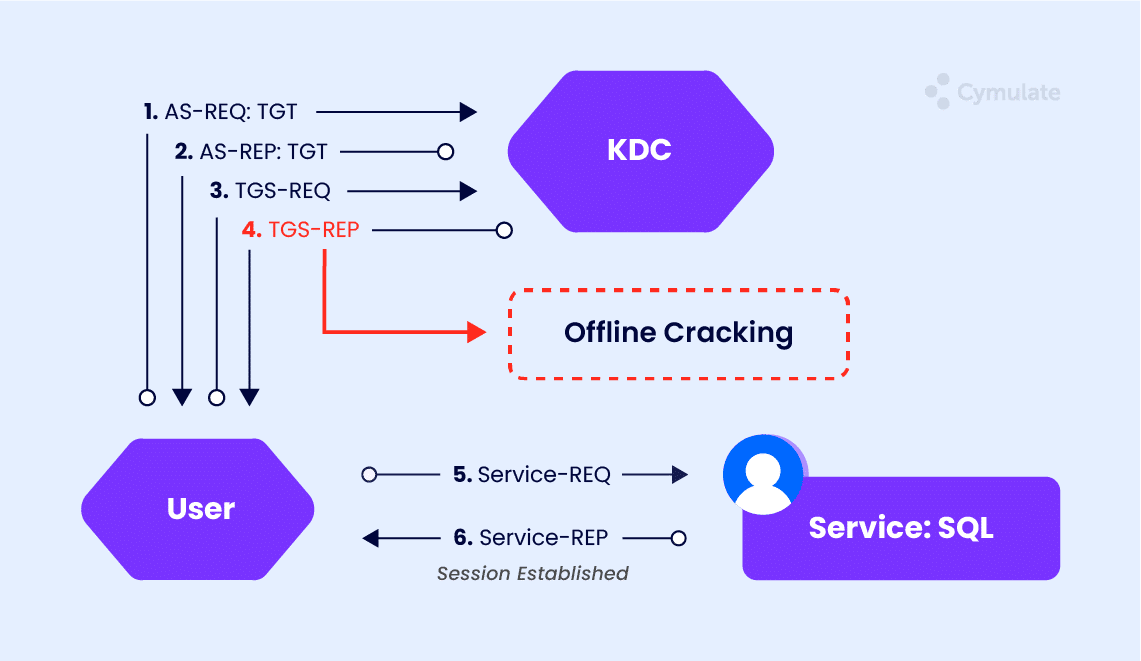
Kerberoasting is a nuanced attack that involves targeting vulnerabilities in the Kerberos protocol. By clearly analyzing and understanding the mechanics of this attack, security professionals can better prepare and implement effective defenses. Here’s how the attack works:
1. Requesting Service Tickets
An attacker with valid domain credentials requests service tickets for service accounts with Service Principal Names (SPNs). These tickets are encrypted using the service account's password hash, which is crucial for authentication.
2. Extracting Ticket Hashes
The attacker extracts the encrypted ticket hashes from the system. This can be done using specialized tools like Mimikatz, Rubeus, or PowerView. These tools enable attackers to gather ticket information without raising immediate alarms.
3. Offline Cracking
The attacker takes the extracted hashes offline and uses password-cracking tools, such as Hashcat or John the Ripper, to reveal the plaintext passwords of the service accounts.
Offline cracking allows attackers to work undisturbed, testing thousands of password combinations per second without triggering network defenses.
By obtaining these passwords, attackers can impersonate service accounts, potentially gaining elevated privileges within the network. This foothold enables them to access sensitive data, execute commands under the guise of legitimate users, and compromise critical infrastructure.
Impact of Kerberoasting Attacks
When attackers successfully exploit this technique, they gain unauthorized entry points that compromise data security and operational continuity.
Unauthorized Access
Attackers can access sensitive data and systems by impersonating compromised service accounts. This could include databases, file shares, and applications that rely on service account permissions.
An attacker gaining access to a service account used by an HR application could potentially view or modify sensitive employee records. The consequences extend beyond data exposure—unauthorized changes could disrupt operations and lead to compliance issues.
Privilege Escalation
Gaining control over service accounts may allow attackers to escalate their privileges within the network. Higher privilege accounts can grant attackers control over more significant parts of the network, potentially leading to domain-wide compromise.
For example, an attacker who compromises an account linked to a key IT service may obtain the ability to modify network configurations or create new administrator accounts, amplifying the threat and making detection more challenging.
Network Compromise
With elevated privileges, attackers can move laterally across the network, performing reconnaissance, installing malware, or creating persistence mechanisms. This can make recovery difficult and increase the potential damage of an attack.
An attacker could deploy tools that silently collect login credentials over time, allowing for further infiltration and maintaining access even after initial detection. This persistence can delay incident response efforts and result in long-term impacts on business continuity and data integrity.
Industries heavily reliant on Active Directory, such as large enterprises, educational institutions, and governmental organizations, are particularly vulnerable to Kerberoasting attacks. The extensive use of service accounts and the often-overlooked security measures applied to them contribute to the risk.
Kerberoasting Attacks — Mitigation Techniques
A combination of technical measures and best practices can be used for security and to reduce potential entry points for attackers.
- Monitor Kerberos Ticket Requests: Regularly audit and monitor Kerberos ticket requests to detect unusual patterns indicative of an attack. Unusual spikes in ticket requests or repeated attempts to request service tickets can be a red flag.
For example, implementing an SIEM solution that tracks ticket requests and triggers alerts when high-frequency activity occurs helps organizations identify potential threats early.
Integrating automated threat intelligence feeds can enhance the detection capabilities by correlating known attack signatures with ticketing anomalies. - Implement Strong Password Policies: Service accounts must use complex, unique passwords that are regularly updated. Lengthy, non-dictionary passwords with mixed character types are more resilient against offline cracking.
Using passphrases that combine random words or phrases (e.g., "BlueSky!Lion$Tree") makes passwords both memorable and secure. Regularly enforcing password expiration policies can prevent attackers from exploiting credentials over extended periods. - Limit SPN Exposure: Identify and audit SPNs to understand which service accounts are exposed. This can help in minimizing the accounts vulnerable to Kerberoasting.
For example, conducting regular audits using tools like PowerShell scripts to enumerate SPNs and assess their necessity helps reduce exposure. Deactivating unnecessary or outdated service accounts and ensuring that critical SPNs are safeguarded with stronger controls can significantly decrease the attack surface. - Restrict Service Account Privileges: Limit the privileges of service accounts to the minimum necessary for their function. Employ the principle of least privilege to reduce the impact of a compromised service account.
For example, configure service accounts so they cannot log in interactively or be used to run non-essential tasks. Applying role-based access control (RBAC) ensures that each service account only has permissions aligned with its specific purpose, preventing excessive access that could be leveraged in an attack. - Use Managed Service Accounts (MSAs):MSAs help streamline the management of service account credentials and ensure automatic password updates. For instance, group MSAs (gMSAs) can be configured to support services running across multiple servers, automating password management while maintaining security.
This reduces the risk of human error associated with manual password updates and ensures that credentials remain up-to-date without administrative overhead.
These measures can help reduce the attack surface and make it more challenging for attackers to exploit Kerberos authentication mechanisms. Organizations should consider improving their security posture with monitoring tools that can alert security teams to potential indicators of compromise (IOCs).
Kerberoasting vs. Similar Attacks
1. Pass-the-Hash
It involves using hashed credentials to authenticate without cracking them. This attack allows an adversary to use password hashes directly to gain access to resources, whereas Kerberoasting requires cracking the hash to reveal the plaintext password.
2. Golden Ticket
Involves forging Kerberos Ticket Granting Tickets (TGTs) to gain unrestricted access. A Golden Ticket attack allows attackers to generate TGTs that can impersonate any account, including domain administrators. Unlike Kerberoasting, this type of attack can grant near-total control over an Active Directory domain.
Kerberoasting specifically targets service account ticket hashes and requires offline cracking, making it distinct in its approach and execution. Unlike real-time attacks that involve active network interaction, Kerberoasting can be conducted offline, making it stealthier and more challenging to detect until it’s too late.
Cymulate’s platform assists organizations in validating these security controls through continuous security validation, where defenses remain strengthened against newer threats.
Preventive Measures Against Kerberoasting
Preventive measures include implementing a series of best practices and security measures designed to strengthen the security of service accounts and the overall Active Directory (AD) environment.
Disable Weak Encryption Types
One of the primary vulnerabilities in the Kerberos authentication protocol is the use of weak encryption types, particularly RC4. Attackers exploit these weaknesses to crack Kerberos tickets more easily. To mitigate this risk, organizations should disable weak encryption algorithms in their Active Directory (AD) settings.
- Disabling weak encryption types involves configuring Group Policy Objects (GPOs) to enforce stronger encryption protocols such as AES (Advanced Encryption Standard). AES provides a much higher level of security compared to RC4 and is less susceptible to brute-force attacks.
- Once weak encryption types are identified, administrators can systematically update their configurations.
For example, they can modify the "Kerberos Policy" settings within the GPO to specify that only strong encryption types are permitted for ticket-granting tickets (TGTs) and service tickets. Additionally, organizations should ensure that all systems and applications support the stronger encryption methods before making these changes to avoid any disruptions in service.
Regular audits should follow these changes to ensure compliance and effectiveness. By actively managing encryption settings, organizations can significantly reduce their exposure to Kerberoasting attacks and enhance the overall security of their authentication mechanisms.
Create Honeypots and Deception Techniques
A honeypot is a decoy account or service that is intentionally created to lure attackers. These accounts typically have Service Principal Names (SPNs) associated with them but serve no legitimate purpose within the organization. The idea is that if an attacker attempts to request tickets for these accounts, it will trigger alerts for suspicious activity.
- To set up a honeypot effectively, organizations should create service accounts with SPNs that are not tied to any real services or applications. These accounts should be monitored closely for any unauthorized access attempts or ticket requests. By analyzing the interactions with these honeypots, security teams can gain valuable insights into attack patterns and techniques used by adversaries.
- Moreover, honeypots can serve as an early warning system for detecting broader attack campaigns targeting the organization's infrastructure. When an attacker interacts with a honeypot, it not only reveals their presence but also provides an opportunity for security teams to respond proactively, potentially mitigating further damage.
In addition to honeypots, organizations can employ other deception techniques, such as fake data or services that appear legitimate but are designed solely for monitoring purposes. This layered approach increases the complexity for attackers and enhances the organization's ability to detect and respond to threats in real-time.
Regularly Audit Service Accounts
Regular audits of service accounts are mandatory in maintaining a secure Active Directory environment and mitigating Kerberoasting risks. Service accounts often have elevated privileges and are essential for various applications and services; however, they can also become prime targets for attackers if not managed properly.
- An effective audit process begins with creating a comprehensive inventory of all service accounts within the organization. This inventory should include details such as account names, associated SPNs, permissions granted, last password change dates, and usage patterns. By having a clear understanding of which accounts exist and their roles within the environment, security teams can identify any unnecessary or outdated accounts that may pose a risk.
- During the audit process, organizations should assess whether each service account is still required for its intended purpose. For example, if an application has been decommissioned, but its service account remains active, it becomes an unnecessary vulnerability that could be exploited by attackers. Any inactive or redundant accounts should be disabled or removed promptly.
- Also, audits should focus on reviewing permissions associated with each service account. Following the principle of least privilege ensures that service accounts only have access necessary for their specific tasks.
Overly permissive accounts increase the risk if they are compromised; therefore, auditing permissions regularly helps maintain tight control over access rights. Documenting findings from these audits is essential for compliance purposes and future reference. It is important to establish a routine schedule for conducting these audits—ideally quarterly or biannually—to ensure ongoing vigilance against potential threats like Kerberoasting attacks.
Cymulate’s Solutions for Preventing and Detecting Kerberoasting
Kerberoasting remains one of the most common techniques adversaries use to compromise Active Directory environments by targeting weakly protected service accounts. Cymulate enables organizations to continuously validate their resilience against Kerberoasting by verifying that preventive, detective, and response controls perform effectively against real-world attack techniques.
Exposure Validation
Cymulate Exposure Validation continuously assesses the security controls protecting Active Directory and Kerberos authentication. By safely emulating attacker techniques, organizations can identify exploitable identity exposures—including weak service account configurations, excessive privileges, and ineffective security controls, before they can be leveraged by attackers.
Continuous validation helps security teams:
- Identify identity-related exposures that could facilitate Kerberoasting attacks.
- Verify the effectiveness of Active Directory security controls and hardening efforts.
- Confirm that implemented mitigations reduce exploitable attack paths.
- Prioritize remediation based on validated security risk rather than theoretical vulnerabilities.
Continuous Security Validation
Security environments constantly evolve as identities, systems, and configurations change. Cymulate continuously validates authentication controls and identity security to detect configuration drift, validate remediation efforts, and ensure defenses remain effective against evolving attacker techniques.
Rather than relying solely on periodic assessments, organizations gain ongoing assurance that their security controls continue to protect against credential theft and privilege escalation techniques.
Red Teaming
Cymulate Red Teaming enables organizations to emulate realistic attack chains that incorporate credential abuse, privilege escalation, and lateral movement techniques commonly associated with Kerberoasting campaigns. These controlled exercises validate the organization's ability to detect, investigate, and respond to identity-based attacks while measuring overall security readiness.
Detection Validation with Detection Studio
Preventing an attack is only part of the defense strategy. Detection Studio validates that SIEM, EDR, and other detection technologies successfully identify Kerberoasting activity and related attacker behaviors.
Organizations can:
- Validate detection rules against realistic attack scenarios.
- Identify gaps in security monitoring and alerting.
- Improve detection coverage for identity-based attacks.
- Strengthen SOC readiness with actionable recommendations to improve detection effectiveness.
Auto Mitigation
For organizations leveraging Auto Mitigation, validated findings can be translated into recommended—or where supported, automated—security control updates. This helps security teams accelerate remediation, improve detection coverage, and reduce exposure with less manual effort.
Strengthening Identity Security Through Continuous Validation
By continuously validating prevention, detection, and response capabilities against real-world attack techniques, Cymulate enables organizations to proactively reduce identity-related risk and strengthen resilience against Kerberoasting and other Active Directory-based attacks. Instead of relying on assumptions, security teams gain measurable evidence that their controls can withstand the latest adversary techniques.
Key Takeaways
The nature of Kerberoasting attack highlights how proactive validation of security controls and continuous monitoring is necessary.
With recognition of the pattern of existing risks and implementing proof-based preventive measures, organizations can improve their security posture to protect against credential theft and privilege escalation.
Cymulate provides the tools and resources necessary to improve your organization's security posture against Kerberoasting and other advanced threats.
Continuous validation, exposure management, and employee awareness are core components in defending against this prevalent attack vector, making sure that a company’s Active Directory environment is secure and well-protected.