
Frequently Asked Questions

Vulnerability Prioritization & Cybersecurity Fundamentals

What is vulnerability prioritization in cybersecurity?

Vulnerability prioritization is the process of sorting through detected vulnerabilities, identifying those that pose the highest risk, and creating a prioritized patching list to minimize exposure. This approach helps organizations focus their resources on addressing the most critical threats, rather than attempting to patch every vulnerability, which is often not feasible due to the sheer volume of patches required.

What is considered a vulnerability in cybersecurity?

A vulnerability in cybersecurity is any weakness or flaw in a system, network, software, or application that can be exploited by attackers to compromise the system's integrity, confidentiality, or availability. Common sources include coding errors, misconfigurations, outdated software, or design flaws.

What are the most common methods for prioritizing vulnerabilities?

The most common methods include using CVSS (Common Vulnerability Scoring System) scores, assessing asset value, exploitability, potential impact, and business context. These methods help organizations determine which vulnerabilities require immediate attention based on risk and operational needs.

How does the Common Vulnerability Scoring System (CVSS) work?

CVSS provides a standardized way to assess and rank vulnerabilities based on their theoretical severity. It uses three metric groups: Base (inherent characteristics), Temporal (factors that change over time), and Environmental (organization-specific context). The final score helps organizations prioritize vulnerabilities according to their unique environment.

What are the limitations of using CVSS for vulnerability prioritization?

CVSS Base scores are generic and do not account for an organization's specific environment, compensating controls, or business context. This can result in incomplete or misleading risk assessments, leading organizations to rely more on contextual data for accurate prioritization.

How does exposure management differ from traditional vulnerability management?

Traditional vulnerability management focuses on identifying and addressing known vulnerabilities (CVEs). Exposure management shifts the focus to the attacker's perspective, prioritizing the most critical security gaps based on the organization's risk profile and considering misconfigurations and control gaps, not just vulnerabilities.

What is the Eisenhower Matrix and how does it relate to vulnerability prioritization?

The Eisenhower Matrix, or Urgent-Important Matrix, is a decision-making tool that helps prioritize tasks by urgency and importance. In vulnerability prioritization, it is used to filter out less urgent vulnerabilities, allowing organizations to focus on those that are both urgent and important for security.

Why can't organizations patch every vulnerability?

Due to the overwhelming number of vulnerabilities and patches—often numbering in the thousands or more—it's not logistically possible for security teams to patch everything. Prioritization ensures that resources are focused on the most critical vulnerabilities to reduce risk efficiently.

What types of vulnerabilities are most commonly prioritized?

Vulnerabilities that are easy to exploit, have known exploits, affect high-value assets, or could cause significant damage (such as data breaches or service disruptions) are typically prioritized. Business context and operational needs also influence prioritization.

How does business context affect vulnerability prioritization?

Business context determines the criticality of assets and the potential impact of vulnerabilities. For example, a vulnerability in a system handling sensitive data may be prioritized over one in a less critical system, even if both have similar technical severity.

What is Cymulate's approach to contextualized vulnerability management?

Cymulate's Exposure Analytics ingests exposure data from various sources, connects data points, and analyzes the context of each vulnerability. This approach saves remediation resources, de-prioritizes non-critical vulnerabilities, provides evidence for auditors, and highlights truly critical vulnerabilities for effective remediation.

How does Cymulate help organizations stay ahead of emerging threats?

Cymulate continuously scans and assesses the attack surface, simulating real attack paths and scenarios. This proactive approach uncovers exposures that could lead to breaches and ensures that emerging threats are addressed in real-time, avoiding blind spots left by periodic assessments.

What are the benefits of using contextual data for vulnerability prioritization?

Using contextual data allows organizations to save time and resources, de-prioritize non-critical vulnerabilities, justify SLA extensions with evidence, and focus remediation efforts on vulnerabilities that truly matter to the organization's risk profile.

How does Cymulate's continuous monitoring differ from periodic assessments?

Cymulate's continuous monitoring provides real-time visibility into the attack surface, allowing organizations to address new threats as they emerge. Periodic assessments may leave blind spots between testing intervals, increasing the risk of undetected exposures.

How does Cymulate simulate real attack paths?

Cymulate mimics the mindset of an attacker by simulating real attack paths and scenarios. This helps uncover exposures that could lead to breaches, enabling organizations to proactively address vulnerabilities before they are exploited.

What is the role of asset value in vulnerability prioritization?

Asset value helps determine which vulnerabilities should be prioritized based on the importance of the affected systems. Vulnerabilities impacting high-value assets or systems with sensitive data are given higher priority to protect critical business operations.

How does exploitability influence vulnerability prioritization?

Vulnerabilities that are easy to exploit or have known exploits available are prioritized because they pose a higher risk of being used in real-world attacks. Assessing exploitability helps organizations allocate resources to address the most immediate threats.

What is the impact of misconfigurations on exposure management?

Exposure management considers not only vulnerabilities but also misconfigurations and control gaps. Misconfigurations can create security weaknesses that attackers exploit, so identifying and prioritizing these exposures is essential for comprehensive risk reduction.

How does Cymulate help with audit and compliance requirements?

Cymulate provides data-backed evidence for auditors, helping organizations justify SLA extensions and demonstrate effective remediation of critical vulnerabilities. This supports compliance with industry standards and regulatory requirements.

Where can I learn more about vulnerability prioritization and related concepts?

You can explore related glossary pages such as Vulnerability Scanning, Vulnerability Management Lifecycle, and Security Posture Assessment for more information.

Cymulate Platform Features & Capabilities

What features does Cymulate offer for vulnerability prioritization and exposure management?

Cymulate offers continuous threat validation, exposure analytics, attack path discovery, automated mitigation, and AI-powered optimization. The platform simulates real-world threats, prioritizes exposures based on exploitability and business context, and provides actionable insights for remediation.

How does Cymulate integrate with other security tools?

Cymulate integrates with a wide range of security technologies, including Akamai Guardicore, AWS GuardDuty, BlackBerry Cylance OPTICS, Carbon Black EDR, Check Point CloudGuard, Cisco Secure Endpoint, CrowdStrike Falcon, Wiz, SentinelOne, and more. For a complete list, visit the Partnerships and Integrations page.

What are the key benefits of using Cymulate for vulnerability management?

Key benefits include improved security posture (up to 52% reduction in critical exposures), operational efficiency (60% increase in team efficiency), faster threat validation (40X faster than manual methods), cost savings, and enhanced threat resilience (81% reduction in cyber risk within four months, as reported by Hertz Israel).

How easy is it to implement Cymulate?

Cymulate is designed for quick and easy implementation, operating in agentless mode with no need for additional hardware or complex configurations. Customers can start running simulations almost immediately, and comprehensive support is available via email, chat, and educational resources.

What feedback have customers given about Cymulate's ease of use?

Customers consistently praise Cymulate for its intuitive, user-friendly interface and actionable insights. Testimonials highlight its ease of implementation, immediate value, and accessible support. For example, Raphael Ferreira, Cybersecurity Manager, noted, "Cymulate is easy to implement and use—all you need to do is click a few buttons, and you receive a lot of practical insights into how you can improve your security posture."

What is Cymulate's pricing model?

Cymulate uses a subscription-based pricing model tailored to each organization's requirements. Pricing depends on the chosen package, number of assets, and scenarios selected. For a detailed quote, you can schedule a demo with the Cymulate team.

What security and compliance certifications does Cymulate hold?

Cymulate holds several industry-leading certifications, including SOC2 Type II, ISO 27001:2013, ISO 27701, ISO 27017, and CSA STAR Level 1. These certifications demonstrate Cymulate's commitment to robust security and compliance standards. More details are available on the Security at Cymulate page.

How does Cymulate support GDPR compliance?

Cymulate incorporates data protection by design and has a dedicated privacy and security team, including a Data Protection Officer (DPO) and Chief Information Security Officer (CISO), to ensure GDPR compliance and robust data security practices.

What types of organizations benefit most from Cymulate?

Cymulate is designed for organizations of all sizes, from small enterprises to large corporations across industries such as finance, healthcare, retail, media, transportation, and manufacturing. It serves CISOs, SecOps teams, Red Teams, and Vulnerability Management teams.

How does Cymulate compare to other vulnerability management solutions?

Cymulate stands out with its unified platform combining Breach and Attack Simulation (BAS), Continuous Automated Red Teaming (CART), and Exposure Analytics. It offers continuous, real-time validation, AI-powered optimization, and a comprehensive threat library, providing measurable improvements in threat resilience and operational efficiency. For more, see the Cymulate vs Competitors page.

What pain points does Cymulate address for security teams?

Cymulate addresses fragmented security tools, resource constraints, unclear risk prioritization, cloud complexity, communication barriers, inadequate threat simulation, operational inefficiencies in vulnerability management, and post-breach recovery challenges. See real-world examples in the case studies.

Are there case studies showing Cymulate's impact on vulnerability management?

Yes. For example, Hertz Israel reduced cyber risk by 81% in four months, and a sustainable energy company scaled penetration testing cost-effectively with Cymulate. Explore more success stories on the Case Studies page.

What educational resources does Cymulate provide?

Cymulate offers a Resource Hub, blog, webinars, e-books, and a continuously updated cybersecurity glossary. These resources help users stay informed about the latest threats, best practices, and platform features. Visit the Resource Hub and Glossary.

How does Cymulate support different security roles?

Cymulate tailors its solutions for CISOs and security leaders (providing metrics and insights), SecOps teams (automating processes and improving efficiency), Red Teams (offensive testing with a large attack library), and Vulnerability Management teams (prioritizing and validating exposures). Learn more on the respective role pages.

What is Cymulate's overarching mission and vision?

Cymulate's mission is to transform cybersecurity practices by enabling organizations to proactively validate defenses, identify vulnerabilities, and optimize their security posture. The vision is to create a collaborative environment for lasting improvements in cybersecurity strategies. More details are on the About Us page.

Cymulate named a Customers' Choice in 2025 Gartner® Peer Insights™
Learn More
New Case Study: Credit Union Boosts Threat Prevention & Detection with Cymulate
Learn More
New Research: Cymulate Research Labs Discovers Token Validation Flaw
Learn More
An Inside Look at the Technology Behind Cymulate
Learn More

Vulnerability Prioritization  

What is Vulnerability Prioritization?

Vulnerability prioritization is the process of sorting through detected vulnerabilities, pinpointing those that pose the highest risk, and creating a prioritized patching list designed to minimize exposure.

With new cyber threats emerging daily, organizations face the challenge of managing an overwhelming number of patches. There are thousands upon thousands, if not hundreds of thousands of different patches that might need to be applied within any given environment. This poses a major problem to security teams, as it is not logistically possible to patch everything.

By prioritizing the most critical vulnerabilities, organizations can allocate their resources and focus their efforts on building a robust security posture and preventing costly breaches.
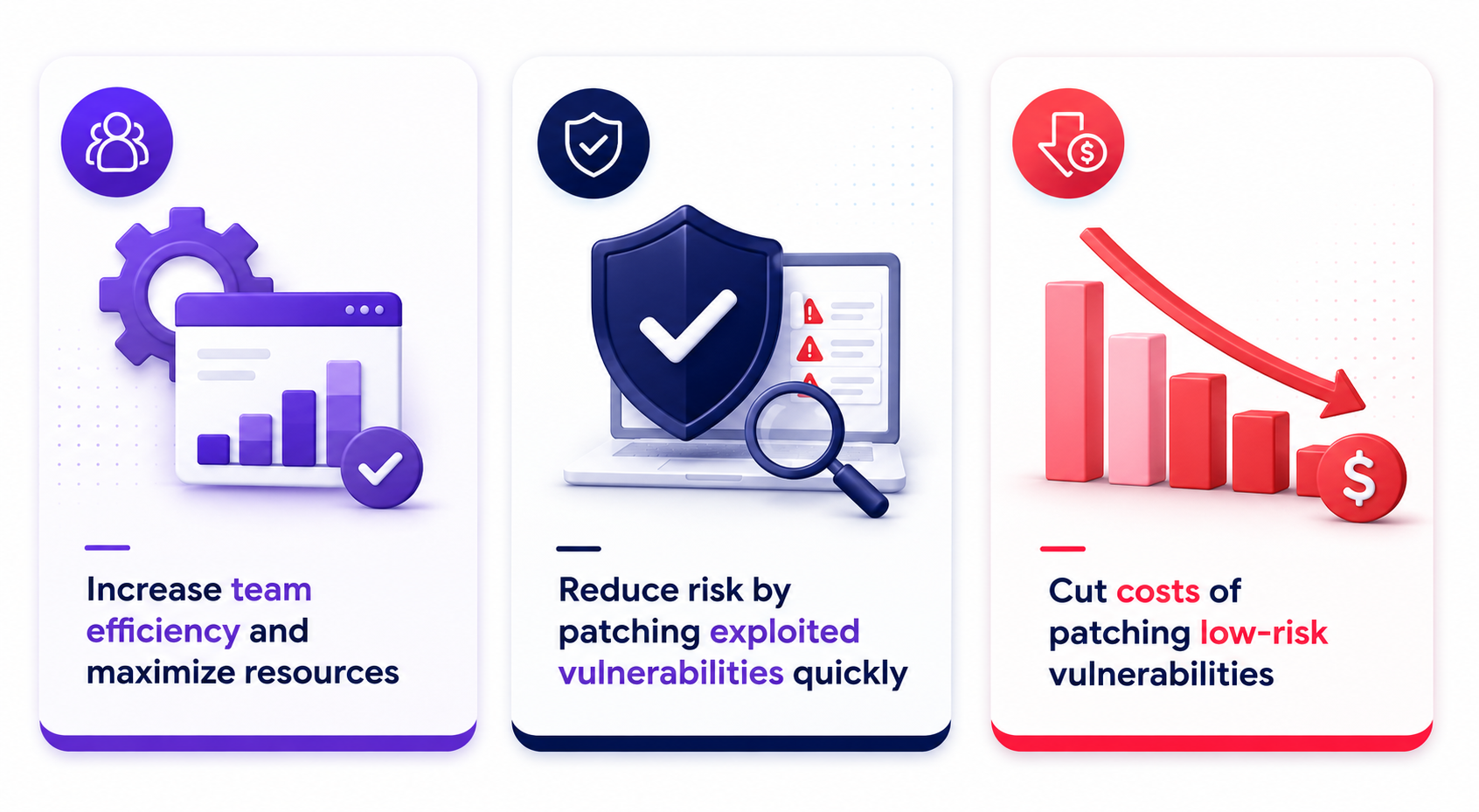
vulnerability prioritization benefits

What is Considered a Vulnerability in Cybersecurity?

A vulnerability in cybersecurity refers to any weakness or flaw in a system, network, software or application that can be exploited by attackers to compromise the system's integrity, confidentiality or availability.

These vulnerabilities can arise from various sources, such as coding errors, misconfigurations, outdated software or even inherent design flaws. Common types of vulnerabilities include:

  • Software bugs or code flaws
  • Unpatched systems with outdated software
  • Misconfigurations in system settings or security policies
  • Weak authentication mechanisms, like weak passwords
  • Insecure APIs or interfaces

How Vulnerability Prioritization Works

The goal of any vulnerability prioritization method is to emulate the Eisenhower Matrix. Also known as the Urgent-Important Matrix, the Eisenhower Matrix helps deciding on and prioritizing tasks by urgency and importance, filtering out less urgent and essential tasks that can be postponed or ignored altogether.

Each new vulnerability prioritization technology aims at fine-tuning such a matrix based on two main parameters:

  • Ensuring optimal security and resilience
  • Minimizing the number of vulnerabilities that require patching

There are, however, different paths to achieve that result, with varying degrees of success based on the accuracy and depth of the input data, the ability to integrate the context, and the resulting correlation options.

The Most Common Methods for Prioritizing Vulnerabilities

The most common methods for vulnerability prioritization focus on assessing the risk and impact of each vulnerability, allowing organizations to prioritize patches effectively. These methods include:

  • CVSS (Common Vulnerability Scoring System) scores: These numerical scores help assess the severity of vulnerabilities.
  • Asset value: Vulnerabilities affecting high-value assets or systems with sensitive data are prioritized.
  • Exploitability: Vulnerabilities that are easy to exploit or have known exploits available are given higher priority.
  • Potential impact: The damage that could result from an exploit, such as data breaches, financial loss, or service disruption, is considered.
  • Business context: The specific industry or business environment influences how vulnerabilities are prioritized, with some vulnerabilities posing more risk based on operational needs.

The Role of Common Vulnerability Scoring System (CVSS)

The “Common Vulnerability Scoring System” (CVSS) is the dominant method used today for vulnerability prioritization. It offers a standardized way to assess and rank vulnerabilities based on their theoretical severity.

CVSS is divided into three key metric groups: Base, Temporal and Environmental. Each metric group assesses different aspects of a vulnerability's severity.
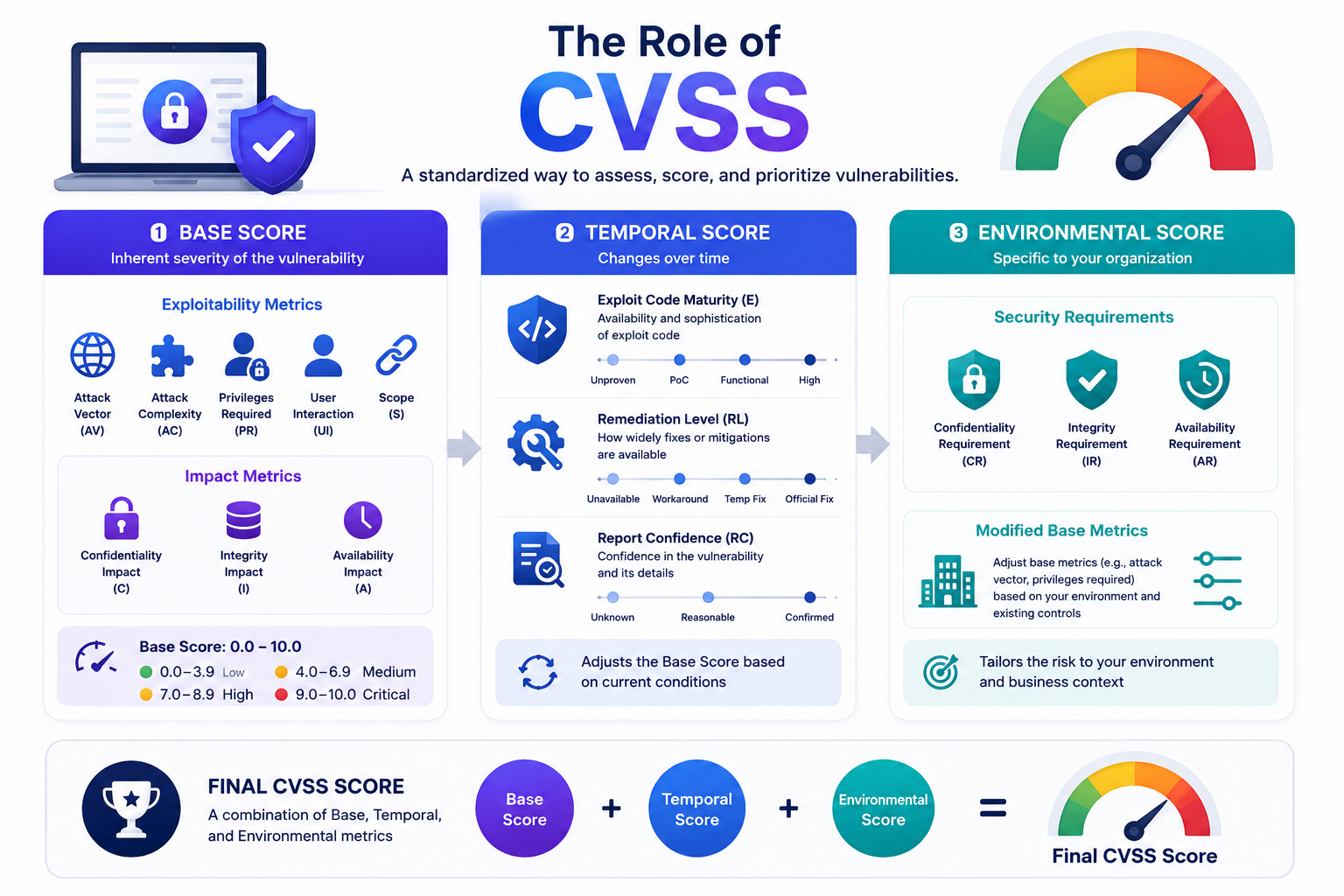
1. Base Score (Fundamental Severity of the Vulnerability)

The Base score is the most commonly used part of CVSS and evaluates the inherent characteristics of a vulnerability that do not change over time or across environments. It is divided into two components: Exploitability Metrics and Impact Metrics.

Exploitability Metrics measure how easily a vulnerability can be exploited:

  • Attack Vector (AV): How the vulnerability can be exploited (network, adjacent network, local, or physical).
  • Attack Complexity (AC): How difficult it is to exploit the vulnerability (low or high).
  • Privileges Required (PR): What level of access is needed to exploit the vulnerability (none, low, or high).
  • User Interaction (UI): Whether exploiting the vulnerability requires human intervention (none or required).
  • Scope (S): Whether the vulnerability affects other systems beyond the vulnerable component (changed or unchanged).

Impact Metrics evaluate the potential consequences of exploiting the vulnerability

  • Confidentiality Impact (C): The impact on the confidentiality of data (none, low, or high).
  • Integrity Impact (I): The impact on the integrity of data (none, low, or high).
  • Availability Impact (A): The impact on the availability of the affected system or data (none, low, or high).

The Base score is calculated from these metrics and is expressed as a number from 0.0 to 10.0, where:

  • 0.0–3.9: Low
  • 4.0–6.9: Medium
  • 7.0–8.9: High
  • 9.0–10.0: Critical

2. Temporal Score (Changing Over Time)

The Temporal score adjusts the Base score based on factors that evolve over time, such as:

  • Exploit Code Maturity (E): The availability and sophistication of exploit code (unproven, proof-of-concept, functional, or high).
  • Remediation Level (RL): How widely patches or mitigations are available (official fix, temporary fix, workaround, unavailable).
  • Report Confidence (RC): The degree of confidence in the existence and technical details of the vulnerability (unknown, reasonable, confirmed).

These adjustments refine the Base score, providing a more accurate measure of the vulnerability's current severity.

3. Environmental Score (Specific to the Organization's Environment)

The Environmental score tailors the Base and Temporal scores to the specific environment of the affected organization. It takes into account factors like the importance of the affected systems and the presence of mitigating controls.

  • Security Requirements (CR, IR, AR): These reflect the importance of confidentiality, integrity, and availability to the organization. Each can be classified as low, medium, or high, depending on the criticality of the system impacted by the vulnerability.
  • Modified Base Metrics: Adjustments can be made to Base metrics (e.g., modifying the attack vector or privileges required) based on the actual environment to better reflect the risk.

The Environmental score helps organizations prioritize vulnerabilities in their specific context, as vulnerabilities that might be critical for one organization could be less important for another based on how and where the affected systems are used.

The final CVSS score is a combination of the Base, Temporal, and Environmental metrics. Many organizations use only the Base score for vulnerability prioritization, but the Temporal and Environmental metrics add important context that can better align risk to the organization's specific needs.

The problem with the Common Vulnerability Scoring System (CVSS)

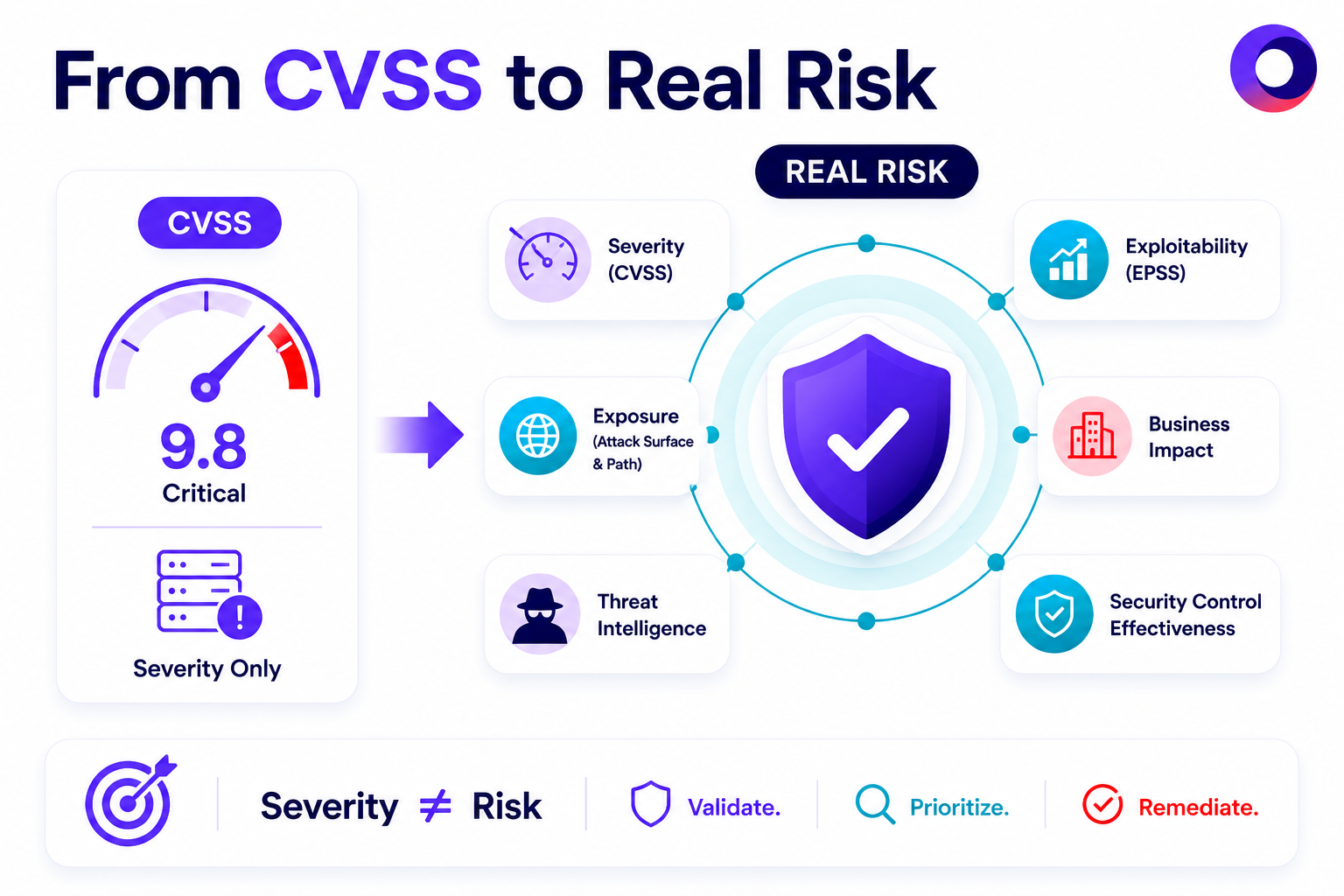
While CVSS Base scores provide a helpful starting point, they lack the crucial context needed to make informed decisions for individual organizations.

CVSS Base scores rely on generic metrics that are agnostic to the unique environment of any specific organization. These scores assess vulnerabilities based on predefined criteria like the attack vector, complexity, and impact, but do not take into account compensating controls, business context, or real-world evidence.

Without these critical factors, CVSS Base may provide an incomplete or even misleading picture of the actual risk posed by a given vulnerability, resulting in:

Because of this, security leadership today relies less on CVSS and more on Contextual Data. Analysts export CSV/XML reports and manually compile reports from them. Security data engineers attempt to stream data from the security stack into data aggregators. While these are good solutions on paper, organizations struggle to implement them. They often end up being manual, partial, and expensive. As a result of these implementation issues, these solutions fail to meet the original purpose of reducing the time to mitigation.

The move from traditional vulnerability management to exposure management

Traditional vulnerability management focuses on improving your security posture by identifying and addressing Common Vulnerabilities and Exposures (CVEs), which are industry-recognized weaknesses that attackers might exploit. In contrast, exposure management shifts the perspective to that of the attacker, concentrating on the most critical security gaps specific to your organization’s risk profile.

Exposure management offers a comprehensive view of an organization's security landscape. By adopting this approach, security resources can be allocated more strategically, with actions prioritized based on the actual risk they pose to the organization. For example, a high-severity vulnerability in a critical system that handles sensitive data would demand immediate attention.

On the other hand, a similar vulnerability in a less essential system, which is well-protected by other security layers, could be deprioritized. Moreover, exposure management goes beyond just identifying vulnerabilities—it also considers other types of exposures, such as misconfigurations and control gaps, to determine which ones pose the greatest risk to the organization.
Cymulate Contextualized Vulnerability Management

Cymulate Exposure Analytics ingests exposure data from various sources, connects between the data points, and analyze the context of each vulnerability. Contextual Data is key for an effective prioritization solution:

  • Saves time and resources for the remediation teams
  • De-prioritize non-critical vulnerabilities
  • Provide data-backed evidence for auditors to justify SLA extensions
  • Highlights the priority of truly critical vulnerability and drive effective remediation
contextualized vulnerability management

The Cymulate approach focuses on continuous scanning and assessment, mimicking the mindset of an attacker. By simulating real attack paths and scenarios, it uncovers exposures that could lead to potential breaches. Continuous monitoring of the attack surface ensures that emerging threats are addressed in real-time, avoiding the blind spots often left by periodic assessments.

Experience the power of Cymulate firsthand—book a demo today to see how it can help you streamline remediation, prioritize critical vulnerabilities, and stay ahead of emerging threats in real-time.

Book a Demo