
Frequently Asked Questions

CTEM & Vulnerability Management Fundamentals

What is Continuous Threat Exposure Management (CTEM)?

Continuous Threat Exposure Management (CTEM) is a proactive, risk-driven approach to cybersecurity that continuously discovers, validates, prioritizes, and remediates exposures across all environments—including cloud, SaaS, identity, and data. Unlike traditional vulnerability management, CTEM uses automated threat validation and real-world attack simulations to assess true exploitability and operational risk, enabling organizations to focus remediation on exposures that matter most. Learn more.

How does CTEM differ from traditional vulnerability management?

Traditional vulnerability management (VM) is reactive and periodic, focusing on scheduled scans and patching based on CVSS scores and compliance requirements. CTEM, by contrast, is continuous and risk-driven, expanding scope to all exposures (not just CVEs) and using automated adversary validation to prioritize and remediate based on real-world exploitability and business impact. See comparison table.

Why is threat validation important in vulnerability management?

Threat validation is crucial because not all vulnerabilities are equally exploitable or pose the same risk. Automated threat validation tests whether existing security controls mitigate vulnerabilities, helping teams focus on exposures that are truly critical and require immediate action, while deprioritizing those already mitigated. This approach reduces guesswork and improves resource allocation. Read more.

What are the main challenges with traditional vulnerability management?

Traditional VM teams face challenges such as an overwhelming backlog of vulnerabilities, limited resources, compliance demands, and difficulty prioritizing which vulnerabilities are truly critical. With thousands of new CVEs each month, it's hard to identify which exposures matter most without context on exploitability and mitigation. Learn more.

How does CTEM help organizations prioritize vulnerabilities?

CTEM correlates vulnerability data with threat intelligence, business context, and real-world attack simulation results to calculate true severity risk scores. This enables organizations to prioritize remediation efforts on exposures that are actually exploitable and pose real business risk, rather than relying solely on generic CVSS scores. More info.

What practical steps can organizations take to evolve from VM to CTEM?

Organizations can evolve to CTEM by: 1) Evaluating their current exposure discovery and prioritization methods, 2) Identifying gaps in visibility and collaboration, 3) Defining a business-aligned scope, 4) Incorporating threat validation to test existing controls, and 5) Expanding to continuous, automated validation. See the 5-step process.

How does Cymulate's Exposure Management Platform support CTEM?

Cymulate's Exposure Management Platform automates threat-based exposure validation, ingests data from leading VM tools, maps vulnerabilities to attack simulations, calculates unified risk scores, and provides dashboards for prioritization and remediation. It enables a continuous, data-driven cycle of discovery, validation, prioritization, and remediation. Platform details.

What is the role of attack simulations in CTEM?

Attack simulations automatically validate the true exploitability of vulnerabilities in an organization's environment by testing whether current defenses detect or block exploitation. This provides evidence-based risk assessment and helps prioritize remediation based on real-world scenarios. Learn more.

How does Cymulate calculate severity risk scores?

Cymulate calculates severity risk scores by unifying CVSS data, threat intelligence, asset criticality, and prevention/detection coverage. This approach reflects actual operational risk rather than relying solely on static vulnerability scores. Platform overview.

What is a 'virtual patch' in the context of CTEM?

A 'virtual patch' refers to mitigation policies or controls that can be implemented to reduce risk from vulnerabilities that cannot be immediately patched. CTEM provides insights into such mitigations, allowing teams to improve prevention and detection as an alternative to immediate patching. Read more.

How does Cymulate help with compliance and reporting?

Cymulate provides interactive dashboards and automated reporting that help organizations meet compliance requirements by demonstrating validated risk reduction, remediation actions, and continuous improvement in threat resilience. See benefits.

What integrations does Cymulate support for exposure management?

Cymulate integrates with leading vulnerability management tools such as Tenable, Qualys, and Rapid7, as well as security platforms like Microsoft and CrowdStrike, to aggregate exposure data and provide a consolidated view for CTEM. See all integrations.

How does Cymulate automate remediation actions?

Cymulate automates remediation by generating vendor-specific detection rules, applying patches, or deploying mitigation scripts directly from the platform, streamlining the process from validation to action. Automated Mitigation.

What is the business impact of evolving to CTEM with Cymulate?

Organizations using Cymulate for CTEM have reported up to an 81% reduction in cyber risk within four months, a 52% reduction in critical exposures, and a 60% increase in team efficiency. These improvements lead to better threat resilience, operational efficiency, and cost savings. See case study.

Where can I find technical guides on evolving vulnerability management to CTEM?

You can access the full technical guide, 'Vulnerability Management Must Evolve to CTEM,' which provides in-depth steps and best practices for transitioning to CTEM, at this link.

How does Cymulate help organizations move from reactive to resilient security?

Cymulate enables organizations to shift from reactive patching to proactive, continuous risk management by automating threat validation, exposure prioritization, and remediation. This empowers security teams to demonstrate and enhance threat resilience in a dynamic threat landscape. Learn more.

What customer feedback highlights Cymulate's ease of use?

Customers consistently praise Cymulate for its intuitive interface and ease of use. For example, Raphael Ferreira, Cybersecurity Manager, said, 'Cymulate is easy to implement and use—all you need to do is click a few buttons, and you receive a lot of practical insights into how you can improve your security posture.' See more testimonials.

How quickly can Cymulate be implemented?

Cymulate is designed for rapid deployment, operating in agentless mode with no need for additional hardware or complex configurations. Customers can start running simulations almost immediately after deployment. Book a demo.

What resources are available to help new users get started with Cymulate?

New users have access to a comprehensive knowledge base, technical guides, webinars, e-books, and real-time support via email and chat. The platform also features an AI chatbot for quick answers and best practices. Resource Hub.

What security and compliance certifications does Cymulate hold?

Cymulate holds SOC2 Type II, ISO 27001:2013, ISO 27701, ISO 27017, and CSA STAR Level 1 certifications, demonstrating adherence to industry-leading security and privacy standards. See details.

How does Cymulate ensure data security and privacy?

Cymulate uses encryption for data in transit (TLS 1.2+) and at rest (AES-256), hosts data in secure AWS data centers, and follows a strict Secure Development Lifecycle (SDLC) with regular vulnerability scanning and third-party penetration testing. More info.

What is Cymulate's pricing model?

Cymulate operates on a subscription-based pricing model tailored to each organization's requirements. Pricing depends on the chosen package, number of assets, and scenarios selected. For a detailed quote, schedule a demo.

Who can benefit from using Cymulate?

Cymulate is designed for CISOs, security leaders, SecOps teams, red teams, and vulnerability management teams in organizations of all sizes and industries, including finance, healthcare, retail, media, transportation, and manufacturing. See personas.

What are some real-world results achieved with Cymulate?

Hertz Israel reduced cyber risk by 81% in four months using Cymulate. Other customers have reported a 52% reduction in critical exposures and a 60% increase in team efficiency. Read the case study.

How does Cymulate compare to other exposure management and BAS platforms?

Cymulate stands out for its unified platform, continuous threat validation, AI-powered optimization, and comprehensive coverage across the attack lifecycle. It offers the industry's largest attack simulation library and frequent updates. For detailed comparisons with AttackIQ, Mandiant Security Validation, Pentera, Picus Security, SafeBreach, and Scythe, see Cymulate vs. Competitors.

What technical documentation is available for Cymulate?

Cymulate provides guides, whitepapers, solution briefs, and data sheets covering topics like CTEM, exposure validation, automated mitigation, and detection engineering. Access these resources at the Resource Hub.

How does Cymulate address the pain points of different security personas?

Cymulate tailors solutions for CISOs (metrics and risk communication), SecOps (automation and efficiency), red teams (offensive testing), and vulnerability management teams (validation and prioritization). Each persona's unique challenges are addressed with dedicated features and workflows. Learn more.

What are the key capabilities of Cymulate's platform?

Cymulate offers continuous threat validation, unified exposure management, attack path discovery, automated mitigation, AI-powered optimization, complete kill chain coverage, and an extensive threat simulation library. Platform features.

How does Cymulate support collaboration across security teams?

The platform enables collaboration between SecOps, red teams, and vulnerability management teams by providing a unified view of exposures, shared dashboards, and actionable insights for coordinated remediation. See how it works.

How often is Cymulate's threat simulation library updated?

Cymulate's threat simulation library is updated daily, ensuring coverage of the latest attack techniques and emerging threats. Learn more.

How does Cymulate help organizations justify security investments?

Cymulate provides quantifiable metrics and evidence-based reports that help CISOs and security leaders communicate risk, demonstrate ROI, and justify investments to stakeholders and regulators. See CISO resources.

What support options are available for Cymulate customers?

Cymulate offers email support, real-time chat, a knowledge base, webinars, and an AI chatbot for troubleshooting and best practices. Contact support.

How does Cymulate address cloud and hybrid environment exposures?

Cymulate secures hybrid and cloud infrastructures through automated compliance and regulatory testing, integrating with cloud security tools and validating exposures across all environments. Cloud Security Validation.

What are some common pain points Cymulate solves?

Cymulate addresses fragmented security tools, resource constraints, unclear risk prioritization, cloud complexity, communication barriers, inadequate threat simulation, operational inefficiencies, and post-breach recovery challenges. See solutions.

How does Cymulate help with vulnerability management in regulated industries?

Cymulate provides automated validation, compliance reporting, and tailored controls for industries like finance and healthcare, helping organizations meet regulatory requirements and prove cyber resilience. Healthcare whitepaper.

Where can I find Cymulate customer case studies?

You can explore customer success stories and case studies by industry and use case at Cymulate's customer page.

Cymulate named a Customers' Choice in 2025 Gartner® Peer Insights™
Learn More
New Case Study: Credit Union Boosts Threat Prevention & Detection with Cymulate
Learn More
New Research: Cymulate Research Labs Discovers Token Validation Flaw
Learn More
An Inside Look at the Technology Behind Cymulate
Learn More

Evolving Vulnerability Management to Continuous Threat Exposure Management 
By: Amanda Kegley

Last Updated: February 15, 2026

Vulnerability management (VM), a cornerstone of cybersecurity since the 1990s, has been steadily evolving. The introduction of the Common Vulnerabilities and Exposures (CVE) system in 1999 standardized the identification and sharing of vulnerabilities. Next, the Exploit Prediction Scoring System (EPSS) added predictive intelligence to vulnerability prioritization.  

Now, the industry stands at its next significant milestone: the shift to continuous threat exposure management (CTEM). This enables organizations to move beyond static scanning to continuously validate vulnerabilities with a threat-based approach, effectively prioritize and quickly remediate.  

Key blog highlights: 

  • Explore the persistent challenges VM teams encounter, and the critical role threat validation plays in strengthening their processes 
  • Discover how the Cymulate Exposure Management Platform integrates threat validation into vulnerability prioritization and demonstrates how attackers exploit weaknesses within your unique environment 
  • Uncover the practical steps organizations can take to transform a traditional VM program into a continuous, threat-informed CTEM program 
  • See how the Cymulate Exposure Management Platform automates threat validation to assess and prioritize real-world risk across your assets and vulnerabilities 

Challenges with traditional vulnerability management

VM teams continue to face day-to-day challenges and must balance limited resources against an ever-growing backlog of vulnerabilities.  They must also navigate extensive compliance demands and reporting obligations. With thousands of new CVEs emerging every month, organizations struggle to identify and prioritize which vulnerabilities are critical and truly matter in their environment.  

According to a survey by Ponemon Institute, approximately 60% of breaches involve unpatched vulnerabilities, underscoring the critical need for smarter prioritization and more dynamic approaches to managing risk, such as threat-based validation.  

The hard truth is that not every vulnerability can or should be patched immediately. Security teams must make daily trade-offs, deciding which patches are truly critical and which can safely wait. Yet, without context on how each vulnerability interacts with real-world attack paths and security controls, these decisions are little more than educated guesses. Wouldn’t it be nice to know which vulnerabilities are truly critical in your environment and pose a business risk? Or understand how some vulnerabilities are not truly critical since you already have existing security policies in place that provide mitigation of an attack that exploits the vulnerability? 

As the attack surface expands with the evolution of cloud, SaaS, identities, supply chain and AI, the reactive “find, prioritize, fix” model no longer suffices. Plus, adversaries continue to mature. Organizations now require a continuous, context-driven strategy that validates, proves and prioritizes exposures based on actual exploitability and true operational risk to maintain threat resilience. 

Your solution is CTEM 

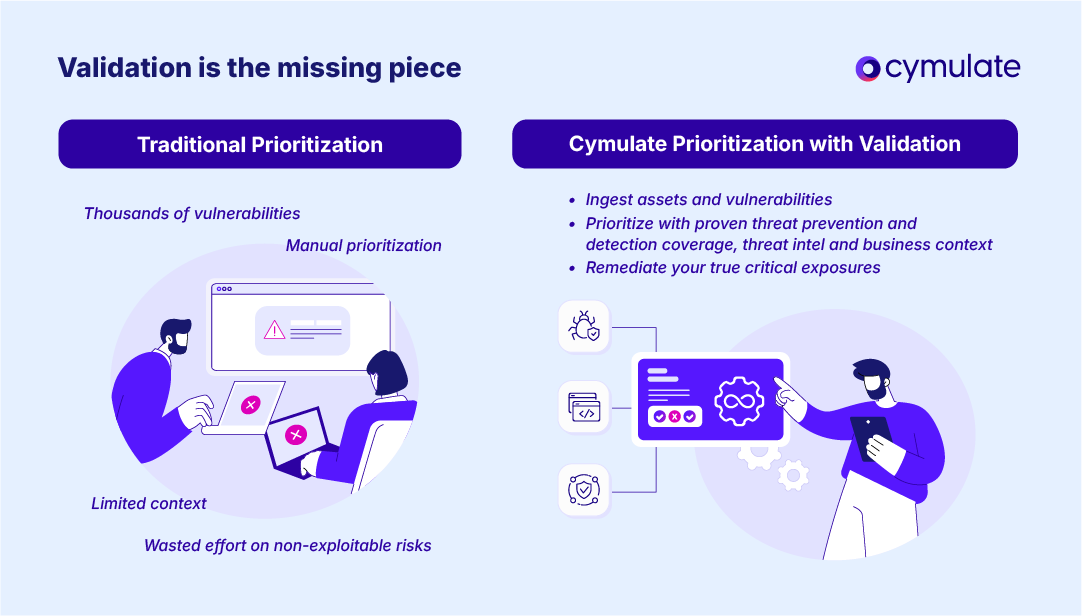
The Cymulate Exposure Management Platform introduces automated threat-based exposure validation as the critical missing piece in many solutions that claim to deliver full CTEM. It provides organizations with data-driven evidence, combining threat intelligence and business context to reveal how attackers could exploit vulnerabilities by bypassing specific security controls and policies. 

By correlating ingested vulnerability data with tested and validated prevention and detection coverage (formerly known as breach and attack simulation), threat intelligence and business context, Cymulate calculates true severity risk scores. This enables organizations to effectively prioritize and focus remediation efforts on exposures that are truly exploitable within their environment. 

Security teams are able to understand if their existing defenses already mitigate vulnerabilities, which allows them to focus their patching efforts on those that require immediate action versus those that can be safely deferred. For those truly exploitable security gaps that cannot be patched immediately, teams gain insights into security policies that can be implemented to improve prevention and detection as a form of mitigation, referred to as virtual patches. 

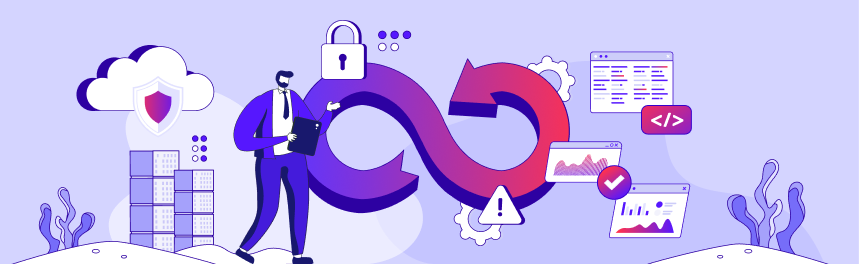
The result is a data-driven, continuous cycle of discovery, validation, prioritization and remediation, which is a strategic evolution from reactive vulnerability patching to proactive, risk-based exposure management. Security teams are empowered to proactively and continuously demonstrate and enhance their threat resilience. 
Vulnerability management vs. CTEM: What’s the difference?

Traditional VM is reactive and periodic, focusing on a continued cycle of scanning and patching IT-managed assets. The prioritization is based mostly on CVSS scores and compliance requirements. More mature organizations may be prioritizing with business context data and attack path mapping. 

CTEM, in contrast, is continuous and risk-driven, expanding the scope beyond CVEs to include exposures in cloud, identity and data environments. It introduces automated adversary exposure validation into the process. Once the exposures are correlated with real attack scenarios and business priorities, security teams are equipped to continuously execute threat-based validation, prioritize, remediate and prove threat resilience. 

Function Vulnerability Management Continuous Threat Exposure Management 
Scope IT assets and network vulnerabilities All exposures across cloud, SaaS, identity and data 
Discovery Scheduled scans Continuous monitoring and exposure discovery 
Prioritization CVSS scores, sometimes exploitability Contextualized by threat, business impact and mitigations 
Validation Manual assessment and validation (if applicable) Attack simulations automatically validate true exploitability of vulnerabilities in an organization’s environment based on real-time existing security controls 
Mobilization Patch and report Collaborate on remediation, improve controls and measure risk reduction 

Table: Difference of VM and CTEM

5 ways security leaders can evolve to CTEM 

Below are steps organizations can take to mature their vulnerability management program to CTEM. 

  1. Evaluate your current landscape: Identify how your organization currently discovers and prioritizes exposures. 
  2. Pinpoint and prioritize gaps: Look for blind spots in asset visibility, fragmented tools or poor collaboration between teams. 
  3. Define a business-aligned scope: Focus on critical assets and compliance-driven areas to deliver quick wins and ROI. 
  4. Incorporate threat validation: Test whether existing security controls already mitigate key security gaps and identify critical exposures. 
  5. Expand to continuous validation: Automate ongoing testing to ensure resilience keeps pace with evolving threats. 

Inside the Cymulate Platform: How it works 

Below is an overview on how the Cymulate Exposure Management Platform ingests assets and exposures and calculates severity risk scores by correlating threat intelligence, business context and threat simulation prevention and detection results.
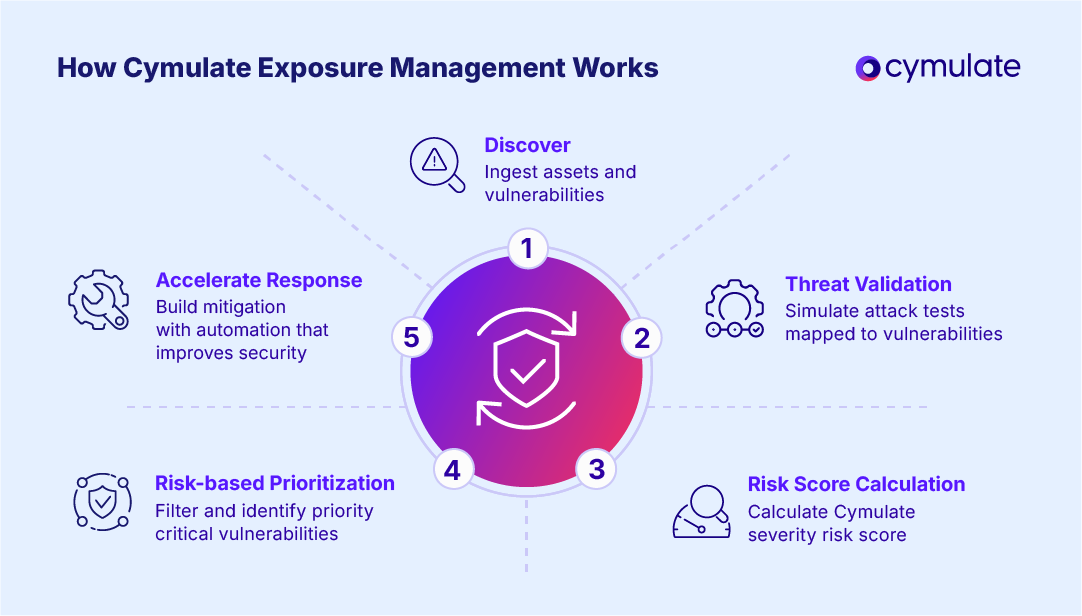
  • Data ingestion: The platform connects with leading VM tools like Tenable, Qualys and Rapid7 as well as security platforms like Microsoft and CrowdStrike, aggregating exposure data from across environments and providing a consolidated view. 
  • Mapping to attack scenarios: Each vulnerability is automatically mapped to attack simulations in our comprehensive attack simulation library to allow organizations to test whether current defenses detect or block exploitation. 
  • Risk score calculation: Cymulate severity risk score unifies CVSS, threat intelligence, asset criticality and prevention/detection coverage to reflect actual operational risk. 
  • Prioritization dashboard: Teams leverage interactive dashboards to visualize which vulnerabilities to escalate or de-escalate, enabling effective resource allocation and improving threat resilience for systems, applications, resources and data. 
  • Remediation and mobilization: Cymulate automates remediation actions, from generating vendor-specific detection rules to applying patches or mitigation scripts. 

From reactive to resilient 

With adversaries rapidly advancing and organizations facing dynamic business needs, larger attack surfaces, more security tools, limited resources and strict regulatory compliance requirements, evolving to CTEM is essential. To thrive in today’s threat landscape, security and risk leaders need continuous confidence in their overall threat resilience. 

Cymulate enables this evolution from VM to CTEM by delivering automated threat validation, effective exposure prioritization and comprehensive remediation. 

Ready to go deeper? 

Read the full technical guide 

Book a live demo 

Cymulate Exposure Validation makes advanced security testing fast and easy. When it comes to building custom attack chains, it's all right in front of you in one place.
Mike Humbert, Cybersecurity Engineer
DARLING INGREDIENTS INC.
Learn More
Book a Demo