
Frequently Asked Questions

MITRE ATT&CK v19 Changes & Operationalization

What are the major changes introduced in MITRE ATT&CK v19?

MITRE ATT&CK v19 introduces significant updates, including the retirement of the Defense Evasion tactic and the creation of two new tactics: Stealth (TA0005) and Defense Impairment (TA0112). The Impair Defenses technique (T1562) has been restructured, and new techniques such as Social Engineering (T1684), Exploitation for Defense Impairment (T1687), and Disable or Modify System Firewall: Windows Host Firewall (T1686.003) have been added. These changes shift the focus from detection alone to validating that security controls can withstand direct attacks and manipulation.

How does the split of the Defense Evasion tactic impact security validation?

The split of the Defense Evasion tactic into Stealth and Defense Impairment creates a clearer separation based on adversary intent. Stealth focuses on attackers blending in to avoid detection, while Defense Impairment centers on adversaries actively disabling or breaking security controls. This requires organizations to validate both their detection logic and the resilience of their controls against direct attacks.

What is the significance of the restructuring of the Impair Defenses technique in v19?

The restructuring of the Impair Defenses technique (T1562) consolidates several sub-techniques into a new parent technique (T1685: Disable or Modify Tools) and reassigns others under the Defense Impairment tactic. This change emphasizes the need for organizations to ensure their defensive controls remain operational and resilient against direct attacks, not just detectable by security tools.

What new techniques and sub-techniques were introduced in MITRE ATT&CK v19?

MITRE ATT&CK v19 introduces three new techniques/sub-techniques: (1) Disable or Modify System Firewall: Windows Host Firewall (T1686.003), (2) Exploitation for Defense Impairment (T1687), and (3) Social Engineering (T1684). These additions require organizations to validate their mitigations and detection strategies for these evolving adversary behaviors.

How should organizations operationalize the changes in ATT&CK v19?

Organizations should update their ATT&CK mappings, prioritize high-impact changes (such as the restructuring of T1562), align validation to adversary intent (distinguishing between Stealth and Defense Impairment), and incorporate new and reorganized techniques into their validation programs. Automated Exposure Validation platforms like Cymulate can streamline this process by providing automatic crosswalk updates and simulation content aligned with the latest framework.

What is the difference between the Stealth and Defense Impairment tactics?

The Stealth tactic (TA0005) focuses on adversaries blending in to avoid detection, using techniques like masquerading and obfuscation. Defense Impairment (TA0112) involves attackers actively disabling or breaking security controls, such as disabling EDR or modifying firewalls. Each tactic requires different validation strategies: detection logic for Stealth and control resilience for Defense Impairment.

How does Cymulate help organizations adapt to MITRE ATT&CK v19?

Cymulate aligns its attack simulations and validation modules with the latest MITRE ATT&CK framework, including v19. The platform automatically updates mappings, enables simulation of new and reclassified techniques, and provides visibility into prevention and detection coverage across the ATT&CK matrix. This helps organizations quickly operationalize framework changes and validate both detection and control resilience.

What are the practical steps for updating ATT&CK mappings to v19?

Practical steps include reassigning techniques from the retired Defense Evasion tactic to Stealth or Defense Impairment, updating internal documentation and dashboards, prioritizing high-impact changes like T1562 restructuring, and integrating new techniques such as T1685, T1687, and T1684 into validation programs. Automated tools like Cymulate can automate much of this process.

How does Cymulate validate detection logic for Stealth tactics?

Cymulate enables organizations to validate detection logic against low-signal, high-context behaviors associated with the Stealth tactic, such as masquerading or abuse of legitimate tools. The platform provides simulations that help teams assess whether their detection mechanisms can identify these subtle adversary actions.

How does Cymulate test resilience against Defense Impairment tactics?

Cymulate allows teams to proactively test how resilient their controls are against tampering, logging disruption, and EDR interference, which are key aspects of the Defense Impairment tactic. This ensures that security controls remain operational and effective even when targeted by adversaries.

Why is it important to validate both detection and control resilience?

Modern attackers often combine Stealth and Defense Impairment tactics in a single campaign. Validating both detection (can you see the attacker?) and control resilience (can your defenses withstand being disabled?) ensures comprehensive protection against sophisticated threats.

How does Cymulate keep its simulation library up to date with MITRE ATT&CK changes?

Cymulate continuously updates its simulation library to reflect the latest MITRE ATT&CK mappings, including new and reclassified techniques. This enables organizations to test their defenses against the most current adversary tactics and techniques as soon as they are published.

What are the benefits of using Cymulate for ATT&CK v19 operationalization?

Cymulate automates the process of updating ATT&CK mappings, provides simulations for new and restructured techniques, and offers clear visibility into prevention and detection coverage. This reduces manual effort, ensures alignment with the latest framework, and helps organizations quickly adapt to evolving threats.

How does Cymulate map its attack vectors and modules to MITRE ATT&CK tactics?

Cymulate maps its attack vectors and modules directly to MITRE ATT&CK tactics, ensuring comprehensive security validation. For example, Reconnaissance is covered by the Recon vector, Initial Access by Web Gateway and Email Gateway modules, and Execution by Web Gateway and Endpoint Security modules. This alignment provides full coverage across the ATT&CK matrix. Learn more.

How can I visualize my MITRE ATT&CK coverage with Cymulate?

Cymulate provides a MITRE ATT&CK heatmap that allows you to visualize your threat coverage and see which techniques have been validated by attack simulations. This helps identify gaps and optimize your security posture. Learn more.

What is the MITRE ATT&CK framework and why is it important?

The MITRE ATT&CK framework is a globally accessible knowledge base of adversary tactics and techniques based on real-world observations. It provides a common language for describing attacker behaviors and is widely used for security validation, detection engineering, and threat intelligence.

How does Cymulate help organizations baseline and optimize MITRE ATT&CK coverage?

Cymulate enables organizations to baseline their current MITRE ATT&CK coverage by visualizing validated techniques and identifying gaps. The platform helps optimize coverage by providing actionable insights and simulations for common threats and active campaigns. Learn more.

How does Cymulate support detection engineering for MITRE ATT&CK?

Cymulate provides tools and guides for building, validating, and optimizing threat detections that map to MITRE ATT&CK. This helps organizations turn noisy alerts into reliable, validated detections and streamline detection engineering processes. Learn more.

How does Cymulate help organizations operationalize MITRE ATT&CK changes without disrupting SOC workflows?

Cymulate continuously updates its simulation content and mappings to reflect MITRE ATT&CK changes, allowing security and risk teams to validate controls and detections against evolving tactics without manual re-mapping or workflow disruption. This ensures SOC teams can focus on threat resilience rather than administrative updates.

Features & Capabilities

What features does Cymulate offer for exposure management and security validation?

Cymulate offers continuous threat validation, exposure awareness, defensive posture optimization, attack path discovery, automated mitigation, comprehensive integration with SIEM and EDR tools, and dedicated cloud security validation. These features help organizations proactively manage their cybersecurity posture and align with business objectives.

Does Cymulate integrate with other security tools?

Yes, Cymulate integrates with a wide range of industry-leading security tools, including endpoint security (e.g., CrowdStrike Falcon, SentinelOne), cloud security (e.g., AWS GuardDuty, Wiz), SIEM (e.g., Splunk), vulnerability management (e.g., Rapid7 InsightVM), and network security (e.g., Akamai Guardicore). See the full list of integrations.

How easy is it to implement Cymulate and start running simulations?

Cymulate is known for its quick deployment and ease of use. It operates in agentless mode, requiring no additional hardware or complex configurations. Customers can start running simulations almost immediately after deployment, with support available via email, chat, and educational resources.

What technical documentation is available for Cymulate?

Cymulate provides a range of technical resources, including a whitepaper on the Exposure Management Platform, data sheets on platform capabilities and custom attacks, and detailed documentation on technology integrations and MITRE ATT&CK alignment. Explore Cymulate's resources.

Use Cases & Benefits

Who can benefit from using Cymulate?

Cymulate is designed for CISOs, Security Operations (SecOps) teams, Red Teams, Vulnerability Management teams, and Detection Engineers in organizations across industries such as finance, healthcare, and technology. It is ideal for organizations seeking to continuously validate and optimize their security posture.

What business impact can organizations expect from Cymulate?

Organizations using Cymulate typically achieve a 30% improvement in threat prevention, a 52% reduction in critical exposures, a 60% increase in operational efficiency, and an 81% reduction in cyber risk within four months. These metrics are based on customer-reported outcomes. See more.

What pain points does Cymulate address for security teams?

Cymulate addresses pain points such as overwhelming threat volume, lack of visibility, unclear risk prioritization, operational inefficiencies, fragmented security tools, cloud complexity, and communication barriers between security teams and stakeholders.

Are there case studies demonstrating Cymulate's effectiveness?

Yes, for example, Hertz Israel reduced cyber risk by 81% within four months using Cymulate, Nemours Children's Health improved detection and response, and Nedbank focused on critical vulnerabilities. See more case studies.

Competition & Comparison

How does Cymulate compare to AttackIQ?

Cymulate offers a larger threat scenario library and AI-powered capabilities for streamlined workflows and accelerated security posture improvement. AttackIQ does not match Cymulate's innovation, threat coverage, or ease of use. Read more.

What differentiates Cymulate from Mandiant Security Validation?

Mandiant's platform has seen minimal innovation in recent years, while Cymulate continually updates its platform with AI and automation, expanding into exposure management and maintaining a leadership position. Read more.

How does Cymulate compare to Pentera?

Pentera focuses on attack path validation but does not provide the depth of defense assessment and strengthening that Cymulate offers. Cymulate optimizes defense, scales offensive testing, and increases exposure awareness. Read more.

What are the advantages of Cymulate over Picus Security?

Picus Security is suitable for on-premise BAS needs but lacks Cymulate's comprehensive exposure validation platform, which covers the full kill chain and includes cloud control validation. Read more.

How does Cymulate compare to SafeBreach?

Cymulate outpaces SafeBreach with unmatched innovation, precision, and automation. It offers the industry's largest attack library, a full CTEM solution, and comprehensive exposure validation. Read more.

Pricing & Plans

What is Cymulate's pricing model?

Cymulate uses a subscription-based pricing model tailored to each organization's needs. Pricing depends on the chosen package, number of assets, and scenarios required. For a personalized quote, organizations can schedule a demo with Cymulate's team. Book a demo.

Security & Compliance

What security and compliance certifications does Cymulate hold?

Cymulate holds SOC2 Type II, ISO 27001:2013, ISO 27701, ISO 27017, and CSA STAR Level 1 certifications. These demonstrate adherence to industry-leading security and privacy standards, ensuring the platform's reliability and safety. Learn more.

How does Cymulate ensure data security and privacy?

Cymulate's services are hosted in secure AWS data centers with ISO 27001, PCI DSS, and SOC 2/3 compliance. Data is encrypted in transit (TLS 1.2+) and at rest (AES-256). The company follows a strict Secure Development Lifecycle, conducts regular penetration tests, and provides ongoing security awareness training for employees.

Support & Implementation

What support options are available for Cymulate customers?

Cymulate offers email support, real-time chat support, and access to educational resources such as webinars, e-books, and a knowledge base. Customers can reach support at [email protected] or via the chat support page.

What feedback have customers given about Cymulate's ease of use?

Customers consistently praise Cymulate for its intuitive and user-friendly design. Testimonials highlight the platform's ease of implementation, simple navigation, and actionable insights. For example, Raphael Ferreira, Cybersecurity Manager, stated, "Cymulate is easy to implement and use—all you need to do is click a few buttons, and you receive a lot of practical insights into how you can improve your security posture."

Introducing Cymulate Vero AI for Agentic Cyber Defense Engineering
Learn More
New: 2026 Gartner® Market Guide for Adversarial Exposure Validation
Learn More
New Research: Exploiting Configuration Trust in AI Coding Tools
Learn More
New Case Study: How a Financial Authority Validates Cyber Resilience
Learn More

MITRE ATT&CK v19 Unpacked: What Changed and How to Operationalize 
By: Amanda Kegley

Last Updated: May 18, 2026

MITRE ATT&CK v19

MITRE ATT&CK v19 introduces major changes that reshape how organizations understand and validate adversary behavior, including retiring the Defense Evasion tactic and introducing Stealth and Defense Impairment tactics. These updates shift the focus beyond detection alone to ensure that security controls can withstand direct attack and manipulation, whether attackers blend in as legitimate activity to avoid detection or actively break and disable defenses. Organizations must proactively prepare for and operationalize these changes to continuously validate their defenses against evolving tactics, techniques, and real-world threats. 

Summary of changes and what you will gain: 

  • Split of Defense Evasion tactic into 2 tactics: Obtain insights into how the Defense Evasion tactic (a blend of adversary behavior and intent) techniques and sub-techniques have been moved to other tactics, with the majority moved to the newly created tactics: Stealth and Defense Impairment
  • Restructuring of the Impair Defenses technique: Learn about the restructuring of Impair Defenses techniques (T1562) into technique (T1685) and related techniques, highlighting the shift from detection-focused Defense Evasion to Defense Impairment and where organizations must validate that security controls can withstand, detect and recover from direct attacks. 
  • Introduction of new techniques: Gain visibility into the newly introduced Defense Impairment techniques (including a new sub-technique) and a Stealth technique focused on social engineering to help operationalize and validate defenses against behaviors that disable controls or exploit human trust. 
  • How to operationalize ATT&CK v19: Learn how to operationalize ATT&CK v19 by updating mappings, prioritizing key technique and sub-technique changes, aligning validation to attacker intent and incorporating new tactics and techniques, while leveraging automation (like Cymulate) to streamline coverage and reduce manual effort. 
  • Cymulate and MITRE ATT&CK v19 in action: Understand how Cymulate enables organizations to fully prepare for the split of the Defense Evasion tactic, specifically to validate detection logic against low-signal, high-context behaviors, such as masquerading or abuse of legitimate tools (Stealth tactic) and proactively test how resilient their controls are against tampering, logging disruption and EDR interference (Defense Impairment tactic). 

What Has Changed with ATT&CK v19 

The most notable changes in MITRE ATT&CK v19 include the retirement of the Defense Evasion tactic, the creation of 2 new tactics that replace the Defense Evasion tactic, the restructuring of the Impair Defenses (T1562) technique and the creation of 2 new techniques/sub-techniques focusing on attackers attempting to disable defenses and leverage social engineering. 

Change #1: Explanation and impact of the Defense Evasion tactic split 

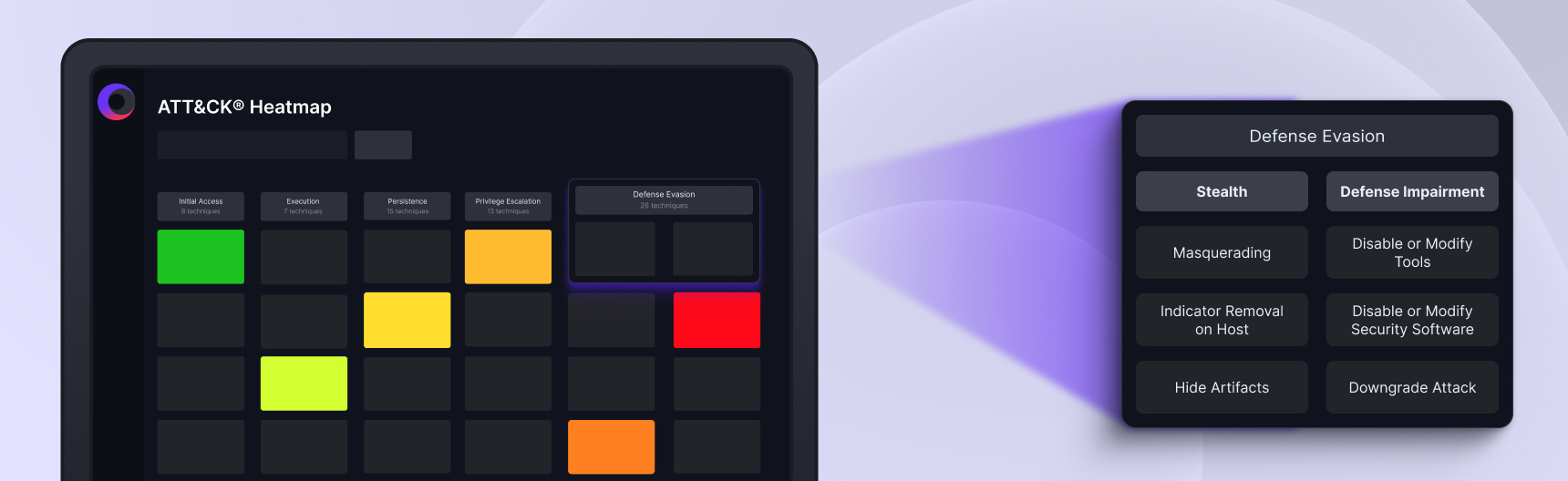
With the retirement of the Defense Evasion tactic, MITRE introduced two distinct tactics: Stealth and Defense Impairment, as shown in the table below. This change introduces a clearer separation based on adversary intent, not just behavior, highlighting two fundamentally different security and threat validation challenges. 

Old Tactic (v18)New Tactic (v19) Adversary Intent Impact to DefensesExample Behaviors
Defense Evasion (TA0005) Stealth (TA0005)  
*note – keeps old ID 
Blend in to avoid detection Defenses are running but being deceived; viewed as legitimate behavior • Hide artifacts 
• Obfuscation 
• Masquerading 
Defense Evasion (TA0005) Defense Impairment (TA0112) Break and/or disable defenses Controls are being disabled and/or broken • Disable EDR 
• Modify firewall 
• Modify cloud compute architecture 

 Table 1: New tactics from the retirement of Defense Evasion 

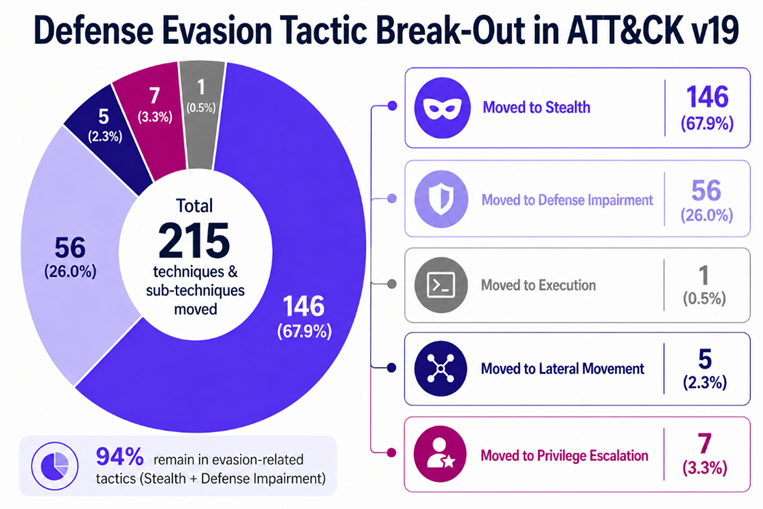
Most techniques and sub-techniques previously categorized under Defense Evasion (94%) have been redistributed into the new Stealth and Defense Impairment tactics. However, MITRE also used this opportunity to reassign a smaller subset to other existing tactics, such as Lateral MovementPrivilege Escalation, and Execution, where they more accurately reflect adversary intent. The visual below illustrates how Defense Evasion previously grouped a wide range of attacker behaviors, and how this reclassification now better aligns with real-world activity. 
Change #2: Restructuring of the Impair Defenses technique 

The T1562 parent technique (Impair Defenses) and several of its sub-techniques have undergone significant restructuring. T1562, along with T1562.001 and T1562.006, has been merged into a new parent technique, T1685: Disable or Modify Tools, while the remaining sub-techniques have been revoked and reissued under new IDs within the Defense Impairment tactic. 

This change goes beyond simple renaming. It reflects a shift in how defenders should think about these behaviors. Previously, many of these activities were grouped under Defense Evasion as individual sub-techniques, often treated primarily as detection challenges. In v19, they are explicitly categorized as Defense Impairment, emphasizing that these actions are not just about hiding, but about actively degrading or disabling security controls. 

Ultimately, this change reinforces a critical shift for organizations. It is not enough for security teams to merely detect adversary activity; they must also ensure that their defensive controls remain continuously operational and withstand and recover from direct attacks. 

Change #3: Introduction of new techniques/sub-techniques 

This release introduced three new techniques/sub-techniques highlighted in the table below. Security teams must operationalize these new techniques and sub-techniques by validating that they have the necessary mitigations and detection strategies in place. Learn more in the following section on operationalizing strategies. 

New Technique Tactic Technique Type Description
Disable or Modify System Firewall: Windows Host Firewall (T1686.003) 
*(T1686 parent) 
Defense Impairment (TA0112) New sub-technique Adversaries may disable or modify the Windows host firewall to bypass controls limiting network usage and further advance their mission, such as enabling remote access. 
Exploitation for Defense Impairment  
(T1687) 
Defense Impairment (TA0112) New technique Adversaries may exploit vulnerabilities in security software, infrastructure, or defensive components to degrade, disable, or otherwise continue to impair their ability to prevent, detect, or respond to malicious activity. 
Social Engineering (T1684) Stealth (TA0005) New technique Adversaries may use social engineering techniques to influence users to take actions that result in unauthorized access, approval of changes, disclosure of sensitive information, or execution of adversary-supplied instructions, while minimizing indicators 

 Table 2: Description of new techniques and sub-techniques 

How to Operationalize ATT&CK v19 

For organizations that leverage the MITRE ATT&CK® framework to guide security validation and control coverage, ATT&CK v19 introduces major changes that require both mapping updates and a shift in how controls are evaluated. 

Organizations using Automated Exposure Validation (AEV) platforms, such as Cymulate, will benefit from automatic crosswalk updates, ensuring that techniques, sub-techniques, and tactics are seamlessly realigned to v19 with minimal effort. This eliminates manual re-mapping and helps teams quickly understand how their existing coverage translates to the new framework. One caveat is that for the new techniques introduced, it is paramount to simulate new attack scenarios that map to these to evaluate their prevention and detection coverage. 

However, for organizations that rely on manual ATT&CK mapping or semi-automated tools, a more deliberate update process is required as outlined below: 

1. Re-map retired defense evasion content 

With the retirement of the Defense Evasion tactic, teams must review all existing mappings in their tools and processes and: 

  • Re-assign techniques to Stealth (TA0005) or Defense Impairment (TA0112) based on adversary intent  
  • Identify and reassign techniques that have moved to other tactics, such as Execution, Lateral Movement or Privilege Escalation  
  • Update any internal documentation, dashboards and reporting that reference TA0005, and create dashboards and documentation for TA0012. 

2. Prioritize high-impact changes (e.g., T1562) 

Special attention should be given to techniques that were revoked, merged or re-issued, particularly: 

  • T1562 (Impair Defenses) and its sub-techniques in MITREv18 have been significantly restructured into T1685 (Disable or Modify Tools)
  • Any detections, controls, or test scenarios tied to these IDs will now require new mappings and validation logic to ensure threat resilience and defenses are not disabled and are actively working. 

3. Align validation to intent, not just technique 

The v19 update introduces a more meaningful distinction between: 

  • Stealth Tactic → validating detection gaps (can you see the attacker trying to hide?)  
  • Defense Impairment Tactic → validating control resilience (can your defenses be disabled, and can you detect attackers trying to disable them?)   

Organizations should take this opportunity to reassess whether their validation programs are focused only on detection, and understand if they are also testing the resilience and integrity of security controls under attack  

4. Incorporate new and reorganized techniques 

Security teams should review and integrate the newly introduced techniques (e.g., T1685T1687T1684) and re-organize areas like Social Engineering, which is now consolidated under the Stealth tactic to ensure coverage reflects current adversary behaviors, not legacy classifications. 

Cymulate and MITRE ATT&CK v19 in Action  

Cymulate is fully aligned with the MITRE ATT&CK framework through its continuous security validation approach, which maps attack simulations directly to the tactics, techniques and sub-techniques. The platform inherently mirrors this structure, allowing organizations to safely simulate real-world attacker behaviors, validate control effectiveness and measure coverage across the full ATT&CK matrix, which includes identification of prevention and detection gaps and risk quantification.  

Cymulate will enable organizations to fully prepare for the split of Defense Evasion into Stealth and Impair Defenses tactics.  

  • Stealth tactic: Enables organizations to validate detection logic against low-signal, high-context behaviors, such as masquerading or abuse of legitimate tools. 
  • Defense Impairment tactic: Allows teams to proactively test how resilient their controls are against tampering, logging disruption and EDR interference, as a few examples.  

Ensuring resilience against both tactics is critical, as modern attackers often combine them in a single campaign, requiring defenses that can detect subtle anomalies while also verifying control integrity and availability. 

For both restructuring defense-impairment behaviors and introducing new techniques and sub-techniques, Cymulate empowers security teams to reassess their detection coverage and validation strategies. Cymulate directly addresses this need by continuously updating its simulation library to reflect the latest ATT&CK mappings, enabling organizations to test newly defined or reclassified techniques as they emerge. Security and risk teams are equipped to quickly operationalize ATT&CK changes by validating existing controls and new detections against evolving adversary tactics without disrupting SOC workflows. 

Interested in Learning More about Cymulate ATT&CK Alignment?

Cymulate has already begun rolling out the new MITRE alignment in the product content and features.. 

Our commitment is simple: deliver industry-standard ATT&CK mapping, behavior-driven analytics, and comprehensive technique coverage. By staying in lockstep with the MITRE ATT&CK evolution, Cymulate helps organizations turn framework updates into real, measurable improvements in threat resilience. 

Want to see it in action? Discover how Cymulate continuously aligns with MITRE ATT&CK and gives you clear visibility into your prevention and detection coverage across the entire adversary lifecycle. 

Sign up for a demo and see how the platform can validate and measure your threat resilience. 

Cymulate Exposure Validation makes advanced security testing fast and easy. When it comes to building custom attack chains, it's all right in front of you in one place.
Mike Humbert, Cybersecurity Engineer
DARLING INGREDIENTS INC.
Learn More
Book a Demo