

Mean Time to Patch (MTTP): What It Is and How to Reduce It
Mean time to patch (MTTP) measures the average time it takes an organization to apply patches to known vulnerabilities after they are discovered or disclosed.
MTTP matters because every delay extends the window of exposure. Attackers often move faster than traditional patch cycles, especially when a vulnerability affects internet-facing systems, identity infrastructure, cloud workloads or widely used software. A lower MTTP helps security teams reduce exposure before attackers can turn a known weakness into a breach.
MTTP is a key vulnerability management KPI. It helps teams measure how quickly they move from discovery to patch deployment, and it gives security leaders a clear view of patching speed across assets, business units and risk tiers.
Key Takeaways
- MTTP measures the average time it takes to patch known vulnerabilities.
- Lower MTTP reduces the window of exposure to exploitable threats.
- Effective vulnerability remediation requires prioritization based on real-world exploitability, not severity scores alone.
- Continuous validation helps security teams focus on the vulnerabilities that matter most.
- Agentic remediation workflows and automated mitigation can accelerate patching and reduce manual work.
What is mean time to patch (MTTP)?
Mean time to patch (MTTP) is the average amount of time it takes to apply a patch after a vulnerability enters the organization’s remediation workflow.
In most cybersecurity programs, MTTP tracks the time between vulnerability discovery and successful patch deployment. Some teams start the clock when a scanner detects the vulnerability. Others start when a vendor discloses the vulnerability or releases a patch. The exact starting point can vary, but the metric must stay consistent to be useful.
MTTP helps vulnerability management teams understand how fast they close known security gaps. A high MTTP can mean patches are delayed by testing, approvals, poor asset ownership, change freezes or unclear prioritization. A low MTTP usually signals stronger security posture for prevention, detection and response.
MTTP does not measure every kind of remediation. It focuses on vulnerability patching. Configuration changes, compensating controls and other mitigation steps usually fall under broader remediation metrics such as mean time to remediate (MTTR).
How to calculate mean time to patch
The basic MTTP formula is:
MTTP = Total time to patch vulnerabilities / Number of vulnerabilities patched
Each part of the formula should be defined clearly:
- Total time to patch vulnerabilities: The combined time between the chosen start point and successful patch deployment for all measured vulnerabilities.
- Number of vulnerabilities patched: The total number of vulnerabilities patched during the measurement period.
- Measurement period: The time range being analyzed, such as one week, one month or one quarter.
For example, if a team patches five vulnerabilities in a month and the total patching time equals 150 days, the MTTP is 30 days.
150 total patching days / 5 patched vulnerabilities = 30 days MTTP
The clock should start at a consistent point. Common options include:
- When the vulnerability is detected internally
- When the vendor publishes a patch
- When the vulnerability is disclosed publicly
- When the vulnerability is added to a ticketing or remediation queue
For most operational teams, the most practical option is internal detection. This shows how long it takes the organization to move from awareness to action. For executive reporting, teams may also track patch release to deployment time. That view shows exposure from the moment a fix becomes available.
MTTP should also be segmented by severity, asset type and exploitability. A single average can hide risk. A 20-day MTTP may look acceptable, but not if internet-facing critical assets take 60 days to patch.
Define what counts as a successful patch deployment
Before calculating MTTP, organizations should establish a clear definition of when a vulnerability is considered patched. In many environments, deploying a patch to every affected asset may take time due to offline devices, operational constraints, maintenance windows, or exceptions.
Common definitions include:
- 100% deployment: The patch is installed on all affected systems.
- Threshold-based deployment: A vulnerability is considered patched when a predefined percentage of affected assets (for example, 95% or 98%) has received the update.
- Risk-based deployment: Critical assets must be patched first, while lower-priority systems may follow under a separate timeline.
- Exception-based deployment: Systems with approved compensating controls or documented business exceptions are excluded from the calculation.
The chosen definition should be documented and applied consistently across reporting periods. Without a clear deployment threshold, MTTP measurements may vary significantly between teams and may not accurately reflect remediation performance.
For example, an organization might define a vulnerability as successfully remediated when:
- The patch is deployed to at least 95% of affected assets, and
- Any remaining systems have approved exceptions or compensating controls.
This approach helps organizations measure operational effectiveness while accounting for the practical challenges of patching large and distributed environments.
Why mean time to patch matters
Modern environments produce more vulnerabilities than security teams can patch immediately. MTTP helps teams measure how fast they close those gaps and whether patching processes are reducing real exposure.
The 2026 Verizon Data Breach Investigations Report found that 31% of breaches now start with software vulnerabilities, making vulnerability exploitation the top initial access vector. Verizon also found that only 26% of CISA Known Exploited Vulnerabilities were fully remediated across the organizations it analyzed. Median time to fully patch a vulnerability also rose to 43 days, up from 32 days the year before.
These numbers show why MTTP matters. Known exploited vulnerabilities often remain open long enough for attackers to find and use them. Reducing MTTP helps teams shorten that exposure window, especially for internet-facing systems, critical assets and vulnerabilities tied to active exploitation.
MTTP works best when paired with exposure validation. A lower average patch time is useful, but security teams also need to know which vulnerabilities create real attack paths. That context helps them patch the vulnerabilities that matter most first.
Mean time to patch (MTTP) vs MTTR
MTTP and MTTR are related, but they measure different things.
MTTP measures the time it takes to patch vulnerabilities. It is specific to patch deployment and is most useful for vulnerability management, endpoint management, server operations, cloud operations and application security teams.
MTTR, or mean time to remediate, is broader. It measures the time it takes to fix a security issue after detection. That issue may require a patch, but it may also require a configuration change, firewall rule, identity policy update, compensating control, containment action or other remediation step.
For example, a vulnerable web server may require a software patch. That belongs in MTTP. A misconfigured storage bucket may require an access policy change. That belongs in MTTR, but not MTTP.
There is overlap. Patching is one form of remediation. Teams often track both metrics because they answer different questions:
- MTTP: How fast do we apply patches?
- MTTR: How fast do we resolve security issues?
A mature vulnerability management program uses both. MTTP helps teams improve patch operations. MTTR helps them understand the broader remediation lifecycle.
What affects mean time to patch?
MTTP is shaped by technical, operational and organizational factors. The most common drivers include:
Volume of vulnerabilities
Security teams often face more findings than they can patch immediately. The Verizon 2026 DBIR found that the median number of CISA KEV vulnerabilities that organizations had to patch rose to 16 in 2025, up from 11 in 2024. That is almost 50% more known exploited vulnerabilities to handle in one year.
High volume increases triage time. It also increases the risk that teams spend time on vulnerabilities that look severe, but do not create real exposure.
Asset criticality and prioritization
Not every asset carries the same risk. A vulnerability on a public-facing VPN, identity provider or payment system deserves faster action than the same vulnerability on a non-production asset with limited access.
Effective MTTP reduction depends on asset context. Teams need to know whether the affected asset is internet-facing, business-critical, connected to sensitive data or part of an attack path.
Organizations should also track MTTP by vulnerability severity and risk level. Critical vulnerabilities should typically have a much lower MTTP than medium- or low-risk findings.
Reporting separate MTTP metrics for critical, high-severity, internet-facing, and business-critical assets provides a clearer view of remediation effectiveness and helps ensure the highest-risk vulnerabilities are addressed first.
Patch testing and deployment processes
Patches can break systems. Many organizations test patches before deployment, especially in production, operational technology, regulated environments and legacy systems. Testing is necessary, but slow testing can create long exposure windows.
Standardized testing, pre-approved patch windows and rollback plans help reduce delay without increasing operational risk.
Tooling and automation maturity
Manual workflows increase MTTP. Teams lose time creating tickets, assigning owners, checking asset context, confirming patch status and following up across teams.
Automation can reduce that friction. It can route findings to the right owner, enrich tickets with exploitability data, trigger workflows and validate whether the patch worked and when all assets have been fully patched.
Organizational workflows and approvals
Patch management often crosses team boundaries. Security identifies the risk, IT owns many assets, application teams own code and business teams approve downtime. MTTP increases when ownership is unclear or approvals take too long.
Clear service-level agreements (SLAs), asset ownership and escalation paths help teams move faster.
Exposure validation and prioritization quality
Poor prioritization can increase MTTP for the vulnerabilities that matter most. If every critical finding receives the same priority, teams may patch the wrong systems first.
Exposure validation helps teams understand whether a vulnerability is reachable, exploitable and tied to a real attack path. That context helps reduce MTTP where it has the greatest risk impact.
How to reduce mean time to patch (MTTP)
Reducing MTTP requires more than telling teams to patch faster. Security teams need better prioritization, fewer manual steps and clearer workflows.
Prioritize exploitable vulnerabilities first
Start with vulnerabilities that attackers are actively exploiting or are likely to exploit soon. Use sources such as CISA KEV, EPSS, threat intelligence, asset exposure and business context.
Severity still matters, but it should not be the only input. A risk-based queue helps teams focus on vulnerabilities that create real exposure.
Start with vulnerabilities that attackers are actively exploiting or are likely to exploit soon. Use sources such as CISA KEV, EPSS, threat intelligence, asset exposure, and business context.
This risk-based approach aligns with Continuous Threat Exposure Management (CTEM), which helps organizations prioritize remediation efforts based on exploitability, exposure, and business impact rather than severity alone. A risk-based queue helps teams focus on vulnerabilities that create real exposure.
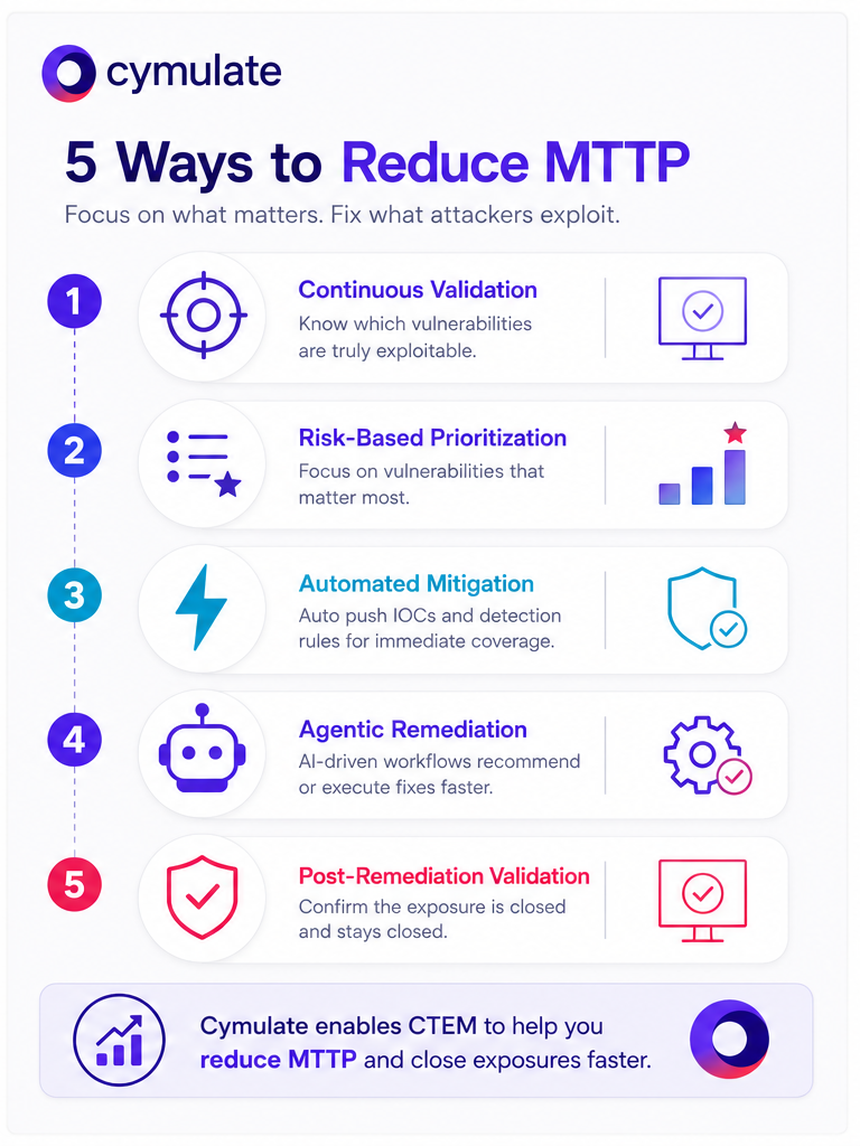
Use continuous exposure validation
Periodic scans can leave teams with stale data. CTEM emphasizes ongoing validation to help organizations understand which vulnerabilities create real exposure in their environment.
The Cymulate Threat Exposure Validation Impact Report 2025 found that 71% of surveyed security leaders view threat exposure validation as essential. It also found that organizations running exposure processes at least once per month reported a 20% reduction in breaches.
Validation helps teams answer practical questions: Is the vulnerability reachable? Can it be used in an attack path? Are compensating controls blocking exploitation? Did remediation work? By continuously validating exposure, organizations can prioritize remediation efforts based on actual risk rather than theoretical severity.
Automate remediation workflows
Automation helps reduce the manual work between detection and patch deployment. Teams can automate ticket creation, assignment, prioritization, owner notification, patch status checks and post-patch validation.
Agentic remediation can add another layer by recommending next steps, generating remediation instructions and helping coordinate action across security and IT workflows. In controlled environments, agentic systems can also execute approved tasks based on policy, risk level and change rules.
Eliminate operational bottlenecks
Long MTTP often comes from handoffs. Security sends a spreadsheet. IT asks for context. Application owners ask for impact. A change board delays approval. The ticket sits without ownership.
Teams can reduce delays by defining patch SLAs, mapping asset owners, pre-approving emergency patch paths and using standard rollback plans. The goal is to make routine patching predictable and urgent patching fast.
Measure and improve continuously
MTTP should be tracked by category. Useful breakdowns include:
- Critical vulnerabilities
- Known exploited vulnerabilities
- Internet-facing assets
- Business-critical systems
- Cloud workloads
- Endpoints
- Servers
- Applications
Teams should also track exceptions. Some systems cannot be patched immediately. In those cases, compensating controls, segmentation, virtual patching or temporary mitigations can reduce exposure until patching is possible.
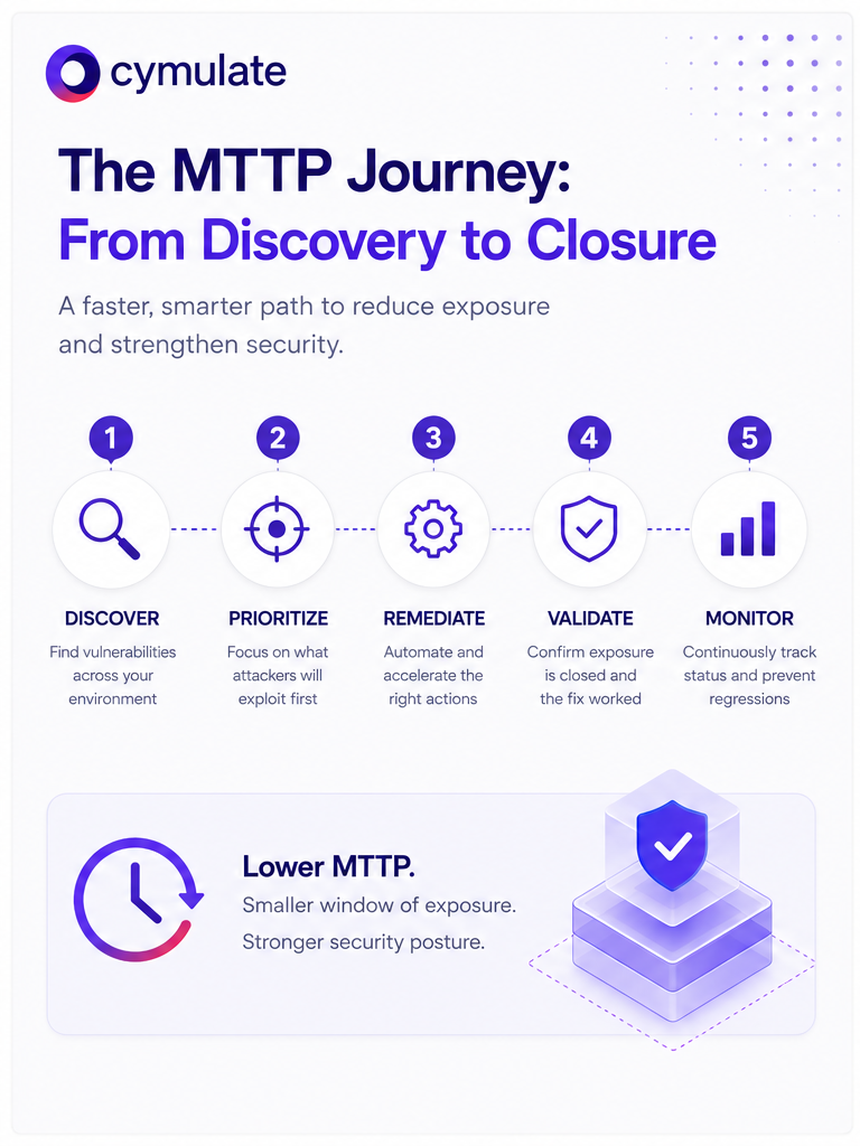
The role of continuous validation, automation and agentic remediation
Patching alone is not enough because teams cannot patch everything at once. To reduce risk effectively, organizations must evolve from traditional vulnerability management to Continuous Threat Exposure Management (CTEM), which helps security teams understand which vulnerabilities matter now, which can wait, and which require compensating controls.
Continuous validation shows whether vulnerabilities are exploitable in the real environment. Automation reduces manual work. Agentic remediation helps teams move from finding to action with less delay.
This creates a stronger operating model:
- Validation confirms whether exposure exists.
- Prioritization ranks vulnerabilities based on exploitability and business context.
- Automation routes the work and reduces manual coordination.
- Agentic workflows recommend or execute approved remediation steps.
- Post-remediation validation confirms the fix worked.
The result is not just a lower MTTP. It is a better patching process that reduces real exposure.
How Cymulate helps reduce MTTP
The Cymulate platform enables Continuous Threat Exposure Management (CTEM) by connecting exposure validation, risk-based prioritization, automated mitigation, and AI-driven remediation workflows. By helping organizations focus on the vulnerabilities that create real risk and accelerating remediation efforts, Cymulate helps security teams reduce MTTP and strengthen their overall exposure management program.
Continuous exposure validation
Cymulate continuously validates exposures using real-world attack techniques. This helps teams identify which vulnerabilities and control gaps create genuine risk in their environment.
AI-powered risk prioritization
Cymulate helps security teams prioritize vulnerabilities based on exploitability, exposure and business impact. This helps teams focus patching effort on vulnerabilities that create the greatest risk.
Automated mitigation recommendations
Cymulate Auto Mitigation helps teams move from validation to action. It can automatically push indicators of compromise (IOCs) for missed prevention opportunities and deploy new detection rules for threats that existing controls failed to detect.
Validation of remediation effectiveness
Patching is not complete until teams confirm the exposure is closed. Cymulate helps validate whether remediation worked, reducing the risk of false closure or incomplete patch deployment. The platform continuously monitors and reports on the status of assets and vulnerabilities, providing ongoing visibility into remediation progress and helping organizations ensure exposures remain closed over time.
Faster identification of urgent vulnerabilities
By combining continuous validation, threat intelligence and automated workflows, Cymulate helps teams identify vulnerabilities that require urgent patching. This supports faster, more focused remediation across complex environments.
The Cymulate Auto Mitigation capability also helps security teams reduce manual work by generating and deploying vendor-specific detection rules and indicators of compromise to connected controls. This can help teams reduce exposure while patches are being tested or deployed.
Featured Resources
View More Resources
Cymulate CTEM
Automate threat validation with Cymulate Exposure Management and identify which risks are truly exploitable.

Financial Regulator Gains Continuous Security Visibility with Cymulate
See how a financial authority uses Cymulate for continuous security validation, faster threat testing, and stronger defenses.

Beyond Validation. The Future is Agentic Cyber Defense Engineering.
Cymulate’s Vero AI powers agentic cyber defense engineering to prove, prioritize and adapt security.