
Inside the Agentic Cyber Defense Engineering Architecture: How it Works

Agentic cyber defense engineering requires more than adding AI to isolated security tasks. It requires an agentic cyber defense engineering architecture that can understand the environment, coordinate specialized security work, and act across the security stack without requiring teams to manually design and manage every workflow.
This architecture brings together three operational components:
- Specialized security agents providing the security expertise
- Governed routines defining the work to be completed, when it should run and when agents and skills are required
- Two-way security integrations connecting the system to the threat intelligence, controls, telemetry and workflows needed to turn decisions into action
Together, these components move cyber defense from periodic, manually coordinated activity to a continuous system that can detect and respond as threats, controls and environments change.
Key takeaways
- Agents automate specialized security work. Each agent performs activities traditionally handled by security architects, red teams, validation teams, detection engineers and security operations analysts.
- Routines make recurring work repeatable. They define the objective, triggers, agents, data sources, actions, guardrails and outputs for work that runs on a schedule, in response to an event or on demand.
- Two-way integrations close the loop. Agents pull context and evidence from security tools, then push approved indicators, detection rules and workflow updates back into the tools where teams operate.
- A governed control plane keeps it safe. Shared context, scoped permissions, full audit trails and configurable approval gates keep every autonomous action visible, authorized and reversible.
How the architecture works
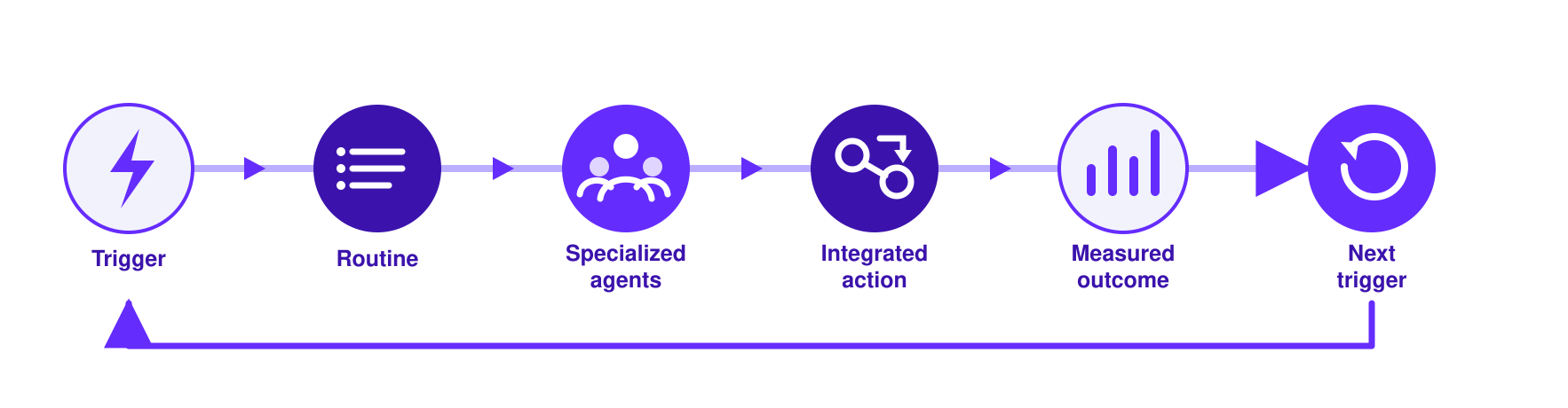
The architecture follows a simple pattern:
Trigger → Routine → Specialized agents → Integrated action → Measured outcome → Next trigger
It first starts with a trigger. A trigger may be an emerging threat, a newly published vulnerability, a completed assessment, a detection rule change or a closed mitigation task. The defense control plane launches the appropriate routine, coordinates the required agents and maintains shared context as work progresses.
Agents use integrations to collect evidence, execute validation and take governed action and only involve humans for decisions or approvals. The outcome updates the organization’s current posture and can initiate the next routine. This is what makes the architecture event-driven: it automatically advances based on changing conditions and results rather than waiting for teams to coordinate the next step.
The control plane: shared context, permissions, audit trails and approvals
Every trigger, routine and agent action in this architecture runs through a single control plane. It is what keeps a system of autonomous agents governed rather than unpredictable, and it does that through three mechanisms.
- Shared context. The control plane maintains persistent, shared state across the entire loop, so every agent that picks up a routine sees the same picture: what triggered the work, what earlier agents found, what has already been tried and what the environment looks like right now. Agents build on each other’s work instead of rediscovering it.
- Audit trails. Every trigger, decision, agent action and integration call is logged in sequence. Security and compliance teams can reconstruct exactly why a routine ran, what evidence it used, what it changed and who or what approved it.
- Approvals. High-risk or irreversible actions, such as creating new attack scenarios or pushing a new detection rule into production or closing out a mitigation, are routed through configurable approval points.
Together, these capabilities enable organizations to complete their security operations effectively and efficiently at the speed required in the post-Mythos era.
Specialized agents perform the security work
The architecture uses agents designed to execute distinct security activities traditionally done by security analysts. They share context and coordinate through the control plane rather than operating as isolated assistants. The value does not come from any single agent. It comes from how agents pass context, evidence and actions to one another as work moves across the closed loop.
| Agent | Responsibility |
| Threat Profiler | Monitors threat intelligence and environmental context to determine which threats, vulnerabilities and attacker behaviors are relevant. |
| Red Teamer | Converts relevant threats into realistic attack scenarios and drafts new scenarios when suitable validation content does not exist. |
| Validation Operator | Configures test points, integrations, pre-requisites and safety controls, then executes attack assessments without disrupting operations. |
| Validation Analyst | Correlates attack activity with prevention and detection telemetry to identify control failures, security gaps and coverage drift. |
| Posture Strategist | Scores findings by demonstrated risk, identifies priorities and translates technical evidence into security and business context. |
| Defense Optimizer | Generates approved improvements, including indicators and vendor-specific detection rules, and deploys them through integrated controls. |
Squad
Goal & Objective
Agents
Skills
Controls
Actions
Squad
Goal & Objective
Agents
Skills
Controls
Actions
Squad
Goal & Objective
Agents
Skills
Controls
Actions
Sample routines for security operations
A routine is a governed workflow that agents execute. It is defined once and can run on a schedule, in response to an event se(i.e., trigger) or on demand. Customers can start with pre-built routines or describe their own objective in plain language to create a custom routine for review.
Each routine defines the required triggers, agents, integrations, decisions, approval points and outputs. Below are common routines that automate adversarial exposure validation, prioritization and mitigation activities.
Emerging threat and CERT tracking
Designed for security architects, this daily routine collects third-party threat intel and CERT advisories, analyzes relevance to the environment, maps attack scenarios and prepares tailored assessments.
Daily assessment analysis
This SecOps routine analyzes assessments completed during the previous 24 hours, summarizes prevention and detection results, analyzes failures, monitors for drift and recommends next steps.
CVE exploitability and KEV awareness
Designed for vulnerability management teams, this routine monitors for new CVEs affecting the technology stack and changes in KEVs. CVEs with existing attack scenarios executes attack validation and calculates risk. When there are no existing scenarios, the Red Teamer agent creates a scenario for review.
Mitigation Tracking and Revalidation
This routine runs daily to monitor open mitigation tasks and compares against customer-defined SLAs, escalating, as needed. When a mitigation task is closed, the original assessment automatically re-runs for verification. If the mitigation was not successful, a mitigation task opens with supporting evidence.
Weekly resilience snapshot
Built for CISOs, this routine aggregates seven days of assessments and outcomes into a resilience score with a trend analysis and the top mitigation priorities. It produces an executive-ready report with plain-language interpretation of what changed, why the score moved and where leadership should focus.
Detection coverage and drift
For detection engineers, this routine responds to changes in detection rules. It compares changed rules with the last-known-good baseline and uses the Red Teamer agent to identify validation scenarios for new rules. When a detection rule stops firing, human review is required.
Daily focus list
This routine gives SecOps managers a ranked list of the actions that matter most that day to prioritize their work.
These are common agentic cyber defense engineering routines. Users can create their own routines with agents to speed up other security activities and improve defenses.
Integrations turn decisions into coordinated cyber defense action
Agents and routines cannot close the loop without access to both exposure validation data and the customer’s security ecosystem. Integrations into security technologies are essential. These security tools span across endpoint, identity, network and cloud environments, including EDR, SIEM and ticketing systems. The system must also integrate with customer-selected threat feeds, KEV catalogs, asset discovery and vulnerability management tools.
These integrations must operate in both directions. Agents pull asset context, findings, alerts, detections, rule changes, task status and validation evidence into the control plane. They also push approved actions back into the environment, including indicators of compromise to controls to improve prevention, vendor-specific rules to improve detection, and task or status updates for ticketing and vulnerability management systems.
Comprehensive two-way integrations are essential to an agentic cyber defense engineering solution. Agentic cyber defense engineering is not a chatbot layered over security data. It is a governed system in which specialized agents autonomously execute repeatable routines across the entire integrated security ecosystem. This allows security practitioners to focus on novel threats, complex investigations and consequential risk decisions while the architecture continuously advances routine cyber defense validation and engineering work.
Put the architecture to work
To explore the complete operating model, download the Agentic Cyber Defense Engineering E-book. To see Cymulate agentic cyber defense engineering in action with Cowork and Vero AI, schedule a demo.
Coming next in the series
This is the third blog in a series all about agentic cyber defense engineering. You can read the previous blogs here:
Stay tuned for the next blog to discover common use cases that will continuously adapt to threats and the environment, validate and improve defenses.
Until then, download the Agentic Cyber Defense Engineering E-book for a deeper look at the operating model and how it can help organizations strengthen threat resilience at machine speed.
Ready to explore how agentic cyber defense engineering can transform your security program?

Featured Resources
View More Resources
Agentic Cyber Defense Engineering Model: 6 Requirements and 3 Foundations
Learn the six requirements and three foundations of an agentic cyber defense framework built to improve security faster.
Cymulate Cowork
Use AI agents and automated routines to validate exposures and streamline cyber defense engineering.
Cymulate Vero AI
Cymulate Vero AI delivers secure, domain-specific cybersecurity AI with private infrastructure and zero customer data training.