

Post-Mythos Security: How Security Teams Can Build an AI-Accelerated Defense Loop
If attackers use AI to move faster, defenders need to move faster too.
That does not mean buying AI for the sake of AI. It means applying AI to the work that slows security teams down today: translating threat signals into validated exposure, deciding what matters, changing controls and proving the result.
This is the real lesson from Mythos.
Frontier cyber models show how quickly AI can discover vulnerabilities, test exploit paths and scale attacker workflows. The defensive answer is not more dashboards. It is an operating model that runs security as an engineering loop.
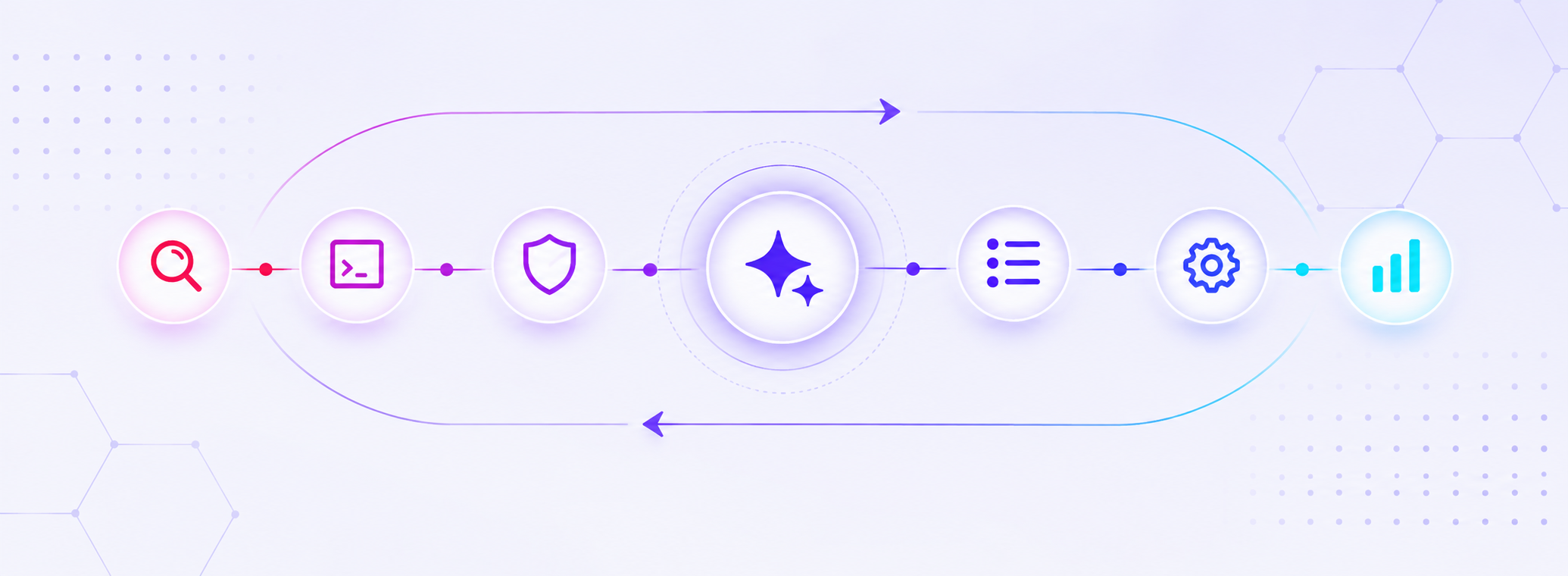
Discover. Emulate. Validate. Prioritize. Adapt. Re-prove.
That loop already exists inside most security organizations. The problem is that too much of it is manual, fragmented and slow. I presented on this topic in a recent webinar that you can access here From AI Hype to AI Risk: A New Security Reality.
The work has to start with plausible outcomes
Security teams face more signals than they can handle: vulnerabilities, threat intelligence, misconfigurations, alerts, exposures, control findings and business requests. AI will increase that volume.
So the first question is not “what else can we find?”
The first question is “what harm is plausible?”
That means security leaders should fund the work that connects four dimensions:
- Threat relevance. Who is coming at us, and with what tradecraft? Which threat actors, campaigns, tools and techniques match our environment?
- Attack surface validation. Is the attack surface actually relevant here? Can the path be reached? Can it be exploited in our environment?
- Control efficacy. Do our preventive and detective layers hold when tested? Can we block, detect and respond to the behavior that matters?
- Business impact. Which service, identity, dataset or obligation takes the hit if the path succeeds?
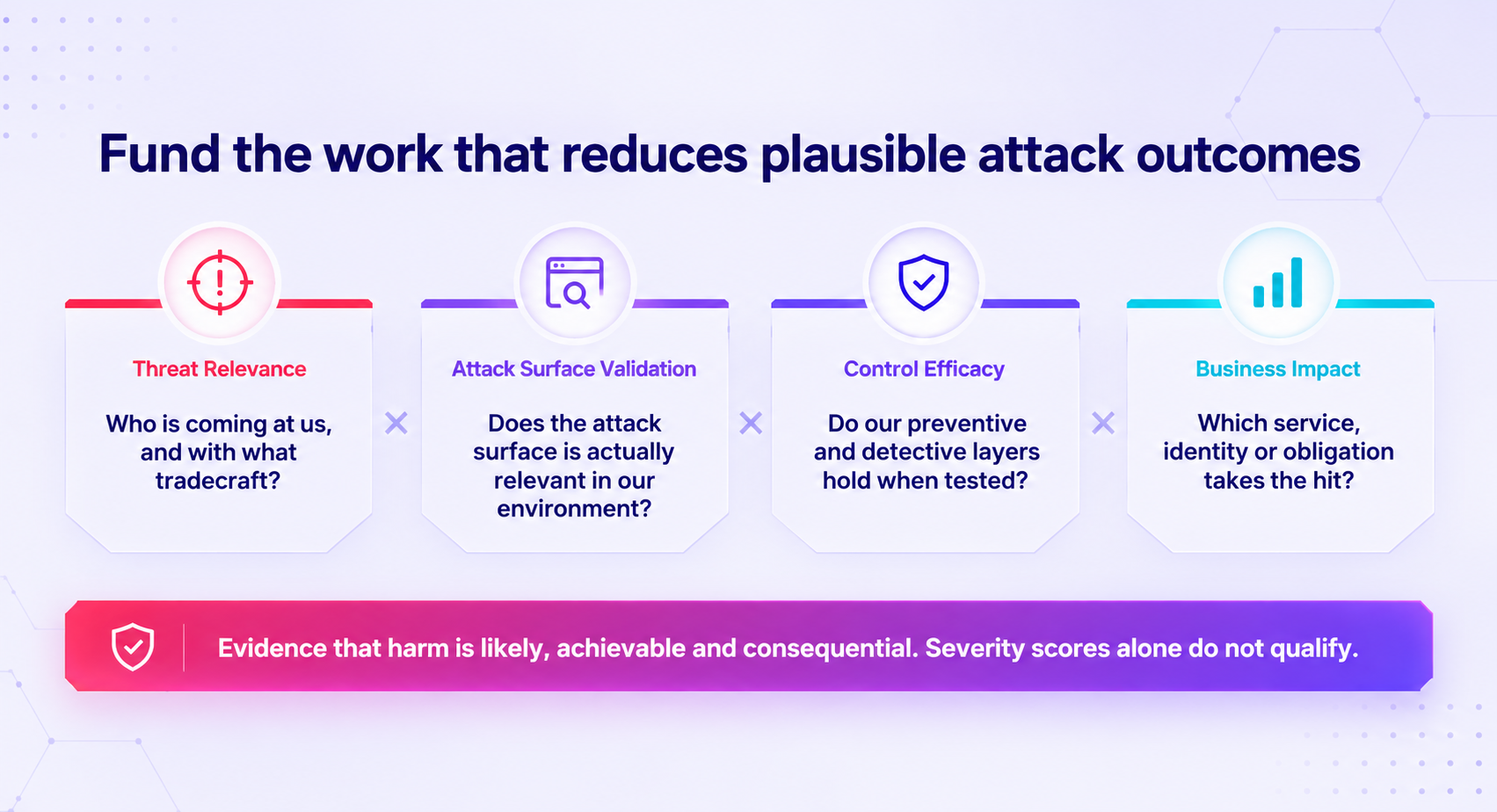
When these four dimensions come together, security teams can move beyond theoretical severity. They can prove whether harm is likely, achievable and consequential.
That is the evidence leaders need.
Why the loop matters
Security has always involved closed loop processes.
A new threat appears. Someone asks if the organization is exposed. The team investigates. A detection is checked. A control owner is pulled in. A fix is proposed. Someone retests. Someone reports. (For smaller teams, this may all be done by the same person.)
In many organizations, that loop runs through Slack messages, tickets, spreadsheets, manual analysis and tribal knowledge. It works only as fast as people can coordinate.
AI changes what is possible.
With the right guardrails, AI agents can help run the loop from signal to shipped change. They can monitor new threats and exposures. They can map behaviors to relevant attack techniques. They can help create emulations. They can interpret validation results. They can rank findings by proven risk. They can suggest control changes and retest after action is taken.
People still stay in charge of scope, materiality, safety and sign-off. That is important. Security automation without governance creates its own risk.
But human governance does not require human repetition.
The goal is to let machines set the pace while people make the decisions that matter.
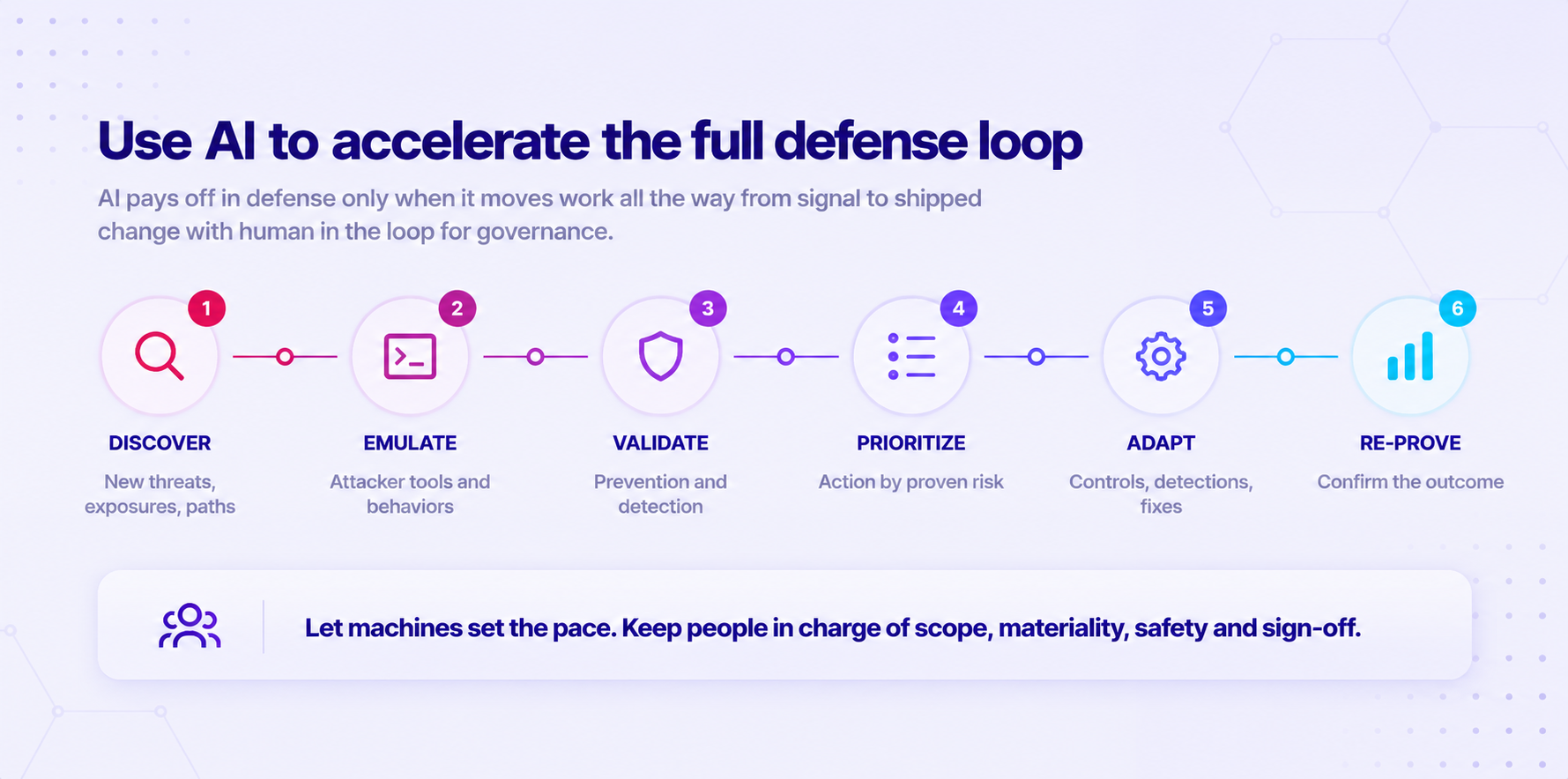
The six stages of an AI-accelerated defense loop
A practical defense loop has six stages.
1. Discover
The loop begins with new threats, exposures and attack paths.
Discovery can come from threat intelligence, vulnerability scanning, attack surface management, incident data, red team findings, vendor research or public reporting. AI can help normalize those signals and translate them into questions the security team can test.
The key is to avoid treating every signal as equal. Discovery should feed the loop. It should not become the final product.
2. Emulate
Once a threat is relevant, the team needs to emulate attacker tools and behaviors.
This is where defenders move from reading about a threat to testing whether it can work. Emulation should reflect how attackers operate, not only which CVE or indicator appeared in a report.
AI can help build and adapt emulation content faster. It can map behaviors to frameworks such as MITRE ATT&CK, suggest test paths and adjust scenarios as new intelligence arrives.
3. Validate
Validation answers the question security leaders actually care about: are we protected?
Can the attack succeed? Do preventive controls stop it? Do detection controls see it? Does the response process trigger? Are there gaps between what the architecture assumes and what the environment proves?
This is where evidence starts to replace opinion.
4. Prioritize
Once validation results are available, the team can rank work by proven risk.
That means looking at achieved impact, control gaps, threat relevance and business context. A finding that touches a critical identity or customer-facing service may move up. A finding blocked by effective compensating controls may move down.
AI can help connect the data, but priority should still reflect the organization’s risk strategy.
5. Adapt
Adaptation is where security work becomes real.
Controls are tuned. Detections are updated. Configurations are changed. Compensating controls are added. Tickets move to owners with measurable outcomes.
This is the stage where many programs slow down. They validate a problem, then lose time converting that evidence into action. AI can help draft changes, route work, recommend owners and support safe updates.
6. Re-prove
The loop closes only when the team proves the outcome changed.
Retesting matters. Without it, the organization does not know whether risk went down. Re-proving also shows drift over time as systems change, controls age and attackers adapt.
This is why the loop must keep running. AI-era defense is not a quarterly exercise. It is continuous engineering.
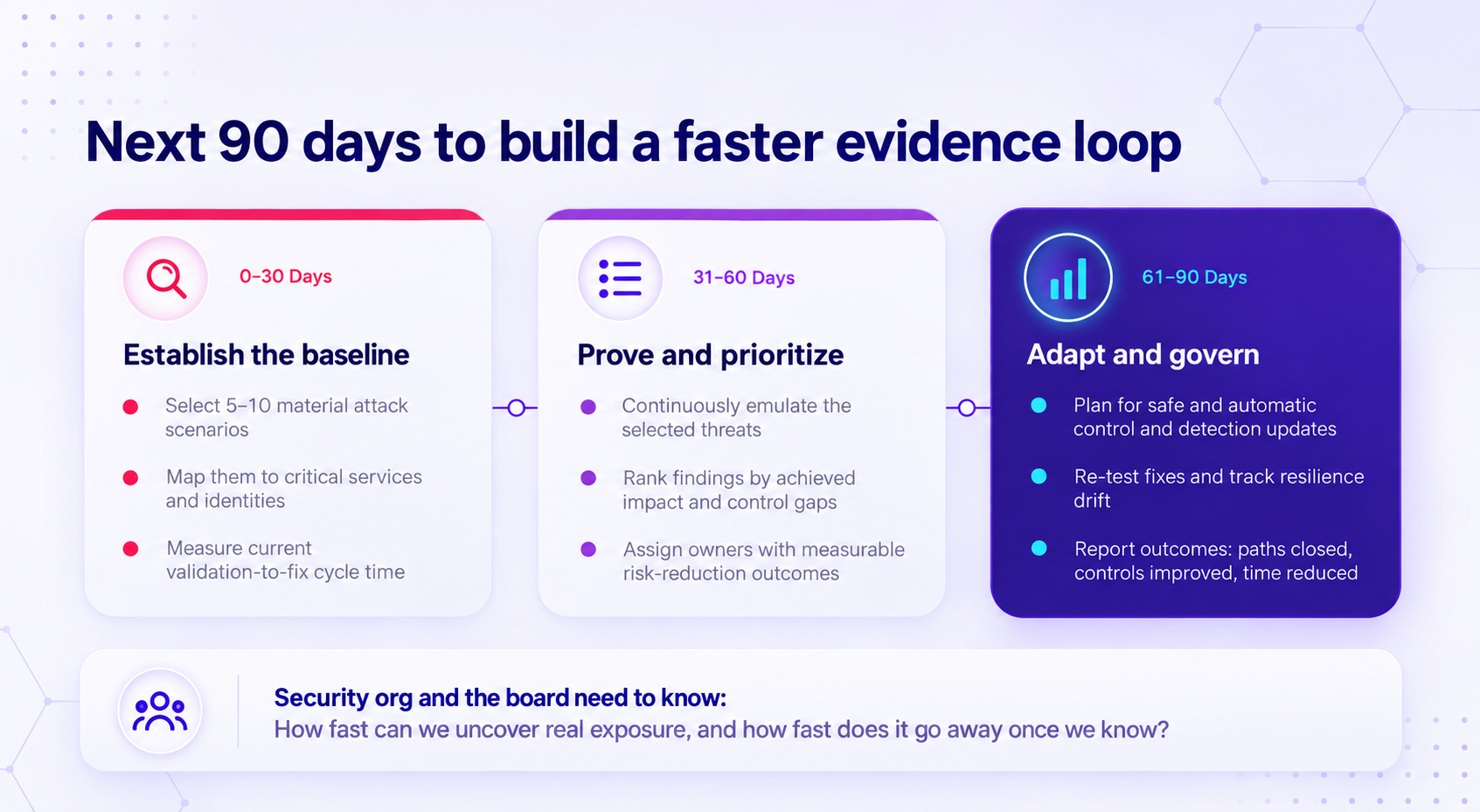
A 90-day plan for security leaders
Security leaders do not need to boil the ocean. They can start with a focused 90-day plan.
Days 0–30: Establish the baseline
Select five to ten material attack scenarios. These should reflect the threats, services and identities that matter most to the business.
Map each scenario to critical services and identities. Measure whether the organization can validate those paths today. Establish current validation-to-fix cycle time.
The goal is to answer a simple question: how fast can we uncover real exposure?
Days 31–60: Prove and prioritize
Continuously emulate the selected threats. Rank findings by achieved impact and control gaps. Assign owners with measurable risk-reduction outcomes.
This phase should change how the organization talks about risk. Instead of debating abstract severity, teams should discuss proven exposure and expected business impact.
The goal is to answer the next question: once we know about exposure, how fast can we make it go away?
Days 61–90: Adapt and govern
Plan for safe control and detection updates. Retest fixes. Track resilience drift. Report outcomes in plain business terms: paths closed, controls improved and time reduced.
This phase is where AI assistance can become part of the operating model. Start with human approval. Define what AI can recommend, what it can draft and what it can change only after sign-off.
The goal is to build speed without losing control.
What to report to the board
The board does not need to know how many findings a scanner produced this week.
The board needs to know whether the organization is getting faster at reducing real exposure.
A useful report should answer:
- Which plausible attack paths did we test?
- Which paths succeeded?
- Which controls failed or missed the behavior?
- Which business services, identities or obligations were affected?
- What changed?
- Did we re-prove the outcome?
- How much time did we remove from the cycle?
This gives leaders a clearer view of resilience. It also gives security teams a better way to justify investment. The case is no longer “we have many vulnerabilities.” The case is “we proved these attack outcomes were possible, removed them and reduced the time required to do it again.”
AI in the loop is mandatory
The main lesson from Mythos is not that defenders should panic.
The lesson is that defenders need their own AI strategy.
Attackers will use AI to discover, test and adapt. Security teams need AI to accelerate the defensive engineering process: proving, prioritizing, changing and proving again.
This is not about removing people from security. It is about putting people where they have the most value: setting strategy, approving material changes, governing safety and deciding what risk means for the business.
AI can take on much of the repetition. It can help teams move from signal to action faster. It can keep the loop running when human capacity is limited.
That matters because the attacker’s advantage is speed. The defender’s answer has to be speed with evidence and control.
Closing
Security teams cannot meet AI-scale attack with manual coordination alone.
They need a loop that turns new signals into validated exposure, ranks work by proven risk, adapts controls and confirms the outcome. That loop must be engineered. It must be governed. And now, it can be accelerated by AI.
The question for security leaders is simple:
What part of your security program is slowest today, and what would cut that time in half?
To learn more, check out the full webinar From AI Hype to AI Risk: A New Security Reality.

Featured Resources
View More Resources
Post-Mythos Security: When Exploits Outpace the Patch Cycle
AI accelerates vulnerability discovery and exploitation, making threat validation and evidence-based prioritization essential.

From AI Hype to AI Risk: A New Security Reality
Join Cymulate CTO Avihai Ben-Yossef: explore AI-driven attacks and how continuous validation helps defenders prioritize.

Agentic Cyber Defense Engineering
This e-book explores the six stages of agentic cyber defense engineering and how they work together to strengthen cyber defenses.