

Claude Mythos: Anthropic’s Cybersecurity Focused AI Model
Claude Mythos is a family of advanced Anthropic AI models with restricted access for sensitive work, including cybersecurity and biology research. Anthropic describes its latest version, Mythos 5.1, as its most capable model for those fields. Its official model page explains the access restrictions and safeguards.
Security teams are paying attention because published evaluations show progress in finding software weaknesses and carrying out complex attack tasks. That creates opportunities for defenders and pressure on remediation workflows. The practical issue is how quickly your team can turn a finding into a verified fix while keeping people accountable for the decisions.
What Is Claude Mythos?
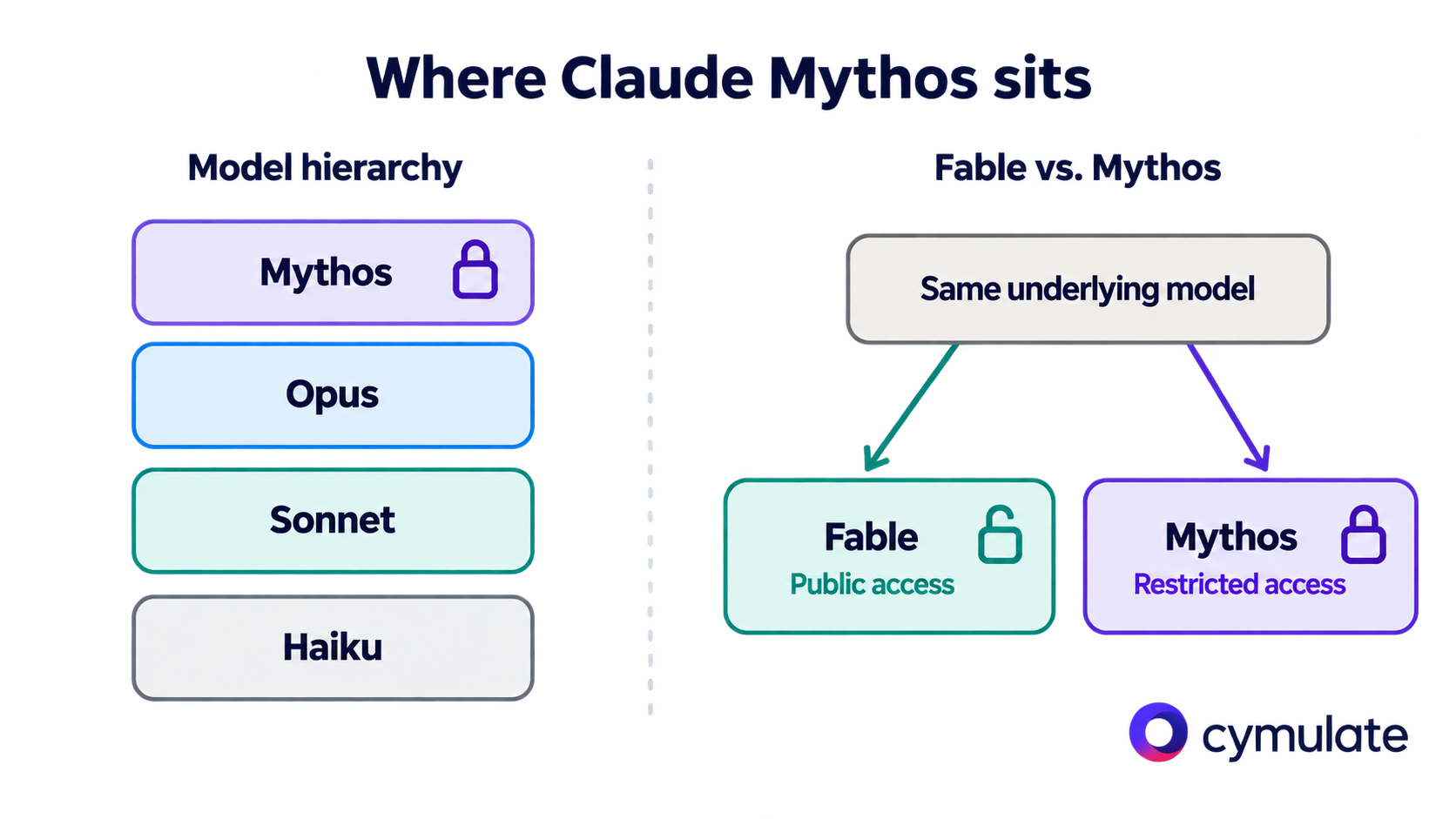
Anthropic Mythos sits above the Opus class in the company’s model hierarchy. The original Mythos Preview was a general-purpose model, even though its security performance drove the restricted launch. Anthropic says those capabilities emerged from improvements in coding, reasoning and autonomy, rather than explicit training for exploitation. Anthropic’s technical research describes that distinction.
The distinction matters when comparing vulnerability discovery AI with a conventional scanner. A scanner usually checks for recognized conditions. An AI research workflow can investigate hypotheses about unfamiliar code. Its output still needs review: a plausible explanation is not evidence that an attacker can reach and exploit the affected code in your environment.
Claude Fable is the publicly available counterpart. At matching versions, Fable and Mythos share an underlying model, but Fable applies additional safeguards. Anthropic’s June launch announcement explains why the company gave these configurations different names.
Mythos access remains controlled and depends on the relevant program and approved use.
Searches for “Mythos Claude” or “Mythos AI” generally refer to this model family. For a useful comparison, identify the version, its safeguards and the tools used during testing. Those details determine what an evaluation actually demonstrates. Check out the list of available Claude models and capabilities.
For security leaders, this also separates a model from a complete security product. The surrounding workflow determines which repositories or systems it can inspect, which tools it can use and how findings reach a human reviewer. Assess those boundaries before comparing a research demonstration with a production deployment.
Claude Mythos Release Timeline
The Claude Mythos release happened in stages. Public reporting, restricted research access and general availability of Fable are separate milestones.
| Date | Milestone |
| March 2026 | Leaked draft posts brought Mythos into public discussion before its official announcement. |
| April 7, 2026 | Anthropic announced Mythos Preview and Project Glasswing, including access for launch partners and more than 40 additional organizations. |
| June 2, 2026 | Anthropic expanded Glasswing to approximately 150 additional organizations across more than 15 countries. |
| June 9–12, 2026 | Anthropic launched Claude Mythos 5 and Fable 5 on June 9, then suspended access on June 12. |
| July 1, 2026 | Anthropic announced redeployment following government approval. Mythos access remained restricted to a set of U.S. organizations. |
| Sept. 1, 2026 | Anthropic introduced Mythos 5.1 and Fable 5.1, retaining different safeguards and access conditions. |
These dates also explain why early coverage can give a misleading picture of current availability. An April benchmark describes Mythos Preview. It should not automatically become a performance claim about Mythos 5.1 or the safeguarded Fable configuration.
What Makes Mythos Different From Earlier Claude Models
The strongest evidence concerns task completion and sustained work. In its independent evaluation, the U.K. AI Security Institute tested Mythos Preview on a 32-step simulated sophisticated corporate attack. Mythos completed the exercise in three of 10 attempts and averaged 22 steps. Opus 4.6 averaged 16 steps.
That result shows why security teams should pay attention to frontier model cybersecurity capabilities across a sequence of actions. Finding one weakness and progressing through an environment are different tests of capability. A tool that maintains useful progress over several stages may change how much work an operator can delegate.
The institute also emphasized the limits of its experiment. The simulated environment lacked active defenders and defensive tooling. Its results did not establish that Mythos could compromise well-defended organizations. Treat the evaluation as evidence of progress under stated conditions, not a forecast for every enterprise.
Model size alone offers little help in assessing that risk. Anthropic’s published pages reviewed for this glossary do not substantiate the 8-trillion-parameter estimate sometimes attached to Mythos. Evaluate demonstrated outcomes, access conditions and reproducibility instead of treating an unconfirmed size estimate as a product specification.
When reviewing a benchmark, ask for the task definition, available context and resource budget. Check whether the model received the vulnerable function directly or had to find it in a large repository. Also distinguish one successful run from reliable performance across repeated attempts. These details make comparisons useful for procurement and internal planning.
Claude Mythos’s Cybersecurity Capabilities
Published findings
Anthropic's published Mythos Preview findings cover several distinct outcomes:
- An OpenBSD flaw enabling remote crashes
- An FFmpeg memory error (Anthropic says the highlighted flaw was not critical and would be difficult to turn into a working exploit)
- A FreeBSD NFS vulnerability with a working remote-code-execution exploit
- A browser exploit chaining four vulnerabilities to escape sandboxes
Benchmark results
- Firefox experiment: Anthropic reported 181 working JavaScript-shell exploits from Mythos Preview, compared with two from Opus 4.6. These are successful experimental attempts, not counts of distinct vulnerabilities.
- Glasswing benchmark: 83.1% for Mythos Preview versus 66.6% for Opus 4.6 on CyberGym vulnerability reproduction.
What these measures actually test
Those measures answer different questions:
- Vulnerability reproduction tests whether a model can demonstrate an existing weakness.
- Zero-day discovery AI searches for previously unknown flaws.
- AI-assisted exploit development goes further by attempting to turn a weakness into a working attack.
A strong result in one category should not substitute for evidence in another.
Additional findings
- Anthropic also reported thousands of additional findings undergoing disclosure and validation.
- That statement should remain an attributed research claim, rather than a settled count of independently confirmed, exploitable vulnerabilities.
Maintainer evidence
- Mozilla reported that Firefox 150 included fixes for 271 vulnerabilities identified during its initial Mythos Preview evaluation.
- That is a concrete remediation outcome in a named product, rather than a general claim that every generated finding is valid or equally serious.
Researcher critiques
Researchers have challenged how broadly the headline claims should be interpreted:
- Bruce Schneier and David Lie argued that the published results left the false-positive rate of unfiltered output unclear. Their critique cautioned against assuming showcased successes represented the whole workflow.
- Stanislav Fort (Aisle) reproduced portions of the showcased analysis with smaller models. He acknowledged that his tests supplied relevant code and did not reproduce autonomous discovery and exploitation end to end.
Bottom line: These findings warrant scrutiny of aggregate counts and claims of exclusivity, without dismissing demonstrated results.
Why Claude Mythos Matters for Security Teams
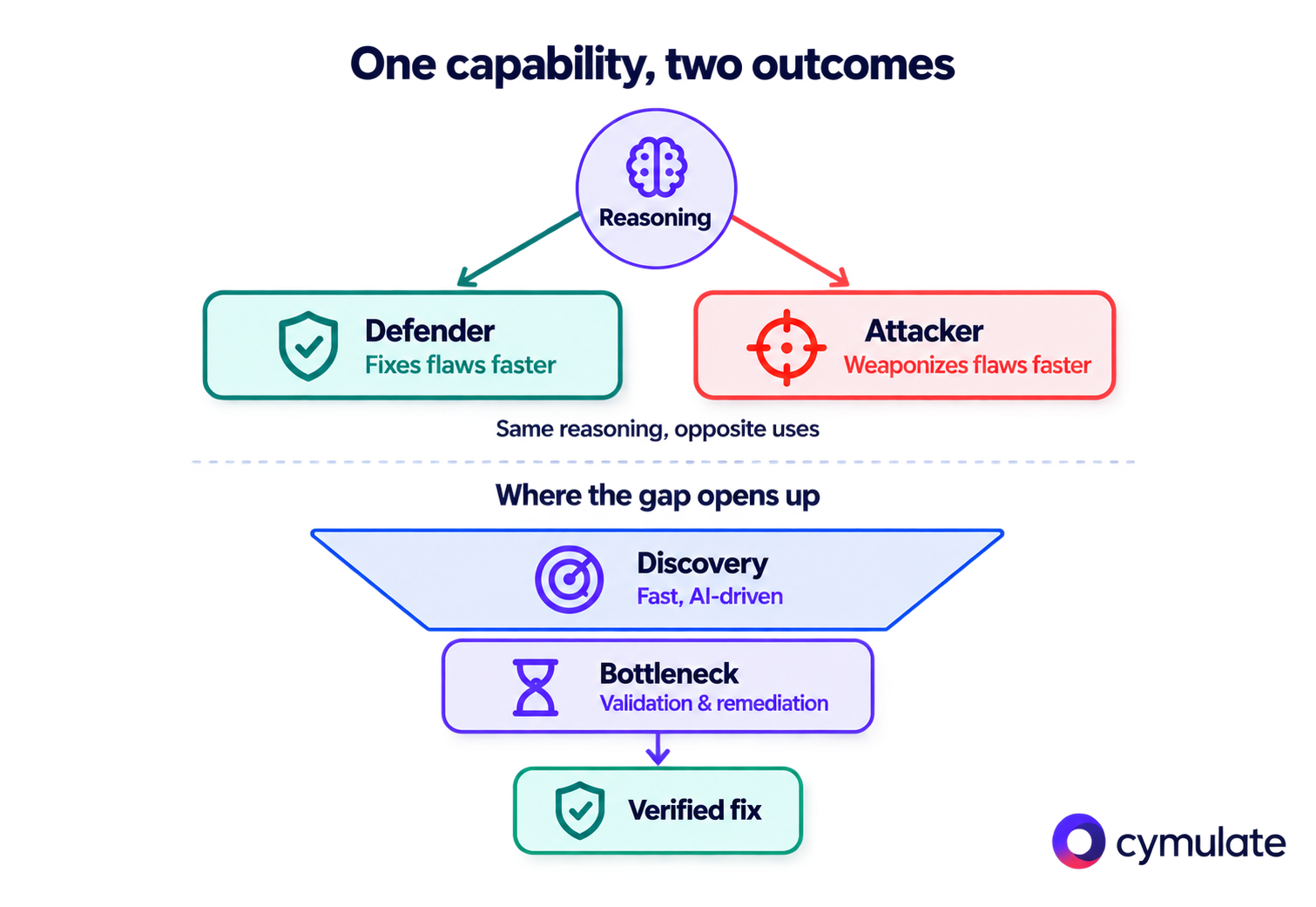
The security implication is dual-use AI risk: reasoning that helps a defender understand a flaw can also help an attacker develop an exploit. Anthropic’s restricted Project Glasswing rollout aims to give defenders an opportunity to strengthen critical software. Access controls address model distribution, but organizations still need to improve how they handle new findings.
Discovery speed has limited value when validation and remediation remain slow. In the Threat Exposure Validation Impact Report 2025, 61% of security leaders said their organizations lacked the ability to identify and remediate cloud exposures. Only 9% reported daily cloud exposure validation. These survey findings describe an existing operational gap; they do not measure attacks caused by Mythos.
Point-in-time assessments remain useful for deep investigation. Between assessments, however, deployments, permissions and security controls can change. A finding assessed last month may have a different attack path today. Continuous exposure validation helps teams keep evidence aligned with the environment they actually operate.
Automated penetration testing supports repeatable testing of potential attack paths. Pair it with control validation to establish whether relevant behavior is prevented or detected. Vulnerability discovery, exploitation testing and detection testing provide different evidence, so a mature program should connect their results.
For example, an AI-generated report might identify a flaw in a service your organization uses. Your first task is to confirm the affected version and configuration. Then establish whether an attacker can reach it, which privileges an exploit would provide and whether existing controls interrupt the path. That sequence turns a generic finding into a defensible remediation priority.
Build the response around clear ownership. Assign the affected service to an accountable team, preserve the evidence and agree on a fix or mitigation. After the change, repeat the relevant test. A closed ticket documents an action; a successful retest provides evidence that the exposure has changed.
Where a patch needs more time, document the interim protection and test it. That might mean reducing network exposure, tightening permissions or adjusting a security control. Keep the original fix on the work plan and review whether the temporary measure still holds after subsequent changes. Validation should support remediation decisions, not become a reason to defer them indefinitely.
Measure the time from discovery to validated priority and from remediation to verification. Track recurring control failures alongside unresolved findings. These measures help leaders see whether additional discovery capacity is reducing risk or simply increasing the queue.
This is the role of exposure management: connecting findings with exploitability, attack paths and business impact. Teams can start improving that process with their existing assessments and controls. Direct access to Mythos is not a prerequisite.
Keep humans responsible for business trade-offs. An automated test can show that a path works or that a control failed. The service owner still needs to weigh availability, implementation effort and the effect on users. Give that owner enough evidence to act, along with a clear deadline and a defined verification step.
How Cymulate is Involved
Cymulate Research Labs participates in the Anthropic Cyber Verification Program, as described in our program participation announcement. Our research focus includes exploitability analysis, adversarial simulation and detection validation – and we put that research to work through agentic cyber defense engineering: a closed loop that doesn’t stop at a finding, but tests it, prioritizes it and pushes a fix back into your controls.

Program membership and access to a particular model should remain separate claims. The Anthropic Cyber Verification Program currently provides certain Opus and Sonnet-class models with adjusted safeguards for vetted defensive use cases. Participation alone does not establish that an organization has Mythos access.
The intended customer benefit is research applied through the platform, rather than direct customer access to Anthropic’s models. For Cymulate customers, that shows up as sharper exploitability analysis, more relevant adversarial simulations, and – through Cymulate Auto Mitigation – vendor-specific detection rules and IoCs pushed straight into the security stack and re-tested to confirm the fix held.
As AI increases the capacity to discover vulnerabilities, validation and remediation can become the bottleneck. Agentic cyber defense engineering closes that gap: it shows which findings matter in your environment, mobilizes the mitigation and proves the fix worked.
Book a Demo to see how Cymulate connects testing with action.
Claude Mythos FAQs
No. As of Sept. 19, 2026, direct Mythos access remains restricted to vetted organizations. Anthropic’s availability information describes trusted access programs and current geographic limits. Fable is the broadly available counterpart. Program participation does not automatically guarantee access to every Mythos version.
Matching versions share the same underlying model, with different safeguards and access rules. Fable 5.1 permits source-code vulnerability identification, while safeguards still restrict tasks such as exploit generation and penetration testing. Mythos offers more permissive safeguards for approved research and defensive work.
Anthropic announced Mythos Preview on April 7, 2026, for restricted defensive use. Claude Mythos 5 followed on June 9 and Mythos 5.1 on Sept. 1. These dates mark successive controlled releases, rather than general public availability of Mythos.
Featured Resources
View More Resources
Post-Mythos Security: How Security Teams Can Build an AI-Accelerated Defense Loop
Build an AI-accelerated defense loop to validate exposure, prioritize proven risk, adapt controls and re-prove resilience.

From AI Hype to AI Risk: A New Security Reality
Join Cymulate CTO Avihai Ben-Yossef: explore AI-driven attacks and how continuous validation helps defenders prioritize.

Agentic Cyber Defense Engineering
This e-book explores the six stages of agentic cyber defense engineering and how they work together to strengthen cyber defenses.