

Cymulate Joins Anthropic Cyber Verification Program

Cymulate has joined the Anthropic Cyber Verification Program, giving Cymulate Research Labs access to advanced AI capabilities for defensive cybersecurity research. This strengthens our ability to improve exploitability analysis, adversarial simulations, detection validation and cyber defense engineering for customers.
The Anthropic program is designed for vetted cybersecurity organizations working on legitimate defensive use cases. It provides structured access to advanced cyber research capabilities, so trusted teams can conduct the dual-use work required to understand real-world risk: exploitability analysis, adversarial simulation, threat modeling, detection testing and security control validation.
For Cymulate, this is more than a milestone. It strengthens our ability to turn advanced cyber research into continuous, AI-powered cyber defense engineering. This helps customers prove their defenses work, prioritize the risks that matter most, improve controls and detections and re-prove security effectiveness as threats evolve.
Mythos changes the attacker-defender equation
Advanced AI models such as Claude Mythos mark a turning point for cybersecurity. They can help defenders analyze vulnerabilities, reason through exploit paths, model adversary behavior and pressure-test defenses faster and more deeply than before.
That power cuts both ways.
The same reasoning that helps a defender understand whether a vulnerability is exploitable can also help an attacker understand how to weaponize it. The same capabilities that support adversarial simulation can also accelerate adversarial operations if misused. To defend effectively, security teams often need to think like attackers while operating responsibly, safely and within clear controls.
The Anthropic Cyber Verification Program helps address that challenge by giving trusted cybersecurity organizations access to advanced capabilities for approved defensive work. For Cymulate, participation in this program strengthens our ability to stay ahead of evolving attacker behavior and translate that understanding into practical validation for our customers.
Why this matters for Cymulate Customers
Cymulate helps organizations continuously validate their security controls against real-world threats. Our platform is built around a simple idea: security teams should not have to guess whether their defenses work. They should be able to prove it.
Being part of the Anthropic Cyber Verification Program gives Cymulate Research Labs deeper access to cybersecurity research capabilities that support this mission. It strengthens our ability to study real exploitability, validate attack techniques in more depth, pressure-test detections and improve the threat intelligence and validation logic behind the Cymulate platform.
In practical terms, this helps Cymulate deliver stronger validation power to customers:
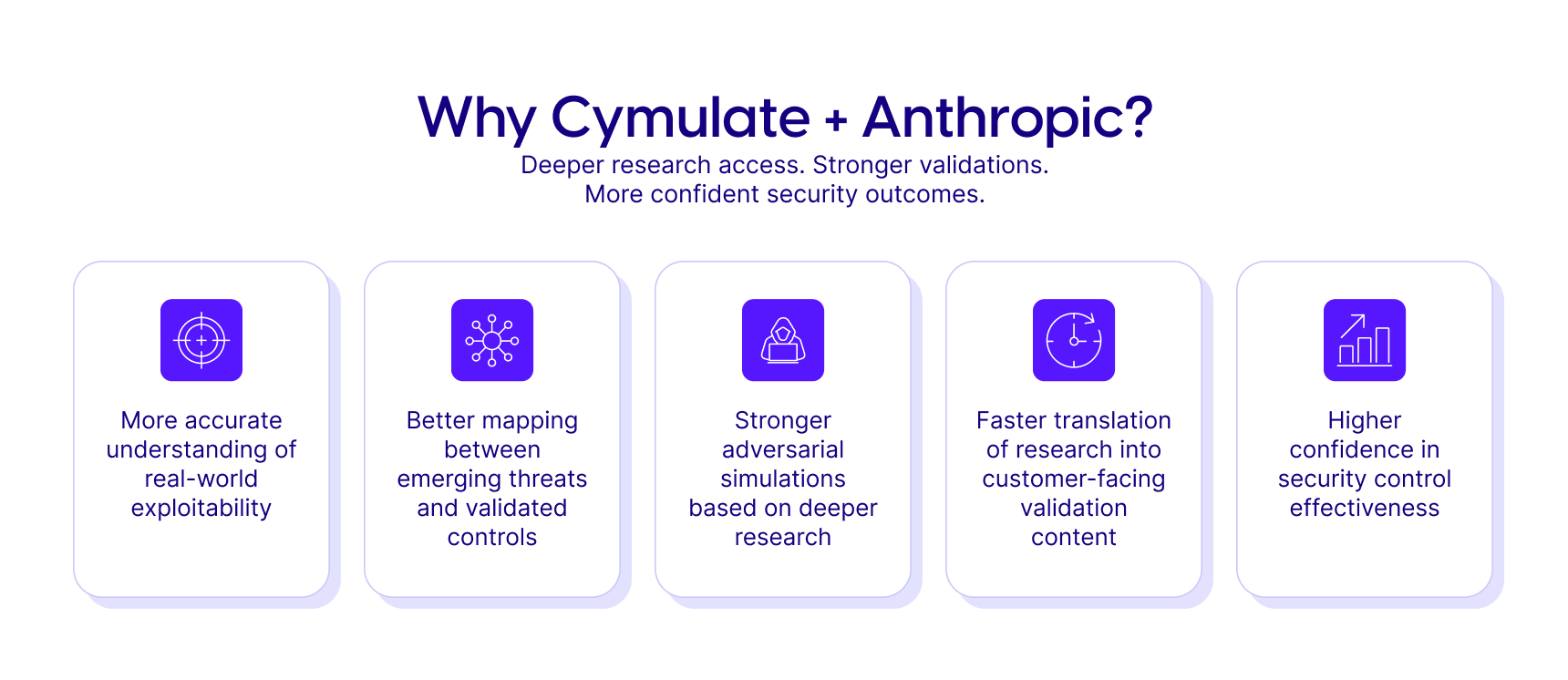
- More accurate understanding of real-world exploitability. Helps teams distinguish between theoretical exposure and risk that can actually be exercised in realistic conditions.
- Better mapping between emerging threats and validated controls. Connects new attacker techniques, vulnerabilities and campaigns to the defenses that should prevent, detect or respond to them.
- Stronger adversarial simulations based on deeper research. Improves the quality and relevance of the attack behaviors customers can safely test against their environments.
- Faster translation of advanced research into customer-facing validation content. Helps security teams validate against emerging threats sooner.
- Higher confidence in security control effectiveness. Gives organizations stronger evidence that their controls are tested against the way threats are actually evolving.
This supports the Cymulate mission to help organizations move from reactive security validation to continuous cyber defense engineering. Customers can validate real threats against their environment, understand which exposures are truly exploitable, prioritize the gaps that matter most and re-test after improvements are made. The outcome is measurable evidence that defenses are improving over time.
How advanced research becomes stronger validation for customers
The use of Anthropic's advanced cyber capabilities at Cymulate is focused on defensive research and customer value. Here are three ways this access can strengthen the validation outcomes customers rely on.
1. Studying exploitability with greater depth
Not every vulnerability creates the same level of risk. What matters most is whether an attacker can realistically exploit a weakness in a given context and what impact that exploitation could have.
With deeper AI-assisted research capabilities, Cymulate can further analyze exploitability patterns, attacker decision paths and the conditions that make a vulnerability meaningful in the real world. This improves the logic behind validation content and supports a more accurate understanding of which exposures matter most.
For customers, that means stronger evidence for prioritization. Instead of relying only on assumptions, teams can validate whether their controls stand up to relevant attack techniques and focus remediation where it will reduce the most risk.
2. Pressure-testing detections and controls
Modern defenses are complex. EDR, SIEM, identity controls, cloud defenses, email security, web gateways and other layers all generate signals. Coverage gaps still happen. The question is not whether a tool is deployed, but whether the control performs as expected when tested against realistic adversary behavior.
Anthropic advanced cyber capabilities can help Cymulate Research Labs reason more deeply about attacker behaviors and detection logic. That supports stronger simulations, better test design and more precise mapping between adversary techniques and expected security control responses.
Security teams can identify where controls are working, where visibility is thin and where improvements are needed before an actual attacker takes advantage of the gap.
3. Accelerating threat intelligence into validation content
Threats evolve quickly. New vulnerabilities, attack techniques, malware behaviors and adversary campaigns can move from research to active exploitation fast.
By using Anthropic capabilities as part of our defensive research workflow, Cymulate can accelerate the process of analyzing emerging threats and translating that understanding into validation content. This helps customers test their environments against current, relevant attack behaviors rather than static or outdated assumptions.
The result is a tighter loop between threat intelligence and security validation: understand the threat, map it to relevant controls, test the environment, identify gaps, improve defenses and validate again.
From advanced research to customer confidence
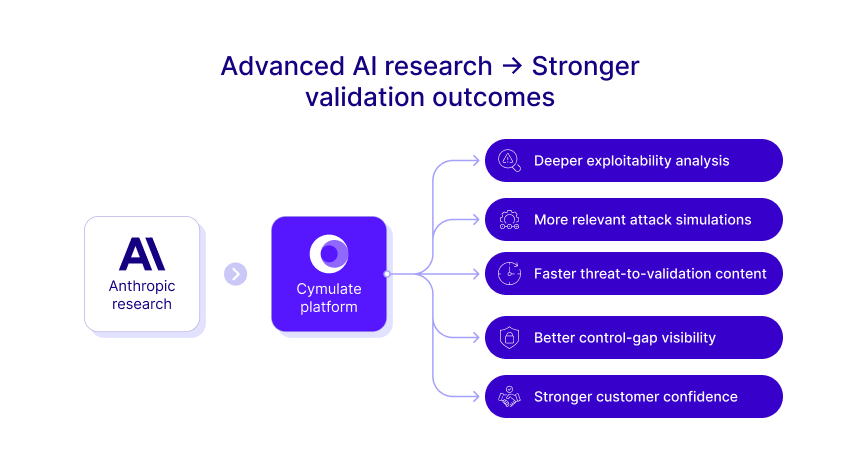
Customers do not interact directly with the underlying research access. They benefit from what that research makes possible inside the Cymulate platform.
For customers, stronger AI-assisted research does not mean adding another layer of security complexity. It means getting more value from the controls they already have by continuously testing, tuning and validating them against current attacker behavior.
For security leaders, this means stronger evidence of readiness and measurable proof of resilience. For SecOps and detection teams, it means more relevant simulations, clearer control-gap mapping and faster validation of fixes. For exposure and vulnerability teams, it means better insight into what is truly exploitable and what should be prioritized first.
As AI-powered threats become more capable, defenders need more than visibility. They need proof. They need to know which threats are relevant, which controls are effective, which gaps require action and whether improvements actually worked.
Approval for Cymulate to join the Anthropic Cyber Verification Program helps us advance that mission.
A stronger advantage for defenders
AI will continue to reshape cybersecurity. Attackers will look for ways to use it to move faster, scale operations and exploit weaknesses more efficiently. Defenders need validated intelligence, realistic testing and continuous improvement.
Cymulate is proud to be part of the Anthropic Cyber Verification Program and to bring advanced, responsible cyber research into the validation capabilities our customers rely on.
The future of cybersecurity will not be won by assumptions. It will be won by teams that can continuously prove what works, prioritize what matters, close the risk-to-fix gap and adapt as threats evolve.
FAQs
The Anthropic Cyber Verification Program gives vetted cybersecurity organizations access to advanced AI capabilities for legitimate defensive cybersecurity work. The program supports approved use cases such as vulnerability research, exploitability analysis, adversarial simulation, threat modeling, penetration testing and security control validation, enabling trusted security teams to conduct advanced research while helping prevent misuse.
Anthropic AI helps cybersecurity researchers analyze vulnerabilities, assess real-world exploitability, model attacker behavior and validate security controls more efficiently. These capabilities help accelerate defensive research, improve adversarial simulations, strengthen detection validation and translate emerging threats into actionable security testing and validation.
Cymulate Research Labs will use Anthropic AI to enhance defensive cybersecurity research, including exploitability analysis, adversarial simulations, detection validation and cyber defense engineering. The resulting research helps improve the validation content, attack simulations, and security control testing delivered through the Cymulate platform.
Customers benefit from more accurate exploitability analysis, stronger adversarial simulations, faster validation against emerging threats and better mapping between attacker techniques and security controls. These improvements help organizations continuously validate their defenses, prioritize the most significant risks and gain greater confidence that their security controls are effective against real-world threats.

Featured Resources
View More Resources
Cymulate Research Hub
Actionable threat research and security intelligence from the Cymulate Research Labs
The Pipe That Trusted Everyone
Ilan Kalendarov, Security Research Team LeadBen Zamir, Security ResearcherElad Beber, Security Researcher How a single misconfigured named pipe let an

CVE-2026-35603: One Writable Folder, Every User Compromised
A Windows configuration flaw lets low-privileged users compromise AI coding tools, enabling cross-user code execution.