

Agentic AI in Cybersecurity: Definition, Use Cases and Benefits
Agentic AI in cybersecurity refers to AI systems that can work toward security goals with a level of autonomy. These systems can interpret signals, reason through options, take action and adapt based on results.
This matters because security teams face more alerts, more tools and faster-moving threats than manual workflows can handle alone. Traditional automation helps with repeatable tasks. Generative AI helps produce content, summarize findings and support analysts. Agentic AI goes further. It can connect a goal to a sequence of actions, such as validating a control, prioritizing an exposure or recommending the next step in an investigation.
Agentic AI cybersecurity is about helping security teams move from reactive work to proactive validation, faster decision-making and more scalable security operations.
Key takeaways:
- Agentic AI can plan, decide and act toward a defined cybersecurity objective.
- It differs from traditional automation because it is not limited to fixed rules.
- It differs from generative AI because it focuses on action, not only output.
- Common use cases include SOC automation, threat detection, exposure validation, attack simulation and security posture management.
- Cymulate applies agentic AI principles through continuous security validation, automated attack simulations and data-driven exposure prioritization.
What is agentic AI in cybersecurity?
Agentic AI in cybersecurity is the use of AI agents that can pursue security goals with minimal manual direction. These agents can analyze data, decide what action to take and execute tasks across connected security systems.
A simple example is an AI system that receives a goal such as “validate whether this endpoint control detects a specific attack technique.” It then selects a safe simulation, runs the test, checks whether prevention or detection worked and recommends the next action.
Agentic AI systems usually combine several capabilities:
- Planning: Breaking a goal into steps.
- Reasoning: Choosing an action based on context.
- Tool use: Connecting with security systems, datasets or workflows.
- Execution: Taking action within approved boundaries.
- Feedback: Learning from outcomes and improving future actions.
This makes agentic AI different from basic automation. Traditional automation follows fixed instructions. For example, if an alert matches a rule, assign it to a queue. Agentic AI can evaluate the broader context, decide which next step makes sense and adapt the workflow based on new information.
It also differs from generative AI. Generative AI creates or summarizes content. It can draft a report, explain a detection rule or summarize incident notes. Agentic AI can use those outputs as part of a larger workflow, but its main value comes from action.
NIST’s AI Risk Management Framework also reinforces the need to manage AI risks through structured governance, measurement and management, especially as AI systems take on more operational responsibility.
How agentic AI works
Agentic AI cybersecurity systems usually work through a loop. The loop starts with a goal, moves through analysis and action, then feeds results back into the next decision.
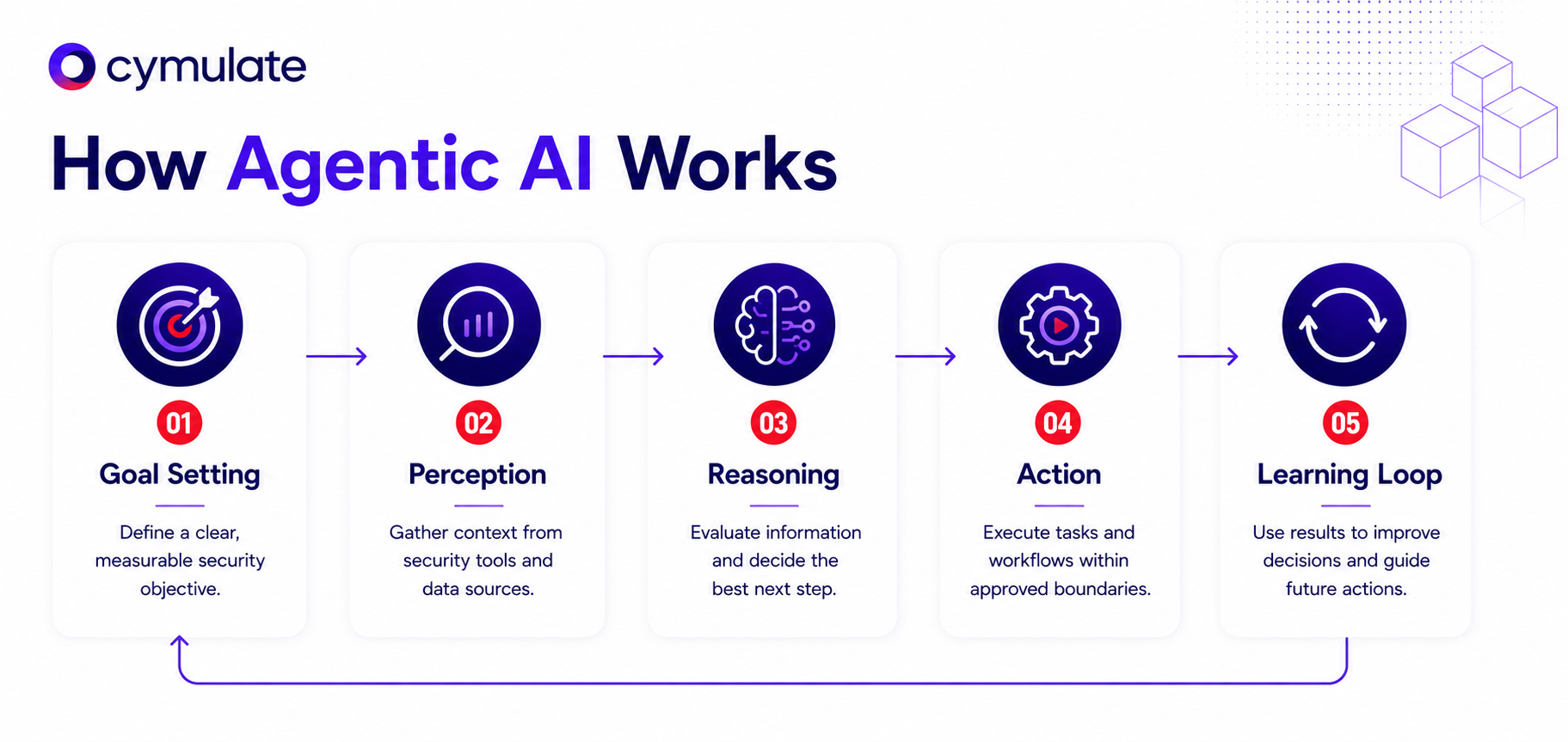
Goal setting
Every agentic workflow needs a clear objective. In cybersecurity, that objective should connect to a measurable security outcome.
Examples include:
- Reduce exploitable exposure across critical assets.
- Validate whether a SIEM rule detects a known technique.
- Test whether endpoint controls block a specific payload.
- Prioritize vulnerabilities based on exploitability and business impact.
- Recommend the next best action after a failed control test.
Strong goal setting matters because autonomy without boundaries can create risk. The system needs to know what it is allowed to do, what requires approval and what outcome it should optimize for.
Perception
Perception is how the system gathers context. In cybersecurity, that context can come from alerts, vulnerability scanners, endpoint detection and response (EDR), security information and event management (SIEM), cloud logs, identity systems, threat intelligence and exposure validation results.
The quality of agentic AI depends on the quality of the signals it receives. Weak data leads to weak decisions. Strong context helps the system separate noise from real risk.
Reasoning
Reasoning is where the AI system evaluates what the information means. It looks at the goal, the environment and the available actions. Then it decides what to do next.
For example, an agentic AI workflow may identify that a vulnerability exists on a critical asset. Instead of assigning the same score as every other scanner result, it can check whether the vulnerability is exploitable, whether a compensating control exists and whether the asset connects to a sensitive business process.
Action
Action is what separates agentic AI from passive AI assistance. The system can execute a task through approved integrations or workflows.
In a security context, actions can include:
- Running an attack simulation.
- Testing a security control.
- Opening a remediation ticket.
- Suggesting a SIEM rule update.
- Triggering a validation workflow.
- Prioritizing exposures based on tested impact.
These actions should happen inside strict control boundaries. Human approval should remain part of sensitive workflows, especially when actions affect production systems.
Learning loop
Agentic AI improves when it receives feedback. If a test fails, the system should record the result, update the risk context and recommend the next action. If a control performs well, the system can use that result to reduce uncertainty and focus on higher-risk gaps.
This loop helps security teams move away from point-in-time assessment. Instead of testing once, they can continuously validate whether controls still work as environments, threats and configurations change.
Agentic AI vs. Generative AI in cybersecurity
Generative AI and agentic AI are related, but they solve different problems.
| Category | Generative AI | Agentic AI |
| Main function | Produces text, code, summaries or explanations | Plans and executes actions toward a goal |
| Role in security | Assists analysts with research, reporting and documentation | Drives workflows such as validation, triage and prioritization |
| Level of autonomy | Usually responds to a prompt | Can take multi-step action within approved boundaries |
| Typical output | A written answer, summary, rule draft or recommendation | A completed task, workflow result or next action |
| Example | Summarizing an incident timeline | Running a validation test and recommending mitigation |
Generative AI can help a SOC analyst understand an alert. Agentic AI can help the team investigate, validate and prioritize the next action.
This distinction is important for security leaders. Buying “AI” is not enough. The real question is what the system can do. If it only summarizes information, it is assistive. If it can work toward an operational security goal, it is agentic.
Key use cases of agentic AI in cybersecurity
Agentic AI cybersecurity has the most value when it handles workflows that require speed, context and repeated decision-making.
SOC automation
Security Operations Center (SOC) teams deal with high alert volume and limited time. Agentic AI can support triage by grouping related alerts, enriching them with context and recommending next steps.
For example, an AI agent can review an alert, check asset criticality, compare it with known threat intelligence, inspect related events and decide whether the alert needs escalation. This helps analysts spend less time sorting noise and more time investigating real risk.
Threat detection and response
Agentic AI can help improve detection and response by connecting signals across tools. It can compare an observed behavior with known attack techniques, identify missing telemetry and recommend detection logic.
This is useful for detection engineering. A team can define a goal such as “validate detection for credential dumping.” The agentic workflow can run a safe test, check whether the SIEM or EDR detected it and suggest tuning if the rule failed.
IBM’s 2025 breach research found that organizations with extensive use of AI in security saved $1.9 million compared with organizations that did not use those solutions. The same report found that 97% of organizations reporting an AI-related security incident lacked proper AI access controls, which shows why security AI needs both speed and governance.
Exposure validation
Exposure validation is one of the strongest use cases for agentic AI. Security teams already have many tools that identify possible risk. The harder task is proving what is exploitable and what matters most.
Agentic AI can help validate exposures by selecting relevant tests, running simulations, checking control response and prioritizing remediation based on evidence.
Cymulate’s 2025 Threat Exposure Validation Impact Report found that 71% of surveyed security leaders see threat exposure validation as absolutely essential in 2025. It also found that organizations running exposure processes at least once per month experienced a 20% reduction in breaches.
Attack simulation automation
Attack simulation gives security teams a safe way to test how defenses perform against real-world tactics and techniques. Agentic AI can make this process more adaptive.
Instead of running a static test plan, an agentic workflow can choose simulations based on the organization’s environment, recent threat intelligence and previous validation results. If one path fails, it can recommend another test or mitigation step.
Cymulate reports that automated security validation can test 230 times more threats than manual testing methods. This scale matters because manual testing alone cannot keep up with fast-changing attack techniques and complex hybrid environments.
Security posture management
Security posture management depends on prioritization. A team needs to know which exposures matter, which controls failed and which actions reduce risk fastest.
Agentic AI can help by combining asset context, exploitability, control performance and business impact. It can then guide teams toward the exposures that deserve attention first.
This is where agentic AI becomes useful for continuous threat exposure management (CTEM). It supports the shift from “find everything” to “validate what matters and act on it.”
Benefits of agentic AI in cybersecurity
Agentic AI can improve security operations when teams apply it with clear goals and governance.
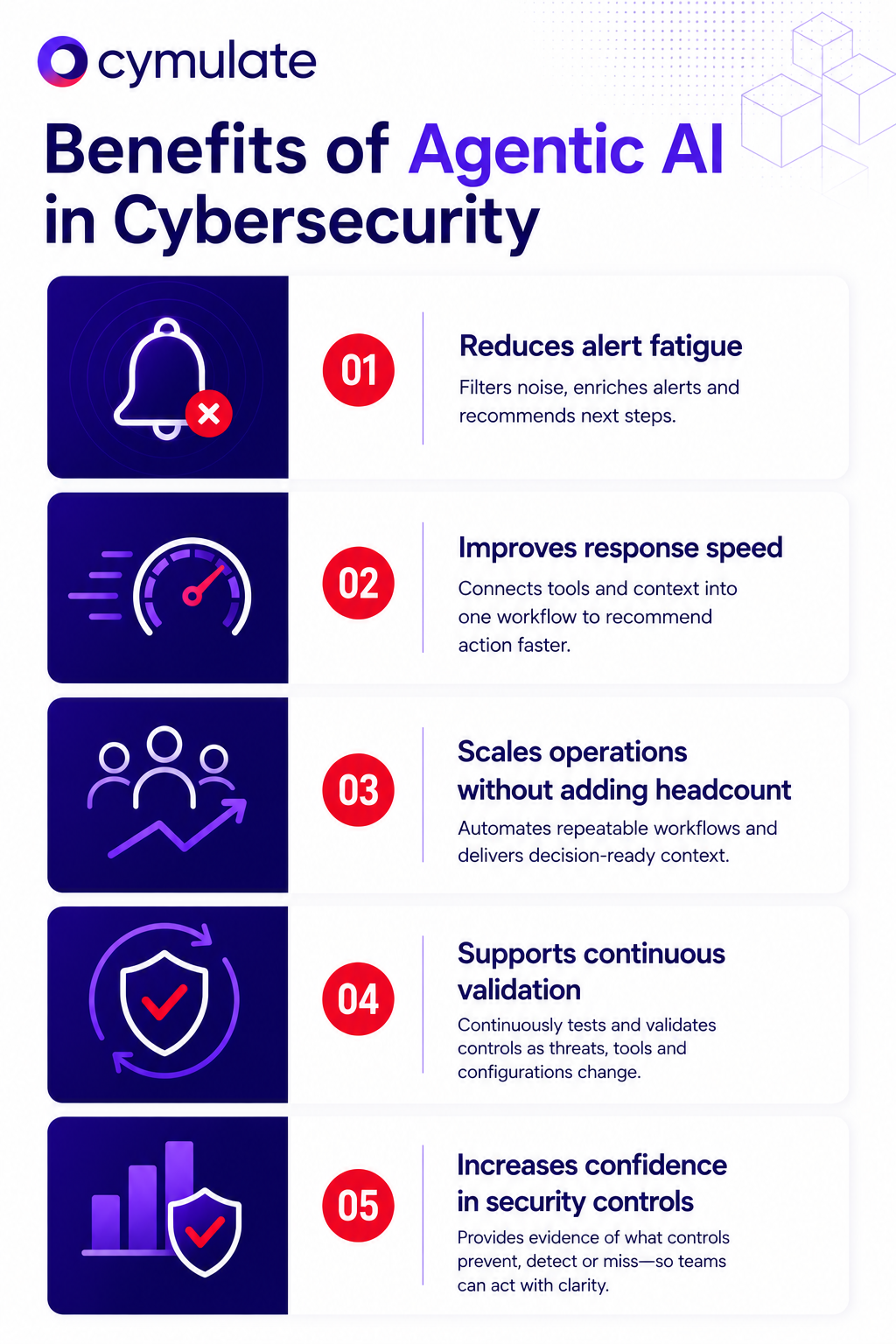
It reduces alert fatigue
Alert fatigue happens when teams receive more alerts than they can review. Agentic AI helps by enriching alerts, filtering noise and recommending next steps. It does not remove the need for analysts, but it gives them better context before they make a decision.
It improves response speed
Security teams often lose time moving between tools. Agentic AI can connect those steps into one workflow. It can gather context, check related signals and recommend action faster than a manual process.
Speed matters most when attackers move quickly across identities, endpoints and cloud environments.
It scales operations without adding headcount
Many organizations cannot grow their security teams fast enough to match their environment. Agentic AI helps by automating repeatable workflows and supporting analysts with decision-ready context.
This is especially valuable for tasks such as control testing, detection validation and exposure prioritization.
It supports continuous validation
Point-in-time testing gives a snapshot. Continuous validation shows whether defenses work as threats, tools and configurations change.
Cymulate’s impact data shows that 89% of security leaders have already begun implementing AI into exposure validation processes. It also found that 67% of respondents using automated security control validation observed positive changes in security metrics, such as fewer breaches or lower associated costs.
It increases confidence in security controls
Security leaders need evidence, not assumptions. Agentic AI can help prove whether controls prevent, detect or miss specific attack behaviors.
That evidence helps teams tune controls, prioritize budget and communicate security posture to executives in practical terms.
Challenges and considerations
Agentic AI introduces new value, but it also needs strong guardrails.
Trust and explainability
Security teams need to understand why an AI agent recommended or took an action. Black-box decisions are hard to trust, especially in incident response, detection engineering and control tuning.
Agentic AI systems should provide clear reasoning, evidence and audit trails.
False positives and decision risk
An AI agent can make the wrong call if the data is incomplete, stale or misleading. This can lead to wasted effort or missed risk.
Teams should start with low-risk workflows, monitor results and use human review for high-impact actions.
Integration with existing tools
Agentic AI becomes useful when it connects to the tools teams already use. That includes SIEM, EDR, cloud security, vulnerability management, ticketing and threat intelligence platforms.
Weak integrations limit action. Strong integrations help the AI system move from recommendation to execution.
Governance and control boundaries
Autonomy should never mean unlimited permission. Organizations need policies that define what the AI agent can do, when it needs approval and how actions are logged.
This aligns with broader AI security guidance from NIST, which highlights the need for common terminology, risk management and mitigation methods for attacks against AI systems.
How Cymulate applies agentic AI principles
Cymulate applies agentic AI principles through Vero AI, a domain-specific AI system designed for cybersecurity operations, exposure validation and security workflow orchestration. Unlike general-purpose AI assistants, Vero AI is purpose-built for cybersecurity use cases and operates within strict security, privacy and governance boundaries.
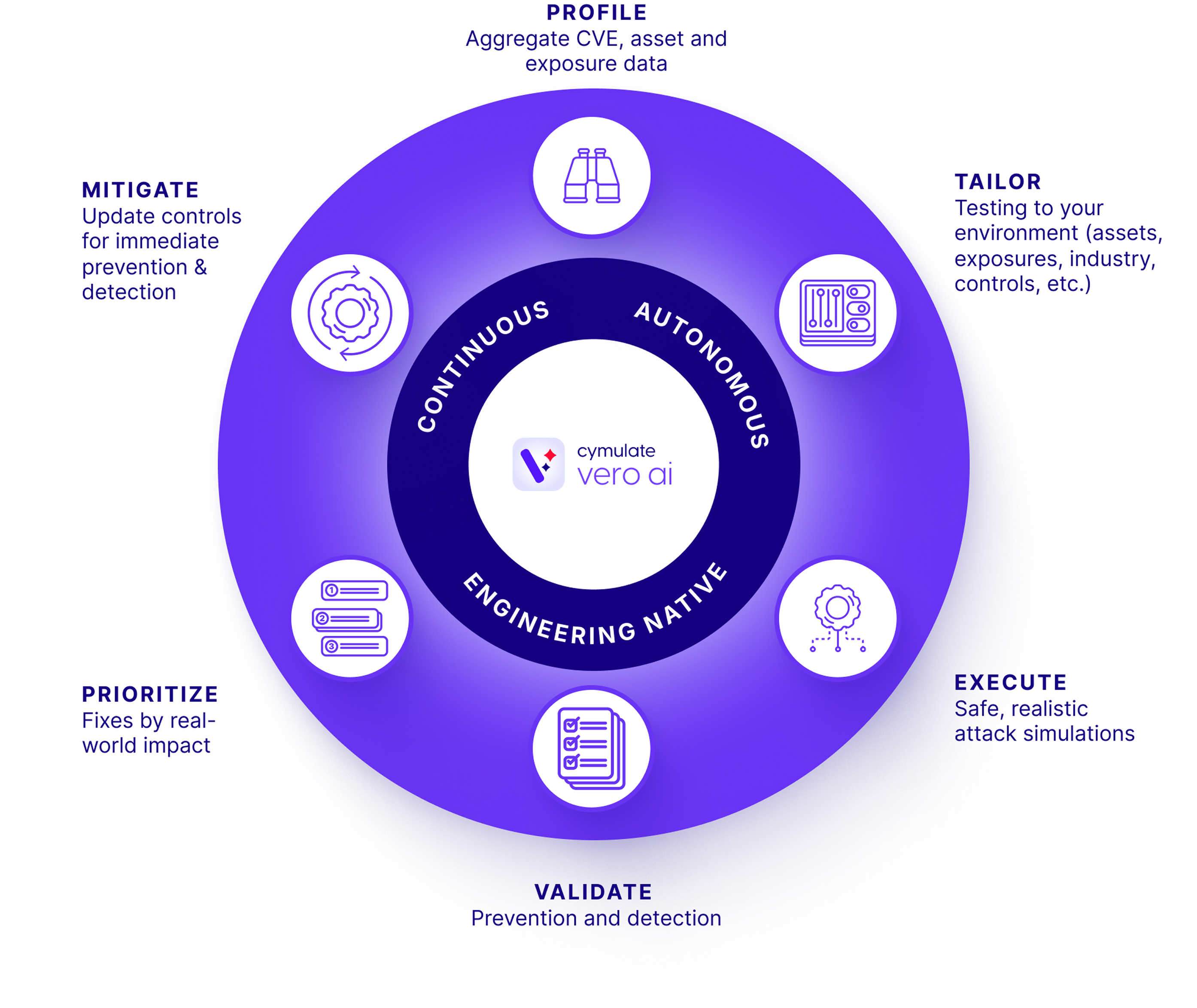
Vero AI uses an agentic AI architecture in which specialized AI agents handle specific cybersecurity tasks, including cybersecurity Q&A, dashboard creation, assessment generation and exposure validation workflows. A supervisor agent orchestrates requests and routes them to the appropriate domain-specific agent, helping ensure actions stay within defined operational boundaries.

The platform reflects the core agentic AI cybersecurity workflow:
- Define a security objective
- Analyze environmental and exposure context
- Select the appropriate validation or analysis activity
- Execute approved workflows or simulations
- Analyze outcomes and control performance
- Recommend the next best action
Cymulate combines commercially available foundation models accessed via Azure OpenAI and AWS Bedrock private endpoints with secure orchestration, observability and safety controls.
Security and governance are built into the architecture. Cymulate states that customer data is never used to train AI models, never shared across tenants and never exposed to public AI systems. The platform also applies multiple layers of AI guardrails, including NVIDIA NeMo Guardrails for content filtering and output sanitization, supervisor-agent routing, RBAC, SSO, MFA and full audit tracing through Langfuse observability.
For sensitive workflows such as SIEM validation, Cymulate applies one-way cryptographic hashing to validation queries before persistence. This helps ensure detection rules and validation logic cannot be reconstructed even if unauthorized access occurs.
Within exposure validation workflows, Vero AI helps security teams:
- Continuously validate security controls
- Prioritize exploitable exposures
- Support attack simulation workflows
- Improve detection validation
- Map environmental context to security risk
- Recommend remediation based on tested evidence
- Accelerate security decision-making with auditability and governance
This approach supports continuous threat exposure management (CTEM) by helping organizations move from reactive assessments to evidence-based, continuously validated cyber resilience.
Featured Resources
View More Resources
The Future is Agentic Cyber Defense Engineering
Cymulate’s Vero AI powers agentic cyber defense engineering to prove, prioritize and adapt security.
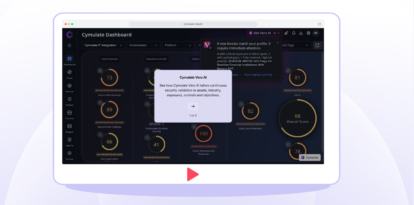
Cymulate Vero AI
See how Cymulate Vero AI tailors validation to your environment and automates the path to remediation.
Cymulate Platform
Cymulate automates threat validation and integrates exposure data to prove risk and optimize resilience.