

CISA BOD 26-04: Moving Beyond KEV to Risk-Based Vulnerability Validation

CISA's new Binding Operational Directive (BOD) 26-04 changes vulnerability management from prioritizing vulnerabilities by severity to prioritizing them by measurable operational risk. Organizations now need to validate exploitability, assess exposure, verify mitigations and continuously confirm that remediation actually reduced risk.
If a vulnerability meets all four factors, it gets a three-day remediation deadline. Everything else has more time.
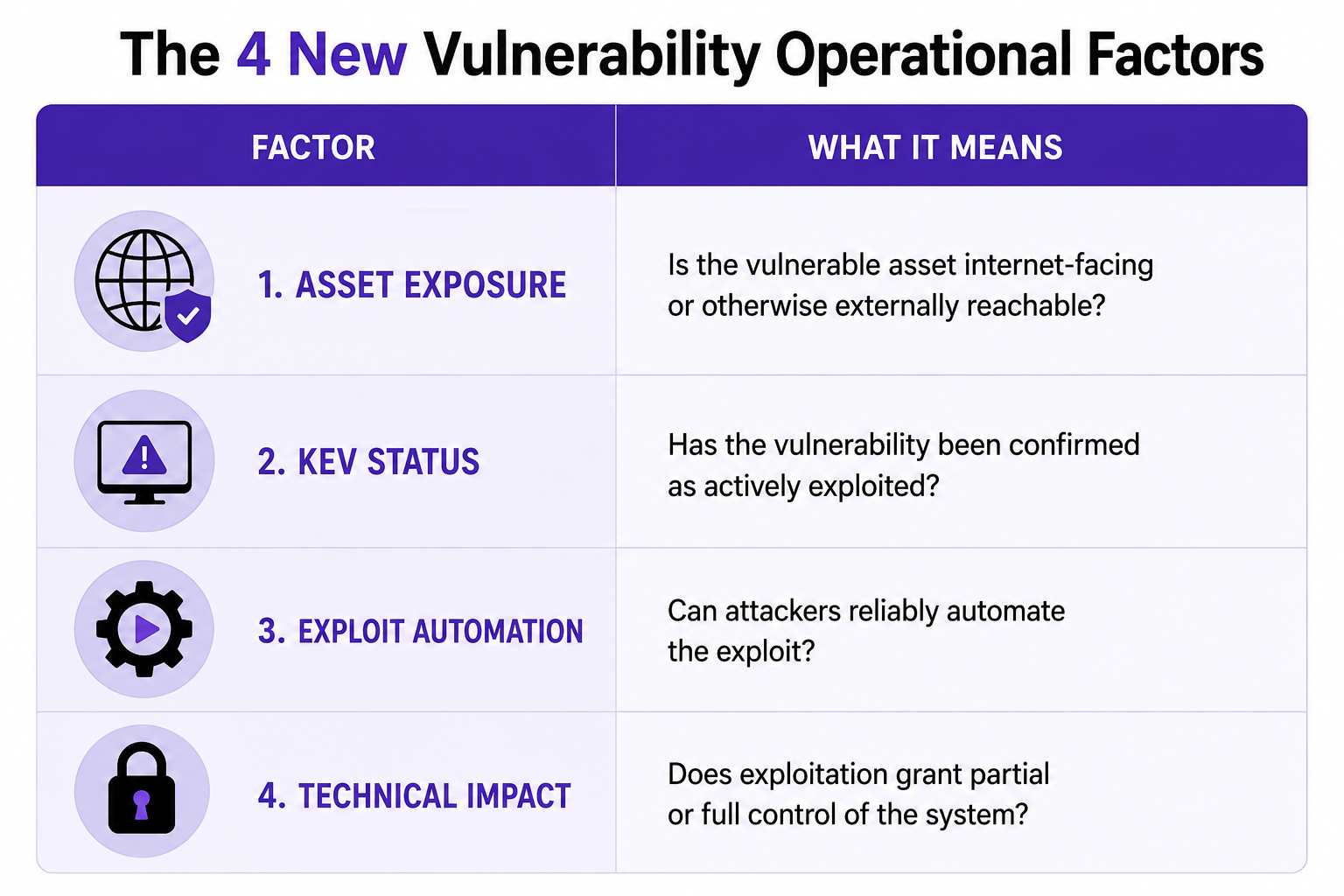
Before I go any further, there's one point worth making: this isn't new thinking for us. Long before this version 26-04, Cymulate was already prioritizing vulnerabilities this way. Our scoring applied the CVSS score to operational factors that determined whether a vulnerability is truly exploitable and poses real risk in a specific environment.
| Traditional Vulnerability Management | BOD 26-04 Risk-Based Model |
| Prioritize by CVSS | Prioritize by operational risk |
| Focus on patching | Focus on reducing risk |
| KEV is the primary signal | KEV is one of four factors |
| Measure remediation by patch deployment | Measure remediation by validated risk reduction |
| Severity-driven | Evidence-driven |
The commentary was immediate and, honestly, a little repetitive. Within weeks half the vendors in the space had published some version of the same take: CVSS is dead, stop patching everything, prove what's actually exploitable. They're not wrong. Risk-based prioritization is the right call, and proving exploitability instead of inferring it from a score is exactly where this industry should have gone years ago. But, that's only the front half of the directive. And it's now the crowded half.
If you read 26-04 to the end, past the SSVC tree everyone screenshotted, it asks three much harder questions that almost nobody is talking about. They're the questions I want to spend this post on, because they're the ones that decide whether you actually satisfied the directive or just closed a ticket.
Key Takeaways
- BOD 26-04 expands vulnerability prioritization beyond KEV.
- Operational risk now determines remediation urgency.
- Organizations should validate exploitability, not assume it.
- Compensating controls must be tested.
- Continuous validation provides evidence that remediation reduced risk.
Three Critical Requirements in CISA BOD 26-04 Most Organizations Miss
1. Were you already compromised before you patched?
26-04 doesn't just tell you to fix the worst flaws fast. For the flaws that meet all four of the operational criteria, it tells you to check for prior compromise before you apply the update. Even though this is easy to skim past, it is a big deal. A patch is good in that it closes the door and mitigates the risk; however, it does nothing about whoever already walked through it. If a vulnerability was exposed, in KEV, automatable, and high-impact, the directive's own logic says assume it was interesting to somebody, so prove it wasn't used against you. Ranking tools were never built to answer that. They rank doors. They don't tell you which ones were already opened.
2. What do you do when you can't patch in three days? Because often you can't.
This is the question that gets waved away, and it's the one operators actually live in. Three days is a fantasy for a lot of the riskiest assets: the vendor patch isn't out yet, the system is end-of-life, the change window is weeks away and you cannot afford downtime. A prioritized list that says "fix this in three days" is useless if you physically cannot.
Read 26-04 carefully. It asks you to reduce risk inside the window, and it explicitly leaves room for compensating action when a patch isn't available. That means the real lever, more often than anyone admits, isn't the patch at all. It's a compensating mitigation (a security control tightened, a rule deployed or a path segmented). This neutralizes the exploit now, so you buy down risk while the patch waits. The catch: an unproven mitigation is just a hope. You have to know it actually blocks the technique with validation that uses the latest threats.
3. Did the fix actually close the path, inside the clock?
Whether you patched or mitigated, teams are satisfied and treat the action as the finish line, when the “patch is deployed” or the “control is changed.” But this is not the finish line.
Deployed does not immediately equate to closed. Patches roll back, fail to apply cleanly to every instance, or fix the CVE while leaving the attack path reachable through a compensating gap somewhere else. The directive asks you to reduce risk, not to increment a patch-coverage percentage. The only way to know you did that is to test the path again after the fix and validate to verify the defenses around it now hold. Prioritization tells you what to fix. It cannot tell you the fix worked.
What working on the asset side taught me about validation
I spent a big part of my career on the asset side of this problem: building the inventory, mapping what an organization actually has and discovering what is genuinely reachable. I still believe in that work. The "is the asset exposed" question sitting at the top of the SSVC tree lives or dies on it.
But here's what that experience taught me, and it's the whole point of this post: a great inventory, and a great prioritized list built on top of it, is the setup, not the answer. Knowing what you have and what's exposed tells you where to point. It doesn't tell you whether someone already got in, and it doesn't tell you whether your remediation held. Every prioritization model is, at bottom, an estimate of risk at a point in time.
26-04 is quietly asking for something an estimate can't give you: proof. Proof you weren't breached. Proof the path is closed. Proof that still holds when conditions change.
That word, proof, is the whole reason I do what I do at Cymulate, so let me be direct about where I think the value actually is.
How Cymulate already aligns with this model
BOD 26-04 is a new regulatory direction, but the principle underneath it is one we've built on for years here in Cymulate. Rather than prioritizing a vulnerability just because it sits in KEV or carries a high CVSS score, Cymulate validates exposures and delivers proof on whether it presents meaningful risk by combining the same operational factors the directive now names:
- External and internal attack surface exposure
- Attack path reachability
- Exploitability, checked through safe simulation
- Security control effectiveness
- Potential business impact
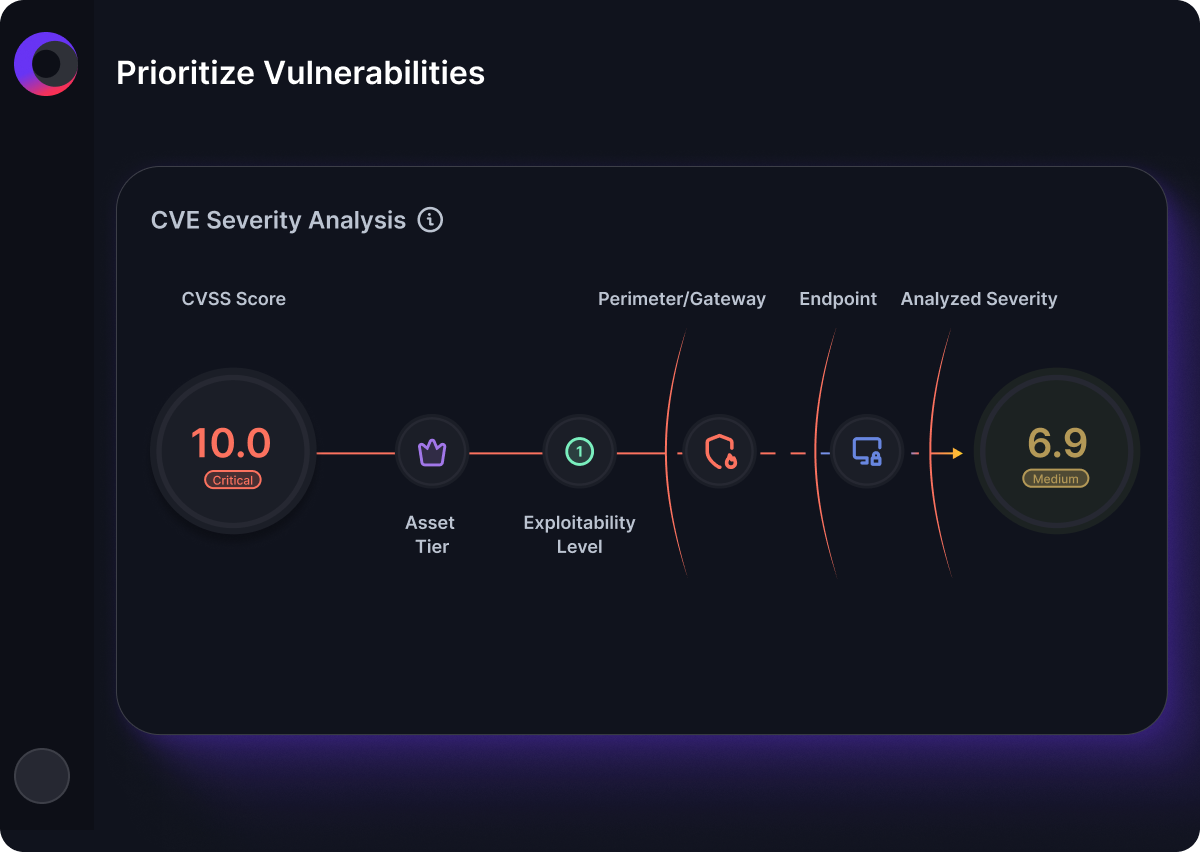
With Cymulate, security teams can quickly prioritize remediation on validated exposure, not on the mere presence of a vulnerability. A KEV-listed flaw is treated as an important intelligence signal, but its real priority is set by whether it's actually exposed, reachable by an attacker, exploitable in your environment and able to advance an attack.
The directive provides the prioritization framework. The Cymulate platform, powered with agentic AI, provides the operational mechanism to run it, which is not laid out specifically in the director. It’s up to organizations to figure out to implement this model. We already have an out of the box solution built for you.
The table below summarizes the key asks in the directive and how Cymulate accomplishes each of these asks.
| What BOD 26-04 asks | What Cymulate does |
| Is the asset publicly exposed? | Continuously discovers and validates the exposed attack surface. |
| Is exploitation likely? | Safely validates exploitability with attack simulations, no live-asset detonation. |
| What is the real operational risk? | Weighs attack paths, control effectiveness, and business context. |
| Prioritize remediation | Produces validated, evidence-based remediation priorities. |
| Reduce risk while patching | Tests whether compensating controls actually block the attack, and auto-remediate fixes to security controls |
How Cymulate turns a risk estimate into proof
Cymulate delivers validation, prioritization and mitigation, all in one platform. It's worth being precise about the mechanic, because the precision is the point. We don't detonate exploits on your production servers. Nobody sane wants their live domain controller compromised to satisfy a directive. Instead, we deploy a test point (a lightweight agent, a URL, or an email) into an environment configured with the same security controls as the asset you care about, and we safely run the attacker techniques a given exposure depends on.
What we measure is the effectiveness of your configured security controls: did they detect it, block it or did the attacker succeed? From that, we infer the security posture of every asset sitting behind the same controls. It's still an inference, but it's an inference from your defenses' measured behavior, not from a generic severity score. Map that mechanic onto 26-04 and its back half stops being a compliance essay and turns into a loop you can run.
We validate exposure against your real controls, not a score.
"Prove exploitability" only means something if it's proven against the controls actually protecting the asset. A severity number only means something if it reflects those same controls, so the risk score we put on each testable vulnerability isn't inherited from a CVSS figure. It's calculated from what we measure around that asset: whether the controls in front of it stop the techniques the exploit relies on, scored down to the (asset, environment) pair rather than as one global number. It's still an estimate, a calculated one, but it's grounded in your defenses' measured behavior instead of a generic score.
That's also why a CVE only counts as validated in our prioritization when a test ran in an environment connected to the affected asset, so you never get a Frankenstein score that borrows severity from one place and control effectiveness from another.
And we don't need to fire the exact CVE to tell you your risk: we deliver exposure validation to prove your controls stop the techniques that exploit relies on. That's the SSVC "exposure" and "impact" questions answered with evidence about your defenses. It's also, not coincidentally, the roadmap my team has been heads-down on all year. 26-04 just made it federal policy, which will eventually become the new standard.
We tell you which mitigation actually buys down risk while you wait to patch.
This is the one operators feel immediately. When you can't patch in the window, we don't hand you a generic "apply compensating controls" shrug. Every finding comes with mitigation guidance mapped to it and managed centrally in the Mitigation Hub. And with Cymulate Auto Mitigation we go past guidance: we can push the specific control updates on a schedule you set, not just hand you a document.
The part that matters is that you can validate the mitigation the same way you validated the exposure: apply the control, re-run the techniques against a test point carrying that control set, and confirm they're now blocked. That turns a compensating control from a hope into a proven risk reduction you can defend to an auditor while the patch is still weeks out. For the assets where three days is a fantasy, this is the difference between real safety and a missed-deadline finding.
We answer "would we even have seen it?" before you patch.
True forensic triage of a specific host, combing it for prior compromise, is IR's job. What we add before you patch is the other half of that question: if that exploit had been used against you, would your stack have caught it? We run the technique against a test point sharing the asset's controls and watch your detection and response. If it stays silent, you've learned something urgent: the path wasn't just open, it was invisible, and that reshapes your priority before you touch the patch.
We prove closure for the patch or the mitigation.
After the fix goes in, you re-run the same validation and confirm the techniques are now blocked or detected. If they are, you have an artifact showing the exposure is closed, for the auditor, the board, the insurer. If they still get through, you know in hours that "done" didn't mean "closed": a rollback, a partial deployment, a gap the fix never touched. And note what this does and doesn't claim: we're proving the controls around that asset now stop the attack, not re-exploiting your live server. That's the point. Proof without putting the real asset at risk.
We keep proving it.
26-04 demands for re-assessment "as conditions change," not an annual snapshot. Our assessments run on a schedule and on triggers, so validation isn't a one-time screenshot, it's continuous. A path that held last week can reopen on a config drift, a new integration or a rolled-back update. Continuous validation is how you catch that before an attacker does.
Put those together and you get the loop the directive is actually describing: validate exposure against your controls, get actual proof of exploitability, mitigate with automation, prove the mitigation holds, patch and prove closure and always re-validate. Prioritization gets you to the starting line. Continuous validation is what crosses it.
Don’t wait to act on BOD 26-04.
BOD 26-04 binds federal agencies. So did KEV, and KEV never bound a single private company before it turned up in cyber-insurance questionnaires, audit frameworks, and third-party risk reviews. 26-04 is a more sophisticated model than KEV, and it will travel the same road, probably faster. The commercial standard is being written right now, inside this directive. The teams that get ahead of it won't be the ones with the best-looking prioritized list. They'll be the ones who can prove, before the clock runs out, that the door is shut and nobody was already inside.
That's the half of the directive worth building for. It's the half we already built.
Ready to see your solution to BOD 26-04?
Schedule a Cymulate demo today to learn how continuous exposure validation helps you prove what vulnerabilities are exploitable, reduces risk while waiting for patch and re-validates.
FAQ
CISA Binding Operational Directive (BOD) 26-04 is a federal cybersecurity directive that requires federal agencies to prioritize vulnerability remediation based on actual risk, rather than relying solely on severity scores or whether a vulnerability appears in the Known Exploited Vulnerabilities (KEV) Catalog. It replaces previous directives with a more nuanced, risk-based approach that evaluates operational factors such as internet exposure, active exploitation, exploit automation and technical impact to determine remediation urgency and timelines.
The KEV Catalog is a list of vulnerabilities that CISA has confirmed are being actively exploited in the wild. It answers the question: “Is this vulnerability currently being exploited?”
BOD 26-04 is the operational framework that tells agencies how to prioritize and remediate vulnerabilities. While KEV status remains an important input, it is now only one of several risk factors considered. A vulnerability doesn’t have to be in the KEV Catalog to warrant rapid remediation if other risk factors indicate high operational risk
Risk-based vulnerability prioritization is the practice of fixing vulnerabilities according to their likelihood of exploitation and potential business impact, rather than simply patching those with the highest CVSS scores first.
This approach considers factors such as:
- Whether the asset is internet-facing
- Whether the vulnerability is actively exploited
- How easily attackers can automate exploitation
- The potential impact if the vulnerability is successfully exploited
- The criticality of the affected asset to the organization
The goal is to focus limited remediation resources where they reduce the most risk.
Stakeholder-Specific Vulnerability Categorization (SSVC) is a decision-making framework developed by CISA and Carnegie Mellon University’s CERT Coordination Center. Instead of assigning a single numeric score, SSVC helps organizations determine the appropriate response to a vulnerability by evaluating contextual factors such as exploitation status, mission impact, technical impact and exposure.
BOD 26-04 adopts SSVC principles to support more consistent, evidence-based remediation decisions rather than relying solely on severity ratings.
Continuous Exposure Validation (CEV) helps organizations move beyond identifying vulnerabilities to understanding which ones actually create exploitable risk. By continuously validating attack paths, security controls, and compensating controls, CEV enables teams to:
- Confirm whether a vulnerability is practically exploitable in their environment.
- Identify the assets that present the highest exposure.
- Verify whether security controls are effectively reducing risk.
- Prioritize remediation based on validated exposure rather than theoretical severity.
This aligns closely with BOD 26-04’s emphasis on risk-based prioritization, helping organizations focus remediation efforts where they will have the greatest security impact.
To help security teams align with the directive’s emphasis on reducing real-world risk, organizations should:
- Maintain an accurate inventory of assets and vulnerabilities.
- Prioritize remediation using contextual risk factors rather than CVSS alone.
- Validate whether vulnerabilities are actually exploitable.
- Continuously test security controls and compensating controls.
Compensating controls, such as network segmentation, web application firewalls (WAFs), endpoint protections, or access restrictions can reduce immediate risk when patching isn’t feasible or must be delayed. Organizations should use a solution like Cymulate to validate that compensating controls effectively prevent exploitation and continue to plan for patching whenever practical. Continuous validation can provide evidence that compensating controls are working, while also identifying when they are no longer sufficient.
Cymulate Continuous Threat Exposure Management enables organizations to validate which vulnerabilities are truly exploitable in their environment. By continuously testing and validating attacks, security controls and compensating controls, Cymulate helps security teams distinguish high-risk exposures from lower-priority findings, enabling faster and more informed remediation decisions.
Cymulate Exposure Validation helps reduce alert fatigue by identifying the vulnerabilities that represent genuine business risk. Rather than treating every critical CVSS finding as equally urgent, security teams can prioritize vulnerabilities that are exploitable and exposed.

Featured Resources
View More Resources
Cymulate CTEM
Automate threat validation with Cymulate Exposure Management and identify which risks are truly exploitable.

Cymulate Exposure Validation
Prove security readiness with AI-powered exposure validation that continuously tests threats and strengthens defenses.

Vulnerability Management Must Evolve to CTEM
Discover how CTEM helps VM teams decide what to patch now, verify existing mitigations, and proactively strengthen threat resilience.