

Endpoint Security Best Practices: How to Validate Your Controls

Endpoint devices are a primary target of attackers seeking initial access to your network. Once compromised, the devices become launch points for privilege escalation, lateral movement and data theft. Yet many organizations rely on endpoint security tools without ever verifying they actually work.
This article covers best practices for endpoint security validation to ensure your defenses are properly configured and ready for real-world threats.
Key highlights:
- Endpoint security validation is the continuous measurement of how well your endpoint controls detect and prevent threats.
- Endpoint detection and response (EDR) best practices establish a baseline of defense that requires continuous testing to ensure policies remain effective against evolving threats.
- Cymulate enables continuous endpoint security validation with an automated platform that identifies weaknesses and tests your controls.
What is endpoint security validation?
Endpoint security validation is the process of systematically testing and verifying that antivirus (AV) and endpoint detection and response (EDR) solutions function as designed against real threats. Unlike passive monitoring or log reviews, validation involves actively simulating attack techniques and malicious behaviors to assess detection and prevention capabilities.
The scope of endpoint security validation encompasses three pillars:
- Coverage: If your solution detects both known threats and new, emerging ones.
- Configuration: If your controls are properly tuned, updated with the latest threat intelligence and set up correctly for your environment.
- Effectiveness: If your tools can actually stop real attacks when they happen on your devices, not just identify them after the fact.

Why is endpoint security important?
Endpoint security is often identified as the most critical control point, as endpoint devices are the primary targets of attackers. Threat actors are looking to gain initial access to an endpoint, escalate their privileges and then move laterally across other endpoints on the network in search of systems and data of value (or your IT crown jewels).
Security controls include legacy signature-based AV solutions and more sophisticated behavior-based EDR solutions within a broader endpoint protection platform (EPP). But having endpoint security tools installed is not enough.
Malicious actors constantly evolve their attack techniques, and security tools require proper configuration and regular updates to stay effective. Without validation, you have no way to know if your AV or EDR solution will actually catch an invasion. A tool that worked well six months ago may fail against new threats today. Validation reveals gaps in detection, misconfigured settings and outdated threat signatures before an attacker exploits them.
Best practices for endpoint security validation
An effective approach to cybersecurity validation is to simulate real threats, including ransomware, rootkits, DLL side-loading, code injection and other advanced evasion techniques.
Here are the six core endpoint security best practices designed to validate both AV and EDR solutions:
1. Test your controls weekly
Given the role that endpoints play in day-to-day business operations and the diversity of endpoint devices (Windows, Mac, Linux, Desktops, Laptops, Servers, etc), weekly testing helps you identify weaknesses before attackers do. Your security controls need regular validation to ensure they remain effective against new attack techniques and emerging threats.
2. Test detection of known malware files
Security teams should conduct validation tests using a comprehensive suite of the latest known malware file samples to determine the detection and prevention capabilities of the antivirus solution and verify that the signature database is up to date and that the software is properly configured to scan all relevant files and data streams.
These tests simulate the dropping of signature-based malware samples to disk to test the response of traditional antivirus and anti-malware software running on the endpoint.
3. Validate detection of malicious behaviors
Today’s threat actors have moved beyond signature-based attacks, which are easily detected by endpoint security controls, to more behavior-based attacks that are harder to detect because they often leverage legitimate system processes and user behavior to bypass security controls. These types of attacks require more sophisticated EDR solutions to detect and prevent attacks based on suspicious and malicious behaviors.
Security teams should simulate a wide range of adversary behaviors using different execution methods and payloads covering the latest malware, ransomware, worms and trojan samples to validate their EDR detection and prevention capabilities fully.
4. Detect system-level manipulation (rootkits)
Rootkits are a type of malware that typically runs at low levels in the operating system to avoid detection. They often manipulate core system functions and substitute system calls to try to disguise their malicious actions.
Security teams should test their endpoint security controls to validate the integrity of system binaries and determine if the controls can detect when system functions have been altered by a threat actor.
5. Catch malicious DLL loading
DLL side-loading is another method used by threat actors to load malicious files into the memory space of legitimate applications to evade detection.
Security teams should simulate these attacks to verify their endpoint security solution can detect and block this evasion technique before it compromises systems or data.
6. Stop code injection attacks
Code injection is a method used to exploit the applications that are running on the endpoint devices with the goal of compromising systems, applications and data.
Security teams should simulate the injection of malicious code into input fields of their trusted applications running on their endpoints.
Follow the best practices for endpoint security validation with Cymulate
The Cymulate Endpoint Security Validation solution removes the manual work from EDR testing. Instead of building custom test scenarios or struggling with spreadsheets, your security team gets an automated platform that continuously validates your AV and EDR controls.
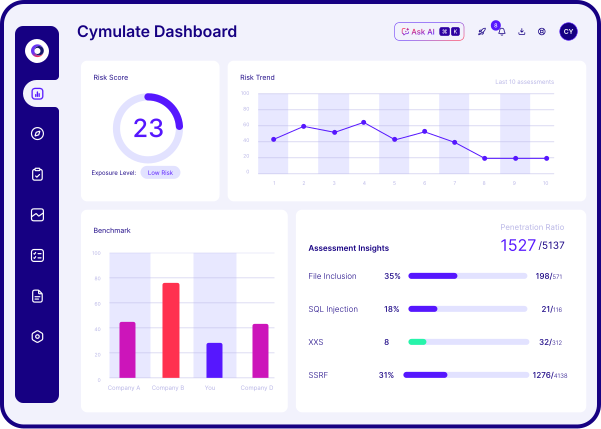
Our platform offers:
- More than 490 test scenarios against attack techniques
- Production-safe testing with no risk to your environment
- Automated assessment reports with Risk Scores and Penetration Ratios
- Actionable mitigation guidance and EDR-specific rules to fix gaps
- Integration with leading EDR solutions (Microsoft Defender, CrowdStrike, SentinelOne, and more)
Schedule a demo to see how Cymulate automates endpoint security best practices, from continuous threat simulation to immediate gap remediation.

Featured Resources
View More Resources
Endpoint Security Validation
Test and optimize the efficacy of your Av and EDR security controls with our endpoint security validation solution.

SentinelOne + Cymulate = Self-Healing Endpoint Security
Validate and optimize SentinelOne endpoint security with Cymulate to uncover gaps and improve threat detection.

Security Validation Best Practices
Explore the Principles of Security Validation in this best practices eBook from your authority in security and exposure validation.