

MITRE ATLAS AI Security Framework: Tactics and Techniques Explained
AI models, copilots and agents are now part of the enterprise attack surface. By connecting them to corporate data, repositories, APIs, files, messaging systems and operational tools, enterprises create business value, but they also introduce attack paths not addressed by traditional security frameworks.
Security teams need a common language for these threats and evidence that their defenses work. MITRE ATLAS organizes adversary tactics and techniques involving AI-enabled systems. Cymulate Exposure Validation helps teams turn relevant adversary behaviors into controlled tests that measure prevention, detection and response across the applications, identities, data, infrastructure and security controls surrounding AI.
This article explains how ATLAS describes attacks against AI-enabled systems, why agents can increase the potential impact and how organizations can use exposure validation to test the effectiveness of their security controls to prevent and detect.
Key Takeaways
- ATLAS provides a common language for AI threats. It organizes adversary tactics, techniques, mitigations and case studies involving machine learning, generative AI and agentic systems.
- AI security must cover the complete system. Models operate within applications, data pipelines, infrastructure, identities, APIs, tools and security controls, all of which create attack paths.
- ATLAS helps identify relevant behaviors to test. Exposure validation then determines whether the corresponding prevention, detection and response controls work.
- Point-in-time assessments quickly become stale. Models, prompts, data sources, integrations, permissions and controls change frequently, so validation should be continuous.
What Is MITRE ATLAS?
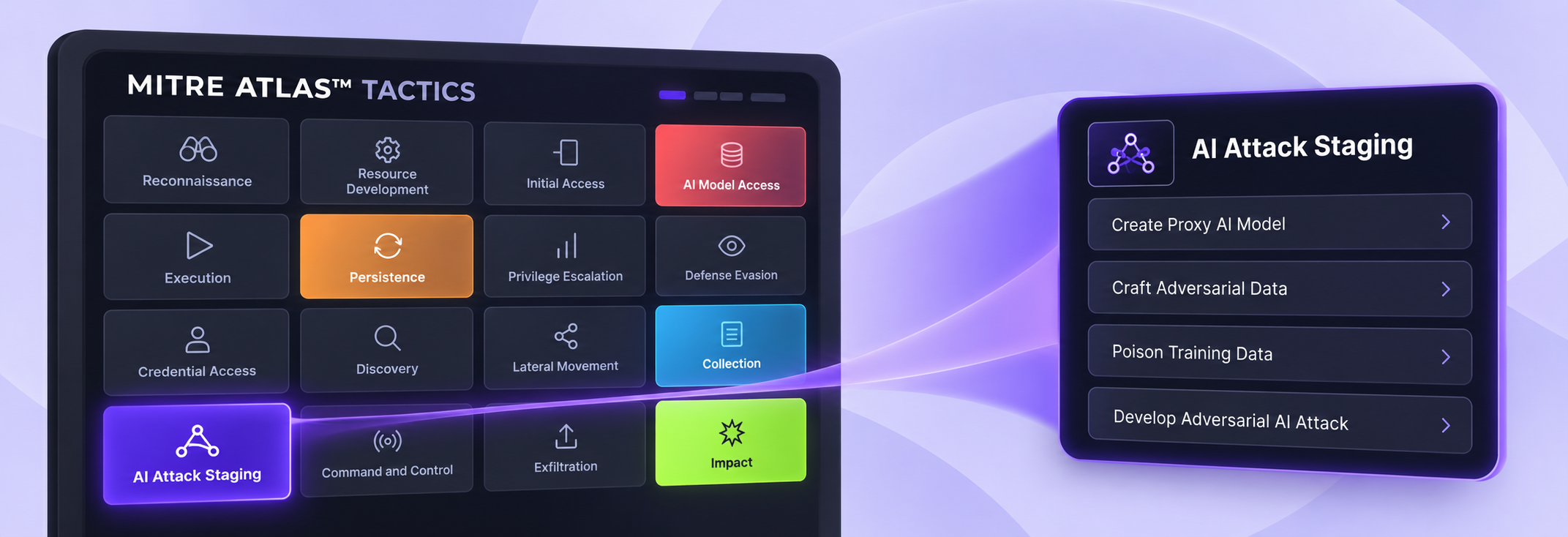
MITRE ATLAS, short for Adversarial Threat Landscape for Artificial-Intelligence Systems, is a publicly available knowledge base of adversary tactics and techniques targeting AI-enabled systems. It is modeled on MITRE ATT&CK and focuses on threats involving machine learning, generative AI and the systems built around them.
ATLAS organizes AI threats into four primary elements:
- Tactics. The adversary's objective at a stage of an attack.
- Techniques and sub-techniques. How the adversary attempts to achieve that objective.
- Mitigations. Measures that can reduce the likelihood or impact of a technique.
- Case studies. Observed incidents and realistic demonstrations that show how attacks unfold.
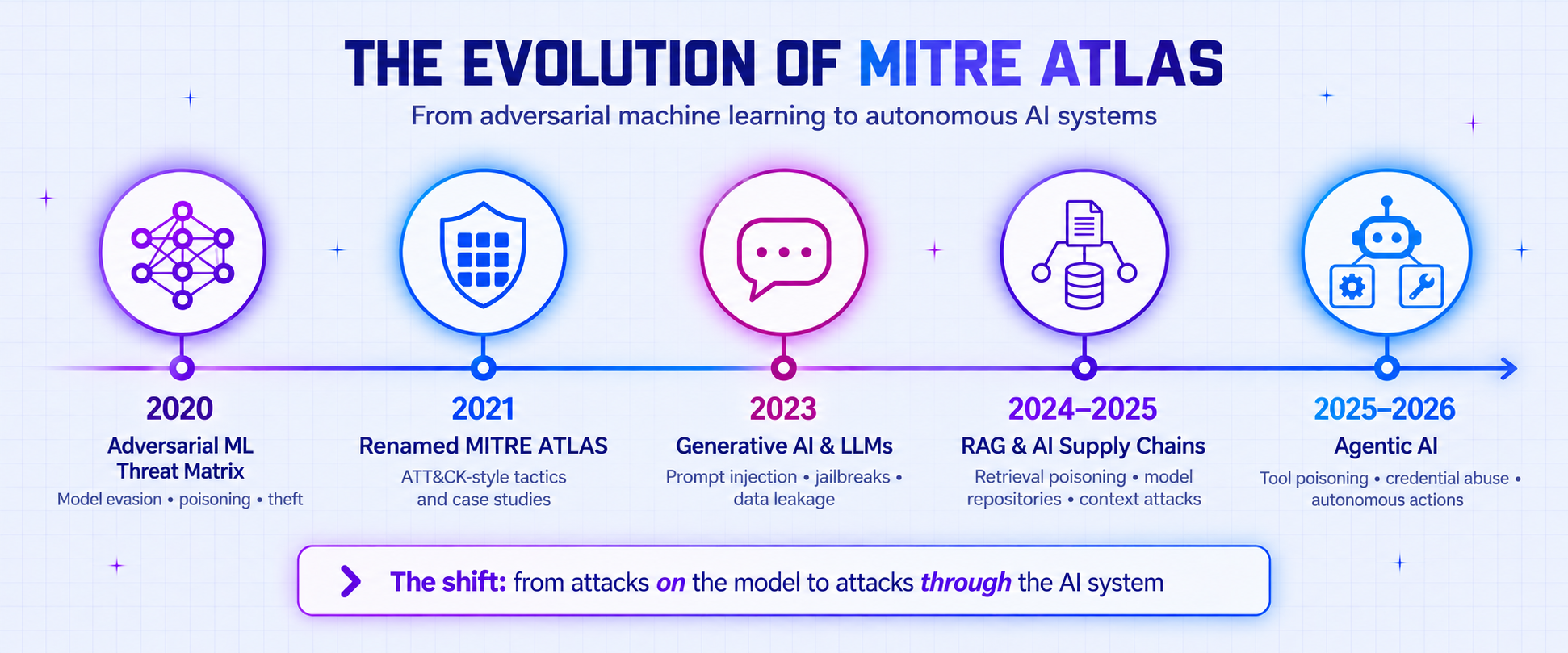
ATLAS initially emphasized adversarial machine-learning risks such as model evasion, training-data poisoning, model extraction and intellectual-property theft. Its coverage later expanded to generative AI risks, including direct and indirect prompt injection, sensitive-data leakage, retrieval poisoning and compromised tools or dependencies.
Its agentic AI coverage addresses systems that retain memory, use service identities, access enterprise data, invoke tools and act across connected environments. Relevant behaviors include poisoning agent context or tool data, changing agent configurations, invoking tools in unintended ways and exfiltrating data through agent actions. Security teams should use the current ATLAS dataset when selecting techniques because the knowledge base continues to evolve.
MITRE ATLAS vs. MITRE ATT&CK
MITRE ATLAS and MITRE ATT&CK both provide a common language for understanding adversary behavior, but they address different parts of the attack surface.
| MITRE ATLAS | MITRE ATT&CK | |
| Primary focus | Threats targeting AI-enabled systems | Adversary behavior across enterprise and other technology environments |
| What it covers | Machine learning, generative AI, AI agents and supporting AI systems | Tactics and techniques used to compromise, persist in and operate across traditional IT environments |
| Example threats | Prompt injection, data poisoning, model extraction and abuse of AI agents or tools | Credential theft, persistence, privilege escalation and lateral movement |
| How security teams use it | Identify and test AI-specific adversary behaviors | Understand and test broader adversary behaviors across the enterprise |
| Relationship | Extends threat modeling to AI-specific attack techniques | Provides broader coverage of adversary behavior across enterprise environments |
The two frameworks are complementary. An attack involving an AI system may combine ATLAS techniques such as prompt injection or data poisoning with ATT&CK techniques targeting identities, endpoints, cloud infrastructure or other connected systems.
Security teams can therefore use MITRE ATLAS alongside MITRE ATT&CK to understand the complete attack path, from attacks targeting the AI system itself to the broader enterprise environment the system can access.
How MITRE ATLAS Addresses the AI Attack Surface
A model rarely operates alone. It is part of an AI enabled system that may include training and fine tuning data, retrieval sources, prompt and model repositories, APIs, application code, plugins, tools, service accounts, cloud workloads, endpoints and monitoring infrastructure.
MITRE's AI Security 101 describes three dimensions that help defenders understand how an adversary may approach that system:
- AI access time. Can the adversary influence the system during training, inference or both?
- AI access points. Can the adversary interact through a digital interface such as an API, or manipulate physical inputs such as sensors?
- System knowledge. Does the adversary know the model, architecture and data in detail, or can the adversary only observe inputs and outputs?
These questions shift attention from the model alone to the ways an attacker could reach, manipulate or use the complete system as a bridge to other assets.
ATLAS covers both AI-specific and conventional cyber risks:
- Data and model poisoning. Manipulating training, fine-tuning, retrieval or other influential data to change system behavior.
- Evasion. Crafting inputs that cause a model to produce an incorrect prediction or classification.
- Model extraction and inversion. Reproducing aspects of a model or recovering sensitive information about its training data.
- Prompt injection. Introducing instructions that cause a generative model to disregard its intended constraints.
- AI supply chain compromise. Targeting model repositories, dependencies, tools, containers or other supporting components.
- Compromise or abuse of the surrounding application. Stealing credentials, exploiting connected services, or causing the host application to misuse its legitimate permissions and automation capabilities.
MITRE ATLAS and Agentic AI Security
The security boundary changes when AI moves from a model that generates content to an agent that can act on that content.
- AI model. Processes input and returns output. Primary risks include manipulation, leakage, extraction and unsafe content.
- AI agent. Uses a model within a larger system that can reason across steps, use tools and data, and take actions. Additional risks include tool abuse, privilege misuse, memory poisoning and unauthorized actions.
Prompt injection illustrates the difference. Against a model, a successful injection might manipulate a response or disclose information available in the model's context. Against an agent, the same technique could influence the system to invoke a tool, access a connected service, modify a file or perform an action using enterprise privileges. The underlying weakness may be similar, but the agent's access can substantially increase the attack path and impact.
Agent security therefore cannot stop at model safeguards. Organizations also need to validate the host application, identities and permissions, tool access, authorization boundaries, data exposure, segmentation, memory and downstream actions. This applies to internally developed agents and AI-enabled applications adopted from third parties.
The OWASP AI Agent Security Cheat Sheet recommends least-privilege tool access, validation of untrusted inputs, human approval for high-impact actions, and monitoring of agent decisions and tool calls.
Turning MITRE ATLAS Techniques into Security Tests
ATLAS describes how adversaries behave. It is not a complete control framework and does not determine every test an organization should run. Security teams can use it to select relevant threat behaviors, map them to the AI system and its controls and build validation scenarios around the most consequential attack paths.
For example, a scenario based on indirect prompt injection could place malicious instructions in content retrieved by an agent. The test could then determine whether the agent attempts an unauthorized tool call, whether identity and authorization controls block the action, whether monitoring detects the behavior and whether the response process produces the expected alert and evidence.
A practical validation process has four steps:
- Map the system. Identify the model, application, data sources, identities, tools, infrastructure and connected assets.
- Select relevant behaviors. Choose ATLAS techniques based on likely access paths, system knowledge, permissions and potential business impact.
- Run controlled scenarios. Test the applicable prevention, detection and response controls without disrupting production operations.
- Measure and repeat. Record what was blocked, detected or missed, address gaps, and retest after material changes.
Before production, validation can uncover exploitable attack paths across the model, host application, identities, data, tools and connected systems. In production, repeated validation can show whether controls still work as models, integrations, permissions, data sources and infrastructure change.
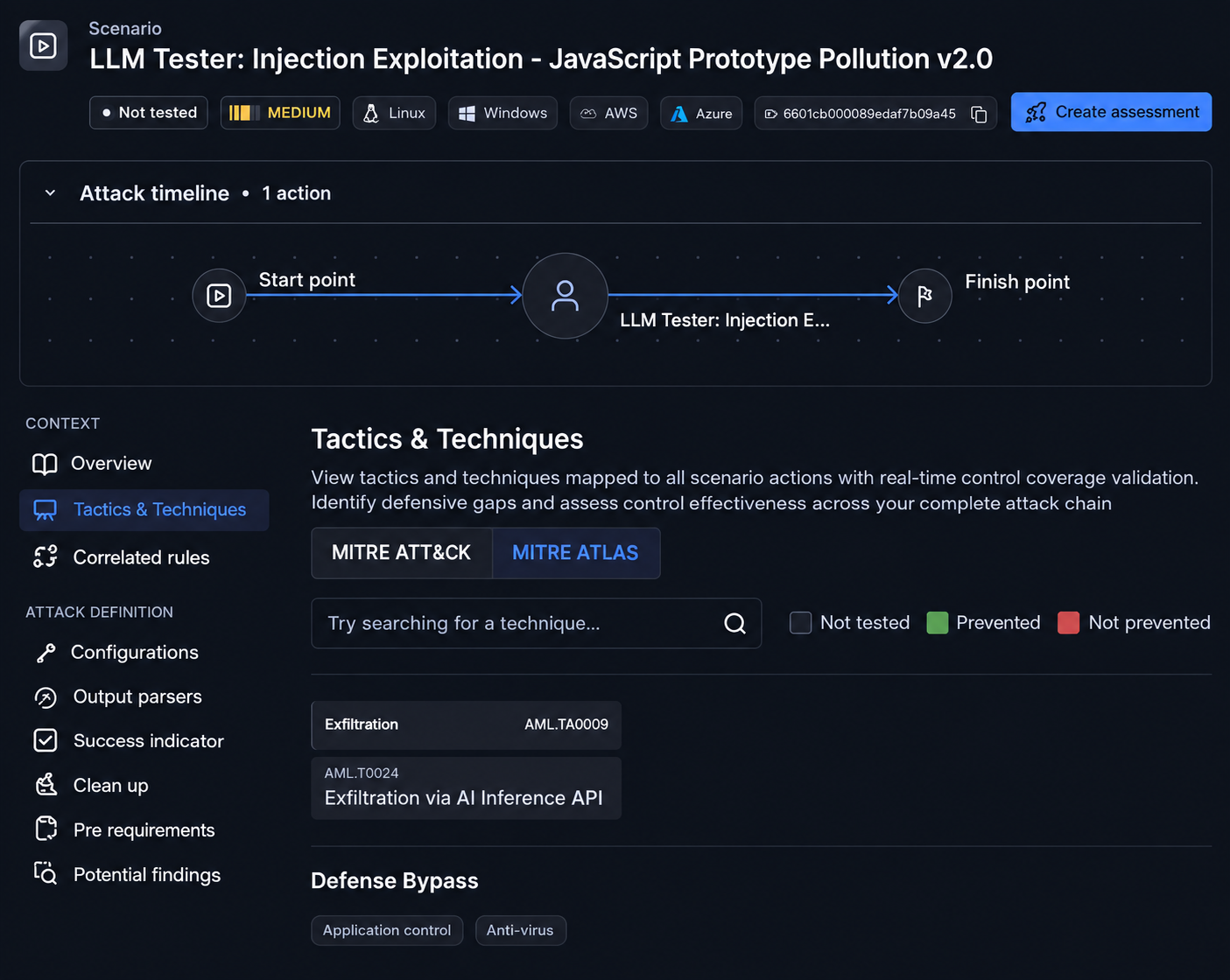
With Cymulate Exposure Validation, organizations have out-of-the-box attack scenarios to evaluate AI security. As an example, the attack scenario in the figure below is mapped to ATLAS technique AML.T0024: Exfiltration via AI Interface API, which simulates attempts to “exploit the "injection_exploitation" vulnerability and modify user input or system prompts to leak data or execute unintended instructions.”
What Organizations Should Validate When They Build or Buy AI
Validation priorities depend on how an organization participates in the AI ecosystem.
- Organizations that build or operate AI. Validate access to code and data, development and deployment pipelines, dependencies, model and artifact repositories, cloud workloads, inference interfaces, tenant isolation, service identities, agent memory, tool permissions, logging and approval controls for high-impact actions.
- Organizations that adopt enterprise AI services. Validate user access, identity protections, connected repositories, data boundaries, endpoint and cloud controls, agent permissions, monitoring and the vendor configurations available to the customer.
Using a third-party AI service does not eliminate the customer's security responsibility. It changes which controls the customer can govern and validate.
Using MITRE ATLAS with Continuous Exposure Validation
In summary, AI security extends beyond prompts and model safeguards. Models depend on data, applications, infrastructure and identities. Agents extend that system with memory, tools, permissions and the ability to act.
Security teams can use MITRE ATLAS to identify relevant adversary behaviors, map them to the systems and controls that matter and prioritize repeatable tests. Cymulate Exposure Validation provides controlled evidence of how those defenses perform across the AI system and the enterprise environment around it.
Ready to put an ATLAS-informed AI security program into practice? Learn how Cymulate Exposure Validation tests threats, controls, and exposures, and schedule a demo with our experts.

Featured Resources
View More Resources
From AI Hype to AI Risk: A New Security Reality
Join Cymulate CTO Avihai Ben-Yossef: explore AI-driven attacks and how continuous validation helps defenders prioritize.
Test LLM Resilience Against Prompt Injection and Jailbreaks with New Cymulate Attack Scenarios
Test LLM resilience against prompt injection and jailbreaks with production-safe attack scenarios aligned to MITRE ATLAS
Testing LLM Resilience: How Cymulate Exposure Validation Simulates Prompt Injection and Jailbreaks
See how Cymulate is redefining LLM security by simulating real-world prompt injection and jailbreak attacks to validate AI defenses.