
Frequently Asked Questions

Attack Surface Management (ASM) Fundamentals

What is Attack Surface Management (ASM)?

Attack Surface Management (ASM) is the ongoing process of identifying, monitoring, and reducing potential points of entry that attackers could exploit in a network or system. ASM helps organizations proactively address vulnerabilities and enhance their cybersecurity posture by adopting an attacker’s perspective to cover all exposed assets, including those on the Internet and in supply chains. [Source]

What is an attack surface?

An attack surface refers to the total sum of all possible points—such as software, hardware, web applications, and physical devices—where an unauthorized user (the "attacker") can try to enter or extract data. It encompasses all vulnerabilities within a system that can be exploited to gain access to secure information or cause harm. [Source]

How does Attack Surface Management (ASM) differ from asset discovery?

ASM adopts an attacker’s perspective to cover all exposed assets, including those on the Internet and in supply chains, whereas asset discovery typically focuses on identifying known assets within an organization. ASM goes beyond asset discovery by continuously monitoring for both known and unknown assets that could be exploited. [Source]

What is external attack surface management (EASM)?

External attack surface management (EASM) is a crucial aspect of ASM that helps organizations identify and mitigate risks associated with their external-facing assets, such as domains, IP ranges, websites, and cloud resources. EASM continuously assesses these assets for vulnerabilities and generates prioritized issues for remediation. [Source]

Why is Attack Surface Management (ASM) important for organizations?

ASM is essential because technological changes, such as increased reliance on external services and remote work, have expanded the attack surface. Without ASM, unknown or forgotten assets can become vulnerable entry points for attackers. ASM helps organizations proactively discover and secure these assets, reducing the risk of cyber threats. [Source]

What types of assets does ASM uncover?

ASM uncovers a wide range of assets, including shadow and orphaned IT, active and inactive assets, managed and unmanaged devices (such as BYOD), rogue assets, hardware, software (including open-source and proprietary), SaaS and vendor-managed assets, and leaked credentials. [Source]

How does ASM help with vulnerability management?

ASM provides a comprehensive approach to vulnerability management by automating asset discovery, risk assessment, and vulnerability assessment processes. It enables organizations to understand their attack surface, prioritize remediation efforts, and build a robust inventory of assets, which are crucial for effective security operations. [Source]

What are the main functions of ASM tools?

Robust ASM tools provide discovery (reconnaissance), findings classification (by network, server, OS, service, application, data, and policy level), and report generation. These functions help organizations identify, categorize, and address vulnerabilities across their entire attack surface. [Source]

How does ASM classify findings?

ASM classifies findings into categories such as network-level (firewall policies), server-level (infrastructure), operating system, service level, application level, data level (privacy and sensitive information), and policy level (missing security controls). This classification helps prioritize remediation efforts. [Source]

How does ASM support organizations during mergers and acquisitions?

During mergers or acquisitions, ASM helps IT and security teams identify rogue assets that threat actors may use to target the company. This ensures that all assets, including those inherited through M&A, are accounted for and secured. [Source]

How does ASM address the risks of shadow IT and orphaned assets?

ASM uncovers shadow and orphaned IT, such as unapproved hardware or software and forgotten assets, which may not be fully deactivated. By identifying these, ASM helps prevent attackers from gaining an initial foothold through overlooked entry points. [Source]

How does ASM handle managed and unmanaged devices?

ASM includes both managed and unmanaged devices, such as employee-owned devices (BYOD), in its asset inventory. This comprehensive approach ensures that all devices, regardless of ownership, are monitored for vulnerabilities. [Source]

What role does threat intelligence play in ASM?

ASM tools leverage threat intelligence feeds to generate security ratings and risk scores, enabling organizations to assess potential vulnerabilities within their systems and prioritize remediation efforts. [Source]

How does ASM help reduce the risk of data breaches?

By providing visibility into all assets and their associated risks, ASM enables organizations to identify and address possible attack vectors, reducing the likelihood of data breaches. [Source]

How does ASM support compliance and regulatory requirements?

ASM helps organizations maintain compliance by ensuring all assets, including those that may be overlooked, are identified and monitored for vulnerabilities. This comprehensive approach supports regulatory requirements for asset management and risk mitigation. [Source]

How does ASM integrate with vulnerability management programs?

ASM automates asset discovery and risk assessment, providing a foundation for effective vulnerability management programs. It ensures that all assets are included in vulnerability assessments and that remediation efforts are prioritized based on risk. [Source]

What are the benefits of using Cymulate's ASM tools?

Cymulate's ASM tools provide advanced security testing, continuous assessment, and validation of security posture. They leverage threat intelligence, generate actionable reports, and help organizations stay ahead of cyber threats by identifying and addressing vulnerabilities across all assets. [Source]

How does Cymulate empower organizations to improve their security posture?

Cymulate empowers organizations by providing tools for continuous assessment, threat simulation, and comprehensive security validation. This enables organizations to proactively identify vulnerabilities, optimize defenses, and enhance resilience against cyber threats. [Source]

Features & Capabilities

What features does Cymulate offer for attack surface management?

Cymulate offers continuous threat validation, automated attack simulations, exposure analytics, attack path discovery, automated mitigation, and integration with a wide range of security technologies. These features help organizations identify, prioritize, and remediate vulnerabilities across their attack surface. [Source]

Does Cymulate integrate with other security tools?

Yes, Cymulate integrates with a wide range of security technologies, including Akamai Guardicore, AWS GuardDuty, BlackBerry Cylance OPTICS, Carbon Black EDR, Check Point CloudGuard, Cisco Secure Endpoint, CrowdStrike Falcon, Wiz, SentinelOne, and more. For a complete list, visit the Partnerships and Integrations page.

What security and compliance certifications does Cymulate hold?

Cymulate holds several key certifications, including SOC2 Type II, ISO 27001:2013, ISO 27701, ISO 27017, and CSA STAR Level 1. These certifications demonstrate Cymulate's commitment to robust security and compliance standards. [Source]

How does Cymulate ensure data security and privacy?

Cymulate ensures data security through encryption for data in transit (TLS 1.2+) and at rest (AES-256), secure AWS-hosted data centers, a tested disaster recovery plan, and a dedicated privacy and security team, including a Data Protection Officer (DPO) and Chief Information Security Officer (CISO). [Source]

How easy is it to implement Cymulate's platform?

Cymulate is designed for quick and easy implementation, operating in agentless mode without the need for additional hardware or complex configurations. Customers can start running simulations almost immediately after deployment. [Source]

What feedback have customers given about Cymulate's ease of use?

Customers consistently praise Cymulate for its intuitive and user-friendly platform. For example, Raphael Ferreira, Cybersecurity Manager, stated, "Cymulate is easy to implement and use—all you need to do is click a few buttons, and you receive a lot of practical insights into how you can improve your security posture." [Source]

What is Cymulate's pricing model?

Cymulate operates on a subscription-based pricing model tailored to each organization's requirements. Pricing depends on the chosen package, number of assets, and scenarios selected. For a detailed quote, organizations can schedule a demo with Cymulate's team. [Source]

How does Cymulate compare to other ASM solutions?

Cymulate stands out by offering a unified platform that integrates Breach and Attack Simulation (BAS), Continuous Automated Red Teaming (CART), and Exposure Analytics. It provides continuous threat validation, AI-powered optimization, and an extensive threat library, making it suitable for organizations seeking comprehensive and automated ASM capabilities. [Source]

What business impact can organizations expect from using Cymulate?

Organizations using Cymulate can achieve up to a 52% reduction in critical exposures, a 60% increase in team efficiency, and an 81% reduction in cyber risk within four months. These outcomes are supported by customer case studies and measurable metrics. [Source]

Who can benefit from Cymulate's ASM solutions?

Cymulate's ASM solutions are designed for CISOs, security leaders, SecOps teams, red teams, vulnerability management teams, and organizations of all sizes across industries such as finance, healthcare, retail, media, transportation, and manufacturing. [Source]

What pain points does Cymulate address for security teams?

Cymulate addresses pain points such as fragmented security tools, resource constraints, unclear risk prioritization, cloud complexity, communication barriers, inadequate threat simulation, operational inefficiencies in vulnerability management, and post-breach recovery challenges. [Source]

Are there case studies demonstrating Cymulate's effectiveness?

Yes, Cymulate features multiple case studies, such as Hertz Israel reducing cyber risk by 81% in four months and a sustainable energy company scaling penetration testing cost-effectively. These case studies are available on the Cymulate Customers page.

Where can I find more resources about ASM and Cymulate?

You can find a combination of insights, thought leadership, and Cymulate product information in the Resource Hub. The Cymulate Blog also covers the latest threats, research, and ASM best practices.

How does Cymulate support continuous improvement in security?

Cymulate updates its SaaS platform every two weeks with new features, such as AI-powered SIEM rule mapping and advanced exposure prioritization, ensuring customers always have access to the latest capabilities. [Source]

Cymulate named a Customers' Choice in 2025 Gartner® Peer Insights™
Learn More
New Case Study: Credit Union Boosts Threat Prevention & Detection with Cymulate
Learn More
New Research: Cymulate Research Labs Discovers Token Validation Flaw
Learn More
An Inside Look at the Technology Behind Cymulate
Learn More

What is Attack Surface Management (ASM)

By: Cymulate

Last Updated: July 23, 2025

Attack Surface Management (ASM) is the ongoing process of identifying, monitoring, and reducing potential points of entry that attackers (hackers) could exploit in a network or system. It helps organizations proactively address vulnerabilities and enhance their cybersecurity posture. The difference between ASM and asset discovery is that it adopts an attacker’s perspective to cover all exposed assets, including on the Internet and in discoverable assets in supply chains.

What is an Attack Surface?

An attack surface refers to the total sum of all possible points, such as software, hardware, web applications, physicals devices and so on where an unauthorized user (the "attacker") can try to enter or extract data. It encompasses all the vulnerabilities within a system that can be exploited to gain access to secure information or cause harm.

External attack surface management

External attack surface management (EASM) is a crucial aspect of attack surface management that helps organizations identify and mitigate risks associated with their external-facing assets, such as domains, IP ranges, websites, and cloud resources.

By continuously assessing these assets for vulnerabilities, an EASM solution, also known as an attack surface management solution, generates prioritized issues for the security team to remediate and reduce the external attack surface.

In addition to external attack surface management, internal attack surface management is also important for organizations seeking to move to the cloud and secure their digital infrastructure. However, external attack surface management specifically focuses on assets that are accessible from the public Internet, making it a vital component of a robust external attack surface management solution.

How does Attack Surface Management work?

The goal of ASM is to ensure that all assets, secure or insecure, known or unknown, are exhaustively listed and that the list is continuously updated so that asset monitoring can be comprehensive.

Exposed assets uncovered through ASM include:

  • Shadow and orphaned IT – covers a wide range of data and practices, ranging from employees’ unapproved use of hardware or software to forgotten previous versions that have not been fully deactivated and could enable an intruder to gain an initial foothold.
  • Active or inactive assets – Though classic asset discovery procedures rarely miss active assets, inactive ones might be forgotten in successive deployments
  • Managed and unmanaged devices – including employee-owned vulnerable devices (BYOVD)
  • Rogue assets – generated by malicious actors to impersonate your domains
  • Hardware – including all devices, listed or unlisted, inherited through an M&A, email servers, data storage centers, and more
  • Software – including unknown open-source software, public code repositories such as Github, APIs, web and mobile applications, and more
  • SaaS-related and vendor-managed assets
  • Leaked credentials
  • Other
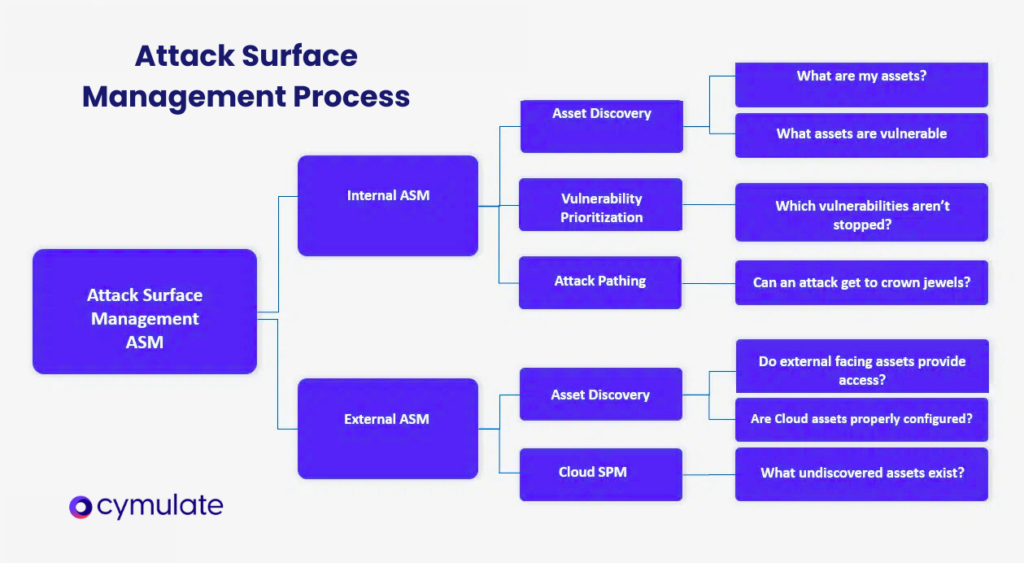
Attack Surface Management Process

Many of these assets can appear anytime on the Internet and are completely ignored by traditional firewalls or EDR services. In other words, ASM discovers assets on the external asset surface typically ignored by defensive tool arrays.

Effective vulnerability management is crucial for protecting your organization from cyber threats. Attack surface management (ASM) provides a comprehensive approach to vulnerability management by automating asset discovery, risk assessment, and vulnerability assessment processes.

ASM tools analyze the attack surface in real-time, covering all of an organization’s assets beyond traditional security controls like mapping, firewall, and endpoint protection. To build an effective vulnerability management program, organizations need to understand their attack surface, prioritize remediation efforts, and build a robust inventory of assets, all of which are crucial for the success of security operations.

Why do you need Attack Surface Management (ASM)?

The combination of technological development, such as increased reliance on external services, abrupt societal change, such as the massive move to work from home during the COVID-19 pandemic, and the acceleration of the threat landscape expansion is creating a perfect mix for turning unknown assets into ticking cyber threat time bombs.

While security teams still often focus on reducing attack surfaces, without an adversarial-based discovery process such as ASM, the reduced surface fails to include unknown assets. On the other hand, cyber attackers have no qualms about using advanced reconnaissance tools that will uncover those overlooked exposed assets.

In today's ever-evolving cybersecurity landscape, it is crucial for organizations to adopt robust attack surface management (ASM) practices. While asset discovery procedures may effectively identify active assets, there remains a significant security risk associated with inactive assets, including cloud assets, that often go unnoticed during successive deployments. These forgotten assets can become vulnerable entry points for malicious actors, including IoT devices, which are increasingly being used in business environments. Therefore, understanding and implementing ASM is essential in mitigating these potential threats.

ASM goes beyond traditional asset management by encompassing both managed and unmanaged devices. This includes employee-owned devices brought into the workplace, also known as BYOD (Bring Your Own Device). Such devices can introduce additional security challenges if not properly monitored and secured.

Main functions of ASM tools

Robust ASM tools provide a full range of services that include:

  1. Discovery – the reconnaissance phase (AKA recon) during which the ASM tool impersonates attackers by scanning multiple sources for intelligence that could later be exploited, including domains and sub-domains (for application and infrastructure vulnerabilities, web misconfigurations, and open ports,) organizational, employee, and technical information that can be used in a social engineering attack or to gain illicit network access and initial foothold, and other exploitable intelligence that an attacker may take advantage of.
  2. Findings classification – there are different ways of classifying uncovered assets and the degree of severity of the exposure they generate. Cymulate’s ASM uses the following classification categories: Network-level – Firewall policies and “network-level” protocols findings
  3. Server level – Everything that can be considered infrastructure.
  4. Operating System, built-in administrative capabilities, HTTP servers such as IIS and Apache
  5. Service level – Services that are installed on top of the “infrastructure” |
  6. Application level – Web application and other custom applications scanners
  7. Data level – Privacy-related and sensitive information disclosure findings
  8. Policy level (Insights) – Missing security controls rather than misconfiguration
  9. Report generation – Once the uncovered assets have been classified, the ASM tool generates a report listing all uncovered assets, categorized and correlated with the type of risk they generate.

Key Takeaways

Attack surface management is crucial in today's cyber threat landscape, where attackers are constantly scanning and targeting vulnerable assets, including an organization’s digital assets. With mergers or acquisitions, it is important for IT and security teams to identify rogue assets that threat actors may use to target the company.

In the realm of cybersecurity, attack surface management (ASM) is a critical aspect that organizations must prioritize. To effectively manage their security posture, companies often rely on tools like Cymulate's ASM tools, which provide valuable insights into an organization's overall security standing.

These ASM tools leverage threat intelligence feeds to generate security ratings and risk scores, enabling businesses to assess the potential vulnerabilities within their systems. By combining informational data, such as the number and type of assets, with risk data related to findings, organizations gain a comprehensive understanding of their attack surface, including both open-source and proprietary assets. This includes viewing ASM results per findings to identify and address possible attack vectors and reduce the risk of data breaches.

Cymulate Exposure Validation makes advanced security testing fast and easy. When it comes to building custom attack chains, it's all right in front of you in one place.
Mike Humbert, Cybersecurity Engineer
DARLING INGREDIENTS INC.
Learn More
Book a Demo