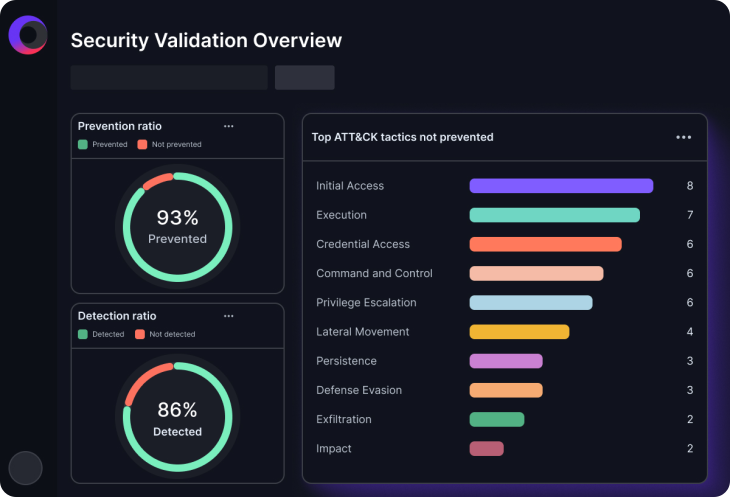
Frequently Asked Questions

Blue Team Basics

What is a Blue Team in cybersecurity?

A Blue Team is a group of security professionals responsible for defending an organization's assets against cyberattacks. They use various tools and techniques to identify, assess, and mitigate security risks, often working alongside Red Teams who simulate attacks to test defenses. [Source]

What are the main responsibilities of a Blue Team?

Blue Teams are tasked with monitoring and detection, incident response, vulnerability management, and security control validation. Their goal is to protect the organization from cyber threats by continuously monitoring systems, responding to incidents, managing vulnerabilities, and ensuring security controls are effective. [Source]

Who typically makes up a Blue Team?

A Blue Team is usually composed of defensive security professionals such as security analysts, incident responders, and network defenders. Their expertise covers monitoring, detection, and response to cyber threats. [Source]

How do Blue Teams interact with Red Teams?

Blue Teams often work in tandem with Red Teams, who act as ethical hackers to test the organization's defenses. Blue Teams use the findings from Red Team exercises to improve detection, response, and mitigation strategies. [Source]

What is the difference between Blue, Red, and Purple Teams?

Red Teams play offense by simulating attacks, Blue Teams play defense by protecting assets, and Purple Teams combine both approaches for real-time collaboration. Purple Teams help Blue and Red Teams work together to improve detection and response strategies during simulated attacks. [Source]

What are common tasks performed by Blue Teams?

Common Blue Team tasks include continuous monitoring of networks and systems, incident response, vulnerability assessments, patch management, and validating security controls like firewalls and intrusion detection systems. [Source]

What methods and tactics do Blue Teams use?

Blue Teams use continuous monitoring, behavioral analytics, endpoint detection and response (EDR) tools, threat hunting, deception technologies like honeypots, and security orchestration, automation, and response (SOAR) platforms. AI and machine learning are also used to detect subtle threats in real-time. [Source]

How do Blue Teams use exposure management?

Exposure management helps Blue Teams view cyber assets from an attacker's perspective, identify the biggest gaps, and prioritize remediation. This approach enables Blue Teams to focus on the most critical threats and reduce the risk of missing high-priority incidents. [Source]

What challenges do Blue Teams face?

Blue Teams face challenges such as staying ahead of evolving threats, resource limitations (budget and personnel), and the need for strong collaboration with Red Teams and other departments. They must also manage large volumes of data and avoid alert fatigue. [Source]

How does alert fatigue impact Blue Teams?

Continuous monitoring generates vast amounts of logs and alerts, which can lead to alert fatigue. This increases the risk of missing critical threats as teams may become overwhelmed by lower-priority alerts. [Source]

How do Blue Teams prioritize risks?

Blue Teams use exposure management frameworks to identify and prioritize the most significant vulnerabilities and attack vectors, ensuring that remediation efforts focus on the highest-risk threats. [Source]

How can Blue Teams improve collaboration with other teams?

Blue Teams can improve collaboration by working closely with Red Teams and leveraging Purple Team exercises, which combine offensive and defensive strategies in real-time to enhance detection and response. [Source]

What is the role of automation in Blue Team operations?

Automation helps Blue Teams streamline tasks such as monitoring, detection, and response, allowing them to focus on strategic initiatives and respond more efficiently to threats. SOAR platforms and AI-driven tools are commonly used. [Source]

How do Blue Teams use threat intelligence?

Blue Teams regularly update threat intelligence, detection rules, and security tools to stay ahead of evolving threats. This helps them identify new attack techniques and adjust defenses accordingly. [Source]

What is the importance of security control validation for Blue Teams?

Security control validation ensures that firewalls, intrusion detection systems, and endpoint protection are correctly configured and functioning as intended, reducing the risk of successful attacks. [Source]

How do Blue Teams use behavioral analytics?

Blue Teams use behavioral analytics to spot anomalies in network and user activity, which can indicate potential risks or ongoing attacks. This proactive approach helps detect threats that may bypass traditional security controls. [Source]

What are honeypots and how do Blue Teams use them?

Honeypots are deception technologies deployed by Blue Teams to attract attackers and gather intelligence without exposing real systems. This helps teams learn about attacker tactics and improve defenses. [Source]

How does Cymulate help Blue Teams?

Cymulate provides technologies, workflows, and metrics that enable Blue Teams to drive exposure management. The platform offers full visibility of the attack surface, business context, and advanced security validation to focus remediation and prove cyber resilience. [Source]

What is the benefit of continuous assessments for Blue Teams?

Continuous assessments transform one-off security exercises into repeatable programs, allowing Blue Teams to strengthen security posture before the next attack. Cymulate automates exposure discovery, validation, and remediation planning. [Source]

Cymulate Platform Features & Capabilities

What features does Cymulate offer to support Blue Teams?

Cymulate offers continuous threat validation, exposure management, attack path discovery, automated mitigation, AI-powered optimization, and a unified platform that combines Breach and Attack Simulation (BAS), Continuous Automated Red Teaming (CART), and Exposure Analytics. [Source]

How does Cymulate automate Blue Team tasks?

Cymulate automates exposure discovery, security validation, and remediation planning, allowing Blue Teams to focus on strategic initiatives and respond more efficiently to threats. [Source]

What integrations does Cymulate provide for Blue Teams?

Cymulate integrates with a wide range of security technologies, including Akamai Guardicore, AWS GuardDuty, BlackBerry Cylance OPTICS, Carbon Black EDR, Check Point CloudGuard, Cisco Secure Endpoint, CrowdStrike Falcon, Wiz, and SentinelOne. For a full list, visit the Partnerships and Integrations page.

How easy is it to implement Cymulate for Blue Teams?

Cymulate is designed for quick and easy implementation, operating in agentless mode with no need for additional hardware or complex configurations. Customers can start running simulations almost immediately after deployment. [Source]

What feedback have Blue Teams given about Cymulate's ease of use?

Customers consistently praise Cymulate for its intuitive interface and ease of use. For example, Raphael Ferreira, Cybersecurity Manager, said, "Cymulate is easy to implement and use—all you need to do is click a few buttons, and you receive a lot of practical insights into how you can improve your security posture." [Source]

What certifications does Cymulate hold for security and compliance?

Cymulate holds several key certifications, including SOC2 Type II, ISO 27001:2013, ISO 27701, ISO 27017, and CSA STAR Level 1. These certifications demonstrate Cymulate's commitment to robust security and compliance standards. [Source]

How does Cymulate help Blue Teams prioritize exposures?

Cymulate validates exploitability and ranks exposures based on prevention and detection capabilities, business context, and threat intelligence, helping Blue Teams focus on the most critical vulnerabilities. [Source]

What measurable outcomes have Blue Teams achieved with Cymulate?

Customers have reported up to a 52% reduction in critical exposures, a 60% increase in team efficiency, and an 81% reduction in cyber risk within four months of using Cymulate. [Source]

How does Cymulate support Blue Teams in regulated industries?

Cymulate supports Blue Teams in regulated industries by providing automated compliance and regulatory testing, as well as quantifiable metrics to prove compliance with standards and regulators. [Source]

What educational resources does Cymulate offer for Blue Teams?

Cymulate provides a Resource Hub, webinars, e-books, a blog, and a continuously updated cybersecurity glossary to help Blue Teams stay informed and improve their skills. [Resource Hub] [Glossary]

How does Cymulate's pricing model work for Blue Teams?

Cymulate operates on a subscription-based pricing model tailored to each organization's requirements, including chosen package, number of assets, and scenarios. For a detailed quote, schedule a demo with the Cymulate team. [Source]

What support options are available for Blue Teams using Cymulate?

Cymulate offers comprehensive support, including email support, chat support, a knowledge base, webinars, and an AI chatbot for real-time troubleshooting and guidance. [Source]

How does Cymulate help Blue Teams in post-breach recovery?

Cymulate enhances visibility and detection capabilities after a breach, ensuring faster recovery and improved protection by replacing manual processes with automated validation and remediation. [Source]

Where can Blue Teams find Cymulate's thought leadership and research content?

Blue Teams can access Cymulate's thought leadership, research, and product information through the Resource Hub, blog, reports, and glossary. [Resource Hub] [Blog] [Glossary]

New: 2026 Gartner® Market Guide for Adversarial Exposure Validation
Learn More
Cymulate named a Customers' Choice in 2025 Gartner® Peer Insights™
Learn More
New Research: The Security Tradeoffs Behind AI Tooling
Learn More
An Inside Look at the Technology Behind Cymulate
Learn More

Blue Teaming

What is a Blue Team in Cybersecurity?

In cybersecurity, a Blue Team is a group of security professionals tasked with defending an organization's assets against cyberattacks. The Blue Team uses various tools and techniques to identify, assess, and mitigate security risks.

Blue Teams often work in tandem with Red Teams, who act as ethical hackers to test the organization's defenses. By simulating real-world attack scenarios, Blue Teams can better understand an organization's security posture and identify areas for improvement.

What Does a Blue Team Do?

Blue Teams are composed of defensive security professionals, such as security analysts, incident responders, and network defenders, dedicated to protecting the organization from cyber threats.

While the tasks and responsibilities of a blue team can vary between organizations depending on their industry’s threat landscape, company size, and budget, the most common tasks performed by a blue team are:

  • Monitoring and Detection: Blue Teams continuously monitor networks, systems, and applications for suspicious activities or anomalies. This involves analyzing logs, alerts, and data from security tools to detect potential threats in real-time.
  • Incident Response: Blue Teams are responsible for responding when a security breach or incident occurs. The same goes for simulated attacks, where the Blue Teams are responsible for devising a defense strategy against the Red Teams' discoveries.
  • Vulnerability Management: Blue Teams proactively identify and remediate vulnerabilities in systems, applications, and networks. This includes conducting regular vulnerability assessments and implementing patches or mitigation strategies.
  • Security Control Validation: Ensuring that the organization’s security controls, such as firewalls, intrusion detection systems, and endpoint protection, are correctly configured and function as intended.

Methods and Tactics Used by Blue Teams

Blue Teams employ various methods and tactics to assess and optimize a robust cybersecurity posture. Their approach is often tailored to the threat landscape, scope, and specific needs of the organization. Standard techniques include continuous monitoring of network traffic and system logs to detect suspicious activity alongside Endpoint Detection and Response (EDR) tools that protect endpoints from advanced threats.

In addition to reactive strategies, Blue Teams often engage in proactive threat hunting, using behavioral analytics to spot anomalies that could indicate potential risks. They may also deploy deception technologies like honeypots to gather intelligence on attackers without exposing real systems.

To improve efficiency, Blue Teams can streamline tasks using security orchestration, automation, and response (SOAR) platforms, while AI and machine learning help detect subtle threats in real-time.

Blue Team vs Red Team and Purple Team

While the Red Team plays offense, the Blue Team plays defense, and the Purple Team combines offensive and defensive strategies. Blue Teams are often tasked with composing a mitigation and response strategy based on Red Teams’ findings.

For instance, a Red Team attack might include a simulated phishing campaign targeting employees to gain unauthorized access to sensitive information. After identifying which employees clicked on malicious links or opened phishing emails, the Blue Team would develop a mitigation strategy that includes refining email filtering rules, strengthening authentication measures, and singling out staff that require additional training on recognizing phishing attempts.

On the other hand, a Purple Team takes a more collaborative approach, combining the Red Team's offensive insights with the Blue Team's defensive strategies in real-time.

For example, instead of waiting for the Red Team’s report after a phishing simulation, the Purple Team would work alongside both teams throughout the process. As the Red Team launches their simulated attacks, the Purple Team helps the Blue Team improve detection and response strategies on the fly. This leads to faster adjustments, such as real-time refinement of security controls and enhanced awareness training.
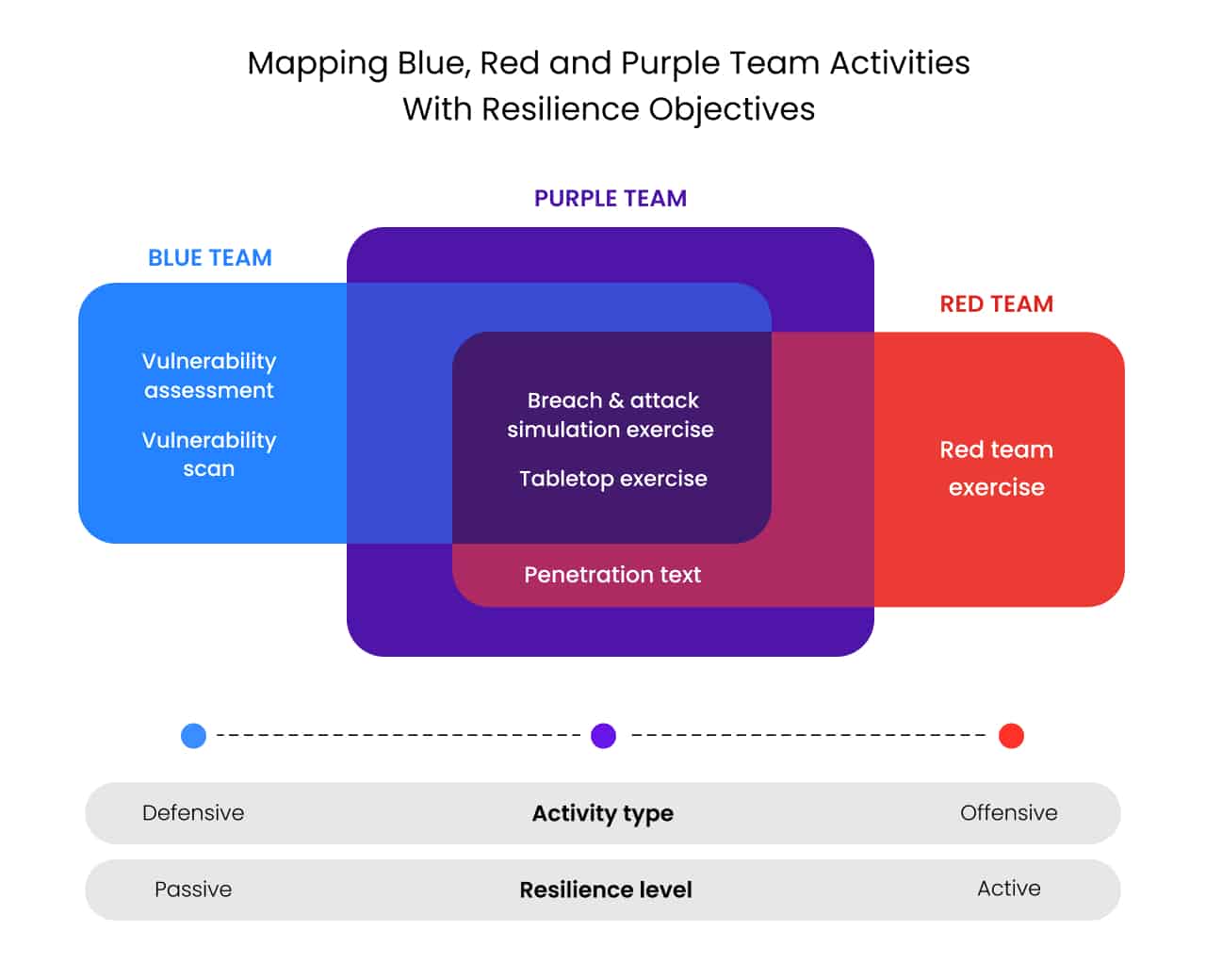
Mapping Blue, Red and Purple team activities with resilience objectivies

Blue Teams’ Challenges

Having a professional and seasoned Blue Team as part of your cybersecurity department can significantly benefit any organization. However, Blue Teams face the challenge of staying ahead of the constantly evolving threat landscape, as attackers are always developing new techniques to take down even the strongest cyber defense. Therefore, Blue Teams must regularly update threat intelligence, detection rules, and security tools to remain effective.

This can be a tall order even for the most seasoned Blue Teams. Resource limitations, such as budget constraints and a lack of personnel, make staying ahead of the evolving threat landscape even more difficult. The Blue Team also depends on strong collaboration with Red Teams and other departments to ensure the implementation of their strategies.

Exposure Management to Help Prioritize Risks

The biggest hurdle for Blue Teams is the sheer volume of data they must analyze, as continuous monitoring of networks, systems, and endpoints generates vast amounts of logs and alerts. This can lead to alert fatigue, where critical threats may be overlooked. Additionally, new threats that emerge daily can overwhelm security teams and make it difficult to determine which are the most dangerous threats to their organizations.

Exposure management provides a framework for Blue Teams to view their cyber assets and support processes from the attacker’s view of the organization. With this approach, Blue Teams can identify the biggest gaps and prioritize appropriate remediation. By prioritizing the most critical threats, Blue Teams can focus on addressing the most significant vulnerabilities and potential attack vectors, reducing the likelihood of missing high-priority incidents.

Exposure management helps Blue Teams streamline their efforts, ensuring they can respond swiftly and effectively to the most dangerous threats rather than being overwhelmed by lower-risk alerts.

image

How Cymulate Helps Blue Teams

Cymulate provides the essential technologies, workflows, and metrics to help Blue Teams drive exposure management. Cymulate's platform combines full visibility of the attack surface with business context and the most advanced security validation to focus remediation and prove cyber resilience.

Through the automation of exposure discovery, security validation, and actionable remediation plans, Cymulate provides Blue Teams continuous assessments that transform one-off exercises into a repeatable program to strengthen security posture before the next attack.

Book a Demo